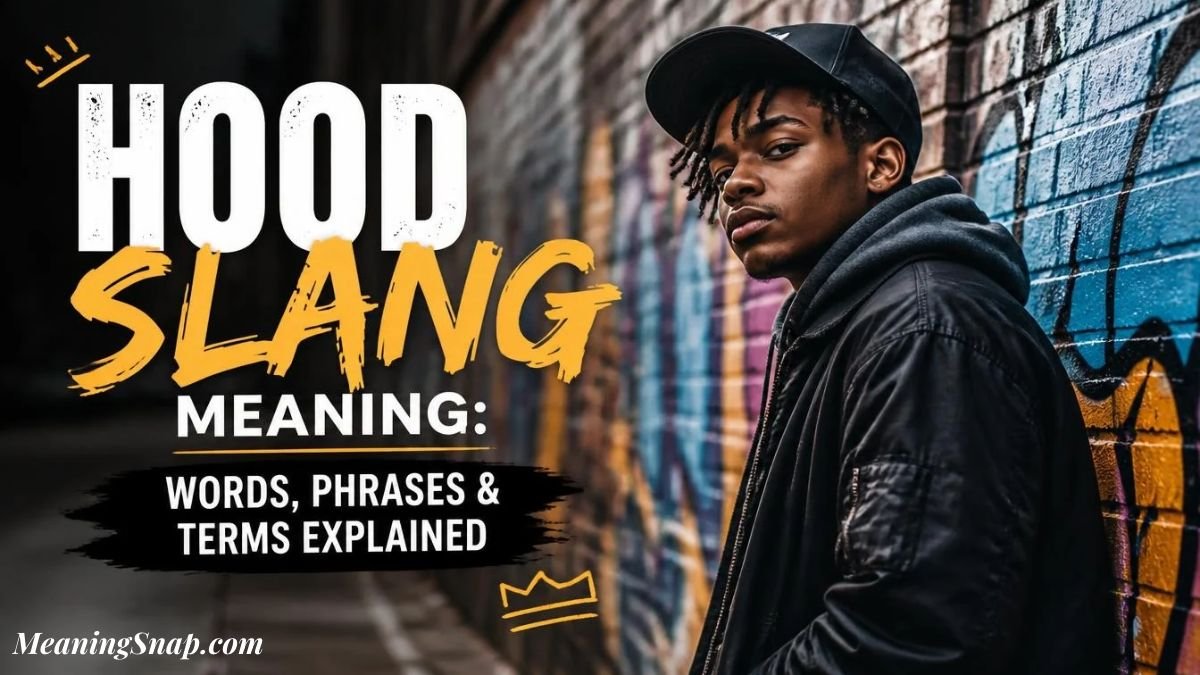
Your car has a hood. Your sweatshirt has a hood. So when a friend says he’s “from the hood,” it’s fair to wonder which one he means. The hood slang meaning is neither. It’s short for neighborhood, and it carries far more feeling than that plain word does.
Here’s the thing: the term opens a much bigger door. Hood slang covers the words, phrases, and shortcuts used in and around mostly Black, urban neighborhoods, a vocabulary that now shows up in songs, group chats, and TikTok comments everywhere. You might have heard “finna” in a track, or a coworker said “welcome to the hood” after your car got a flat tire. Either way, you’re here to decode it.
This guide gives the short answer to the hood slang meaning first. Then it covers the words, the phrases, the tone, and the manners that come with them.
Quick Answer: The hood slang meaning comes down to this. “Hood” is short for neighborhood, and hood slang is the informal vocabulary tied to urban neighborhoods, drawn mostly from African American Vernacular English. Most words are casual and friendly, but the tone depends on who says them and why.
What Hood Slang Meaning Covers (and What It Doesn’t)
Start with the word itself. In this sense, “hood” is a clipped form of “neighborhood.” EnglishClub’s slang entry describes it as a neighborhood, especially a poor urban one. Plenty of people who use the word aren’t thinking about money at all. They mean home.
So hood slang is the everyday language that grows out of those neighborhoods. Most of it traces back to African American Vernacular English, or AAVE, a dialect with its own grammar rules and not a sloppy version of standard English. Hip-hop carried much of that vocabulary into the mainstream. Social media then pushed it everywhere else.
One more thing to know up front. Hood slang isn’t a single fixed list. It shifts by city, age, and year, and a word that was everywhere in 2019 can sound dated now.
Read More: OFC Slang Meaning: What It Means in Text, Chat & Social Media 2026
Hood Slang Meaning vs. Urban Slang, AAVE and Gen Z Slang
People use these labels interchangeably, and that causes half the confusion. Here’s how they differ.
| Label | What it points to | Example |
|---|---|---|
| Hood slang | Everyday vocabulary tied to neighborhood life, mostly AAVE-rooted | finna, my hood |
| Urban slang | A loose catch-all for city and hip-hop slang, not a precise category | Varies by speaker |
| AAVE | A full dialect with its own grammar, not just a word list | Habitual “be,” as in “he be working” |
| Gen Z slang | Generation-wide internet slang, a good share of it borrowed from AAVE | no cap, bet |
The overlap is real. A word like “bet” can count as hood slang, AAVE, and Gen Z slang at once. That’s why the hood slang meaning of any single word is easier to judge by who says it and where it started than by the label attached to it.
Is Hood Slang Positive or Negative?
The short answer is that the same word can flatter or sting. Say a friend tells you, “You’re so hood.” If you’ve just been loud, loyal, and unbothered at a family cookout, that’s a compliment. If a stranger says it about your block or your outfit, it can land as a stereotype.
That swing is also why the hood slang meaning of “hood person” is hard to pin down. Usually it describes someone from the hood, or someone seen as street-smart, direct, and loyal to their area. Some people wear that description with pride. Others hear a whole community squeezed into one image.
Put-downs follow the same rule. Words like “goofy” (silly, foolish), “clown” (someone acting foolish), and “lame” (uncool) are mild and show up well beyond the hood. Between close friends they’re teasing. From a stranger, they’re rude. Harsher insults lose their context in print, so this guide leaves them out.
Hood Slang Words Translated Into Plain English
Here’s a quick translator for the hood slang meaning behind the words you’ll hear most. The tone column matters as much as the meaning.
| Word | Plain English | Tone and notes |
|---|---|---|
| hood | neighborhood, home turf | Warm from residents, can sound like a stereotype from outsiders |
| finna | about to do something | Casual, widely understood |
| deadass | seriously, for real | Casual, adds emphasis |
| on God | I swear it’s true | Sincere, emphatic |
| no cap | no lie | Casual, since “cap” means a lie |
| bet | okay, sure, deal | Casual agreement |
| aight | all right, okay | Relaxed and short |
| what’s good | hello, what’s up | Friendly greeting |
| ayo | hey, or a reaction to surprise | Casual attention-getter |
| jawn | a thing, place, or person | Regional, tied to Philadelphia |
These aren’t internet inventions. Merriam-Webster dates deadass to 1963, and Dictionary.com added finna, an AAVE form of “fixing to,” in a 2021 update. A dictionary entry shows a word is established. It doesn’t make the word formal.
Hood Slang Meaning for Friends, Girls and Family
Hood slang loves a nickname. What you call someone says a lot about how close you are, so think of it as a ladder.
Start with homie, a friend from your neighborhood or circle. Fam widens the circle to people you treat like relatives, whether or not you share blood. Twin sits higher still. It’s for the one friend who thinks like you, dresses like you, and finishes your jokes. Bruh and dawg are looser ways to address a friend, and bruh doubles as a sigh when someone disappoints you.
For girls and women, shawty is the one you’ll hear most. Merriam-Webster treats it as a spelling of “shorty” in Southern and African American speech and dates it to 1989. It can mean a girl, a young woman, or a girlfriend, and the warmth depends on the speaker. Between friends, it’s casual. From a stranger, some women find it presumptuous. Baddie, meanwhile, praises a confident, put-together person, and it’s often used as a compliment between friends.
Read More: Selling Meaning Slang: What Does “Selling” Mean in Slang?
“Welcome to the Hood” and “My Hood”: What They Mean
These two phrases look alike but do different jobs.
“My hood” is the simple one. It means my neighborhood, the place I’m from, and it usually carries loyalty. When someone posts “back in my hood for the weekend,” they’re talking about home, not geography.
“Welcome to the hood” has two uses. The first is literal. Someone greets a newcomer to the neighborhood, either warmly or with a teasing edge. The second is sarcastic, and it works like “welcome to the club.” Your friend moves to a new city, pays for parking for the first time, and gets a ticket. You text, “Welcome to the hood.” Same words, different mood.
Neither phrase works like a fixed dictionary entry. Treat them as patterns of use, not official definitions.
Read Also: What Does 6 7 Mean in Slang? The Viral Number Phrase That Took Over 2026
Hood Slang in Real Chats
Tone changes everything, so here are six short exchanges that show hood slang in action. Each one comes with a quick read on the mood.
Casual plans:
“Are you still coming tonight?”
“Bet. I’m finna leave now.”
Easy and confident, with no drama. One word confirms the plan, and the other tells your friend you’re already moving.
Sincere goodbye:
“On God, I’m gonna miss you, fam. Text me when you land.”
A heartfelt send-off. The phrase adds weight so the feeling doesn’t sound like small talk.
Surprised:
“Deadass? You got the job?”
“No cap. They called this morning.”
Disbelief turning into joy. One speaker asks for proof, and the other hands it over.
Sarcastic:
“Just got my first parking ticket in the city.”
“Welcome to the hood.”
Teasing, not unkind. The speaker is joking about a rite of passage.
Frustrated:
“Bruh, I asked you twice. Where’s my charger?”
Annoyed but friendly. The first word works like a groan.
Playful caption:
“Back in my hood for the weekend. Nothing beats home.”
Pride, plain and simple. The phrase signals roots.
Hood Slang Meaning in Texts: How to Reply
Getting a text full of hood slang is a small test, and the fix is simple. Match the energy, keep it short, and don’t fake it.
If someone writes “what’s good?”, a plain “Not much, you?” works fine. A “bet” is a yes, so “see you then” closes the loop. When a friend sends “deadass?”, they want confirmation, and “yeah, for real” does the job. If you don’t know a word at all, ask. “Wait, what does that mean?” costs nothing and beats guessing wrong.
You Also Like: FEIN Meaning Slang: What It Means on TikTok, in Texts, and in Everyday Conversations
Hood Slang Meaning on TikTok, Reddit and Urban Dictionary

Most people meet hood slang online first, so the platform matters.
TikTok didn’t invent this vocabulary. It speeds up how fast a word travels, and it often turns a word into a meme. A term in a skit can be exaggerated for laughs, so a clip shows how a word gets performed, not always how it gets used day to day.
Urban Dictionary is crowdsourced. Anyone can submit an entry, which means some are sharp and some are jokes. Use it as evidence that people say something, then check the meaning against a standard dictionary or several independent sources. If entries on the same word contradict each other, treat that word with caution.
Reddit works differently. Threads are opinion, which makes them useful for hearing how real speakers feel about a word and poor as a rulebook. One person’s “that’s offensive” is another person’s “that’s just how we talk.” When you’re sorting out a hood slang meaning, treat platforms as clues and dictionaries as anchors.
Da Hood: The Roblox Game, Not the Slang
Searching “Da Hood” can send you to a video game instead of a definition. According to Know Your Meme, Da Hood is a Roblox roleplay game, created on January 27, 2019, by a developer group called Da Hood Entertainment. The “Da” is just a stylized “the,” and the title borrows the neighborhood idea.
Players do borrow hood slang in chat, but game chat adds its own inside jokes and exaggeration. If you’re trying to learn the real hood slang meaning of a word, a game server is a poor teacher.
Where Hood Slang Comes From
Start with a surprise. The word “hood” has three unrelated histories, and only one belongs here.
The oldest is the head covering, the kind attached to a jacket or a monk’s robe. That “hood” has Old English roots, and it gave us the car hood too. The second, “hoodlum,” was first recorded in San Francisco in the 1870s, and nobody has pinned down where it came from. The third is the shortened “neighborhood” this article is about.
That third one, the root of today’s hood slang meaning, has a fuzzy start date. Dictionary.com places its first recorded use around 1965 to 1970, while Etymonline lists it by 1987. When reputable sources disagree, the honest answer is that the term rose in the late 20th century, tied to Black American speech and hip-hop. Any exact origin story beyond that is guesswork.
Who Uses Hood Slang Today
Black communities in the U.S. created and keep reshaping most of this vocabulary, which is why credit matters whenever the hood slang meaning of a word comes up. Hip-hop gave it a global stage. Now plenty of Gen Z and Millennial speakers, from every background, use words like finna and no cap.
UK speakers have their own versions. “Ends,” for example, often fills the same role as “hood” in British slang.
Age and place matter too. Jawn lives in Philadelphia, and a word that’s everyday in one city can draw a blank in another.
Read Also: 304 Meaning: What Does 304 Mean in Slang?
When to Skip Hood Slang (and Common Slip-Ups)
Hood slang fits casual talk with people you know. It fits poorly in job interviews, school essays, and formal emails, where standard formal English is expected.
Three slip-ups come up again and again:
- Using a word you can’t explain. If you can’t say what it means in plain English, wait.
- Imitating an accent along with the words. That tends to read as mockery, even when you mean it kindly.
- Assuming every word travels. A term from last year’s trend can sound stale, and a regional word can confuse people.
Hood Slang Meaning: Questions Answered
How do you pronounce “hood”?
It rhymes with “good” and “wood.” The “oo” is short, like the sound in “book.”
Is the word “hood” offensive?
Not on its own. It turns sour when an outsider uses it to call a neighborhood dangerous or low-class, since that’s the stereotype people push back on.
Is hood slang the same as AAVE?
They overlap but aren’t identical. AAVE is a full dialect with its own grammar, while hood slang names the vocabulary, much of it from AAVE, plus regional and hip-hop terms.
Can anyone use hood slang?
Nothing stops you, and plenty of these words are everyday English now. The smart move is to use words you understand, in settings where they fit.
Is hood slang the same as “ghetto slang”?
People search both, but they don’t carry the same weight. “Ghetto” is often heard as an outsider’s put-down, while “hood” is more often how people describe their own neighborhood, so “hood slang” is the label this guide uses.
How do I learn hood slang without sounding forced?
Listen first, and use a word only after you’ve heard it in several real settings. If a word is new to you, check a standard dictionary, then see how different speakers use it.
The Next Time You Hear a Hood Slang Word
Before you decide a word is an insult or a compliment, check three things: who said it, who they said it to, and what mood they’re in. That one habit decodes most of the hood slang meaning you’ll run into, from “finna” to “welcome to the hood.” And if a word still stumps you, ask. Asking beats guessing.

Alex Morgan is a writer focused on explaining slang, words, phrases, acronyms, and popular expressions in a simple and easy-to-understand way. Through clear explanations and helpful examples, Alex helps readers quickly understand what words and phrases mean and how they’re commonly used.