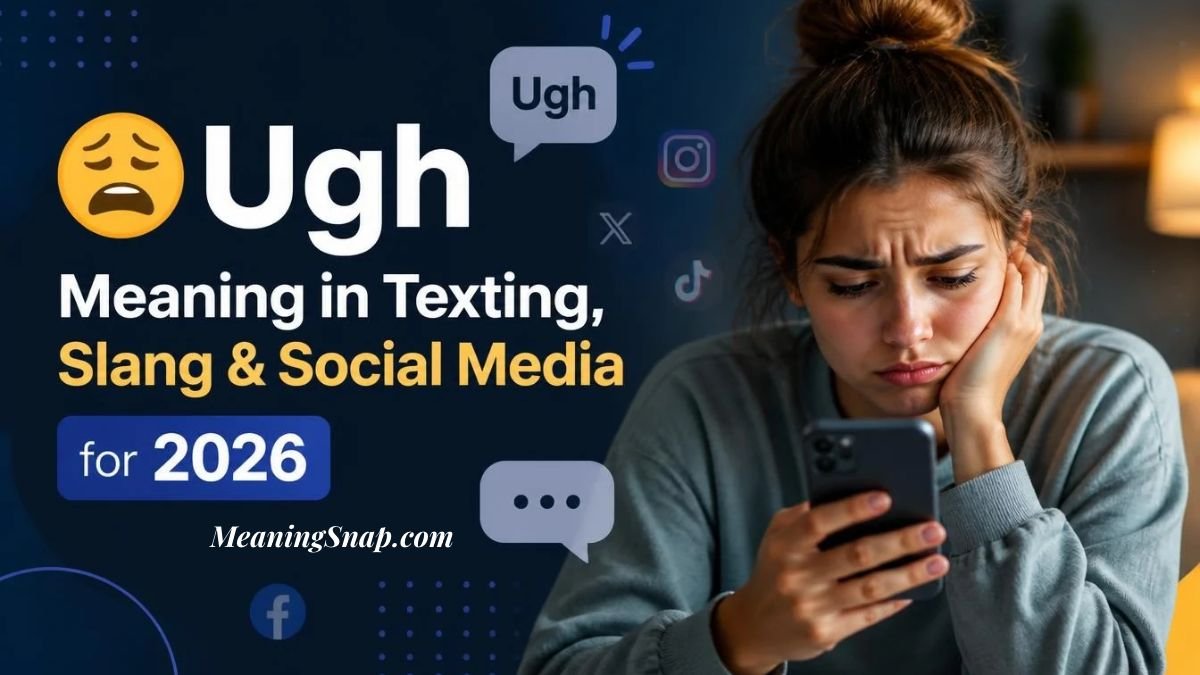
You text a friend, “Want to move dinner to 8?” Three seconds later, one word lands on your screen: “ugh.” Now you’re staring at it. Is she annoyed at the plan, at the day, or at you?
The ugh meaning is simpler than it feels. It’s a sound people type when something annoys them, lets them down, grosses them out, or wears them out. That’s the whole word. What changes from chat to chat is the target and the intensity, and both depend on clues you can learn to spot.
This guide walks through those clues, shows how spelling shifts the tone, and gives you real examples and reply ideas. The next lone “ugh” won’t send you spiraling.
What Is the Ugh Meaning When Someone Texts It?
In texting, ugh is a reaction sound. The sender feels irritated, let down, grossed out, or worn out, and one short word says so without a full explanation. Merriam-Webster defines ugh as an interjection for a cough or grunt, or for expressing disgust or horror. Dictionary.com gives the same disgust sense and lists the cough or grunt as a noun. Texting borrowed the sound and gave it a keyboard.
Two things help right away. Ugh is a real word, not an abbreviation, so it has no hidden full form to decode. And it carries no fixed target. One ugh can point at a rainy forecast, a dull meeting, a gross smell, or a person. You work out which one from the message around it.
That second point drives everything else in this guide. The ugh meaning stays constant while the target and the strength change, so reading it well comes down to spotting clues.
Read More: IGH Meaning in Text: What It Means, How to Use It & Real Chat Examples
Ugh Meaning From a Girl or a Guy: Is It About You?

Plenty of people search this with a specific text open on their phone. They want to know whether the sender’s gender changes the answer. It doesn’t. No dictionary treats ugh differently depending on who types it. A girl texting “ugh, same” and a guy texting “ugh, same” are sharing the same annoyance.
What changes the reading is context. Here are three clues that do most of the work:
- What came right before it. If your message was a complaint or bad news, the ugh usually joins you in the annoyance. If your message was a request or an invitation, the ugh may land on the request itself.
- What follows it. “Ugh, my boss” points outward. A bare “ugh.” leaves the target open, and a quick “what’s up?” clears it.
- How well you know the sender. A friend who ughs at everything isn’t upset with you. A normally warm contact who goes short and flat deserves a second look.
The mistake to avoid is treating every ugh as a verdict on you. Plenty of them aim at the weather, the commute, or Monday.
You Also Like This: REF Meaning: What It Stands For in Text, Sports and Work (2026)
How Spelling and Punctuation Change the Ugh Meaning
Typing habits carry a lot of emotion in text, and ugh stretches easily. This table shows how the common forms usually read.
| Form | Usual tone | Example |
|---|---|---|
| ugh | Plain annoyance or mild letdown | “Ugh, it’s Monday.” |
| ughh or ughhh | Stronger and more dramatic, often playful | “ughhh I have so much laundry” |
| UGH | Loud frustration, often exaggerated | “UGH my train is canceled” |
| ugh. | Flat, tired, or cold | “ugh. fine.” |
| ugh… | Reluctance, trailing off | “ugh… do we have to?” |
| eugh | An alternate spelling you’ll see in UK writing, mostly for disgust | “Eugh, who left this in the fridge?” |
| ugh with 😩 or 🙄 | The emoji steers it: 😩 reads weary, 🙄 reads eye-roll annoyance | “ugh 🙄 not again” |
These readings are habits, not rules. The same “ughhh” can be a joke from a close friend and a pointed sigh from someone who rarely uses it. Check the sender’s usual style before you read too much into one extra letter.
Where Ugh Sits in a Message Changes the Ugh Meaning
Position matters as much as spelling. Ugh turns up in a few places, and each one does a different job.
As an opener, it sets the mood for what follows: “Ugh, I missed the bus.” The reader gets the feeling first and the reason second.
As the whole message, it asks the other person to fill the gap. A lone “ugh.” works as a small request for sympathy. Sometimes it’s a quiet signal that the sender is done talking.
As an aside, it comments on a single detail. Merriam-Webster’s example sentences show the pattern in published writing, where a parenthetical “(ugh)” follows something the writer dislikes. Chat copies the move: “Dinner with the in-laws on Friday (ugh) but dessert’s on me.”
Ugh also closes thoughts. “I’m skipping the party because ugh” skips the explanation and trusts you to fill in the feeling. Those same example sentences include that “because ugh” ending.
Ugh Meaning Across Frustration, Disappointment, Disgust and Exhaustion

One word covers four moods. Dictionaries lead with disgust and horror, and chat stretches the word to cover mild annoyance, letdown, and tiredness too. The words around it tell you which mood you’re getting.
Frustration has an obstacle attached. Something blocks the sender: a glitch, a delay, a stubborn coworker. Expect a reason soon after.
Disappointment arrives when a plan falls apart. It tends to be short and quiet, because the sender feels deflated, not angry.
Disgust is the original flavor. It names an object, often something physical like a smell, a texture, or a mess.
Exhaustion usually carries time words such as “all day,” “still,” or “again.” The sender isn’t upset at anything. They’re drained.
Telling the four apart saves you from answering frustration with a joke or exhaustion with a fix.
You Also Read This: TYT Meaning Explained: What Does TYT Mean in Texting, Slang & Social Media?
Ugh Meaning in Real Chats: Six Examples
These six chats cover different tones. Notice how much the surrounding words do.
Frustrated:
Jordan: Wi-Fi is down again.
Sam: Ugh. Third time this week.
Sam isn’t blaming Jordan. The ugh signals shared frustration, and “third time this week” supplies the reason.
Disappointed:
Priya: The concert got postponed to next spring.
Leah: ugh. I already bought a dress
Leah’s ugh carries letdown, and the lowercase, no-exclamation style keeps it quiet. The dress shows what she’s disappointed about.
Disgusted:
Mia: Found a yogurt from last month in the back of the fridge.
Dan: eugh. Toss the whole shelf.
Eugh names an object, which is the classic disgust setup. Dan jokes along, so the ugh meaning stays light.
Exhausted:
Chris: How was the double shift?
Ana: ughhh don’t ask. I’m asleep by seven.
The stretched spelling plus “don’t ask” signals drained, not angry. Nothing and no one is the target.
Playful:
Noah: I booked us a sunrise hike. Alarm’s at 4:30.
Eli: ughhh fine. But you’re buying the coffee.
Eli complains and agrees in the same breath. The “fine” gives it away: the groan is theater, and the yes is real.
Cold:
Kai: I forgot to book the table. Again.
Rae: ugh. ok.
Here the ugh meaning turns personal. The period, the flat “ok,” and the repeated mistake make Kai the target.
Why People Send Ugh Instead of Explaining
Text strips out tone of voice. A sigh, a groan, or an eye roll face-to-face turns into a few typed letters, and ugh is the fastest way to carry that groan across a screen. That’s a big part of the ugh meaning in texting: it’s a mood shortcut.
It also saves effort. Typing out “I’m annoyed that the meeting ran long and now I’m behind” takes a minute nobody has. “Ugh” takes a second and still gets the point across. And it invites the other person in. A lone ugh often works as an opening line, a small nudge that says “ask me what happened.”
That last part is why a bare ugh deserves a reply. The sender usually wants a response, even if they never say so.
Ugh Meaning on WhatsApp, Instagram and Other Chats

The ugh meaning doesn’t change from app to app. A lone ugh reads the same in iMessage, WhatsApp, and Instagram. What changes is the format around it.
On WhatsApp, chats move in quick bursts, so ugh often works as an instant reply to the message you just sent. The app also lets people react to a message with an emoji, and a 😩 reaction can do the job ugh would do in words.
On Instagram, you’ll meet it in DMs and in replies to stories. An “ugh” sent under a friend’s story about a canceled flight reads as sympathy, not complaint. In captions, people drop it as a mood label on a photo of a messy desk or a rainy window.
In group chats, one ugh invites others to pile on with their own. If you can’t tell whether it’s aimed at someone, check who spoke last.
Can the Ugh Meaning Be Positive?
Dictionaries define ugh as a negative reaction, and none lists a positive sense. Chat still bends the word. People attach ugh to things they like as a mock complaint: “ugh, you’re so thoughtful” or “ugh, I love this song.”
The feeling underneath is overwhelm, not displeasure. The thing is almost too good, so the sender pretends to protest. You can spot it when a compliment or something sweet follows, and when the spelling stretches into “ughhh.” It’s the same irritated sound used for fun, not a second official meaning.
If you want to use it that way, keep it with people who know your humor. A stranger can’t tell your “ugh, you’re amazing” from a real complaint.
Read More: OBE Meaning: UK Honor, Out-of-Body Experience & More
How to Reply Once You Know the Ugh Meaning
Your best reply depends on which mood you spotted. Pick the one that fits:
- Shared problem: “Ugh, what happened?” Sympathy plus one question keeps the chat moving.
- Bare ugh with no context: “You okay?” or “What’s up?” Short and low-pressure.
- Exhaustion: Skip the fix and offer relief. “Want me to handle dinner?”
- Playful ugh: Match the energy. “I know, I’m too good at this.”
- Cold ugh aimed at you: Own it fast. “You’re right, I dropped that. Can I fix it today?”
You don’t need a long reply. One kind line beats three paragraphs of guessing.
Where Ugh Comes From
The ugh meaning began as a written attempt to capture a sound. The Oxford English Dictionary’s earliest citations show it standing in for a cough. By the mid-19th century, it had become a word for disgust. References disagree on exact first-use dates, so there’s no tidy year to pin on it.
Did You Know: The earliest written examples of ugh stand for a cough, not a feeling. Dictionaries still list both senses today.
Merriam-Webster also notes that interjections are far more common in electronic messages than in other types of writing. That fits how at home ugh feels in a text thread.
Ugh vs Meh, Ew, Oof and Sigh
These five reactions overlap, so people accidentally swap them. The table separates the ugh meaning from its neighbors by feeling.
| Term | Feeling | Best used for | Example |
|---|---|---|---|
| Ugh | Annoyance, letdown, disgust, tiredness | Anything that bothers you | “Ugh, more traffic.” |
| Meh | Indifference | Things you don’t care about either way | “Meh, pizza or tacos is fine.” |
| Ew | Disgust | Something gross to see, smell, or taste | “Ew, that milk expired.” |
| Oof | Wincing sympathy | Someone else’s painful moment | “Oof, that’s rough.” |
| Sigh | Resignation | Giving in or venting quietly | “Sigh. Fine, I’ll do it.” |
How to Use Ugh in a Sentence Without Sounding Off
Using ugh yourself takes one habit: name the target. “Ugh, the printer jammed again” tells your friend exactly what annoyed you. A bare “ugh” makes them guess, and some guesses land on them.
Match the spelling to the volume you mean. “Ugh, I missed my stop” is a mild groan. “ughhh I have three exams on Friday” is a big, dramatic one. Both work, as long as the dramatic one goes to someone who’ll hear the joke in it.
Keep ugh away from people. Aim it at situations, objects, and your own bad luck. “Ugh, you’re so annoying” can be playful with a close friend, but it needs a smile emoji or a laugh to land that way.
Is the Ugh Meaning Rude, and When Should You Skip It?
Ugh isn’t rude on its own. It’s an informal reaction, and the tone depends on the target. “Ugh, Mondays” is harmless. “Ugh, you again” stings because it points at a person.
Some settings call for a different word. Skip ugh in these:
- Professional emails: It reads as complaining. Swap in “That’s frustrating” or “I’m concerned about the delay.”
- Academic writing: Interjections don’t belong in essays or reports. Describe the reaction instead: “The results were disappointing.”
- Serious conversations: When someone shares bad news, ugh can sound like a brush-off. Try “That sounds hard. I’m here if you want to talk.”
FAQs
Does ugh have a full form?
No. Dictionaries list ugh as an interjection, not an acronym, so there’s no official expansion. Treat any full form you see online as a guess.
Why do people write ughh or ughhh?
The extra letters stretch the sound the way you’d drag out a groan in person. A longer groan means a bigger feeling, though friends often use it as a joke.
How do you pronounce ugh?
Most people say a short, throaty “uhg” or “uhk.” Merriam-Webster also lists a plain “uh” ending, so the spoken form varies.
Is there an opposite of ugh?
Ugh has no official antonym. Sounds of pleasure like aww, yum, and yay do the opposite job.
What does it mean when someone says “you are ugh”?
It isn’t a dictionary phrase. People stretch ugh into a descriptive word, so “you’re so ugh” usually means “you’re annoying” or “you’re too much.” Tone, emoji, and the sender’s history tell you whether it’s teasing or serious.
The Quick Way to Read Any Ugh
Check what came before it. Look at what follows it. Match the spelling to the sender’s usual style. If you’re still unsure, ask one short question, like “ugh at me or at the day?”
Once you know the ugh meaning is a small groan, not a hidden message, most lone ughs lose their sting. Read the clues, answer the mood, and move on.

Alex Morgan is a writer focused on explaining slang, words, phrases, acronyms, and popular expressions in a simple and easy-to-understand way. Through clear explanations and helpful examples, Alex helps readers quickly understand what words and phrases mean and how they’re commonly used.