You’re replying to a friend who just sent a long, heartfelt message, and your thumbs freeze. Is it “that’s mean” or “that means”? Both look fine and sound almost identical. Here’s how that’s mean vs. that means works, and how to pick the right one in seconds.
The short answer: “that’s mean” is short for “that is mean,” and it describes something unkind. “That means” explains what something signifies or leads to. Try swapping in “that is.” If the sentence still works, write “that’s mean.” If it falls apart, you want “that means.”
The rest of this guide shows why the two get mixed up, gives you examples to copy, and covers the places where “mean” and “means” switch jobs, like “a means to an end.”
That’s Mean vs That Means: The Core Difference
Here’s the thing. The two phrases look like twins, but they do different work.
“That’s mean” is a contraction, which is a short form made by squeezing two words together. It stands for “that is mean.” Here “mean” is an adjective, a word that describes something. In its most common sense, it tells you a person, comment, or action is unkind.
“That means” has no hidden “is.” In this phrase, “means” is a verb, the action word that links an idea to its explanation or result. Merriam-Webster lists “means” as the third-person singular present form of “mean,” the form you use after “that,” “it,” “he,” or “she.”
The whole that’s mean vs that means question comes down to one check: is there a hidden “is”? This table puts the two phrases side by side.
| Phrase | What it is | What it tells the reader | Example |
|---|---|---|---|
| That’s mean | “That is” + adjective | Something is unkind or cruel | “That’s mean. She saved you a seat.” |
| That means | “That” + verb | Something signifies or results in something else | “That means the store closes at nine.” |
That’s Mean vs That Means: When “That’s Mean” Fits
Use “that’s mean” when you’re judging how someone treated another person. It points at behavior or a remark, and it can stand alone as a complete reaction.
Here are two ways it shows up:
- Text message: “You told her how the movie ends? That’s mean.”
- School chat: “Everyone laughed at his drawing. That’s mean.”
Both reactions judge an action, not a fact. That’s why “mean” (unkind) fits and “means” doesn’t.
Dictionaries list more than one sense of this adjective. The American Heritage Dictionary puts “lacking in kindness” first. It also lists “stingy,” as in “mean with money,” and a slang sense meaning excellent or skillful, as in a mean game of bridge. Context tells you which sense you’re getting. Add a money or skill word, and the meaning shifts. Leave it bare, and readers hear “unkind.”
Read More: How-To vs. How-Tos: Which One Is Correct?
That’s Mean vs That Means: When “That Means” Fits
Use “that means” when you’re explaining what something implies or causes. “That” points back to whatever you just said. “Means” announces what follows from it.
Here are three spots where it shows up:
- Work email: “The vendor missed the deadline. That means we need a backup plan by Friday.”
- Caption: “Sunscreen on, playlist ready. That means summer has started.”
- Text message: “She replied with three emojis. That means she’s happy, right?”
Each sentence states a fact first, then spells out its result. The result can also be an action ending in -ing, as in “That means leaving at six.”
Why That’s Mean vs That Means Sounds So Alike
Say them out loud. “Thats-meen” and “that-meens” use the same letters and almost the same sounds. The only difference is where the “s” lands, and in fast speech that “s” slides around.
Writing adds to the problem. Voice-to-text tools match sounds first, so they can pick the wrong spelling when two phrases sound alike. In a quick text, a missing apostrophe or a stray letter slips past easily. That overlap explains why the that’s mean vs that means mix-up happens even when you know the rule.
The good news: spelling isn’t your only clue. The meaning of the sentence gives you the answer.
Read More: TGIF Meaning in Text: The Real Definition, Uses, Examples & Social Media Guide (2026)
That’s Mean vs That Means: Correct, Incorrect, and Why
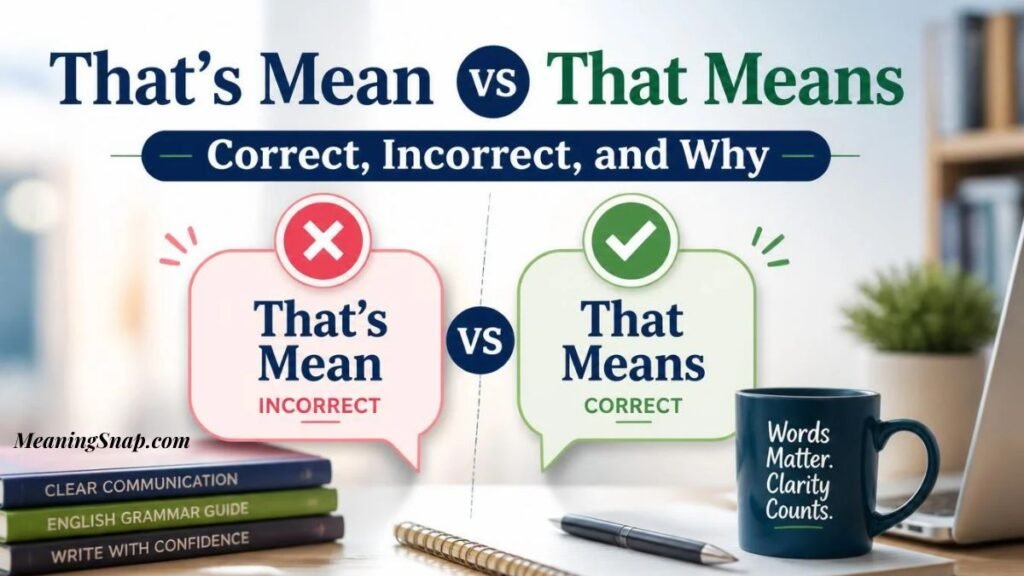
Real slip-ups fall into a few patterns. This table shows each one with a quick fix. A helper verb is a small word like “does” that supports the main verb, and it matters in the second row.
| Correct | Incorrect | Why |
|---|---|---|
| That means we’re late. | That’s mean we’re late. | A result needs a verb to link it to the fact. “That is mean we’re late” connects nothing. |
| What does that mean? | What does that means? | The helper verb “does” already carries the -s, so the main verb goes back to its base form, “mean.” |
| That means he’s busy. | That mean he’s busy. | A single subject like “that” takes “means” in a statement. |
| That’s mean of him. | That mean of him. | The apostrophe-s supplies the missing “is.” Without it, the sentence has no verb. |
| That’s meant to be funny. | That’s mean to be funny. | “Meant” is the form of the verb used for intentions, as in “meant to.” |
A Quick Test for That’s Mean vs That Means
You don’t need to memorize rules. Two swaps settle that’s mean vs that means in a few seconds.
First, try the “that is” swap. Replace the phrase with “that is.” “That is mean” works, so “that’s mean” is right. “That is we’re late” makes no sense, so you need “that means.”
Second, try the “signifies” swap. Replace the phrase with “that signifies” or “that implies.” If the sentence still makes sense, write “that means.”
Memory Trick: The apostrophe in “that’s” stands in for the missing “i” in “is.” No apostrophe, no “is,” so you’re using the verb “means.”
That’s Mean vs That Means in Questions and Negatives
Helper verbs show up all the time in questions and negatives. They follow the same rule as “does” in the table above, so “mean” loses its -s each time:
- “Does that mean we can leave early?”
- “That doesn’t mean she’s upset.”
- “Did that mean anything to you?”
- “A late bus won’t mean a missed exam.”
Notice that “that’s mean” can still join the conversation. “That doesn’t mean it’s mean” is a legitimate sentence. It uses “mean” twice, first as a verb and then as an adjective, and the swap test sorts out each one.
Read More: WYG Meaning in Text: What It Means & How to Reply
That Means in a Sentence: More Examples
Seeing the phrase in real sentences helps it stick. These cover different moods:
- Frustrated: “The printer is out of paper again. That means my essay won’t print in time.”
- Surprised: “The boss approved the budget? That means we can finally hire.”
- Sarcastic: “Another group project. That means I’m doing it alone again.”
- Playful: “Cookie dough in the fridge? That means dinner is optional.”
The pattern never changes. A fact comes first, “that” points back at it, and “means” delivers the consequence. “This means” and “it means” follow the same pattern.
“That Means a Lot” or “That’s Mean a Lot”?
If you’re thanking someone, the answer is “that means a lot.” Merriam-Webster lists a sense of “mean” that covers importance, with a sample sentence about health meaning everything to someone. In “that means a lot,” the same verb tells the reader how much something matters to you.
“That’s mean a lot” isn’t standard English. It reads as a typo for “that means a lot,” because “that is mean a lot” has no clear meaning. Even in a thank-you note, that’s mean vs that means decides the tone, so check the “s” before you hit send.
- Text message: “Thanks for coming to my recital. That means a lot.”
- Card: “Your note made my week. That means so much.”
If you want to call something unkind instead, add a word that fits: “That’s so mean” or “That’s a mean thing to say.”
Mean or Means as a Noun: Does It Change the Rule?
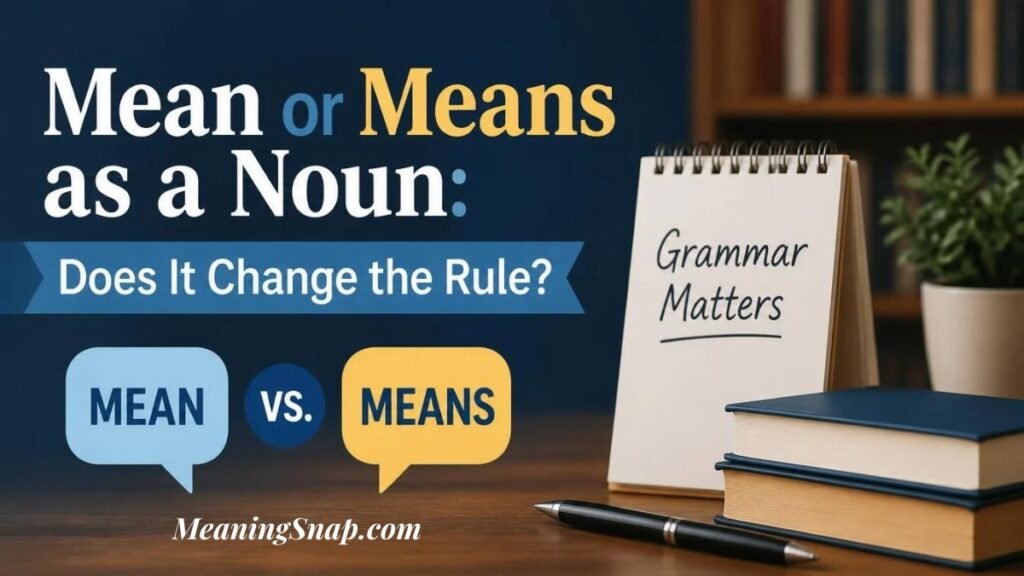
Both words also work as nouns, and that adds a twist to that’s mean vs that means. This table shows all four jobs.
| Word | Part of speech | Meaning | Example |
|---|---|---|---|
| mean | Adjective | Unkind, stingy, or (informally) skilled | “That’s mean” or “a mean guitar solo” |
| mean | Noun | The average of a set of numbers | “The mean of 2, 4, and 9 is 5.” |
| means | Verb | Signifies or intends | “That means we start early.” |
| means | Noun | A way of getting something done, or money | “Email is a quick means of reaching her.” |
The noun “means” has a quirk. It looks plural, but it can take a singular or a plural verb. Merriam-Webster describes it as plural in form but singular or plural in construction. Oxford Learner’s Dictionaries also lists the plural as “means” and includes phrases like “a means to an end” and “beyond your means.”
This is where “that’s” and “means” can sit side by side without a mistake. “That’s a means to an end” is correct, because “that’s” is “that is” and “a means” is the noun. The earlier test still works: “that is a means to an end” makes sense, so the apostrophe stays.
US vs UK: One Difference Worth Knowing
Oxford Learner’s Dictionaries labels the “not generous” sense of “mean” as British English, as in “She’s always been mean with money.” The American Heritage Dictionary lists the same sense, so American readers will recognize it too.
The unkind sense comes first in both dictionaries. When you write “that’s mean” with nothing else around it, it reads as “that’s unkind” on both sides of the Atlantic. Add “with money” or “with the chocolate sauce,” and the stingy sense takes over.
Formal vs Casual: Does That’s Mean vs That Means Change in a Text?
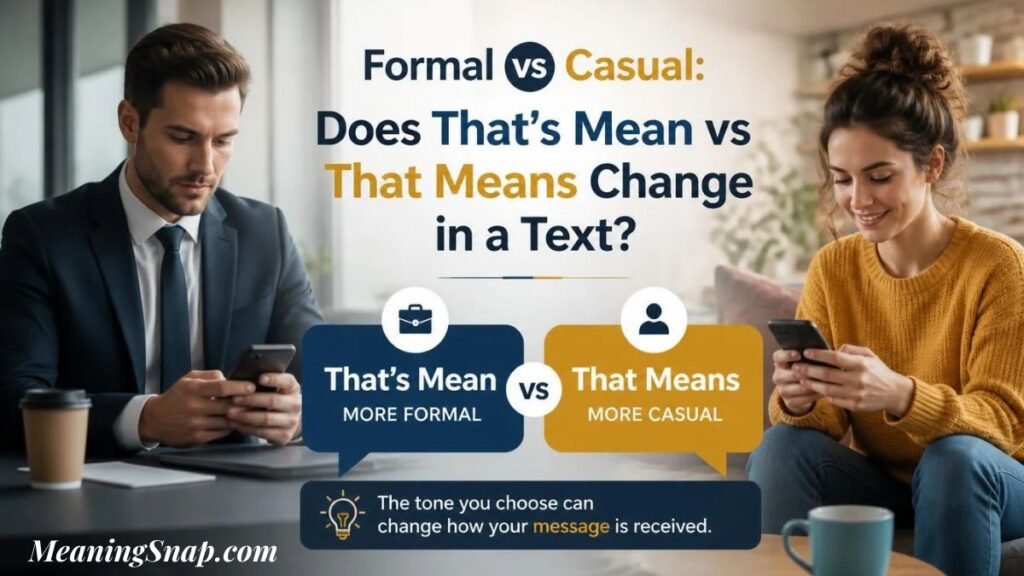
The rule stays the same in every setting. Only the tone around it shifts.
In a group chat, you can drop the apostrophe and type “thats mean,” and friends will still follow you. They fill in the gap from context. In a cover letter or school paper, write “that’s mean” with the apostrophe, or spell out “that is” if your teacher or editor wants no contractions.
“That means” never changes. It has no apostrophe to lose, so it looks the same in a text, an email, and an essay. In formal writing, a sharper word often does the job better than “mean,” such as unkind, harsh, rude, or hurtful.
Read Also: IFG Meaning in Text: What It Stands For and How to Reply
Does the Same Rule Work for It’s Mean vs It Means?
Yes. The “it is” swap and the “signifies” swap both carry over.
Compare “He’s mean” (he’s unkind) with “He means well” (his intentions are good). Compare “It’s mean to leave her out” with “A red sky means rain.” The same split happens with “she” and “this.” “She’s mean with money” describes a stingy person, while “This means war” announces a result.
Spot the “is” and you’ve found the adjective. No “is,” and you’re looking at the verb.
Self-Test: That’s Mean vs That Means in Five Questions
Try these before you read the answers. Fill each blank with “that’s mean,” “that means,” or “mean.”
- “You skipped my birthday? ___!”
- “The roads are icy. ___ we should leave early.”
- “Does that ___ the meeting moved?”
- “Thanks for helping me move. ___ a lot.”
- “Laughing at her answer was ___ of them.”
Here are the answers, with the fastest way to spot each one:
- That’s mean. The “that is” swap works, and the sentence judges an action.
- That means. A fact comes first, and the blank announces the result.
- Mean. The helper verb “does” already carries the -s.
- That means. It’s a thank-you, and “that is mean a lot” makes no sense.
- Mean. The phrase “mean of them” needs the adjective on its own, with no “that” in front.
Four right out of five is solid. If you missed one, reread the swap test and run it on that sentence.
Frequently Asked Questions About That’s Mean vs That Means
What does “that’s mean” mean?
It says that something is unkind or cruel. Depending on context, it can also mean stingy, or skilled when it follows words like “a mean guitar.”
Is “that’s mean” a complete sentence?
Yes. “That” is the subject, “is” is the verb, and “mean” describes the subject, so nothing is missing.
What is the past tense of “that means”?
It’s “that meant.” For example, “That meant we missed the train.”
Is “thats mean” without an apostrophe acceptable?
In casual texting, readers will usually understand it. In anything polished, write “that’s mean.”
How do you say “that means” and “that’s mean” in Malay?
“That means” translates as “itu bermaksud” or “itu bermakna.” For the unkind sense of “that’s mean,” Malay speakers would say “itu jahat” or “itu kejam,” though tone shifts the best choice, so ask a native speaker for formal writing.
Is “this means” the same as “that means”?
Mostly, yes. “This” points at something close or about to be said, while “that” points back at something already mentioned.
The Takeaway for That’s Mean vs That Means
Next time your thumbs freeze, say the sentence with “that is” in place. If it fits, you want “that’s mean.” If it doesn’t, write “that means” and keep typing.

Alex Morgan is a writer focused on explaining slang, words, phrases, acronyms, and popular expressions in a simple and easy-to-understand way. Through clear explanations and helpful examples, Alex helps readers quickly understand what words and phrases mean and how they’re commonly used.