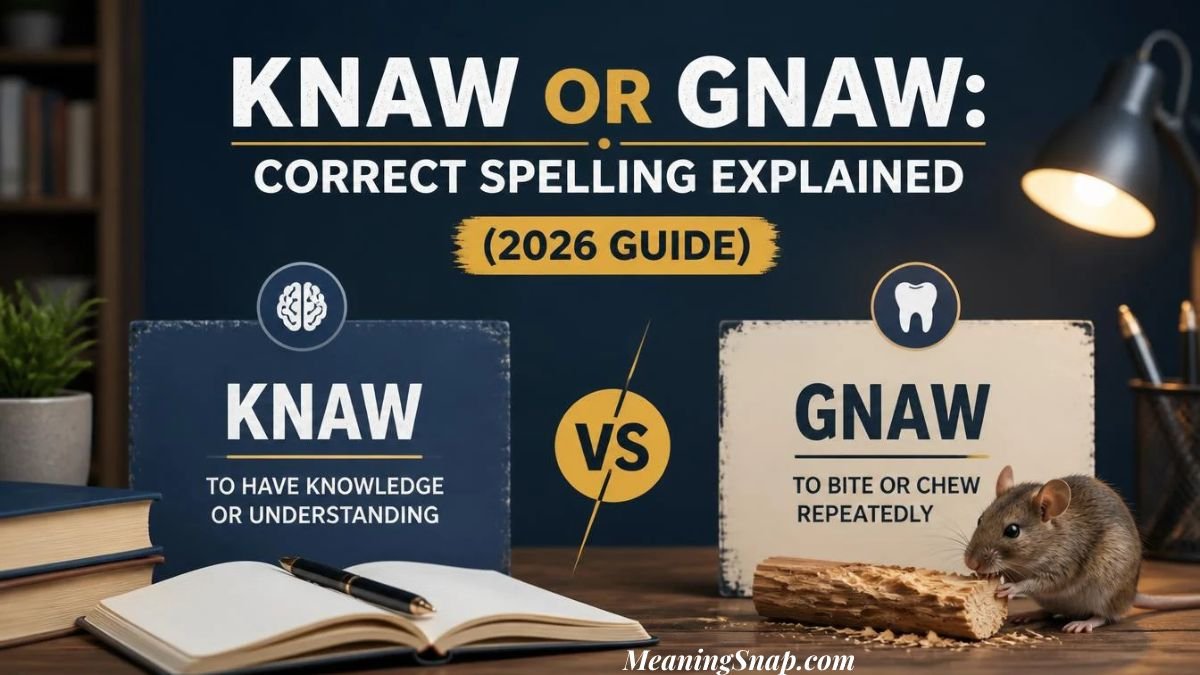
Your puppy just turned a couch leg into a chew toy. You grab your phone to tell a friend, type the word, and freeze. Is it knaw or gnaw?
The short answer: it’s gnaw, with a silent g, in both US and UK English. “Knaw” isn’t an accepted spelling of this word. Gnaw means to bite or chew on something again and again, and it also describes a worry that won’t leave you alone.
Spell-check rescues you most days. When it doesn’t, you’re left squinting at two spellings that both look half right. This guide settles the knaw or gnaw question fast, then shows why the mix-up happens, how to say the word, what it means, and how to lock in the spelling for good.
Knaw or Gnaw: Which Spelling Is Correct?
On the knaw or gnaw question, gnaw is the only standard spelling. Merriam-Webster, Dictionary.com, and Collins all list it, and none of them list knaw as a variant. Every form of the verb keeps the same gn- start.
This table pairs each correct form with the misspelling people type most often.
| Correct | Incorrect | Why |
|---|---|---|
| gnaw | knaw | The base verb opens with gn. |
| gnaws | knaws | Same stem, plus s for he, she, or it. |
| gnawed | knawed | Past tense adds ed to the full stem. |
| gnawing | knawing | The -ing form keeps the stem too. |
Gnaw behaves like a regular verb. Lock in the stem once, and every form follows.
Why Knaw or Gnaw Looks Right (and Isn’t)
Here’s the thing: your instinct isn’t random. English has a big family of words that start with a k you never say. Know, knee, knife, and knit all follow that pattern, so a silent letter before an n feels normal. When your ear hears “naw,” your brain grabs the familiar kn- spelling.
Gnaw belongs to a smaller family. Gnat (a tiny flying insect), gnu (an African antelope), gnome (a folklore creature), and gnash (to grind the teeth) also open with a g you never say. You see them far less often, so your fingers default to the common pattern.
That’s the whole knaw or gnaw trap. Knaw looks right because it fits a pattern English uses all the time. It just isn’t the pattern this word follows.
Read Also: Potato vs Potatoe: Which Spelling Is Right? (guide 2026)
Where Gnaw Comes From
Gnaw is an old word. Etymonline traces it to Old English gnagan, meaning to bite off bit by bit, and Merriam-Webster dates the first known use to before the 12th century. Cousins turn up across the Germanic languages: Old Norse gnaga, Swedish gnaga, German nagen, and Dutch knagen. Etymonline says the word is likely imitative, which means it echoes the sound of the act itself.
That Dutch cousin matters here. Dutch spells the same ancestor word with a k, so your k instinct has a real relative in another language. English settled on gn instead.
Etymonline notes that speakers fully pronounced the g in Old and Middle English. The sound faded later, and the spelling stayed put.
The worry sense arrived early too. Etymonline dates the figurative meaning, wearing something down as if by constant biting, to the early 1200s.
Knaw or Gnaw Meaning: Is Knaw a Real Word?
Not in standard English. Knaw doesn’t mean gnaw, and neither Merriam-Webster nor Dictionary.com lists it as a spelling of that word.
You can still find it in old Scots. The Scottish National Dictionary lists knaw as a Scots form of the verb know and marks it obsolete. Its quotations run from about 1700 to 1823 and include a line from Walter Scott’s Minstrelsy.
So if you spot knaw in an old ballad, read it as know. If a friend texts it to you, they meant gnaw and missed the g.
Did You Know? Scots knaw and English gnaw look like close cousins, but they aren’t. Know descends from Old English cnāwan, and gnaw descends from Old English gnagan. Two separate roots ended up with similar-looking silent openings.
Knaw or Gnaw Pronunciation: How to Say It
Say “naw,” like saw, law, and paw. The g stays quiet. Dictionary.com shows the US sound as /nɔ/, and Collins gives the British sound as /nɔː/, the same vowel held a little longer. In US accents where “caught” and “cot” sound alike, the vowel can slide toward “nah.”
British readers get a bonus trap. In accents that drop the r after a vowel, such as many in England, gnaw sounds the same as nor, according to Wiktionary.
The other forms follow along. Gnaws sounds like “nawz,” gnawing sounds like “NAW-ing,” and the past tense, gnawed, rhymes with clawed. Since the g never reaches your ears, you can’t rely on sound to pick the spelling. That job belongs to your eyes.
Read Also: Rapport or Repore? The Correct Spelling Explained
Gnaw Meaning: Chewing, Wearing Away, and Worrying
Gnaw does three jobs, and each one shows up in everyday writing.
The first job is literal: biting or chewing on something persistently. A dog working on a bone is the classic picture.
The second is physical wear. Rats gnaw a hole in a wall, and acid can gnaw at metal. The third is emotional. A worry, a doubt, or hunger gnaws at you when it won’t let go.
Both at and on appear with the chewing sense. Merriam-Webster’s examples include gnawing at a lip and gnawing on fingernails, and gnaw can take a direct object too, as in gnawing a bone. For feelings and slow damage, dictionaries lean on at, as in anxiety gnawing at confidence or waves gnawing at cliffs.
Knaw or Gnaw Word Forms: Verb, Noun, and Adjective
Most people meet gnaw as a verb, but it stretches further. Collins also lists a noun, the act of gnawing, and Dictionary.com lists gnawable as an adjective for things that teeth can wear down. Gnawing works as an adjective too, as in a gnawing doubt.
Merriam-Webster also has an entry for gnawer, a creature or person that gnaws. Every one of these keeps the gn- opening, so the knaw or gnaw rule never changes with the word form.
Phrases That Pair With Gnaw
Certain partners show up again and again. This list pulls together the combinations you’ll meet most in news and everyday writing.
- gnawing hunger, gnawing doubt, gnawing worry: a feeling that keeps pressing
- gnaw away at: slow, steady damage or worry
- gnaw a hole in: what rodents do to walls, boxes, and wires
- gnaw on a bone: the classic literal image
Notice the pattern. Gnawing nearly always signals something slow and repeated, never a single bite.
Gnaw Synonyms: Which Word Fits Best?
These words overlap with gnaw, but each one leans a different way.
| Word | Best when | Example |
|---|---|---|
| chew | any biting and grinding with the teeth | “The puppy chewed my sneaker.” |
| nibble | small, light bites | “She nibbled the edge of the cracker.” |
| erode | slow wearing away, physical or figurative | “Rain eroded the trail over the years.” |
| corrode | chemical damage, especially to metal | “Salt air corroded the hinges.” |
| plague | trouble that keeps coming back | “Doubts plagued him before the exam.” |
| vex | annoy or worry someone | “The unanswered email vexed her all weekend.” |
Persistence is what gnaw adds. Dictionary.com defines the biting sense as chewing persistently, and the feeling version keeps that idea alive. A worry that gnaws doesn’t quit.
Is There a Slang Meaning for Knaw or Gnaw?
Short answer: no. Merriam-Webster and Dictionary.com list only the biting, wearing-away, and worrying senses, and knaw appears only as the old Scots form of know. Sites built from user submissions, like Urban Dictionary, can hold one-off jokes and personal spellings. Those entries show that someone used a word a certain way, not that the usage is standard, so treat them as hints at best.
Gnaw does turn up in pop culture. Tyler, the Creator’s Camp Flog Gnaw festival in Los Angeles uses it in its name. That’s a proper noun, not slang. Green’s Dictionary of Slang also records one regional New Zealand use, which you won’t need for everyday US or UK writing.
Knaw or Gnaw in a Sentence: Real Examples
These six sentences show gnaw at work. The first three come with the common misspelling, followed by the fix.
Text message. Incorrect: “Our dog knawed through my charger again.” Correct: “Our dog gnawed through my charger again.” Gnawed is the past tense, so the gn stem plus ed does the job.
Email. Incorrect: “The missed deadline has been knawing at the team all week.” Correct: “The missed deadline has been gnawing at the team all week.” Here gnawing describes a worry that lingers, so the at fits.
School report. Incorrect: “Beavers knaw tree trunks to build their lodges.” Correct: “Beavers gnaw tree trunks to build their lodges.” This one uses the literal biting sense with an animal subject.
Social media caption. “Nothing beats gnawing on a fresh corn cob at the lake.” Casual posts welcome gnaw just fine, since no dictionary treats it as informal.
Work chat. “That open question kept gnawing at me until I called the client.” The feeling sense works in professional writing, too.
Group chat. “I’m not even hungry, I’m just gnawing on pretzel sticks out of boredom.” A playful tone changes nothing about the spelling.
A Two-Second Test for Knaw or Gnaw
Start with the teeth test. Gnaw, gnash, grind, and grit all describe what teeth do, and every one of them starts with g. If your sentence involves teeth, chewing, or a worry that keeps biting, reach for gn.
Next, try the swap test. Replace the word with chew. If the sentence still makes sense, you want gnaw. If the sentence is about knowing something, you want know, not knaw.
Finally, run this quick knaw or gnaw self-test. Pick the right spelling in each line.
- The rabbits had (knawed / gnawed) a hole in the fence.
- A small doubt kept (knawing / gnawing) at her all morning.
- Do you (know / knaw) the answer?
The answers are gnawed, gnawing, and know. Three for three means you’ve got it.
When you proofread a draft, search the file for “knaw.” Every hit is a typo unless you’re quoting old Scots, so swap it for gnaw and move on. Then scan for gnaw’s relatives, gnawed and gnawing, since a copy-and-paste habit can spread one wrong spelling across a whole document.
Gnu, New, and Knew: A Related Silent-Letter Mix-Up
Gnaw isn’t the only gn- word that trips up writers. Gnu, the African antelope, sounds like new and knew in most US accents, so a quick text can land on the wrong one. The same tricks that settle knaw or gnaw work here. Say the sentence out loud, picture the animal, and let the meaning pick the spelling.
Here’s a pair to try: “The gnu knew the way to the river.” One word names the animal, and the other word is the past tense of know.
Common Mistakes Around Knaw or Gnaw
Beyond the knaw or gnaw typo itself, a few look-alike words can pull you off course. This table separates gnaw from the words it gets mixed up with.
| Word | Meaning | How it differs from gnaw |
|---|---|---|
| gnash | to grind or strike the teeth together | Gnashing is teeth meeting teeth, often from anger. Gnawing bites into something. |
| know | to be aware of or understand something | It carries the silent k that people wrongly bring over to gnaw. |
| nag | to pester someone with constant complaints | Nag grew out of a dialect word for gnaw, per Etymonline. Use nag for people who keep asking and gnaw for a feeling that keeps biting. |
Read Also: What Does TW Mean in Text? Explained Simply
FAQs
Is knaw ever correct?
Only in historical Scots writing, where it stands for know. In everyday English, it’s always a misspelling of gnaw.
Is the spelling different in British English?
No. US and UK dictionaries both spell it gnaw, and only the vowel length shifts a little.
What is the past tense of gnaw?
Gnawed. Dictionary.com also lists gnawn as a past participle, and Wiktionary calls it archaic, so gnawed is the safe choice.
Can I use gnaw in casual writing?
Yes. Neither Merriam-Webster nor Dictionary.com labels it slang or informal, so it works in texts, essays, and emails alike.
What is a gnawer?
Anything that gnaws, with rodents as the classic example. The word rodent itself traces back to the Latin verb rodere, meaning “to gnaw.”
Is gnat related to gnaw?
Possibly. Etymonline says gnat may connect to gnaw, though it hedges the link.
Knaw or Gnaw: The One Rule to Keep
Teeth, chewing, or a worry that won’t quit? Write gnaw, with the g up front. Save the k for know, knee, and knife.
The next time you hit a knaw or gnaw moment, run the teeth test and move on. The silent g is easy to spot once you know where to look.

Alex Morgan is a writer focused on explaining slang, words, phrases, acronyms, and popular expressions in a simple and easy-to-understand way. Through clear explanations and helpful examples, Alex helps readers quickly understand what words and phrases mean and how they’re commonly used.