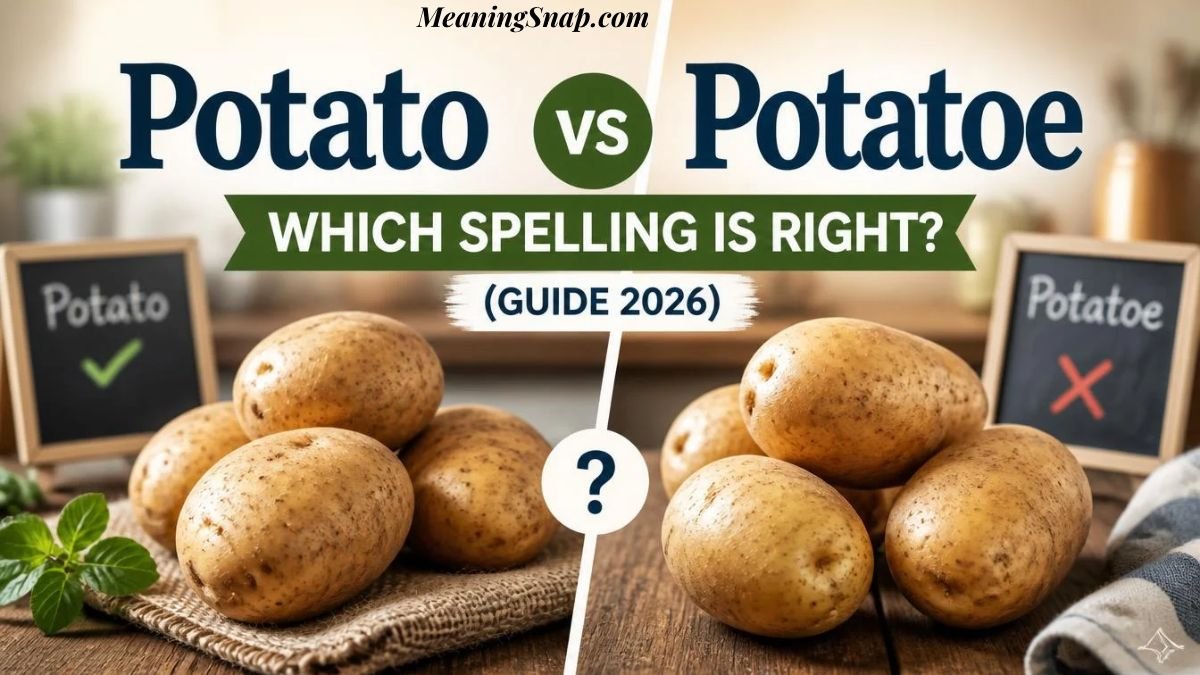
You’re typing a grocery list when your thumbs stall. The potato vs potatoe question has struck again, and both versions look fine at 7 p.m. on a Tuesday. The short answer is simple. “Potato” is the only correct singular spelling, and “potatoes” is the plural. “Potatoe” is wrong everywhere, in the US and the UK, in a text or a term paper. The extra e belongs to the plural only. Spoiler: it’s a one-letter fix, and the reason people miss it is more interesting than the fix. Below, you’ll find the rule behind it, plus real sentences and a short self-test. You’ll also get the story behind one famous “potatoe.”
Potato vs Potatoe: Correct, Incorrect, and Why
This table sorts every form you’re likely to type.
| Form | Status | Why |
|---|---|---|
| potato | Correct | Singular noun. One item, no e. |
| potatoes | Correct | The plural. Merriam-Webster and Oxford Learner’s both list it. |
| potatoe | Incorrect | Merriam-Webster, Oxford Learner’s, and Dictionary.com don’t list it as a variant. |
| potatos | Incorrect | Dictionary.com calls it an invalid plural spelling. |
Dictionaries leave no wiggle room here, so there’s no formal-versus-casual split to sort out. A text to a friend follows the same spelling as a school essay.
Why Potato vs Potatoe Trips People Up
Here’s the thing: the two forms sound almost identical. “Potato” ends in an “oh” sound, and “potatoes” ends in an “ohz” sound. Your ear barely notices the gap, so your fingers guess.
Grocery lists, menus, and recipe cards lean on the plural, so your eyes see the longer shape all the time. Then you write about a single item, and the e tags along.
Other words feed the habit. Hero becomes heroes. Tomato becomes tomatoes. Echo becomes echoes. Once your brain files “o + es” as normal, it applies the pattern to the singular too.
Spellcheck adds a twist. It usually flags “potatoe,” but it stays silent when you write “one potatoes,” because “potatoes” is a real word. Only a read-through catches this slip.
Read More: Rapport or Repore? The Correct Spelling Explained
The “-o” Plural Rule Behind Potato vs Potatoe
The e in “potatoes” comes from a plural rule for nouns ending in o. Word columnist Rob Kyff sums it up in a November 2025 Creators Syndicate column. Add es to the plural, unless a vowel comes before the o, the noun is a shortened word, or it’s a music term. He lists a few rarer exceptions too.
This table shows both groups side by side.
| Plural ending | Singular | Plural | Reason |
|---|---|---|---|
| es | potato | potatoes | Consonant before the o |
| es | tomato | tomatoes | Consonant before the o |
| es | hero | heroes | Consonant before the o |
| es | echo | echoes | Consonant before the o |
| s | photo | photos | Shortened word (from photograph) |
| s | piano | pianos | Music term |
| s | video | videos | Vowel before the o |
| s | zoo | zoos | Vowel before the o |
The rule changes the plural only. The singular keeps its plain o, which settles the whole potato vs potatoe debate. A few -o nouns accept two plurals, so when you meet an unfamiliar one, check its dictionary entry first.
Potato vs Potatoe: Plural and Possessive Forms
Apostrophes cause a second round of mistakes, so this table puts all four forms in one place.
| Form | Spelling | Example |
|---|---|---|
| Singular | potato | I peeled one potato. |
| Plural | potatoes | She peeled four potatoes. |
| Singular possessive | potato’s | The potato’s skin is thin. |
| Plural possessive | potatoes’ | The potatoes’ skins are thin. |
An apostrophe shows ownership. It never builds a plural. If nothing belongs to the potato, drop the apostrophe.
You May Also Read: Hassle vs Hastle: Which Spelling Is Correct?
Potato vs Potatoe in Real Sentences
Seven examples across everyday writing show the correct forms at work.
- Text message: “Grabbing potatoes and onions on my way home. Need anything?” The plural takes es and no apostrophe.
- Email: “Please add one potato to each lunch box.” One item, so no e.
- Caption: “Sunday mood: a baked potato and a good book.” Singular again.
- School: “Our science class grew a potato plant by the window.” Here “potato” describes the plant, so it stays singular.
- Work: “Today’s special is leek soup with roasted potatoes.” Several pieces, so the plural.
- Recipe: “Boil the potatoes for ten minutes, then drain.” Plural, with es.
- Social comment: “My brother is a total couch potato on weekends.” A set phrase, singular.
Three wrong-to-right pairs show where the slip sneaks in.
| Incorrect | Correct | What changed |
|---|---|---|
| I bought one potatoe for lunch. | I bought one potato for lunch. | The singular loses the e |
| We need potatos for the stew. | We need potatoes for the stew. | The plural gains es |
| Fresh potato’s for sale today. | Fresh potatoes for sale today. | The apostrophe goes, es arrives |
Common Mistakes With Potato vs Potatoe
Past the typos above, most slips happen inside set phrases and before other nouns. This table lists the forms you’ll meet most.
| Phrase | Correct form | Note |
|---|---|---|
| sweet potato | sweet potatoes | Same es pattern in the plural |
| couch potato | couch potatoes | The last word takes the es |
| hot potato | hot potatoes | An idiom for a delicate matter |
| potato salad, potato chips, potato skins | potato | Stays singular before another noun |
| mashed potatoes | mashed potatoes | Merriam-Webster lists it as a plural noun |
Two mistakes hide in there. The first is “potatoe chips,” the same extra e wearing a different outfit. The second is “potatoes salad,” which flips the problem by pluralizing a word describing another noun. Merriam-Webster notes the word is often used before another noun, and in this spot it stays singular.
Potato vs Potatoe: Countable and Uncountable Use
Oxford Learner’s labels “potato” as both countable and uncountable, which explains sentences looking odd at first. Countable use covers whole items: one potato, two potatoes. Uncountable use treats the vegetable as a material, so no plural and no article appears. Oxford’s own example is “leek and potato soup,” and “There’s potato in this stew” works the same way.
Think of it this way: if you picture the vegetable cut up or blended into a dish, the singular without “a” sounds natural. Both uses keep the same spelling, and neither one adds an e to the singular.
Potato vs Potatoe in US and UK English
Good news: no regional split exists. Merriam-Webster (American) and Oxford Learner’s (British) both give “potato” with the plural “potatoes,” and neither lists “potatoe.” Collins, shown on Dictionary.com, agrees.
The differences sit on the menu instead. This table shows the words most likely to cause mix-ups.
| Food | American English | British English |
|---|---|---|
| Thin fried slices sold in a bag | potato chips (or chips) | crisps |
| Thick fried sticks | fries, French fries | chips |
| Potato baked in its skin | baked potato | jacket potato |
So a UK menu listing chips with your fish means fries, not a bag of snacks. The spelling of the vegetable stays put either way.
Potato, Potahto: What the Phrase Means
Odds are you’ve met “potato, potahto” in a comment thread. It means the difference between two things is trivial. People use it to shrug off a correction or to say two options are the same. Grammarist traces the idiom to the 1937 Gershwin song “Let’s Call the Whole Thing Off,” written for the film Shall We Dance. A typical use: “Call it a sneaker or a trainer. Potato, potahto.”
Bottom line: the phrase plays with pronunciation, not spelling. “Potahto” is never a spelling to use for the vegetable. As for sounds, Merriam-Webster and Oxford Learner’s both put the stress on the second syllable, pə-TAY-toh. None of the entries I checked list “potahto” for the vegetable.
Tomato is different. Britannica’s Learner’s Dictionary shows təˈmeɪtoʊ for American speakers and təˈmɑːtəʊ for British speakers, so the joke lands better there.
Tomato vs Tomatoe: Same Trap, Same Fix
Tomatoes follow the same pattern, so the fix is identical. “Tomato” is the singular, and “tomatoes” is the plural. Oxford Learner’s and Britannica’s Learner’s Dictionary both list tomatoes as the plural. “Tomatoe” and “tomatos” break the same rule as “potatoe” and “potatos,” since a consonant sits before the final o.
Two sentences show the pair in use:
- “I sliced one tomato for my sandwich.”
- “We grew six tomatoes this summer.”
Stop the Potato vs Potatoe Typo for Good
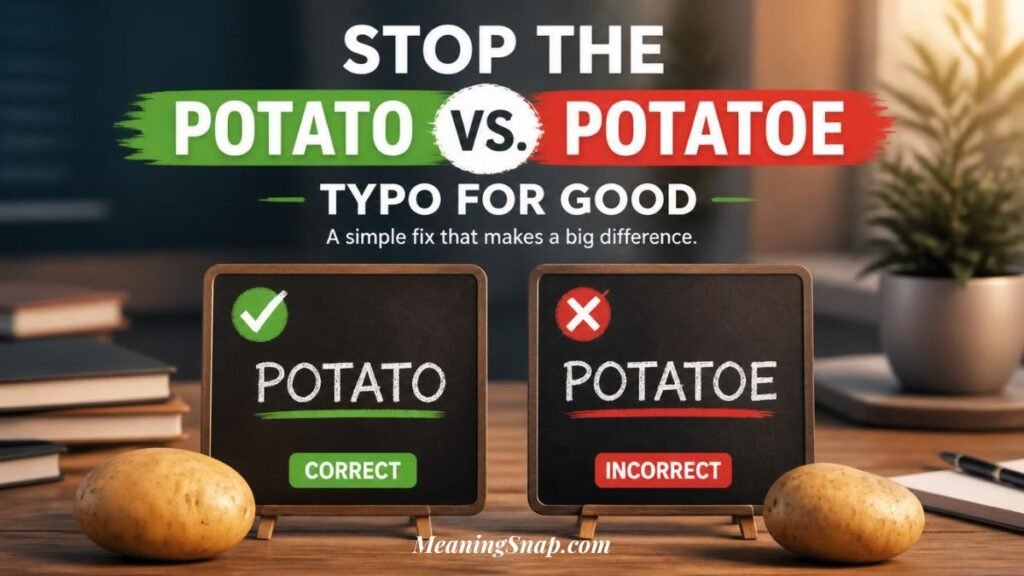
Memory tricks help, but a quick setup works while you type on autopilot. Three fixes take about two minutes.
- On your phone, add a text replacement shortcut so “potatoe” turns into “potato.” Set it to match the whole word, so “potatoes” stays untouched.
- In your word processor, add an AutoCorrect entry for the same swap, and add “potatos” to fix the other wrong plural.
- Before you send a long draft, run find and replace for “potatoe” and “potatos.”
These fixes handle the wrong spellings, but they miss slips made with real words, like “one potatoes” or a stray apostrophe. Only a read-through catches those. Ask yourself one question per sentence: how many potatoes are we talking about?
Potato vs Potatoe: Memory Tricks and a Quick Self-Test
Two tricks help you decide on your own next time.
- The toes trick. The plural ends in “toes.” Dictionary.com offers the same hint. Potatoes have toes, and a single potato has none.
- The count test. Count the items. One item, no e. Two or more, add es. If nothing belongs to the potato, skip the apostrophe too.
Now the quiz. Pick the right form for each sentence, then check the answers below.
- I peeled one (potato / potatoe) for the soup.
- She packed three (potatos / potatoes) for the trip.
- The (potatoes / potato) salad was gone in ten minutes.
- All four (potatoes’ / potato’s) skins were thin.
- My cousin is a total couch (potatoe / potato).
Answers: 1 potato, 2 potatoes, 3 potato, 4 potatoes’, 5 potato. Five out of five means you’re set.
Where “Potato” Comes From
English borrowed the word from Spanish “patata,” which Merriam-Webster and Oxford Learner’s trace to the Taíno word “batata,” meaning sweet potato. Merriam-Webster dates the first known English use to 1565. Wordorigins.org, which draws on the Oxford English Dictionary, places the earliest example in an account of John Hawkins’s 1564 to 1565 voyage. It also notes the final o appears in the earliest English examples. Spain’s dictionary, per the same page, calls “patata” a blend of Taíno “batata” and Quechua “papa.” Merriam-Webster also lists “spud” as another name for the vegetable, a nickname with no e to worry about.
Did You Know: The first English record of “potato” described the sweet potato, not the white one. Oxford Learner’s says the word took its current sense in the late 1500s.
Nothing in the dictionary histories I checked points to a singular “potatoe.” The word has always ended in o, and the e only ever joined the plural.
Potato vs Potatoe and the 1992 Spelling Bee Moment
Here’s a story worth knowing. On June 15, 1992, at a school in Trenton, New Jersey, a 12-year-old named William Figueroa spelled “potato” correctly on the board. Vice President Dan Quayle, who was leading the spelling bee, told him to add an e, according to UPI and BuzzFeed News.
UPI reported the same day that reporters checked Quayle’s cue card and found “potatoe” printed on it. Mental Floss adds the card came from the school. Quayle later called the episode, in his memoir, “a defining moment of the worst imaginable kind,” as quoted by The Washington Times. Figueroa told BuzzFeed News decades later the day turned out better for him than for the vice president.
The takeaway for spelling is plain. Even a printed card gets it wrong sometimes, so a dictionary beats memory. The moment keeps resurfacing as a joke: The Christian Science Monitor revisited it in 2010, and Kyff’s 2025 column opens with it.
Read More: How-To vs. How-Tos: Which One Is Correct?
FAQs
Is “potatoe” ever correct?
No. Merriam-Webster, Oxford Learner’s, and Dictionary.com list only “potato” for the singular.
Is the plural “potatoes” or “potatos”?
It’s “potatoes.” “potatos” is an invalid spelling.
Is “potatoe” a British spelling?
No. British usage, as shown in Oxford Learner’s and Collins, matches American usage.
Is it “tomato” or “tomatoe”?
It’s “tomato,” with the plural “tomatoes.”
Why do “photos” and “pianos” skip the e?
They fall into exception groups: a shortened word and a music term.
Did Dan Quayle truly tell a student to add an e to “potato”?
Yes. UPI and BuzzFeed News both reported it from the June 1992 event in Trenton.
What does “potato, potahto” mean?
It signals a trivial difference, as in “call it what you like.” The phrase comes from a 1937 song, per Grammarist.
Potato vs Potatoe: One Rule to Keep
Next time your thumbs stall over a grocery list, count the items. One item gets “potato,” with no e. Two or more get “potatoes,” and the e arrives with its toes. Skip the apostrophe unless something belongs to the potato. That’s the whole potato vs potatoe story, and it fits in a single breath.

Alex Morgan is a writer focused on explaining slang, words, phrases, acronyms, and popular expressions in a simple and easy-to-understand way. Through clear explanations and helpful examples, Alex helps readers quickly understand what words and phrases mean and how they’re commonly used.