You’re filling out a help desk ticket at work. One field says “Requester.” The template your coworker sent says “Requestor.” Now you’re staring at the screen, wondering if somebody made a typo.
Here’s the short version. Requester or requestor both work, and both mean a person who makes a request. Requester is the standard dictionary headword, so it’s the safer default. Requestor is a recognized variant that dictionaries list as an alternative. If a form or system already uses one spelling, match it.
That’s the whole answer. The details still matter when you’re writing emails, tickets, contracts, or school papers, so this guide covers what the dictionaries say, where each spelling shows up, how plurals and apostrophes work, and a quick test you can use next time.
Requester or Requestor: The Short Answer
Four major dictionaries cover this pair, and none of them calls either spelling wrong. Merriam-Webster treats requester as the main entry, defines it as one who makes a request, and shows requestor as a variant spelling. Dictionary.com lists the pair the same way and calls requestor a variation of requester. Cambridge gives requester as the headword and puts requestor beside it as an alternative form.
Collins is the strictest of the group. It describes requestor as a rare spelling of requester.
Put that together, and the verdict is simple. Requester is the standard form. Requestor is accepted but less common. Choosing between requester and requestor is a spelling preference, not a grammar rule.
Read Also: How-To vs. How-Tos: Which One Is Correct?
What Does Requester or Requestor Mean?
Both words name the person, group, or system that makes a request. Merriam-Webster defines requester as one who asks something of another. Dictionary.com says it can be a person or an organization. Cambridge words it a bit more narrowly, as someone who asks to see or have something, such as an official record or document.
In daily life, the requester can be anyone. A customer asking for a refund counts. So does a student asking a teacher for a recommendation letter, a coworker asking for access to a shared folder, or a resident asking a city office for records. Whichever you write, requester or requestor, the meaning stays the same.
The word isn’t new, either. Merriam-Webster dates the first known use of requester to 1564, and Collins traces request back to Old French requeste.
Why English Has Two Spellings
English builds most agent nouns, the words for people who do an action, with either -er or -or. Grammarians say -er is the standard ending, while -or is mainly for words that come straight from Latin. Teach becomes teacher. Prosecute, which comes from Latin, becomes prosecutor.
Request reached English through Old French, so requester follows the usual -er pattern. Requestor borrows the Latin-style -or look.
This kind of split isn’t rare. Adviser and advisor are another pair. Merriam-Webster’s usage note says both spellings go back to the 1500s, and even the US government uses both: a National Security Advisor on one hand and a Council of Economic Advisers on the other. Requester and requestor are a smaller version of the same story.
Speech won’t help you choose, because the two spellings sound alike. Cambridge shows requester as ri-KWES-ter, and Merriam-Webster respells requestor the same way. The last syllable is unstressed in both words, so the vowel before the r shrinks to a soft, quick sound that listeners can’t tell apart. That’s why this pair only becomes a question when you write it down.
Read Also: That’s Mean vs. That Means: What’s the Difference?
Is Requester or Requestor More Common in the US and UK?

Dictionaries put requester first in both countries. Merriam-Webster and Dictionary.com, both American, list requester as the main entry. Cambridge and Collins, both British publishers, do the same. Cambridge gives requestor as an alternative, and Collins calls it rare.
You’ll find websites that call requestor the British spelling. The dictionary evidence is thinner than that. Collins lists requestor as a rare spelling of requester in its British English entry, and Cambridge lists it as another form with no country label. Treat requestor as a rare variant, not a UK rule.
How common is each, exactly? Usage counts depend on which collection of text you search and which years you cover, so be wary of any site that quotes a precise percentage without naming its source. The dictionary labels give you the dependable takeaway. In both countries, requester or requestor is a choice between the standard form and the less common one.
Requester or Requestor in Legal, Business and Technical Writing

A popular claim says legal and technical writing prefer requestor. The evidence doesn’t back a clean rule. The US Freedom of Information Act, codified at 5 U.S.C. § 552, uses requester throughout, including in its rules about fees. Amazon’s Mechanical Turk documentation uses Requester for the company, organization, or person who posts tasks. Meanwhile, contract and policy definitions collected on Law Insider include both spellings, and some data-use agreements there define a Requestor.
So no rule says legal writing needs requestor, and no rule says business writing needs requester. Each organization picks a spelling and keeps it. Your job is to notice which one the document in front of you already uses.
Official Forms and System Labels
Labels are the one place where you shouldn’t choose. Oracle’s PeopleSoft documentation, for example, calls the screen the Requester Setup page, while the component behind it carries the name REQUESTOR_TBL. Teams set field names, database tables, and form labels once and then copy them for years.
If a form says Requestor, write Requestor whenever you point to that field, even if you’d use requester in your own sentences. Readers need to find the exact word on their screen.
Is Requestor More Formal?
None of the dictionaries above label requestor as formal. Merriam-Webster and Cambridge treat it as a variant or alternative, and Collins calls it rare. Because the -or spelling turns up in some contracts and forms, it can look official. That says something about those organizations’ habits, though, not about a formality rule in English. In an email, a text, or a school paper, requester reads just as well in a formal tone.
Read Also: TGIF Meaning in Text: The Real Definition, Uses, Examples & Social Media Guide (2026)
Requester or Requestor in Real Sentences
Here are seven sentences, one for each place you’re likely to need the word. Both spellings fit any of them, so use requester or requestor to match whatever your document already uses.
- Text message: “Tell the requester I’ll send the file by five.” In a casual message, the spelling dictionaries list first keeps things simple.
- Work email: “I’ve passed your note to the team and will update the requester once the budget is approved.” The requester is the person who asked, so the update goes back to them.
- Support ticket: “The requester gets an automatic email when the ticket closes.” Every ticket has someone who asked for help, and that person is the requester.
- School: “In our research methods class, the library was the requester and we were the survey team.” The word works for organizations as well as people, as Dictionary.com notes.
- Social caption: “Day three as the unofficial snack requester for the whole team.” A playful tone doesn’t change the spelling.
- Form field: “Enter your department in the Requestor field, then submit the form.” The form uses the -or spelling, so the sentence copies it.
- Government: “The requester asked the agency to waive the copying fees.” This uses the same word as the federal FOIA statute.
Requester or Requestor: Correct, Incorrect and Why
Here are four slips to watch for, each with a fix.
| Correct | Incorrect or Avoid | Why |
|---|---|---|
| Please reply to the requester by Friday. | Please reply to the requestee by Friday. | The requestee is the person being asked. Use requester for the person who asked. |
| The requestor logs in, and the requestor’s manager approves. | The requester logs in, and the requestor’s manager approves. | Both spellings are fine, but switching inside one document looks like a typo. |
| Select “Requestor Name” (the form’s own label). | Select “Requester Name” on a form that says Requestor. | Copy an official label exactly so readers can find the field. |
| Leaving a colleague’s “requestor” as written. | Marking “requestor” as a spelling error. | Cambridge, Merriam-Webster and Dictionary.com all list it. |
Read Also: WYG Meaning in Text: What It Means & How to Reply
Requester or Requestor: Plural and Possessive Forms
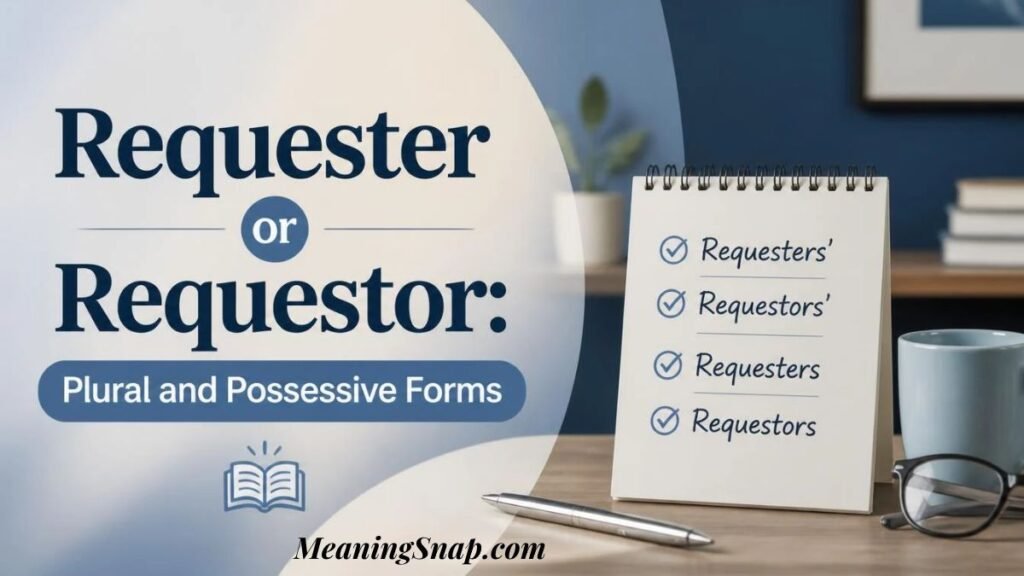
Both words follow the same pattern, so only the spelling changes. Add an s for the plural. For ownership, add an apostrophe and an s to a singular noun, or just an apostrophe to a plural noun that ends in s. The Chicago Manual of Style lays out this pattern, and the AP Stylebook agrees on the plural half of it. The table below shows all four forms.
| Form | Requester | Requestor | Example |
|---|---|---|---|
| Singular | requester | requestor | The requester replied. |
| Plural | requesters | requestors | Both requesters replied. |
| Singular possessive | requester’s | requestor’s | The requester’s ticket is open. |
| Plural possessive | requesters’ | requestors’ | The requesters’ tickets are open. |
The classic slip is adding an apostrophe to a plain plural. Ask yourself whether anything belongs to the requester. If nothing does, you need only an s.
Synonyms for Requester or Requestor
Sometimes the cleanest fix is a different word. Thesauruses list petitioner, applicant, claimant, asker, inquirer, and seeker as near matches. Some even list requestor as a synonym of requester, which shows how close the two spellings sit. Still, each synonym carries its own setting.
- Applicant: someone asking for a job, a permit, a loan, or a spot at a school.
- Claimant: someone asking for something they say they’re owed, such as an insurance payout.
- Petitioner: someone making a formal appeal to an authority, often in legal settings.
- Inquirer: someone asking for information rather than an action.
- Asker: the casual, everyday option, best in conversation.
- Customer or client: someone asking for a product or service in a business setting.
Skip the swap when a template expects a specific word. An applicant won’t fit in a ticketing tool that has a Requester field.
Requester or Requestor vs Requestee
Requestee covers the other side of the exchange. A requester asks. A requestee is the person being asked. Wiktionary defines it as a person from whom something is requested, and contract templates use it the same way, often next to Requestor or Requester.
The ending does the work. Grammarist explains that -ee usually marks the person who receives an action, and employee, paired with employer, is the classic case.
Here’s how it looks in a sentence: “The requester sent the form, and the requestee has ten days to reply.” If your readers might not know the word, add a short definition the first time it appears.
Read Also: PSA Meaning in Text: What Does PSA Mean in Chat? (Updated 2026)
How to Choose Between Requester or Requestor

Use this quick test whenever you’re stuck.
Memory Trick: Think “request, requester,” the same way you’d say “bake, baker.” First, check whether the form, system, or contract already uses a spelling. If it does, copy it. If it doesn’t, write requester. Then keep that spelling from the first line to the last.
If your company or school has a style guide, follow it before anything else. A style sheet settles the question for everyone on the team, and it keeps the spelling steady across documents.
Test Yourself: Requester or Requestor?
Try these four checks. Each answer follows its question.
- You’re emailing a coworker about your own project. Which spelling do you pick? Requester, since no label makes the choice for you.
- The form you’re quoting says “Requestor ID.” What do you write? Requestor ID, because you copy the label.
- A page lists three people who asked for the same file. What’s the plural? Requesters, with no apostrophe, since nothing belongs to them.
- A colleague writes “requestor” in a draft. Do you change it? Not as a correction. It’s an accepted variant, so only change it if your team has agreed on one spelling for the document.
FAQs
Is requestor a real word?
Yes. Major dictionaries list it as another spelling of requester, though it’s the less common one.
Is requester or requestor correct in British English?
Both appear in British dictionaries. Requester is the default, and Collins calls requestor rare.
Which spelling should I use in a client email?
Use requester unless the client’s own form or system uses requestor. In that case, match theirs.
What is another word for requester?
Applicant, petitioner, claimant, asker, and inquirer all work, depending on the setting.
Can I use both spellings in one document?
Avoid it, because the switch looks like a typo. The exception is quoting a label or title that uses the other spelling.
What is the difference between a requester and a requestee?
They sit on opposite sides of the same request. One sends it, and the other receives it.
Requester or Requestor: Pick One and Stay With It
Next time you hit requester or requestor, run through the test. Check for a label to copy, default to requester when nothing’s set, and keep the same spelling to the end. That’s the whole habit. Readers won’t count your -er and -or endings, but they will notice when a ticket, a contract, or an email switches spelling halfway through. Do it once, and you’ll rarely have to think about it again.

Alex Morgan is a writer focused on explaining slang, words, phrases, acronyms, and popular expressions in a simple and easy-to-understand way. Through clear explanations and helpful examples, Alex helps readers quickly understand what words and phrases mean and how they’re commonly used.