A soldier and your friend who hasn’t answered a text since Tuesday share the same three letters. That odd overlap is the whole story behind the MIA meaning in text.
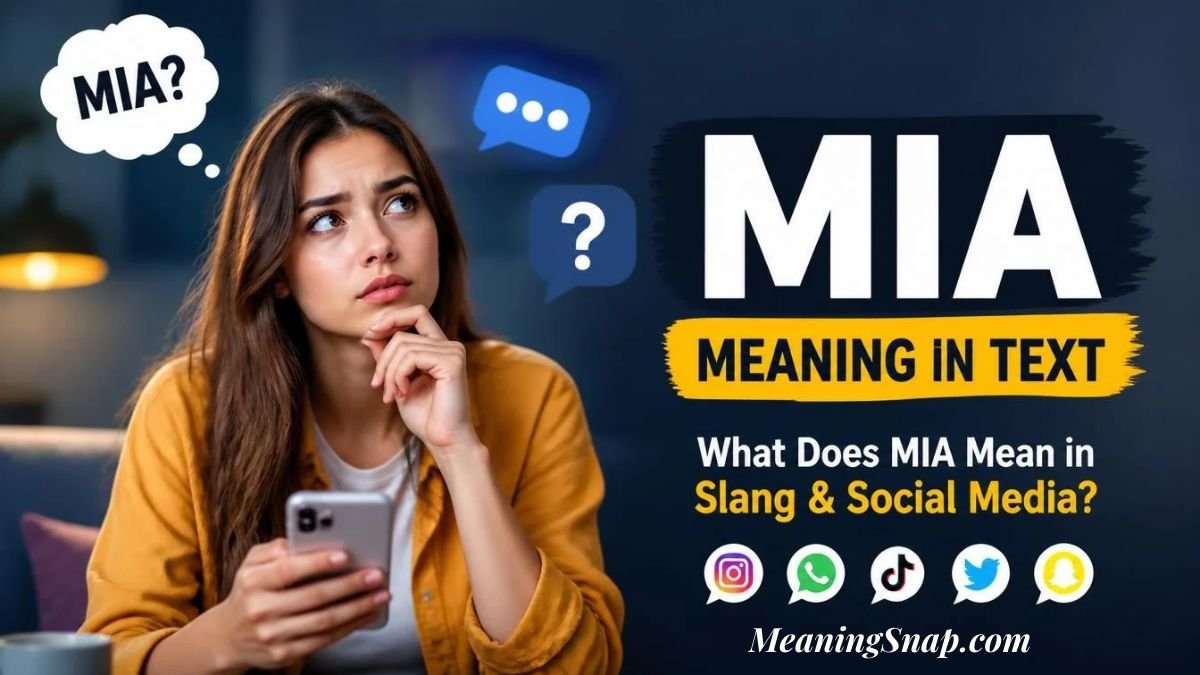
You see “you’ve been MIA lately” pop up in a chat and freeze for a second. Is it a joke? A complaint? A gentle check-in? The short answer: MIA stands for “missing in action,” and in text it means someone has gone quiet or isn’t showing up where they should. Tone does the rest. This guide covers what MIA means in chat and on social media, where it comes from, how to reply, and when it’s smarter to skip it. You’ll also see what the other MIAs mean, from a KATSEYE song to a medical term.
MIA Meaning in Text: The Short Answer
In text, MIA means “missing in action.” It describes a person or thing that has vanished from the place you expected to find it. That place might be a group chat, a video call, a class, or your Instagram feed.
Here’s the thing: the phrase never explains why. Someone who’s MIA might be buried in work, offline for the weekend, dodging a conversation, or just bad at replying.
Dictionaries back up the everyday sense. Merriam-Webster describes the figurative use as someone or something notably or unexpectedly missing, absent, or inactive. Dictionary.com frames it as being absent in a way that’s noteworthy or surprising. Those words matter. People say MIA when they expected to hear from someone and didn’t.
The MIA meaning in text stays the same on WhatsApp, iMessage, Discord, and in comment sections. Only the setting changes. You’ll spot three common patterns:
- About someone else: “Where’s Dana? She’s been MIA since Monday.”
- About yourself: “Heads up, I’ll be MIA until my exams end.”
- About an object: “My charger is MIA again.”
Where the MIA Meaning in Text Comes From
MIA began as a military casualty category. A service member listed as missing in action is unaccounted for after combat, and officials haven’t confirmed whether the person is alive, captured, or dead. The label describes a status, not a verdict. Merriam-Webster dates the first known use of MIA to 1944, which places it in the middle of World War II.
Did You Know: The Defense POW/MIA Accounting Agency, part of the U.S. Department of Defense, still works to recover and identify missing service members from past conflicts. The original meaning is far from a history lesson.
Over time, people borrowed the three letters for everyday absences. A skipped meeting, an unanswered text, a missed study session, all got the same label minus the tragedy. No reliable source pins that shift to one moment or one platform. The jump from battlefield to group chat happened gradually, the way most slang travels.
That history explains why some people wince at casual use. For a family waiting on news about a loved one in uniform, MIA is no joke. Keep that in mind around veterans and military families.
Read Also: TMI Meaning: What It Stands For and When to Use It
MIA Meaning in Text: Real Chat Examples
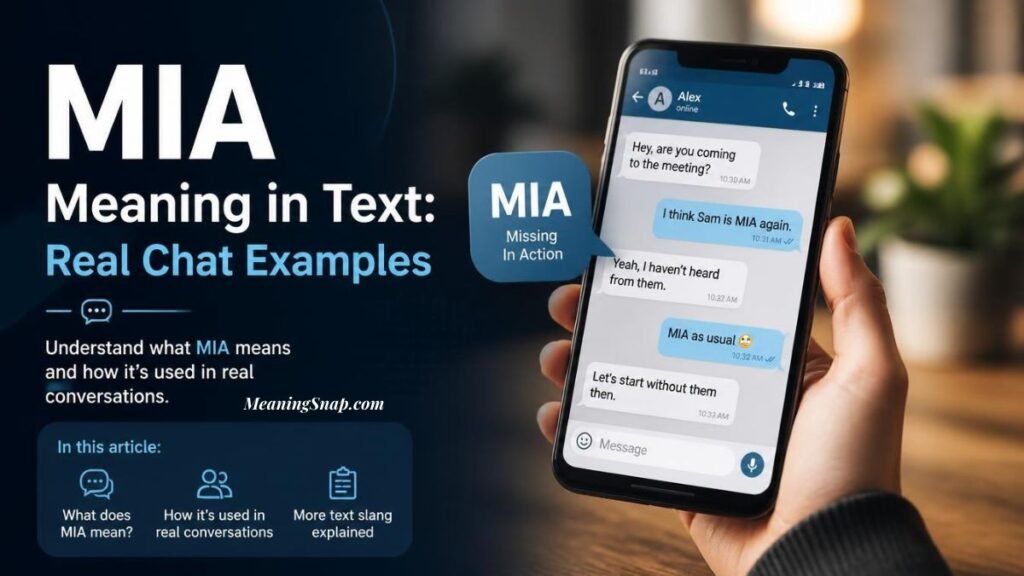
Tone decides everything with this term. Here are six chats, each with a different mood.
Playful nudge
Maya: You’ve been MIA all weekend. Did you move to Mars?
Jordan: Phone died, and I let it stay dead.
Maya’s joke is a friendly poke. She missed Jordan and said so lightly.
Sarcastic complaint
Leo: We picked the restaurant two days ago. Chris has been MIA ever since.
Nia: He’ll show up when the bill arrives.
Leo’s grumble is half joke, half real. Nia’s sarcasm shows the group knows Chris well.
Polite heads-up
Sam: Quick note, I’ll be MIA this week. Finals are eating me alive.
Ari: Good luck! Text me when you surface.
Sam warns people before going quiet. This is the most considerate way to use the word.
Sincere check-in
Tess: You’ve been MIA for three days. Everything okay?
Rob: Rough week. I should have said something.
Tess uses MIA as a doorway, not an accusation. The question after it carries the real message.
Frustrated
Priya: The slides are due at 9 a.m., and Marcus is still MIA.
Dev: I’ve called him twice. Nothing.
A deadline turns a casual label into a complaint. The stress shows in “still.”
Teasing welcome-back
Ben: Look who’s back! I thought you went MIA for good.
Lily: Ha, still here. Work ate my whole month.
Ben teases, with some relief behind the joke. Lily answers with a one-line reason, which is exactly what a good reply does.
MIA Meaning in Text vs Ghosting, AFK, and AWOL
These four get mixed up constantly. This table separates them by what they describe and how they sound.
| Term | What it means | Done on purpose? | Typical tone |
|---|---|---|---|
| MIA | Gone quiet or absent, reason unknown | Not necessarily | Playful to worried |
| Ghosting | Cutting off contact with no explanation | Yes | Hurt, serious |
| AFK | Away from keyboard, usually for a short time | Rarely a message at all | Neutral |
| AWOL | Absent without permission | Implies breaking a rule | Sarcastic, critical |
Spotting the difference in real life comes down to pattern. One unanswered message during a busy day is an MIA moment. Several days of silence after you’ve asked directly, while the person keeps posting elsewhere, starts to look like ghosting. Even then, you’re guessing. A short, direct message beats a theory.
Calling someone MIA is also the gentler move. It leaves room for a good reason, which makes it a safer first word than “ghost.”
Read Also: ML Meaning in Text: What It Stands For and How to Reply
MIA Meaning in Text From a Friend, Partner, or Crush
Between friends, “you’ve been MIA” is mostly affection in disguise. It means I noticed you were gone.
With a partner or a crush, the same phrase carries more weight. It can be a sweet way to say “I missed you.” It can also be a soft opening for a harder talk about someone who keeps going quiet.
Gender doesn’t change the meaning. A text from a guy, a girl, or anyone else saying you’ve been MIA means the same thing. What shifts the message is context: how long the silence ran, how close you two are, and whether it’s a pattern.
Tone clues help. “Long time no see, you’ve been MIA 😂” reads light and teasing. “You’ve been MIA.” with a period and nothing else reads cooler, and a quick reply is smart.
If a partner uses it, treat it as a real signal even when they wrap it in a joke. Answer the feeling behind the word, not just the word.
MIA Meaning in Text at Work and School
Office slang loves MIA. A coworker who’s silent on Slack, a missing file, a server that won’t respond. All MIA. Between teammates, it’s casual and friendly.
Emails to managers, clients, or professors are different. Swap in plain wording such as “unavailable,” “unreachable,” or “out of office.” The same goes for official documents, where “MIA” can read as a military reference.
Naming a coworker as MIA in a big group channel can also feel like public blame. A private message lands better: “Hey, I haven’t seen your update yet. All good?”
School works the same way. Group-project chats are full of MIA, usually with a deadline attached. Between classmates, it’s fine. In a note to a teacher, say “absent” or “unable to reach.”
MIA Meaning in Text on Instagram, TikTok, and WhatsApp
The meaning stays put on every platform. What changes is the audience. This table shows how it tends to appear on each one.
| Platform | How MIA shows up | Example |
|---|---|---|
| Captions or Stories after a posting break, plus comments checking in | “Back after being MIA for a month. Miss me?” | |
| TikTok | Creators returning from a gap, and comment sections asking where they went | “Sorry I went MIA, here’s what happened” |
| Group chats and direct messages nudging quiet members | “This group has been MIA since Friday” |
Public posts usually flip the script. On Instagram and TikTok, people tend to use MIA about themselves, as a way to explain a break to followers. On WhatsApp, it’s more often a private nudge aimed at someone else.
None of the dictionaries or reference sources checked for this guide list a platform-specific definition. Treat any claim of a TikTok-only or Instagram-only meaning with caution.
How to Reply When Someone Says You’re MIA
A good reply is short, honest, and specific. Pick the one that matches your situation.
- You were just busy: “Sorry, work swallowed my week. Free this weekend?”
- It was a light tease: “Ha, I’m alive! Life got loud. What did I miss?”
- You needed space: “I needed some quiet, but I’m back. Sorry I went silent.”
- It was a worried check-in: “I’m okay, thanks for asking. I should have said something.”
Give one line of explanation, then move forward with a plan or a question. Long apologies make a small moment feel bigger than it was. If the person sounded hurt, answer the hurt first and the joke second.
MIA Full Form and Other Meanings Beyond the MIA Meaning in Text
MIA stands for different things depending on the field. This table lists the ones that appear in reputable references.
| Full form | Where you see it | How it’s classified |
|---|---|---|
| Missing in action | Chat, news, military history | The main meaning, listed first in dictionaries |
| Master of International Affairs | University program names | Niche, education |
| Minimally invasive adenocarcinoma | Lung pathology reports | Technical, medical |
| Miami International Airport code | Flight tickets and bag tags | Technical, travel |
The medical entry trips people up when they search “MIA meaning disease.” It’s a pathology term for a small, early-stage type of lung tumor in the World Health Organization’s classification system. It has no link to the slang. If you spot it in your own report, your doctor is the right person to explain what it means for you.
Searchers also ask about police. MIA is a military label, not a police one. When a civilian is truly missing, the term is “missing person,” and the move is to contact local police.
MIA Meaning in Text vs the KATSEYE Song, Spanish “Mía,” and Other Look-Alikes
Same letters, different things. Here’s how to tell them apart.
KATSEYE released a track called “M.I.A.” on their EP Beautiful Chaos on June 27, 2025. The title plays on the slang. Fan write-ups read the song as being about vanishing on your own terms, though you should give it a listen and decide for yourself. If a friend texts “listening to M.I.A,” check whether they mean the song. The British artist M.I.A. is another possibility.
In Spanish, “mía” is the feminine form of “mine,” and it shows up in the idiom “madre mía.” Italian has “mia” too, meaning “my” or “mine” for feminine nouns. Mia is also a popular first name, which is why a text like “Mia is coming tonight” has nothing to do with absence.
Capital letters and context solve most mix-ups. All caps next to words like “been,” “went,” or “still” signals the slang. A capital M followed by lowercase letters usually signals the name.
Read Also: IGH Meaning in Text: What It Means, How to Use It & Real Chat Examples
When to Skip MIA in Text
A few situations call for plainer words.
If someone is unreachable and you’re worried about their safety, drop the joke. Call them, message a family member, and contact local police if the concern is serious. “MIA” in a group chat won’t help anyone find a person who needs help.
The same goes for someone who went quiet after bad news. A warm, direct message works better than a label.
And if the same person goes quiet again and again, saying “you’re always MIA” turns a joke into a jab. Name the actual problem instead: “I’ve felt out of the loop lately. Can we catch up?”
Frequently Asked Questions
Can I use MIA to describe myself?
Yes. “I’ll be MIA this week” is a polite way to warn people before you go quiet.
Is MIA rude or negative?
It depends on tone. With emojis and a smile, it’s teasing, and with a deadline attached, it’s a complaint.
Does MIA always mean something bad happened?
No. Most of the time the person is busy, offline, or distracted, and the word only turns serious when someone is truly missing.
Should MIA be written with periods?
In everyday text, MIA works without them. Grammarist notes the acronym is rendered without periods, though the KATSEYE song title uses M.I.A.
What’s the difference between “is MIA” and “went MIA”?
“Is MIA” describes the current state, as in “he’s MIA right now.” “Went MIA” describes the disappearance itself, as in “she went MIA after the party.”
Can MIA describe objects too?
Yes. Merriam-Webster notes it applies to someone or something, so a lost charger, a missing file, or a server that won’t answer can all be MIA.
Using MIA in Text Without the Awkwardness
Use MIA about yourself when you want to warn people before a quiet stretch. Use it about others only when you know the person well enough for the joke to land. When your gut says something is wrong, skip the slang and send a real message. One honest line from you will do more than any three-letter label.

Alex Morgan is a writer focused on explaining slang, words, phrases, acronyms, and popular expressions in a simple and easy-to-understand way. Through clear explanations and helpful examples, Alex helps readers quickly understand what words and phrases mean and how they’re commonly used.