You’re typing an Instagram caption about a song that hit you right in the chest. Your thumbs stop. Does that lyric resignate with you, or resonate with you? The resignate or resonate question trips up careful writers because the two words look like cousins.
Here’s the thing: they aren’t related. One deals with sound and feelings. The other deals with quitting a job. This guide sorts out which one you want, why the mix-up happens, and how to choose in two seconds.
The short answer to resignate or resonate is simple. Write resonate when something strikes a chord with you or echoes like sound. Resignate isn’t a misspelling of it. It’s a rare word tied to resigning, and it never describes feelings or sound.
Resignate or Resonate: The Quick Comparison
This table puts the right and wrong versions side by side.
| Sentence | Verdict | Why |
|---|---|---|
| That speech resonated with the whole class. | Correct | Resonate covers a message that connects with people. |
| That speech resignated with the whole class. | Incorrect | Resignate never describes a feeling or a connection. |
| Her laugh resonated through the hallway. | Correct | Resonate also covers sound that carries and lingers. |
| He resigned from the team on Friday. | Correct | Resign means to quit a position. |
| He resignated from the team on Friday. | Avoid | Resignate is obsolete in the plain “resign” sense, and the newer slang changes the meaning to “forced out.” |
Meaning decides every row of the resignate or resonate table. If your sentence is about a feeling or a sound, resonate wins. If somebody leaves a job, resign wins. The sections below explain where resignate fits and how to dodge the trap.
You Also Like: Requester or Requestor: What Is the Difference & Which Is Correct?
What “Resonate” Means
Start with resonate, the side of the resignate or resonate pair you’ll use. It has two layers, and both start with sound. The first is literal. A sound resonates when it carries, deepens, or lingers in a space, like a low note in a stairwell. Merriam-Webster also lists a related sense where one thing responds to another as if by resonance, the way a guitar string hums when someone plays a nearby note.
The second layer is the one you see in captions, reviews, and meetings. Merriam-Webster defines it as affecting or appealing to someone in a personal or emotional way, as in a message that resonates with voters. Oxford puts it a little differently. Something resonates when it reminds you of something or matches what you already think or believe.
The history explains why the word works that way. Oxford and Dictionary.com both trace it to Latin resonare, “to sound again.” Think of it this way: a good line echoes in your head after you hear it. The feeling comes back the way a sound does.
Resonate Meaning in Literature
Book talk uses both layers. Reviewers say a novel resonates with readers when it stays with them after the last page. Oxford also labels a literary sense, where something resonates with a quality or feeling, which means that quality fills it. In that sense, a scene can resonate with loneliness: the empty kitchen in chapter two is full of it, even if no character says a word.
How to Pronounce Resonate
Say REZ-uh-nayt. It has three syllables, and the stress lands on the first one. Oxford gives the same pronunciation for US and UK speakers. Resign sounds different: ri-ZYNE, with the stress on the second syllable and a long “i.” Say both aloud and the gap is easy to hear.
You Also Read: Rapport or Repore? The Correct Spelling Explained
Is “Resignate” a Real Word?
Narrowly, yes. The resignate or resonate debate often starts with that question. But resignate isn’t the word you want for feelings, and its story has two separate chapters.
The first chapter is old. The Oxford English Dictionary has an entry for resignate. Language Log, a linguistics blog, pointed out in December 2020 that the older entry labels the word obsolete, glosses it as plain “resign,” and offers a single example from 1692. Resign and resignate both trace back to Latin resignare, which Oxford translates as “unseal” or “cancel.”
The second chapter started in 2020. Turns out the word came back. NPR reported on a woman who said Google forced her out of her job, and “resignated” turned up in the coverage. Language Log’s Sally Thomason defined the new use as forcing someone to resign, matching Urban Dictionary’s entry. She called it a back-formation from “resignation,” built the way people get “designate” from “designation.” She also judged it a fresh coinage, not a continuation of the 1692 word.
Where does that leave you? Treat resignate as rare and informal. A search of Merriam-Webster’s online dictionary turned up the related noun resignatary but no entry for resignate. So in the resignate or resonate decision, resignate loses unless you mean the 2020 slang on purpose.
Did You Know: The same word shows up 328 years apart with two different meanings. In 1692 it meant “resign.” In 2020 it meant “force someone to resign.” Language Log’s author called the modern use a new creation rather than a revival.
Is “Resignated” a Word?
It’s the past tense of the same verb, so it has the same status: rare and informal. You’ll see it in the 2020 “forced to resign” sense, as in “she was resignated.” In formal writing, say “forced to resign” or “pushed out” so readers who’ve never met the word still follow you. If someone simply quit, the past tense is resigned.
Why the Resignate or Resonate Mix-Up Happens
Two patterns do most of the damage.
The first is the shared frame. Both words start with “res,” end in “nate,” and run three syllables. When you skim a word you only half know, your eye fills in the middle.
The second is pattern pressure. English turns “-ation” nouns into “-ate” verbs all the time, like designation and designate. Resignation sounds like it should give you resignate. That’s the same back-formation logic Language Log spotted in the 2020 revival.
Work writing adds a third nudge to the resignate or resonate mix-up. Resonate lives in marketing decks and business news, while resign lives in HR notices. A writer rushing through a work email can grab the wrong one.
Resonate With Someone: How the Phrase Works
Once you’ve picked resonate in the resignate or resonate choice, the next question is the helper word. Resonate usually needs “with.” Merriam-Webster’s learner’s entry and the Britannica Dictionary both mark the “with” pattern as the usual one. The thing doing the connecting goes first. The person it reaches goes after “with.”
This table shows the patterns you’ll meet most often.
| Pattern | What it means | Example |
|---|---|---|
| resonate with + person | An idea connects with someone | The advice resonated with new parents. |
| resonate with + quality | Something is full of a feeling | The letter resonates with gratitude. |
| resonate through + place | A sound carries across a space | The church bell resonated through the valley. |
| resonate to + sound | A thing responds to sound as if by resonance | The floor resonates to the bass. |
| resonate for + time | An effect lasts | The decision will resonate for years. |
Resonate Meaning in a Relationship
People use resonate to say two people click: shared values, similar humor, the same outlook. The word has no separate dating meaning. It’s the same idea of connection, aimed at a person. Merriam-Webster, Oxford, and Britannica all put a message, speech, or issue in the subject spot. So “her values resonate with mine” and “his story resonated with me” sit on safe ground.
You’ll also hear “I resonate with her” in casual talk. People understand it, but the dictionaries we checked don’t show that pattern. Pick the idea-first version for anything formal or edited.
Resignate or Resonate in a Sentence
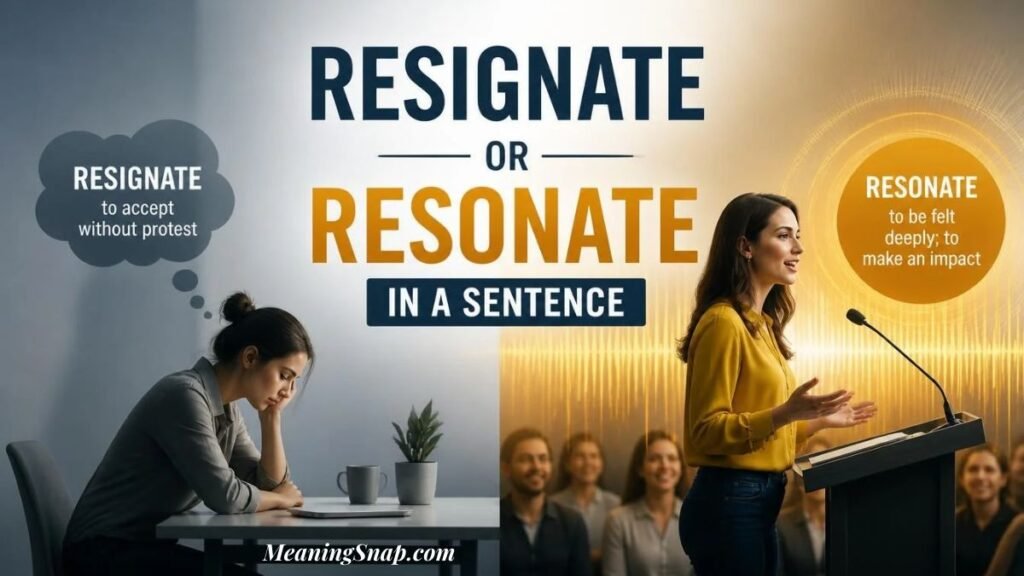
Here are five correct sentences first, then fixes for the resignate or resonate slip. Each one comes from a different setting.
- Text message: “That podcast episode on burnout resonated with me.” The episode is the subject, and you’re the person it reaches.
- Caption: “Some songs resonate long after the last note fades.” Here the word covers sound and feeling at once.
- School: “The poem resonated with me because I moved cities too.” A reader links their own experience to the text.
- Work email: “Our survey shows the new onboarding video resonates with new hires.” This is the business use, and it stays polite and neutral.
- Group chat: “The drums resonated through the whole gym.” That’s the pure sound sense, with no feelings involved.
Now the fixes. This table shows three wrong versions and how to repair them.
| Incorrect | Corrected | Why |
|---|---|---|
| This quote resignates with me. | This quote resonates with me. | Resignate has no feeling sense. |
| The coach’s pep talk resignated with the team. | The coach’s pep talk resonated with the team. | A message that connects needs resonate. |
| The CEO was resignated last week. | The CEO was forced to resign last week. | The 2020 slang is informal, so spell it out in news or business writing. |
Synonyms for Resonate and Resignate
Synonyms rarely match perfectly, but these swaps work in most sentences. They also show what each word is doing, which makes the resignate or resonate choice easier.
| Word | Swap in | Use when |
|---|---|---|
| resonate (feeling) | strike a chord, connect with | A message lands emotionally |
| resonate (sound) | echo, carry, reverberate | A sound lingers in a space |
| resign | quit, step down, leave | Someone gives up a position |
| resignate (2020 slang) | force out, push out | Someone gets pushed out of a role |
Resonate vs Resound and Reverberate
Once resignate or resonate is settled, two other near-neighbors can still trip you up. Merriam-Webster separates resonate from reverberate. Resonate usually suggests a single lasting sound, while reverberate suggests a sound followed by a string of echoes. Resonate also tends to involve a person, and reverberate tends to describe a thing, such as the aftermath of a major event. Dictionary.com calls the gap between resonate and resound subtle, so treat the table below as typical leanings, not strict rules.
| Word | Core idea | Typical subject | Example |
|---|---|---|---|
| resonate | A lasting sound, or a message that connects | Often reaches a person | The speech resonated with fans. |
| reverberate | A sound followed by echoes, or an event rippling outward | Usually a thing or event | The news reverberated across the industry. |
| resound | Filling a space with sound, or echoing back | The sound itself | Applause resounded in the hall. |
Resonate Meaning in Chinese
English learners who tackle resignate or resonate often ask for a translation, and Chinese splits the layers across different words. WordReference’s English-Chinese dictionary and Wiktionary agree on the main one for feelings.
| Sense | Chinese | Pinyin | Fits |
|---|---|---|---|
| Connect emotionally | 共鸣 | gòngmíng | An idea resonating with an audience, as in 得到共鸣 (dédào gòngmíng) |
| Physical resonance | 共振 | gòngzhèn | A violin body or a bridge vibrating in response |
| Echoing sound | 回响 | huíxiǎng | A sound echoing through a hall |
A Quick Test to Pick the Right Word
Run the swap test. Replace the word with “strike a chord.” If the sentence still makes sense, you want resonate. Replace it with “quit.” If that works, you want resigned. The swap test settles most resignate or resonate doubts in under five seconds.
Now a memory trick. Resonate has “son” inside it, like sonic and sonar, so it points to sound. Resign has “sign” inside it, like signature. Both match their Latin roots: sonare means “to sound” and signare means “to sign” or “to seal,” according to Oxford.
Common Mistakes
Three slips cause real errors beyond the basic resignate or resonate swap.
Dropping “with.” “That song resonates me” skips the helper word the dictionaries pair with the verb. Write “That song resonates with me.”
Swapping resonate for resign. “I resonated from my position effective Friday” mixes up the verbs. Resonate never means leave, so write “I resigned from my position effective Friday.”
Using resonate as an adjective. “A resonate voice” needs the adjective form, resonant, as in “a resonant voice.” The noun is resonance.
Quick Questions About Resignate and Resonate
Is resignate a real word?
Yes, narrowly. The OED lists it as obsolete for “resign,” and a 2020 slang use means “forced to resign,” but neither covers feelings or sound.
What does “resonate with me” mean?
It means something connects with you emotionally or matches what you already think or feel. A song, a quote, or a piece of advice can all do it.
Can you say “I resonate with her”?
People say it in casual speech, and others understand it. Dictionary examples put the idea first, so “her story resonates with me” is the safer pick in polished writing.
Is resonate formal or casual?
It works in both. Oxford marks the sound sense as formal, while the “connects with you” sense runs through news and business writing, and plain conversation uses it too.
Which is correct, resignate or resonate?
Resonate, in any sentence about feelings, sound, or connection. Resignate is a rare word tied to resigning.
How do you spell resonate?
R-E-S-O-N-A-T-E, with the stress on the first syllable: REZ-uh-nayt. Resignate swaps the “o” for “ig,” which is the whole difference on the page.
Why doesn’t spellcheck catch resignate?
Spellcheck tests whether a word exists, not whether it fits your sentence. Since resignate has a dictionary entry, a tool may let it slide, so read the meaning twice.
Use Resonate Unless Someone Is Leaving a Job
Next time your thumbs stop over that caption, run the quick test. If “strike a chord” fits, type resonate and move on. If the sentence is about quitting, you want resign or resigned. And if you meet resignate in the wild, read it as rare slang for pushing someone out, not a typo for resonate.
For work emails, news posts, and anything a stranger will read, spell the idea out with “forced to resign.” Then the resignate or resonate choice takes care of itself: feelings and sound get resonate, and job exits get resign.

Alex Morgan is a writer focused on explaining slang, words, phrases, acronyms, and popular expressions in a simple and easy-to-understand way. Through clear explanations and helpful examples, Alex helps readers quickly understand what words and phrases mean and how they’re commonly used.