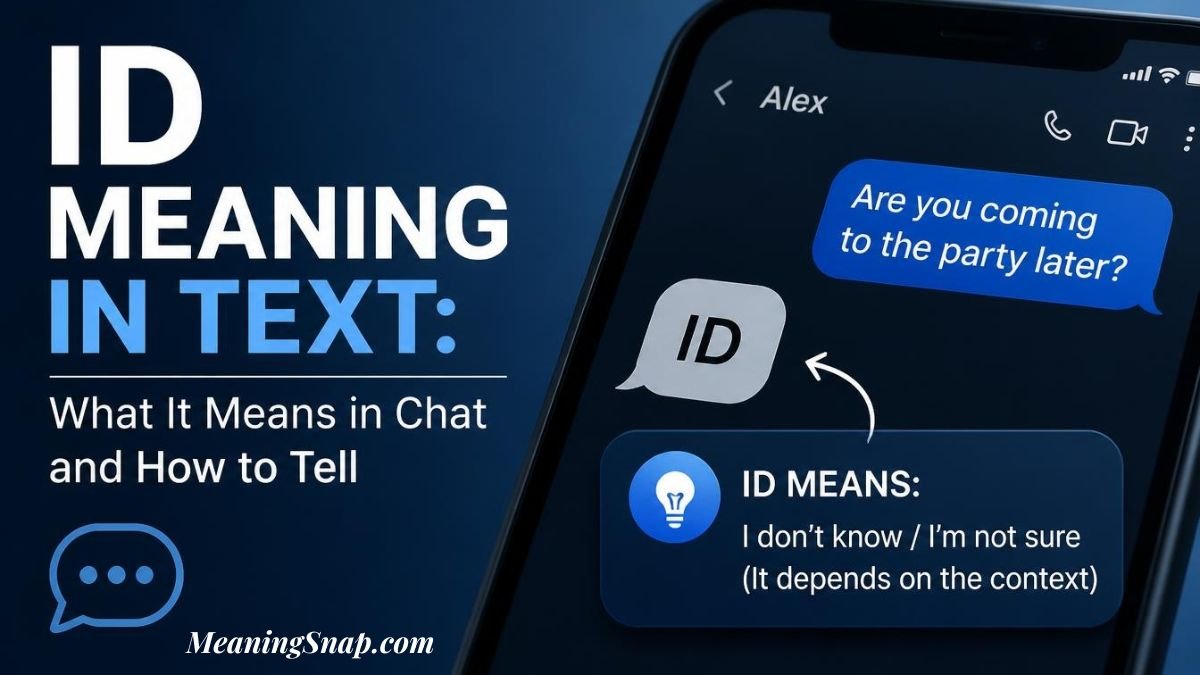
You post a clip from your weekend trip, and a stranger comments “ID?” with nothing else. Ten minutes later, a friend texts “id love to come.” Same two letters, two different messages. Here’s the thing: ID meaning in text shifts with the punctuation and the words around it.
The short answer is simple. ID meaning in text usually points to identification, like a photo ID card. “ID?” asks someone to name a song, outfit, or product. Lowercase “id” before a verb is I’d, meaning I would or I had, typed without the apostrophe.
Below, I sort each meaning by context, show six sample chats, and flag the formal uses (legal citations, psychology, medicine) so nothing catches you off guard. Every meaning here is checked against Merriam-Webster, Britannica, Cambridge, or Green’s Dictionary of Slang. Where only community usage backs a meaning, I say so.
You Also Like: IDM Meaning in Text: What It Really Means When Someone Texts You
ID Meaning in Text at a Glance
This table sorts the four forms you’ll see most. Scan it first, then jump to the section you need.
| Form | Meaning | Where you see it | Example |
|---|---|---|---|
| ID | Identification | Age checks, tickets, sign-ups | “Got your ID on you?” |
| ID? | Name this song, outfit, or product | Comments, clips, shopping posts | “ID on the song at 0:12?” |
| id | I’d (I would or I had) | Casual texts and captions | “id say yes” |
| ID’d | Identified (verb) | Everyday speech, news | “She got ID’d at the door.” |
Everything else in this guide expands one of those four rows.
How to Tell Which ID Meaning in Text You’re Reading
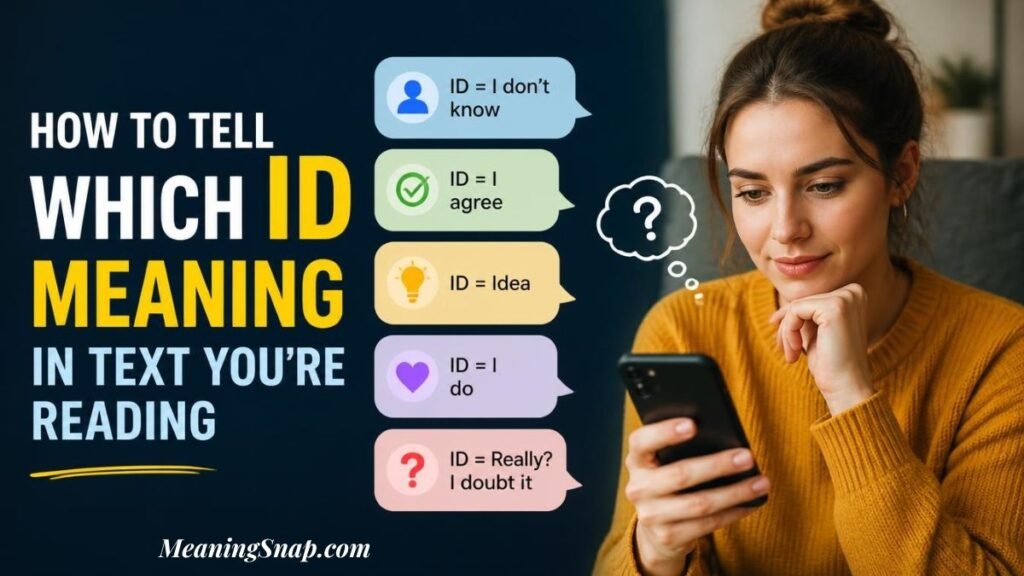
Four quick clues settle most cases:
- A question mark and nothing else, like “ID?”, asks you to name something.
- Lowercase id followed by a verb (love, say, rather, been) is I’d.
- Words like card, check, bring, show, or photo nearby point to identification.
- A request for a number or handle points to an account ID.
The sender doesn’t matter. ID meaning in text from a girl, a guy, or a group chat works the same way, because the sentence carries the meaning. I found no dictionary or community source describing a hidden romantic code for ID. If a message still feels unclear, ask: “Do you mean my ID card or my username?” One line settles it.
ID Meaning in Text as Identification
Most of the time, ID means identification. Merriam-Webster defines the noun as a document, often a card with a photo, showing who someone is. It lists ID card, identification card, and identity card as other names for it.
Texts lean on this sense for plans with an age limit or a door check. “Bring your ID, they scan at the entrance” needs no translation.
ID also works as a verb. Merriam-Webster gives ID’d (or IDed) and ID’ing as forms meaning to identify, and dates the verb to 1944. Green’s Dictionary of Slang adds the sense of checking someone’s identification to enter a club. So “She got ID’d at the movie” means a staff member asked to see her card.
What about ID meaning in card form? Same idea. An ID card is an identification card, and the word travels from the wallet to the chat box unchanged.
Read Also: TGIF Meaning in Text: The Real Definition, Uses, Examples & Social Media Guide (2026)
ID Meaning in Text on Snapchat and Instagram
Platforms don’t add a private code. Dictionaries list no Snapchat-only or Instagram-only sense, so the same forms apply. What shifts is what people want from the word.
On Snapchat, you have a username and a display name. When a friend asks “what’s your ID?”, they usually want the username, the unique handle shown under your display name. Instagram follows a similar split between a handle and a display name, so the same question gets the same answer there.
The ID meaning in text stays the same across both apps. In comments, “ID?” under a video usually asks for a song or an item, and the next section covers it.
What “ID?” Means in Comments and Group Chats
Scroll any viral clip and you’ll spot “ID?” in the comments. Here, ID meaning in text works as a question, not a card. It asks the poster to identify something: the song playing, the jacket, the sneakers, the filter.
Community explanations back this up. In a r/EDM thread, users describe “ID?” as the music crowd’s way to ask for a track name. One commenter adds the same word flags an unreleased track still missing a title. No dictionary lists this sense yet, and the commenters admit they don’t know where it started. So I treat it as community usage, not a formal definition.
When ID Meaning in Text Turns Out to Be I’d
Here’s where lowercase trips people. Britannica, Merriam-Webster, and Cambridge all list I’d as a contraction of I would or I had. Merriam-Webster adds I should. Strip the apostrophe, and you get id.
Two quick examples show the pattern:
- “id love to come” means I would love to come.
- “id already eaten” means I had already eaten.
A spaced version, “I d love to,” follows the same logic. It’s I’d with the apostrophe missing and a space typed in its place. For a fast check, swap in I would or I had. If the sentence still reads right, you’re looking at I’d.
Common Mistake: Reading “id love to” as a request for your photo ID. A friend who texts “id go with you” wants to join the trip, not see your driver’s license.
Casual texts forgive a missing apostrophe. Emails and school work don’t, so write I’d in full there.
Real Chat Examples of ID Meaning in Text
Six sample chats show the range. Each gets one line of explanation, so you won’t see the same point twice.
Casual:
Sam: Is the show 21+?
Priya: Yep, bring ID.
Here, ID means a photo identification card for the door check.
Sarcastic:
Leo: ID on your motivation this morning?
Mia: Lost it somewhere around Monday.
Leo borrows the comment-section habit of asking “ID?” and aims it at Mia’s energy. The joke works because everyone knows the real use.
Sincere:
Dana: id love to help you move, but I’m out of town Saturday.
Dana means I’d, short for I would. No card involved.
Surprised:
Jo: Wait, she got ID’d at the theater?
Kai: Yep, they card everyone for the late show.
ID’d means a staff member asked her to show identification.
Frustrated:
Rae: The app keeps asking for my ID number.
Tom: Check Settings. It wants your user ID, not your license.
Tom separates an account ID inside an app from a government-issued card. Rae’s frustration comes from mixing them.
Playful:
Ava: ID on this song? It’s stuck in my head.
Ben: Sent you the link. You’re welcome.
Ava asks Ben to name the track, and Ben answers with a link.
ID Meaning in Text Citations and Legal Writing
Open a law brief or a research paper and you’ll see “Id.” with a period. It abbreviates idem, the Latin word for the same. Merriam-Webster lists idem as the source, and its legal definition of id. is simply idem.
The Bluebook, the standard citation manual for US legal writing, uses Id. for a citation to the same source as the one right before it. Same page? Write Id. alone. Different page? Add the page, as in Id. at 459. Skip it after a string citation with two or more sources, since the reader gets no clue which source you mean. Columbia Law School’s Bluebook primer adds a formatting note: italicize it, and capitalize the I only at the start of a sentence.
Here’s a quick sample:
- Smith v. Jones, 123 U.S. 456, 458 (2020).
- Id. at 459.
Note 2 points back to the same case, page 459.
You’ll also meet ibid. now and then, a close cousin meaning in the same place. The Bluebook prefers id. over ibid., and other style guides handle repeat citations in their own ways. Ask your teacher or editor which guide applies. As a reference tool, id. saves you from retyping a full citation. As a texting word, it has no link at all to the ID meaning in text you see in chats.
ID Meaning in Text Across Psychology, Medicine, and Other Fields
In English, three things share the spelling: the abbreviation ID, the Latin-rooted word id, and the contraction I’d. Merriam-Webster notes id is simply the Latin word for it.
Merriam-Webster lists the formal senses below. They show up in textbooks, notes, and forms far more often than in chats.
| Field | Meaning | Where you meet it |
|---|---|---|
| Psychology | The unconscious division of the psyche in psychoanalytic theory, alongside the ego and superego | Textbooks, intro classes |
| Medicine | Intradermal, and also an id reaction, a skin rash caused by an allergic response to an infecting agent | Medical notes |
| Geography | Idaho | Addresses, forms |
| Engineering | Inside or internal diameter | Specs, parts lists |
None of these is the usual ID meaning in text. Freud and his translator brought the psychology sense into modern vocabulary, and Merriam-Webster dates it to 1924. If a medical note uses ID and you need the exact sense for your own care, ask the clinician who wrote it, since abbreviations shift between settings.
ID vs IDK, IDC, IDEK and IDGI
The lookalikes share an opening pair of letters but not a meaning. This table keeps them straight.
| Term | Meaning | Tone |
|---|---|---|
| ID | Identification, or a request to name something | Neutral |
| IDK | I don’t know | Neutral |
| IDC | I don’t care | Dismissive |
| IDEK | I don’t even know | Exasperated |
| IDGI | I don’t get it | Confused |
The I-don’t family always adds extra letters after ID. A bare ID follows the other rules in this guide, so ID meaning in text stays separate from IDK.
When to Use ID Meaning in Text, and When to Skip It
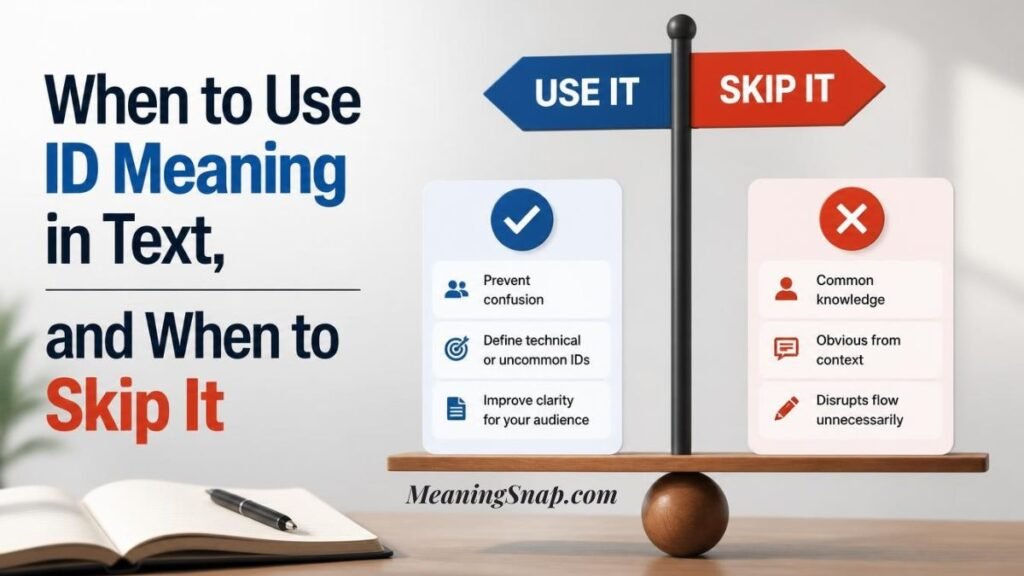
Good fits: texts to friends, comment sections, captions, quick replies, and game chats. In these spots, everyone reads ID and id fast.
Skip it in school essays, job applications, and client emails. Write “identification,” “photo ID,” or I’d with its apostrophe instead. A missing apostrophe in a casual text looks relaxed. In a cover letter, it looks like a slip. Legal and academic work gets the proper Id. form, never the texting version.
How to Reply When Someone Texts You ID
Match the reply to the ID meaning in text. For “ID?” under your post, give the song title and artist, or the product name with a link. If you don’t know, say so. “Not sure, sorry” beats silence.
For “id love to come,” answer as you would for “I’d love to come.” Settle the time and place. Nothing about ID cards.
For “got ID?” at a door or counter, a yes or no does the job.
Read More: SYBAU Meaning: What Does SYBAU Mean in Social Media (2026 Guide)
When a Chat Asks for Your ID: Safe or Scam?
Some requests for your ID are harmless. A friend wanting your username to add you on Snapchat, or a gaming buddy asking for your player ID, is routine.
A photo of your driver’s license or passport is another story. Treat a request for one like a request for your password. A stranger from the internet has no reason to see your government ID, and legitimate verification usually happens inside the app or service itself, not in a private chat. When in doubt, ask which ID they mean. Their answer tells you plenty.
Myths About ID Meaning in Text
Myth: capital letters decide the meaning. Casing gives a hint. Merriam-Webster prints the psychology noun as lowercase id and the abbreviation as ID. But many people type everything in lowercase, so the sentence matters more than the capitals.
Myth: id for I’d is wrong English. The contraction I’d is standard in Merriam-Webster, Britannica, and Cambridge. Dropping the apostrophe is informal typing. It’s fine between friends and risky in formal writing.
Myth: ID means IDK. Some user-written answer pages list ID as short for I don’t. No major dictionary I checked backs it, and every example above works with the standard senses.
Count Every Word
Writing an essay, a caption or a message with a limit? Count words and characters instantly. It is free and needs no sign-up.
More free tools: English to Slang Translator · Decode Slang Text · All Tools
FAQs
What does ID mean in text from a girl?
The same as from anyone: identification, a request to name something, or I’d. Read the sentence, not the sender.
What does ID mean on Snapchat?
It carries the same three meanings as anywhere else. When a friend asks “what’s your ID?”, they usually want your username.
What does ID mean on Instagram?
In comments, “ID?” asks the poster to name a song, outfit, or product. In direct messages, lowercase id before a verb is I’d.
Does ID mean I would?
Only when lowercase id stands in for I’d, which dictionaries define as I would or I had. A capital ID usually means identification.
What does ID mean on Urban Dictionary?
Urban Dictionary entries are user-submitted and approved by volunteer editors, so treat them as evidence of usage, not final definitions. The dictionary-backed senses are identification, I’d, and the formal fields above.
What does Id. mean in a citation?
It abbreviates idem, Latin for the same, and points to the source cited right before it.
What does ID mean in medical notes?
Merriam-Webster lists intradermal among the medical senses, but meanings vary by setting. Ask the clinician who wrote the note.
Final Thought
Next time ID meaning in text puzzles you, check the question mark and the next word first. Those two clues settle most messages.

Alex Morgan is a writer focused on explaining slang, words, phrases, acronyms, and popular expressions in a simple and easy-to-understand way. Through clear explanations and helpful examples, Alex helps readers quickly understand what words and phrases mean and how they’re commonly used.