I saw the comment before I saw the video. Someone had posted a hot take about a show everyone loved, and right under it, in all caps, sat one word: SYBAU. No punctuation, no explanation, just five letters and forty thousand likes. I read it three times and still had no idea what it meant. That is the exact moment this guide is for. If you have landed here wondering about the SYBAU meaning, you are not behind. You just haven’t been handed the decoder yet, and that’s what we’re fixing right now.
This slang shows up everywhere from TikTok comment sections to gaming Discords, and it moves fast enough that even people who spend hours online get caught off guard. By the end of this article, you’ll know exactly what SYBAU stands for, where it came from, how to tell when it’s a joke versus an insult, and what to say back.
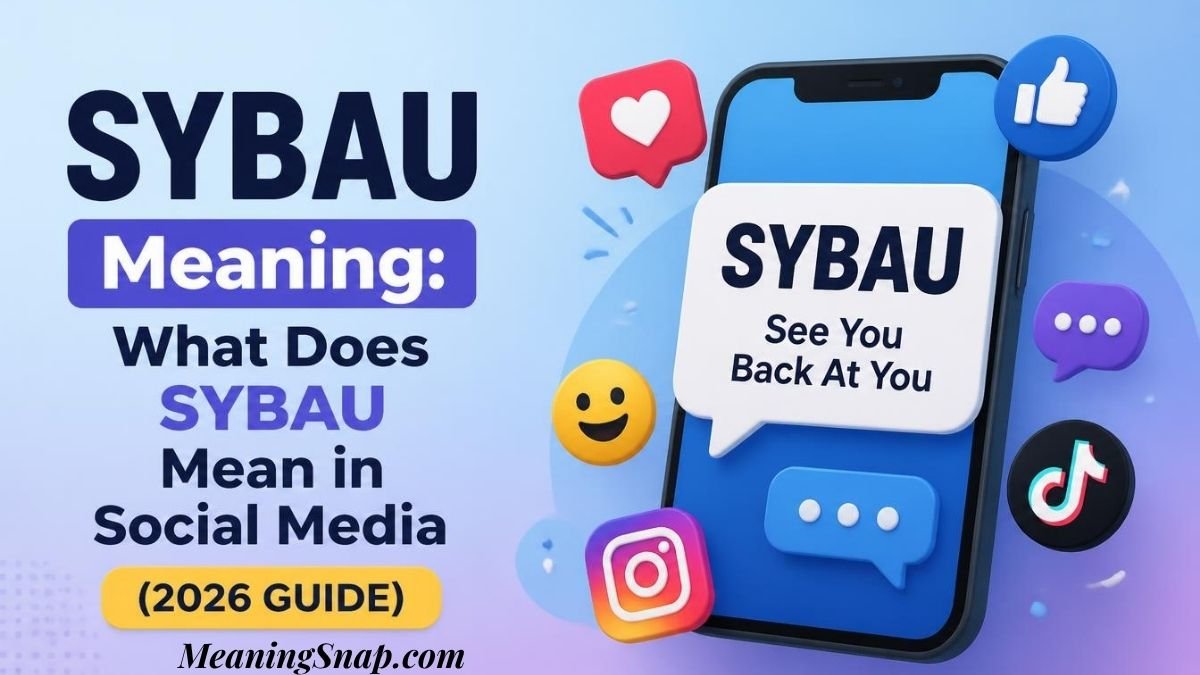
Quick Answer: SYBAU stands for “Shut Your B*tch Ass Up.” It’s an internet acronym used to tell someone to stop talking, and the tone can range from playful teasing between friends to a genuine insult, depending on who says it and how.
What Does SYBAU Stand For? (SYBAU Meaning Full Form)
Let’s get the core SYBAU meaning out of the way first. SYBAU stands for “Shut Your B*tch Ass Up.” It’s blunt by design. The whole point of the phrase is to shut a conversation down fast, and the acronym format makes it quicker to type than the full sentence ever was.
Here’s the thing about slang like this: the words themselves are harsh, but the delivery changes everything. Someone can type SYBAU at their best friend after a rambling story and mean it as a joke. Someone else can type it at a stranger in a comment section and mean it as a real insult. Same five letters, completely different weight.
You’ll usually see it written in full capitals, SYBAU, though plenty of people type it lowercase too. Capitalization doesn’t change the SYBAU meaning, but it does add emphasis, kind of like raising your voice in text form. What actually signals tone is what surrounds it. A skull emoji or a crying-laughing face right after SYBAU almost always means the person is joking. No emoji, short sentence, flat delivery? That usually points to something more serious.
Younger internet users didn’t invent the idea of shortening rude phrases into acronyms, but they did turn it into a whole language. SYBAU fits into that same family as older terms like STFU, just with a sharper, more personal edge baked into the wording itself.
How Do You Pronounce SYBAU?
You might be wondering if this is even meant to be said out loud, and the honest answer is: sometimes. Most people encounter SYBAU only in text, so there’s no single “official” pronunciation the way there is for a real word.
That said, two habits have formed online. Some people say it as a single made-up word, something close to “sigh-bow,” treating it almost like it rhymes with a name. Others spell it out letter by letter, S-Y-B-A-U, the same way you’d say NASA versus FBI. Neither is wrong. It really comes down to the region, the friend group, and how often that specific circle says slang out loud versus just typing it.
In voice chats on Discord or during livestreams, you’ll hear the letter-by-letter version more often. It reads clearly and there’s no ambiguity about what’s being said. The single-word pronunciation tends to show up more in casual spoken banter between close friends who already use the term constantly in text, so saying it as one syllable-y word feels natural to them.
If you’re ever unsure which version to use, spelling it out letter by letter is the safer bet. It’s clearer, it avoids any confusion, and it matches how the term actually reads on a screen, which is where almost everyone learns it first anyway.
Where Did SYBAU Come From? (Origin and History)
Every viral slang term has an origin story that’s messier than people expect, and the SYBAU meaning has one too. It didn’t come from a single video or one influencer. Instead, it grew out of gaming communities and meme forums somewhere around 2021 to 2022, spreading through group chats before most of the internet had ever heard it.
Content moderation played a bigger role in this than most people realize. Platforms started cracking down harder on aggressive language, flagging comments and sometimes muting accounts for using certain phrases outright. Users adapted the way people always do: they abbreviated. Shortening “shut your b*tch ass up” into SYBAU made it faster to type and, for a while, easier to slide past automated filters that were scanning for full words rather than acronyms.
That workaround gave SYBAU real traction in spaces where trash talk is part of the culture, especially competitive gaming lobbies and Discord servers built around specific games. From there, meme pages picked it up. Screenshots of savage replies using SYBAU started circulating on Instagram and Twitter, and the term crossed over from niche gaming slang into something much broader.
It’s also worth noting that SYBAU carries a cultural lineage tied to African American Vernacular English, which is true of a large share of the slang that spreads through mainstream internet culture. Understanding where a term comes from adds real context to how and when it gets used, and it’s part of getting the full SYBAU meaning right instead of just the surface-level definition.
You May ALso Like: WYO Meaning in Text: What It Really Means & Examples
Is SYBAU Still Trending in 2026?
Slang has a shelf life, and a fair question is whether SYBAU has already peaked or if it’s still actively used. As of 2026, it’s holding steady rather than fading out, which puts it in a smaller category of internet acronyms that outlast their first viral wave.
Part of that staying power comes down to flexibility. Terms that only work in one specific context tend to disappear once that trend cycle ends. SYBAU never depended on a single meme format or one platform’s algorithm. It works in a gaming lobby, a group chat, a comment section, or a reaction video caption, and that range has kept search interest and everyday usage fairly consistent year over year.
Search interest for the SYBAU meaning tends to spike whenever a new wave of TikTok reaction content goes viral, since that’s usually where people outside Gen Z first spot the term and go looking for an explanation. Between those spikes, usage stays steady inside gaming and Discord communities where it’s been embedded for a while now.
What has shifted slightly is the tone. Early on, SYBAU leaned more aggressive and confrontational. Now, it shows up just as often as pure comedy, tossed into captions with a laughing emoji rather than used as an actual insult. That shift matters if you’re trying to read the room, because the same term that sounded harsh in 2022 often reads as harmless joking in 2026.
How SYBAU Is Used on TikTok, Discord, Instagram and Twitter/X
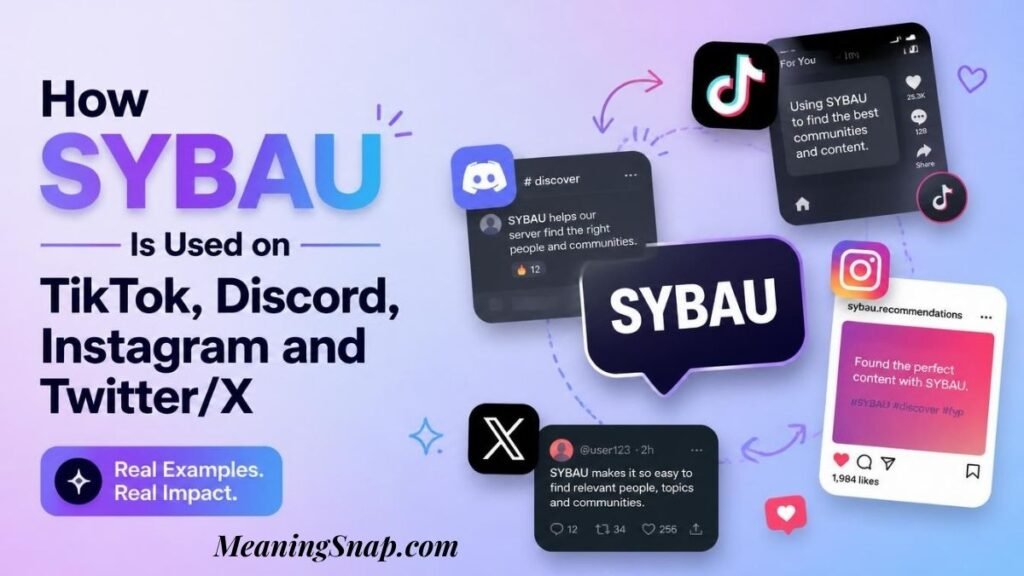
Where you see SYBAU changes how it should be read, so platform context matters. Each app has developed its own flavor of usage over the past few years.
TikTok is where most people outside gaming circles first run into the term. Creators caption reaction videos with SYBAU when responding to an unpopular opinion, and commenters echo it under debate-style content. Instagram usage skews toward meme pages and direct messages, where friends toss it back and forth as a running bit. Discord and in-game chats remain SYBAU’s most natural habitat, since gaming culture already runs on trash talk and quick banter. Twitter and X see it mostly inside meme threads and heated reply chains, often paired with screenshots.
What Does SYBAU Mean on TikTok?
On TikTok specifically, SYBAU shows up constantly in caption text and comment replies under reaction videos, duets, and “hot take” content. Creators often type it directly into a caption after reacting to something ridiculous, letting the word do the joke without needing to say anything on camera. It works so well here because TikTok’s format rewards fast, punchy text overlays, and five capital letters read instantly even at a glance.
What Does SYBAU Mean on YouTube?
YouTube usage looks a little different from TikTok. Instead of captions, SYBAU mostly shows up in comment sections under debate videos, gaming clips, or reaction content, often as a quick reply to another commenter’s take rather than to the video itself. Because YouTube comments tend to run longer and more argumentative than TikTok captions, SYBAU on YouTube leans slightly closer to genuine dismissal, especially in threads that have already turned into a back-and-forth.
A short comparison makes the overall platform pattern easier to picture:
| Platform | How SYBAU Typically Shows Up |
|---|---|
| TikTok | Caption on reaction videos, comments under hot-take content |
| Meme page captions, DMs between friends, story replies | |
| Discord | Gaming banter, competitive match trash talk, server jokes |
| Twitter/X | Meme threads, quote-tweet roasts, heated reply chains |
| Snapchat | Casual close-friend chats, low-stakes teasing |
Notice that four of those five platforms lean toward humor and banter rather than genuine hostility. That’s not a coincidence. SYBAU spreads fastest in spaces built around jokes, reactions, and fast-paced back-and-forth, which shapes the overall SYBAU meaning as it’s actually used day to day, even though the literal words are harsh.
Read More: ISO Meaning Explained: What ISO Stands For, Why It Matters, and How It’s Used Worldwide
SYBAU Spelling Variants You’ll See
Slang rarely stays in one fixed spelling for long, and SYBAU is no exception. You’ll run into a handful of variations depending on who’s typing and how fast they’re doing it.
The standard version is all capitals, SYBAU, which is how it appears most often in captions and comment sections. Plenty of people write it lowercase instead, sybau, especially in casual texting where capitalization gets dropped for speed. You’ll also spot stretched-out versions like sybauu or sybauuu, where extra letters add emphasis the same way “sooo good” hits differently than “so good.”
Some people add periods between each letter, S.Y.B.A.U, which tends to show up when someone wants extra dramatic weight behind the phrase. Occasionally you’ll see sybaw as a typo or a regional pronunciation spelling, though this version is far less common and can confuse people searching for the term’s meaning.
None of these variants change the underlying SYBAU meaning. They’re stylistic choices, not different slang terms. Think of it the way “lol,” “LOL,” and “lolll” all mean the same thing with slightly different energy behind them. If you’re trying to search for background on this slang, sticking with the standard capitalized spelling, SYBAU, will get you the most reliable results.
Is SYBAU Offensive? Reading the Tone and Context
This is probably the most important section for anyone trying to understand SYBAU meaning beyond the dictionary definition, because context decides everything here.
SYBAU reads as friendly when it happens between people who already have an established joking relationship. Close friends who constantly roast each other can drop SYBAU mid-conversation and both people know exactly what’s happening: nobody’s actually mad. Emojis do a lot of heavy lifting here too. A skull emoji, crying-laughing face, or a string of laughing emojis right after SYBAU almost always signals the person is teasing rather than attacking.
The tone flips fast once those signals disappear. SYBAU aimed at a total stranger, especially with no emoji softener and no prior back-and-forth, reads as genuinely hostile. It hits differently in a public comment section than it does in a private group chat, since public use often carries an intent to embarrass rather than just tease. Age gaps matter as well. A younger person aiming this at a teacher, parent, or any authority figure crosses a line that has nothing to do with slang and everything to do with basic respect.
Here’s a simple test: would the same words feel fine face to face, minus the anonymity of a screen? If the answer is yes, it’s probably banter. If the answer is no, the SYBAU meaning in that moment has shifted from joke to genuine insult, and it’s worth reading the room before responding the same way back.
SYBAU vs Similar Gen Z Acronyms (STFU, GYAT, IDGAF)
SYBAU doesn’t exist in isolation. It sits inside a whole cluster of blunt, shortened phrases that Gen Z slang has produced over the last several years, and comparing them side by side makes the SYBAU meaning easier to place.
STFU is the closest relative and the one people confuse it with most. Both tell someone to stop talking, but STFU is older, dating back to early internet chat rooms, and it reads as more generically angry. SYBAU feels newer, more personal, and more meme-coded, carrying a specific Gen Z flavor that STFU never picked up. GYAT is a completely different animal, used as an exclamation about someone’s appearance rather than a command to stop talking, though it shares the same all-caps, acronym-heavy texting style. IDGAF, meaning “I don’t give a f*ck,” expresses indifference rather than aggression, making it closer in spirit to a shrug than a shutdown.
A quick side-by-side helps clarify the differences:
| Term | Meaning and Vibe |
|---|---|
| SYBAU | “Shut your b*tch ass up.” Newer, sarcastic, meme-heavy, common on TikTok and Discord. |
| STFU | “Shut the f*ck up.” Older, blunt, reads as more seriously angry across any platform. |
| GYAT | Exclamation about someone’s looks, not a command. Completely different function from SYBAU. |
| IDGAF | “I don’t give a f*ck.” Expresses indifference, not a request for silence. |
Grouping these terms together shows why SYBAU meaning can’t be reduced to just “another way to say shut up.” It has its own tone, its own platforms, and its own generational fingerprint that separates it from every term next to it on this list.
US vs UK Usage: Does SYBAU Mean the Same Thing?
Slang doesn’t always travel evenly, and it’s fair to ask whether SYBAU means the same thing on both sides of the Atlantic. For the most part, it does, though the frequency and flavor shift a bit depending on the region.
American Gen Z users popularized SYBAU first, largely through TikTok and gaming Discords based in the US, so usage there feels more established and casual. UK audiences picked it up through the same platforms, since TikTok trends rarely stay contained to one country for long, but adoption happened slightly later and tends to concentrate more heavily among younger teens rather than spreading evenly across a wider age range.
One small difference worth noting: British slang already had its own arsenal of blunt phrases for telling someone to stop talking, things like “shut up” delivered with distinctly British sarcasm, or older terms rooted in UK youth culture. SYBAU slots into that existing space rather than replacing anything, which is part of why UK teens use it more as an extra tool in the rotation than as their go-to phrase.
The core SYBAU meaning doesn’t change crossing the ocean. What changes is context sensitivity. UK readers should apply the same friend-versus-stranger, emoji-versus-no-emoji rules covered earlier, since those signals work the same way regardless of which country the conversation is happening in.
How to Respond to SYBAU (And How to Use It Yourself)
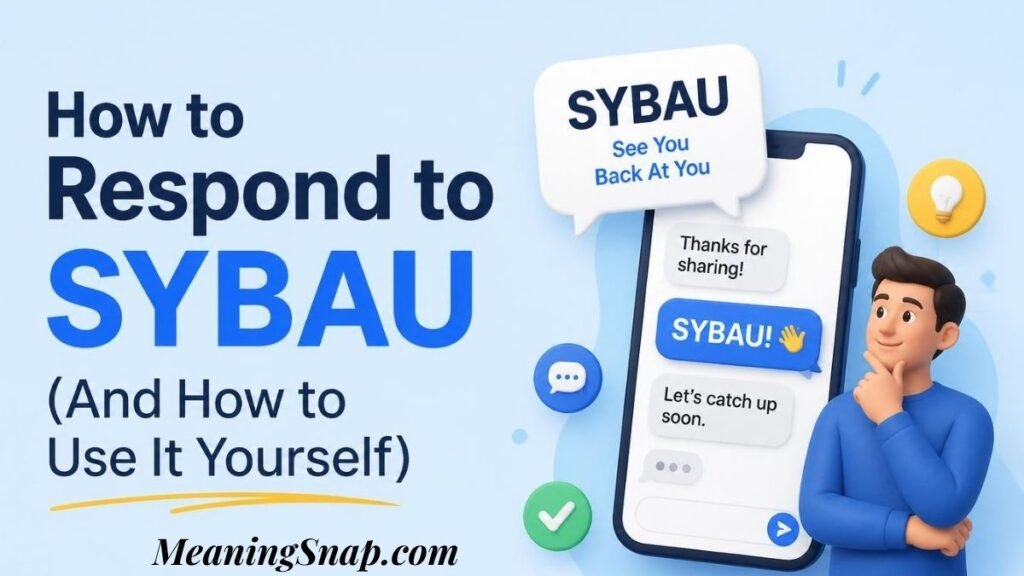
Knowing the SYBAU meaning is only half the picture. The other half is knowing what to do when it lands in your own messages, or when you’re deciding whether to use it yourself.
If a friend sends SYBAU as an obvious joke, the easiest move is matching their energy rather than overthinking it. A simple “make me” keeps things light. Returning “SYBAU back” with the same laughing emoji works just as well. If the SYBAU felt genuinely rude, especially from someone you don’t know well, staying calm beats escalating every time. Calling it out directly, something like “that came across as rude, not funny,” gives the other person a chance to clarify without starting a bigger argument. Ignoring it entirely is also a valid choice, since a lot of online hostility runs on getting a reaction. Blocking or muting works when it keeps happening from the same account.
Using SYBAU yourself follows the same logic in reverse. It works best with people who already know your sense of humor and won’t misread the tone. Adding an emoji softens it instantly, turning a harsh phrase into an obvious joke. Using it with strangers, coworkers, or anyone outside a close circle is a real risk, since you can’t control how they’ll read five letters with no facial expression or tone of voice attached.
A Parent’s Quick Guide to SYBAU
If you’re a parent who just spotted SYBAU in your kid’s messages, take a breath first. Seeing it doesn’t automatically mean something’s wrong.
In most cases, this is ordinary slang exchanged between friends, the digital-age version of teasing a sibling or ribbing a friend at lunch. The context clues from earlier in this guide apply directly here. Emojis after the term, a lighthearted thread, and messages between kids who clearly know each other well all point toward harmless banter rather than anything concerning.
Pay closer attention if the tone shifts. SYBAU aimed repeatedly at your child from someone they don’t seem close to, especially without any joking emojis, deserves a conversation. The same goes for your child sending it toward someone who doesn’t seem to be responding in kind, since that can be a sign of one-sided teasing tipping into something less friendly.
Rather than reacting with alarm, try a simple, low-pressure opener: “I saw this word in your messages, what does it mean to you and your friends?” That approach keeps the door open and treats your kid as capable of explaining their own social world, which usually gets you a far more honest answer than confronting the term as if it’s automatically a red flag.
Real Conversation Examples of SYBAU
Seeing SYBAU meaning play out in actual messages makes the tone differences click faster than any explanation can.
Example 1: Friendly Banter
Maya: okay but what if we repainted the whole room AND got new furniture AND—
Priya: SYBAU it’s midnight 😭💀
Example 2: Gaming Trash Talk
Diego: bro how did you miss that shot
Kai: SYBAU you literally fed the whole game 😂
Example 3: Genuine Frustration
User1: your opinion on this is completely wrong
User2: SYBAU, you clearly didn’t even read the full thread
Example 4: Sarcastic Deflection
Sam: you forgot to text me back for three days
Jordan: SYBAU I was literally drowning in exams 😂
Example 5: TikTok Comment Section
Original poster: pineapple belongs on pizza, fight me
Top comment: SYBAU 💀 this take is not it
Notice how the emoji, the relationship, and the surrounding words shift each example from playful to sharp. The literal SYBAU meaning stays fixed across all five. The emotional temperature does not.
Other or Misinterpreted Meanings of SYBAU
A handful of alternative expansions for SYBAU have floated around online, mostly invented for laughs or as cover stories. “Stay Young, Beautiful And Unique” is one that circulated widely, alongside made-up phrases meant to sound wholesome enough to say around a parent or teacher without raising questions.
These alternate meanings aren’t real. They started as jokes or deliberate misdirection, giving teens a plausible explanation if an adult ever asked what the term meant. The actual SYBAU meaning has only ever been one thing, and every “cleaner” version you’ll find online exists purely as internet humor rather than a genuine alternate definition.
Frequently Asked Questions
What does SYBAU mean in a text message?
SYBAU stands for “Shut Your B*tch Ass Up.” In texting, it works as a quick, blunt way to tell someone to stop talking, though the tone can be playful or genuinely harsh depending on who’s sending it.
Is SYBAU always an insult?
No. Between close friends with an established joking dynamic, it usually reads as banter rather than a real insult. Directed at strangers or used without any emoji softener, it typically comes across as hostile.
Where did SYBAU originate?
SYBAU started in gaming communities and meme forums around 2021 to 2022, partly as a way to dodge content moderation filters. It later spread to mainstream platforms through TikTok reaction videos and meme pages.
Is SYBAU used the same way in the UK as the US?
Mostly, yes. American users popularized the term first, and UK adoption followed through the same social platforms. The underlying meaning stays the same, though UK usage skews toward a slightly younger age range.
What should I say if someone sends me SYBAU?
If it’s clearly a joke, matching their energy with something like “make me” keeps things light. If it feels genuinely rude, staying calm, calling it out directly, or simply not engaging all work better than escalating.
Final Thoughts
SYBAU looks a lot harsher written out than it usually feels in the moment it’s sent. Among the right people, it’s just another piece of fast-moving internet shorthand that adds color to a joke or a roast. Sent to the wrong person, or without any context to soften it, those same five letters can genuinely sting.
The SYBAU meaning itself never changes. What changes is who’s saying it, who’s hearing it, and what surrounds it on the screen. Read the room, watch for the emojis, and when you’re still not sure how something landed, asking beats assuming every time.

Alex Morgan is a writer focused on explaining slang, words, phrases, acronyms, and popular expressions in a simple and easy-to-understand way. Through clear explanations and helpful examples, Alex helps readers quickly understand what words and phrases mean and how they’re commonly used.