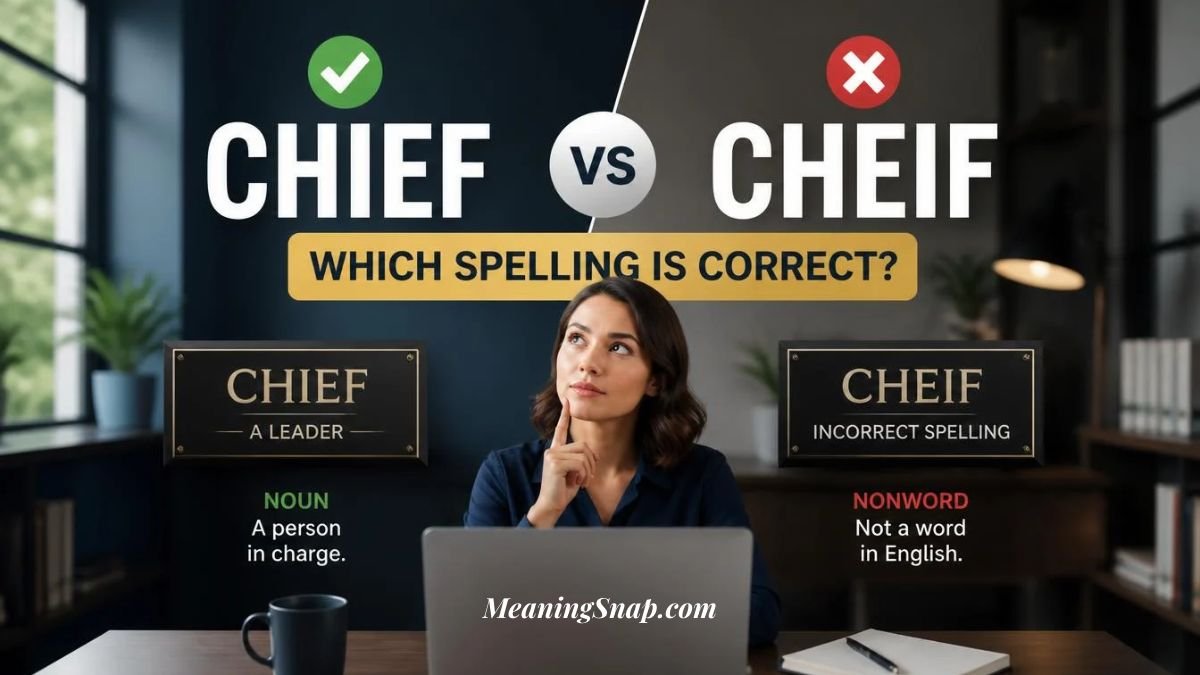
You’re typing a quick email to your boss, and the red squiggle shows up under one word. Was it “cheif” or “chief”? You stare at the screen, and suddenly both versions look wrong.
That’s the chief vs cheif question, and the answer is short. Chief is correct. Cheif is a typo. The letters run i before e, the same way they do in thief and brief. You can stop reading here and still get it right, but the next few minutes make it stick.
This guide covers the spelling rule, a few memory tricks, and the chef and chieftain mix-ups. You’ll also get job titles and the casual “thanks, chief” you see everywhere. Whether you’re polishing a résumé, writing a caption, or finishing a school essay, you’ll know which spelling to trust and why.
Quick Answer: Chief is correct, and cheif is a misspelling. Chief means a leader, or the thing that matters most. The letters follow “i before e,” the same pattern as thief and brief. Use chief in emails, texts, job titles, and school work. The spelling is the same in US and UK English.
Chief vs Cheif: Correct, Incorrect, and Why
This table shows the spellings you’re most likely to type, with the reason each one is right.
| Correct | Incorrect | Why |
|---|---|---|
| chief | cheif | The i comes first, just like thief |
| chiefs | cheifs | Keep the same order and add s |
| chiefly | cheifly | Leave chief alone, then add ly |
| mischief | mischeif | It ends in the same -ief |
| handkerchief | handkercheif | Same ending again |
Two of those words hide chief at the end. If you can spell chief, you’ve got mischief and handkerchief covered too.
Read Also: Knaw or Gnaw: Correct Spelling Explained (2026 Guide)
Chief vs Cheif Meaning: What Chief Stands For
Cheif has no meaning because it isn’t a word. Chief carries two main senses, and both use the same spelling.
As a noun, a chief is the head of a group, like a fire chief or the chief of a department. As an adjective, it means holding the highest rank or being the most important. Merriam-Webster’s examples include chief librarian for rank and chief reasons for importance.
You’ll also meet chief inside plenty of set phrases. They all keep the same ie: chief executive, chief justice, chief of staff, crew chief, and commander in chief. The tag “in chief” means “in the chief position,” so it trails some titles. Add ly and you get chiefly, an adverb that means mainly.
In the chief vs cheif debate, only chief carries any of these meanings.
Read Also: Potato vs Potatoe: Which Spelling Is Right? (guide 2026)
Why Chief vs Cheif Trips People Up
Nobody types cheif on purpose. A few real habits push people that way. Here are the usual culprits.
- The “ee” sound has too many spellings. See, sea, key, field, and receive all share it, so your ear can’t pick the right letters.
- Fingers flip letter order. It’s an easy slip when you’re rushing a message.
- A half-remembered rule. People recall the “ei” in receive and carry it over to words where it doesn’t belong.
- Look-alike exceptions. Weird, seize, and either do use ei, so the pattern can feel random.
A spell-checker usually catches chief. Handwriting, signs, and paper forms don’t give you that safety net, which is why knowing the rule helps.
The Spelling Rule Behind Chief vs Cheif
Most of us met the rhyme in school: i before e, except after c.
Chief fits it cleanly. The vowels make a long ee sound, and no c sits in front of them. Dictionary.com lists chief right beside piece, brief, and thief as examples of the ie spelling.
Plenty of other words follow the same pattern: field, niece, belief, relief, achieve, and yield. After a c, the order flips, as in receive, ceiling, deceit, and receipt.
Now the honest part. The rhyme has holes. Merriam-Webster calls it a handy reminder for one group of words, such as receive and conceited. It lists seize, height, and albeit among the exceptions. Dictionary.com adds caffeine, leisure, and weird. Chief isn’t one of those troublemakers, so the rule works for it.
The Government of Canada’s Writing Tips Plus page goes a step further. It advises checking a good dictionary instead of leaning on the rhyme when you’re unsure.
Now you know chief from cheif, so try our free tools on the slang that trips you up next.
Chief vs Cheif and Other ie/ei Traps
If chief vs cheif trips you up, a few other words likely do too. This table shows the swaps people make most often, with the pattern that fixes each one.
| Correct | Common typo | Pattern |
|---|---|---|
| field | feild | ie, like chief |
| piece | peice | ie, like chief |
| niece | neice | ie, like chief |
| believe | beleive | ie, like chief |
| achieve | acheive | ie, like chief |
| receive | recieve | ei after c |
| ceiling | cieling | ei after c |
| seize | sieze | Exception, so memorize it |
| either | iether | Exception, so memorize it |
Seize and either are the two worth memorizing from that list. They break the pattern, and a dictionary will back you up.
How to Remember Chief vs Cheif (and a 30-Second Self-Test)
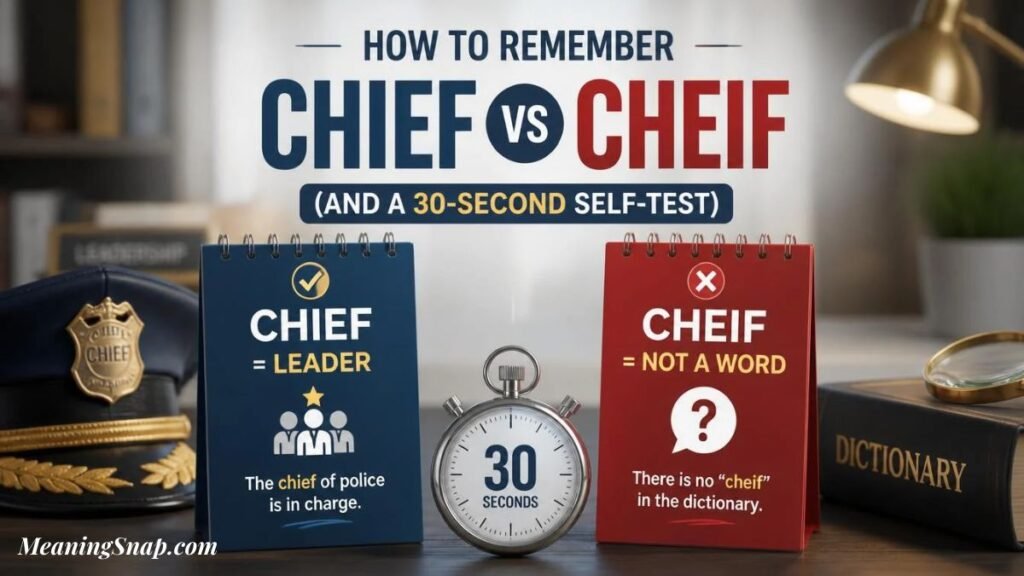
Rules are fine, but a trick sticks better.
Say hi to the chief. The letters h and i sit side by side: c-h-i-e-f. In cheif, the h and i get split up, and the greeting falls apart.
Or swap one letter. Chief and thief differ only in the first letter, c versus t. If thief looks right to you, chief is right too.
Now test yourself. Pick the correct spelling in each pair.
- chief or cheif
- thief or theif
- receive or recieve
- brief or breif
- weird or wierd
The answers are chief, thief, receive, brief, and weird. If you missed the last one, don’t worry. Weird is one of the real exceptions.
Chief vs Cheif Spelling, Letter by Letter
Break the word into three sounds. The ch makes the sound you hear in church. The ie makes the long ee sound you hear in field. The f closes it, like the end of leaf.
That gives you c-h-i-e-f, five letters and one syllable. The ending chunk, ief, shows up in brief, grief, and thief, so you can borrow it from words you already know.
Want it to stick? Type chief five times, slowly, saying each sound as you go. Your fingers pick up the order with practice.
Chief vs Cheif Pronunciation: How to Say It
Say chief like “cheef.” It starts with the ch in church and ends with the f in leaf.
Dictionary entries show the UK pronunciation as /ˈtʃiːf/ and the US one as /tʃif/. You’ll hear essentially the same word either way.
Chief rhymes with beef, leaf, and thief. That last rhyme is a handy spelling clue, since thief uses the same ie.
Cheif has no pronunciation of its own because it isn’t a word. Say “cheef” out loud and you’re saying chief. One catch: say chef and you get “shef,” which is a different word entirely. We’ll sort that out next.
Chief vs Cheif vs Chef vs Chieftain: Same Family, Different Jobs
Here’s the twist. Chief and chef are relatives. Etymonline traces both to the Old French chief, meaning leader, which came from the Latin caput, meaning head.
English borrowed the word twice. Chief came in around 1300 from an older stage of French, when the ch still sounded like the ch in church. Chef arrived in 1842 as “head cook,” short for the French chef de cuisine. It brought the modern French sh sound along.
This table puts the three look-alikes side by side.
| Word | Means | Spelling clue |
|---|---|---|
| chief | A leader, or the most important | ie, like thief |
| chef | A professional head cook | No i at all |
| chieftain | Leader of a clan or tribe, or of a group | ie again, then -ftain |
Chieftain looks like chief plus a tail, but it took a different route. Wiktionary traces it to Old French chevetain and Late Latin capitaneus, the same source that gave us captain. It calls chieftain related to chief. It keeps the ie, so the spelling rule still holds.
The mix-up to watch is chef. It belongs in a kitchen, so a “chef executive officer” reads like a restaurant job.
Chief vs Cheif in Real Sentences
Here’s how the right spelling looks in the places you type most.
- Text: “Guess who just became chief of staff? Priya!” Here chief names a job.
- Email: “Please send the budget to our chief financial officer by Friday.” Chief marks the top person in that department.
- Caption: “Tiny chief of the sandcastle kingdom.” It’s playful, and the spelling stays put.
- School essay: “The chief cause of the delay was bad weather.” Chief means main here, not a person.
- Work chat: “Our crew chief says the van is ready.” Crew chief is a two-word job, and chief stays the same.
- Group chat: “The fire chief gave us a tour of the station today.” The ie holds up in everyday stories too.
Now three wrong-to-right fixes.
- Wrong: “Can you loop in the cheif engineer?” Right: “Can you loop in the chief engineer?” Put the i before the e.
- Wrong: “My cheif concern is the deadline.” Right: “My chief concern is the deadline.” Same swap, even when chief means main.
- Wrong: “Meet the new cheif of police.” Right: “Meet the new chief of police.” The swap works inside longer titles too.
Chief vs Cheif in Job Titles and Plurals
Job titles are where most people use chief, and where the side questions pile up. The spelling never changes, but capitalization and plurals can trip you.
On capitalization, AP Style and The Chicago Manual of Style agree. Both capitalize a formal title directly before a name: Chief Financial Officer Dana Lee. Put the title after the name or on its own, and it drops to lowercase. Think Dana Lee, chief financial officer, or the chief of police. Chicago leans toward a sparing, lowercase “down” style overall.
For plurals, the main noun takes the s. That gives you chiefs of staff, not chief of staffs. Merriam-Webster’s entry for Joint Chiefs of Staff follows the same pattern.
You might also see Chief Master. It’s usually the start of Chief Master Sergeant. According to Military.com’s rank guide, it’s an E-9 rank in the US Air Force and Space Force. Master Chief Petty Officer is a separate rank with the words flipped, so watch the order.
Read Also: Rapport or Repore? The Correct Spelling Explained
Chief vs Cheif on Resumes, Emails, and Signatures
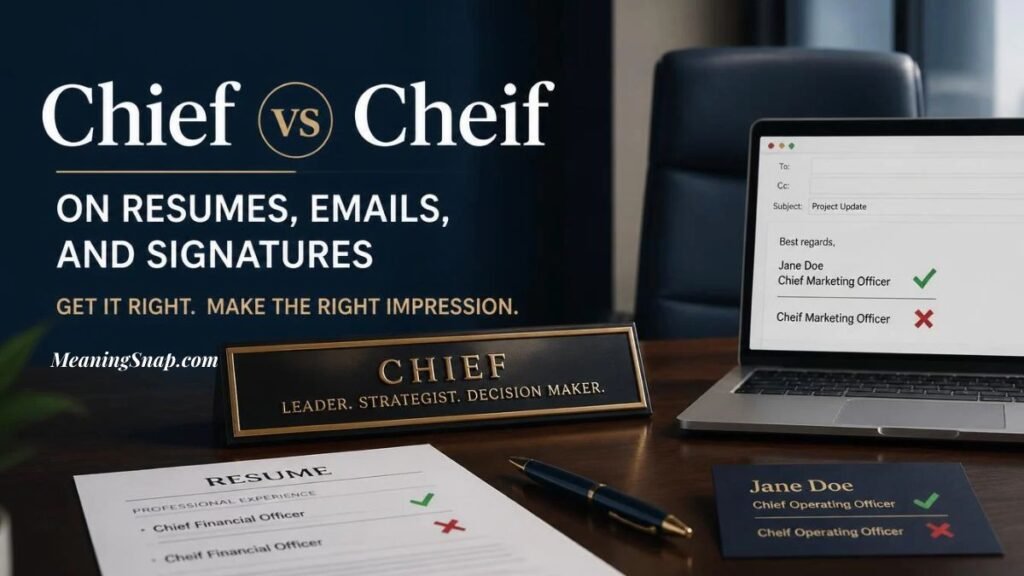
A typo in a casual text is harmless. A typo in a job title sits right where people look first. Titles live in signatures, LinkedIn headlines, résumés, business cards, and slide decks, so chief vs cheif matters most in those spots.
Run a quick check before you hit send or print.
- Search the document for “cheif” with Find (Ctrl+F on Windows, Cmd+F on a Mac).
- Read the title line out loud, one word at a time.
- Check signatures, headers, and file names, where spell-check may not look.
- Set up a text shortcut that swaps cheif for chief. Most phones and word processors let you add one.
Formal and casual writing share one spelling. What changes between a contract and a group chat is capitalization, and whether you’re using chief as a nickname.
Chief vs Cheif in Casual Talk
Chief isn’t only a job title. People use it as a nickname too, and tone does all the work.
Green’s Dictionary of Slang calls it a general way to address someone, often a stranger. Wiktionary marks it as sometimes ironic. Dictionary.com describes a chummy but patronizing feel and tracks the joke phrase “this ain’t it, chief” to social media around 2018.
Here’s how the same word flips with tone.
- Friendly: “Thanks, chief. I’ll send the files in an hour.” The nickname is warm and a little jokey.
- Sarcastic: “Sure, chief. Whatever you say.” Same word, but now it’s an eye-roll.
Spelling matters more here than it seems. A meme or caption with “cheif” reads like a typo and can steal the joke.
One caution. The Diversity Style Guide advises against using chief as a nickname for a Native man, so skip it in that situation.
FAQs
Is it chief or cheif?
Chief, with the i first. If you typed cheif, swap the two letters and you’re done.
Is chiefest a real word?
Yes. Dictionaries list chiefest as the superlative form of chief. Chief already means top or main, so you rarely need it.
What is the plural of chief?
Chiefs. Add an s, as in fire chiefs.
Is it chief of police or police chief?
Both are correct. Merriam-Webster lists chief of police, and WordReference lists police chief for the same job, so pick whichever fits your sentence.
How do you spell chief cook?
Chief cook, with the same ie as chief. On a merchant ship it’s the senior cook in the steward’s department. “Chief cook and bottle washer” is a joking title for someone who handles everything.
Is cheif ever correct?
Not as an English word. Only a deliberate name, brand, or username uses it.
Next time the chief vs cheif question pops up, say hi to the chief. If the h and i sit side by side, you’ve got it right.

Alex Morgan is a writer focused on explaining slang, words, phrases, acronyms, and popular expressions in a simple and easy-to-understand way. Through clear explanations and helpful examples, Alex helps readers quickly understand what words and phrases mean and how they’re commonly used.