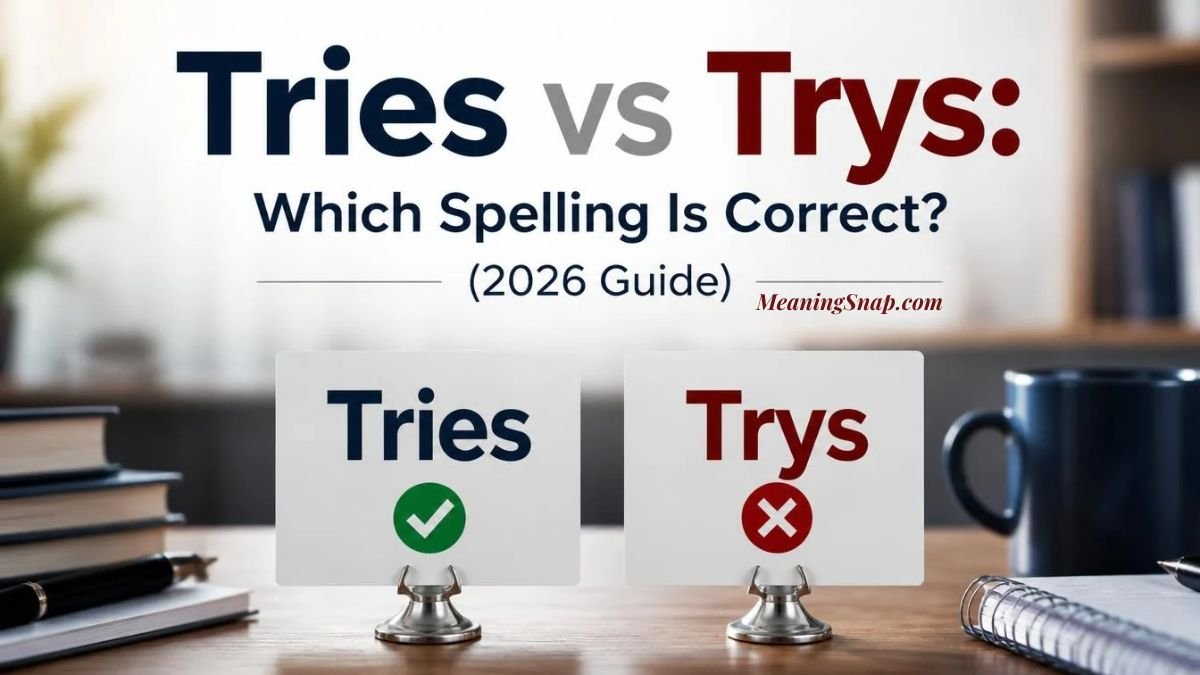
You’re texting a friend about your brother’s new gym habit. “He trys to go every morning,” you type, and a red squiggle shows up under the word. Is it trys or tries? The confusion behind tries vs trys happens because both spellings sound exactly the same out loud.
Here’s the short answer. “Tries” is correct and “trys” is a misspelling. When a verb ends in a consonant plus y, like try, the y turns into ies before the s ending: he tries, she tries, it tries. This guide to tries vs trys covers why that works, where “tries” also shows up as a noun, and how to check yourself in two seconds. It also answers the follow-up questions that come next, like how to write “tries out” and “tries to do something.”
Tries vs Trys: Correct, Incorrect, and Why
This table sorts the forms you’re likely to type, so you can scan it and move on.
| Form | Status | Why | Example |
|---|---|---|---|
| tries (verb) | Correct | The he/she/it form of “try” in the present tense | My cousin tries a new recipe every Sunday. |
| tries (noun) | Correct | The plural of the noun “try” | It took four tries to get the password right. |
| trys | Incorrect | A consonant before the y means the y changes to ies | Not a form of “try” in standard English |
Dictionaries settle the tries vs trys question. Merriam-Webster lists “tries” as the plural of the noun. Collins and the Random House dictionary list “tries” as the third-person singular verb form. None of them lists “trys” as a form of try.
Why Tries Is the Right Spelling
English has a simple habit for words ending in y. Look at the letter right before the y. If it’s a consonant (any letter except a, e, i, o, u), the y changes to ies. In “try,” that letter is r. So try becomes tries.
The same move works for nouns. APA Style points to “baby” becoming “babies” and “family” becoming “families.” Verbs follow the pattern too, which is why cry becomes cries and worry becomes worries.
Now flip it. When a vowel sits before the y, you keep the y and just add s. APA Style gives “attorney” and “attorneys” as its example. Verbs match: play becomes plays, stay becomes stays, and enjoy becomes enjoys.
Memory Trick
Check the letter before the y. In “try,” it’s an r, so the y has to go. Then say the word out loud. “Tries” rhymes with “eyes.” If your ear hears “eyes,” your hand writes ies.
Why Trys Looks Right (But Isn’t)
If the rule is this simple, why does “trys” keep showing up? Turns out the mistake comes from a reasonable instinct. Most verbs just take an s: runs, jumps, plays. Your brain applies the same move to try and lands on “trys.”
Sound adds to the confusion. “Tries” and “trys” would be pronounced the same way, so your ears can’t help you. Spelling is the only place the difference shows up.
Speed matters too. Adding one s takes fewer keystrokes than swapping a y for ies, and a quick message rarely gets a second look. That’s how the tries vs trys mix-up slips into texts, captions, and work chats.
Read Also: Peice or Piece: Which Spelling Is Correct?
Tries Meaning: Verb, Noun, and Rugby Score
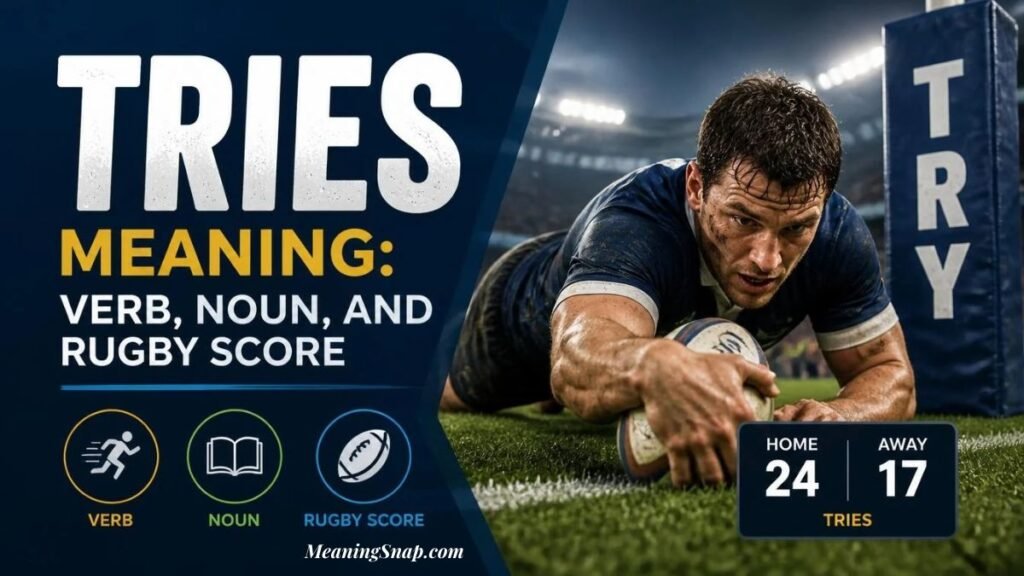
The word “tries” does two jobs, and both use the same spelling. Whichever meaning you pick, the tries vs trys answer stays the same.
As a verb, “tries” most often means to make an effort: “Maya tries to stay calm before exams.” Merriam-Webster also lists testing something to see if it works, as in “He tries the light switch,” and tasting food to find out what it’s like. A judge tries a case in court, and a noisy neighbor tries your patience.
As a noun, “tries” means attempts. “After a few tries, the toddler stacked all five blocks.” Sports writers use it for shot and kick attempts too, like three-point tries in basketball.
Rugby gives the word its own meaning. A try is a scoring play in rugby union and rugby league. A player scores one by grounding the ball in the opposing team’s in-goal area, which sits on or behind the goal line. The plural is “tries,” so “The home side scored three tries after halftime” is correct, and “trys” would be a typo there as well. Sports talk doesn’t change the tries vs trys rule, because a plural noun follows the same spelling pattern as the verb.
He Tries or He Trys? Using Tries With He, She, and It
Present tense gives try two forms. Use “try” with I, you, we, and they. Use “tries” with he, she, it, and any single person or thing. This table lays out the full set.
| Form | When to use it | Example |
|---|---|---|
| try | I, you, we, they | We try the new cafe every payday. |
| tries | he, she, it | She tries the new cafe first. |
| tried | Past tense, any subject | They tried the bakery last week. |
| trying | With is, are, was, were | I’m trying to save money. |
So “he tries” is right, and “he trys” is a misspelling no matter how fast you type.
What Comes After Tries
Most of the time, “tries” is followed by “to” and a base verb: “He tries to call his grandma every Sunday.” The verb after “to” stays plain. It’s “tries to call,” never “tries to calls.”
You’ll also see “tries” followed by an -ing word. The Random House dictionary notes that the meaning can shift between the two patterns. “She tries to open the jar” describes an effort. “She tries opening the jar under hot water” describes testing a method.
Then there’s “try and,” as in “I’ll try and call you.” The Random House Unabridged dictionary says that pattern has been standard since the 17th century, but it works only with the base form, not with tries, tried, or trying. So “he tries and calls” describes two separate actions. Stick with “tries to” when you mean one effort.
Tries vs Trys With Different Subjects
The subject decides the verb. A single name, noun, or pronoun takes “tries”: Maya tries, the dog tries, my phone tries, the person who tries. Two subjects joined by “and” take “try”: “Maya and Leo try again.”
Words like everyone, everybody, someone, and each count as singular too, so you write “everyone tries” and “each of us tries.” That’s the same tries vs trys choice as before. The subject only tells you whether you need the s form at all, and once you do, the spelling is always “tries.”
Read More: Knaw or Gnaw: Correct Spelling Explained (2026 Guide)
Tries Out, Tries On, and Other Phrases With Tries
Phrasal verbs, which pair a verb with a small word like “out” or “on,” follow the same rule. Only the verb changes, and the small word stays put.
“Priya tries out for the school play every spring” uses “tries out” to mean auditions or tests herself. “He tries on three jackets before picking one” means he wears each one to check the fit. “Leo tries his hand at baking this weekend” means he attempts something new. And “Nora tries her best” simply means she makes a full effort. In every phrase, writing “trys out” or “trys on” repeats the original mistake.
Tries vs Trys in Real Texts, Emails, and Captions

These six examples show the correct form in everyday situations, including two incorrect-to-corrected pairs.
Text message (playful): Incorrect: “Dad trys to use emojis and sends the wrong one every time.” Correct: “Dad tries to use emojis and sends the wrong one every time.” Dad is one person, so you need the he/she/it form, and the r before the y turns it into ies.
Email (neutral): “Our manager tries to reply to every message by noon.” A single manager takes “tries,” the same way “she” would.
Social caption (cute): Incorrect: “Baby trys spaghetti for the first time 🍝” Correct: “Baby tries spaghetti for the first time 🍝” Here “tries” means tastes, one of the verb meanings covered above.
School (surprised): “It took Jordan three tries to pass the driving test.” This is the noun. A plural count of attempts always uses “tries.”
Work (matter-of-fact): “Every new hire tries the training portal on day one.” “Every new hire” counts as one person at a time, which is why the verb takes the singular form.
Group chat (frustrated): “She tries so hard, and nobody even says thanks.” Same rule, different mood. The spelling doesn’t change with the tone.
Common Mistakes Around Tries vs Trys
“Trys” isn’t the only slip. These five come from the same y rule or from mixing up verb forms.
- Doesn’t tries. After does, doesn’t, and did, the verb goes back to its base form. It’s “She doesn’t try,” not “She doesn’t tries.” The word “does” already carries the s.
- Tryed. The past tense is “tried,” using the same y-to-i swap as tries. “Trying,” on the other hand, keeps its y.
- Tryes. This spelling adds es without removing the y. The rule says swap, not stack.
- Try’s. An apostrophe plus s forms a possessive, not a plural. APA Style states that apostrophe s is never the way to make a noun plural, so “three try’s” is wrong and “three tries” is right.
- Tense mix-ups. “Yesterday she tries the new place” blends present and past. Use “tried” for yesterday and “tries” for right now.
The Same Rule in Cries, Flies, and Worries
Once you spot the pattern behind tries vs trys, other verbs stop being a problem. This table shows the letter before the y and the form it produces.
| Base verb | Letter before the y | He/she/it form |
|---|---|---|
| cry | r (consonant) | cries |
| fly | l (consonant) | flies |
| worry | r (consonant) | worries |
| study | d (consonant) | studies |
| play | a (vowel) | plays |
| enjoy | o (vowel) | enjoys |
So “crys,” “flys,” and “worrys” make the same mistake as “trys” when you use them as verbs.
A Proofreading Shortcut for Trys
Spell check catches “trys” most of the time, but it can slip through in captions, usernames, and quick replies. Before you publish anything, search your draft for “trys.” Do the same for “crys,” “flys,” and “worrys.” One search takes a few seconds and clears out the whole family of mistakes, including the tries vs trys slip.
Tries vs Trys Quick Self-Test

Fill in each blank, then check the answers below the list.
- My sister ___ a new hairstyle every summer. (try)
- He doesn’t ___ hard enough. (try)
- Last night we ___ the new ramen place. (try)
- It took the team two ___ to solve the puzzle. (try)
- Pick the correct sentence: “She always trys to help” or “She always tries to help”?
- Fix the error: “Nobody trys harder than Ava.”
- Choose the right form: “Ben and Ali (try/tries) again.”
- Fill the blank: “She ___ out for the soccer team tomorrow.” (try)
Answers: 1. tries. 2. try. 3. tried. 4. tries. 5. “She always tries to help.” 6. “Nobody tries harder than Ava.” 7. try, because two subjects joined by “and” take the plain form. 8. tries.
Read More: Rapport or Repore? The Correct Spelling Explained
FAQs
Is trys ever correct?
Not as a form of the English word “try.” The letters can show up in names, place names, or other languages, but in the tries vs trys choice, “tries” is the only accepted English spelling.
Is the tries vs trys rule different in British English?
No. The British Collins dictionary and the American Random House dictionary both list “tries,” so the spelling is the same on both sides of the Atlantic.
How many points is a try worth in rugby?
Five points in rugby union and four in rugby league. The plural is “tries” in both.
Is it “tries out” or “trys out”?
It’s “tries out.” The verb takes the ies spelling and “out” stays the same, as in “She tries out for the team.”
Is tries singular or plural?
It depends on the job. As a verb, “tries” is singular, as in “she tries.” As a noun, “tries” is plural, as in “two tries.”
Is tries formal or informal?
Neither. It’s the standard spelling in formal and casual writing alike. Shortened slang like “tryna” is a separate, intentional informal form, not a spelling of “tries.”
Do names ending in y follow the same rule?
No. APA Style says a surname is usually made plural by adding s, so the plural of Kennedy is Kennedys. That rule covers plural names only, so it doesn’t make “trys” acceptable.
One Last Check Before You Send
Next time the squiggle appears, glance at the letter before the y. A consonant means ies, so “tries” wins every round of tries vs trys, whether you’re texting, emailing, or posting a caption. Then hit send.

Alex Morgan is a writer focused on explaining slang, words, phrases, acronyms, and popular expressions in a simple and easy-to-understand way. Through clear explanations and helpful examples, Alex helps readers quickly understand what words and phrases mean and how they’re commonly used.