Picture the office holiday party. Someone suggests a gift swap, you groan, and a coworker says, “Don’t be such a Grinch.” Now you’re wondering whether you just got insulted. The grinch meaning is simple: a grinch is a grumpy person who spoils the fun for everyone else, usually around Christmas.
Whether it stings depends on tone, and that’s where most people get stuck. The word also has a backstory. It comes from a green, cave-dwelling character in a 1957 Dr. Seuss book, and that story changes how the word lands.
Below you’ll find the grinch meaning, six chats that show the tone shifting, the movie versions people mix up, and a few good replies for when the label gets aimed at you.
Grinch Meaning in Everyday Talk
The short answer to the grinch meaning question: a grinch is someone who drags down the mood or kills other people’s enjoyment. Merriam-Webster treats the word as a noun for a grumpy spoilsport, and Britannica’s dictionary labels it informal US English for an unpleasant person who ruins other people’s fun.
Dictionary.com adds a detail most pages skip. It defines a grinch as a person or a thing that dampens the pleasure of others. So a rainstorm on picnic day can be a grinch too, though people mostly aim the word at humans.
Christmas is home turf, but the grinch meaning isn’t locked to December. It fits anyone who plays the buzzkill: the neighbor who shuts down a block party at 8 p.m., the friend who vetoes every plan, the boss who cancels the team lunch. The mood is what counts, not the calendar.
Read Also: Slang for Friends: 100+ Popular Terms People Use in 2026
Is Calling Someone a Grinch an Insult?
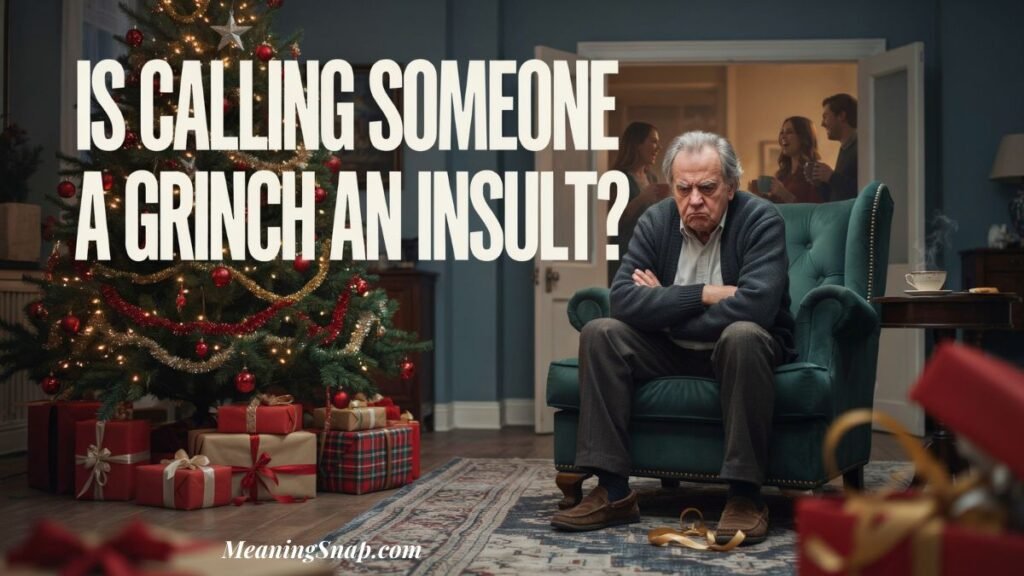
It can be, but it doesn’t have to be. The grinch meaning sits on a sliding scale. Between friends, with a smile or a laughing emoji, it’s teasing. From a stranger or a boss with a flat tone, it reads as criticism.
Here’s the thing that softens it. The original Grinch changes by the end of his story, so a friendly “Grinch” often carries a wink: grumpy now, but you’ll come around. That undertone helps explain why it’s such an easy word to toss around at holiday time.
Six short chats show how the tone shifts.
Group chat, playful:
Maya: Who’s up for decorating the office tree this Friday? Dev: It’s the second week of November. Maya: Okay, Grinch. The tinsel is happening anyway.
Maya teases Dev for resisting early decorations. Nobody’s hurt, and that “okay” tells you she’s laughing.
Coworkers, sarcastic:
Priya: Mandatory karaoke at the team party. Everybody sings. Tom: Wonderful. Put me down as the office Grinch. Priya: You say that every year, then sing the loudest.
Tom hangs the label on himself in a dry voice, and Priya calls his bluff. Used this way, the word works as a joke about reluctance, not a real complaint.
Family, sincere:
Aunt: Not one light on the house yet. Such a Grinch this year. Jordan: I’m not a Grinch. I’m worn out and the budget’s tight.
The aunt means a light jab, but Jordan hears a judgment. Answering with the real reason, instead of laughing it off, is a fair move when the label stings.
Neighbors, frustrated:
Alex: The landlord just banned our rooftop party. Sam: Seriously? What a Grinch.
Sam aims the word at a decision-maker, and Christmas appears nowhere in the chat. It simply means “the person who killed our fun.”
Friends, surprised:
Leah: Wait, you signed up for the toy drive? Omar: Yep. Wrapped forty gifts last night. Leah: Omar the Grinch? Your heart grew three sizes!
Leah borrows the story’s big moment, when the Grinch’s shrunken heart swells after he changes his mind. She’s saying the grump just turned generous.
Social caption, self-deprecating:
Officially a Grinch this year. Send cocoa.
The writer owns a low-energy mood and asks for comfort. Here the word feels almost cozy.
Read Also: What Does ‘Advent’ Mean? The Christmas Countdown, Calendars, and the Four-Week Season
Being Grumpy vs Being a Grinch
A bad mood alone doesn’t make someone a grinch. The grinch meaning needs an audience, because the whole idea is spoiling the pleasure of others. Someone who skips the party and quietly watches a show at home is grumpy, sure, but not a grinch. The same person turns into one when they trash the plan, mock the decorations or sigh loudly through the toast.
That clears up a question many readers have: is a loner or a Christmas skeptic automatically a grinch? Not by the grinch meaning alone. Someone who simply doesn’t celebrate, and lets everyone else celebrate in peace, isn’t ruining anything. The label fits when the mood spreads and the fun shrinks.
The Grinch himself follows this rule. He didn’t just dislike Christmas up on his mountain. He came down and took it from the Whos.
Where the Word Comes From
Dr. Seuss, whose real name was Theodor Seuss Geisel, published How the Grinch Stole Christmas! in 1957. The Grinch is a grouchy creature who lives in a cave on Mount Crumpit, high above the town of Whoville. His heart is two sizes too small, and his only company is his dog, Max.
Annoyed by the Whos’ holiday cheer, he sneaks down and steals their presents and decorations. Then he drives the sleigh to the top of the mountain, ready to dump the loot. But the Whos sing anyway. He realizes Christmas means more than presents and feasts, his heart grows three sizes, and he brings everything back and joins their feast.
Dictionary sources disagree on one point. Dictionary.com credits Seuss with coining the word in that book. Vocabulary.com says he didn’t invent it but made it a household word. The safe claim is the one both agree on: the book is where the word took off.
The 1966 TV special pushed it further. Boris Karloff narrated and voiced the Grinch, and Seuss wrote the lyrics to “You’re a Mean One, Mr. Grinch.”
Later versions kept tweaking his motives. The 2000 film adds a backstory in which classmates tease him as a kid. Each version changes why he’s grumpy, but the grinch meaning stays put: the word describes the spoiled fun, not the backstory.
Read Also: Hood Slang Meaning: Words, Phrases & Terms Explained
Which Grinch Are People Searching For?
Search results for “grinch” mix two things: the word and the character. Plenty of people who type it want a movie, not a definition. This table shows how the main versions line up, so you know which one a friend means.
| Version | Year | Who’s in it | Worth knowing |
|---|---|---|---|
| Book | 1957 | Written and illustrated by Dr. Seuss | The source of the word |
| TV special | 1966 | Boris Karloff as narrator and the Grinch’s voice | Directed by Chuck Jones |
| Live-action film | 2000 | Jim Carrey as the Grinch, Taylor Momsen as Cindy Lou Who | Directed by Ron Howard |
| Animated film | 2018 | Benedict Cumberbatch as the Grinch, Cameron Seely as Cindy Lou Who | Made by Illumination, with Pharrell Williams narrating |
| Sequel | In development | Jim Carrey reported in talks to return | No confirmed release date found |
Taylor Momsen played Cindy Lou Who in the 2000 film, not the 2018 one. A few cast pages online mix that up.
As for a “new Grinch movie,” nothing new has been released. Reports from June 2026 say Universal and Imagine Entertainment are developing a sequel, with Ron Howard set to direct. A separate video game, The Grinch 2: Saving Christmas, was scheduled for September 18, 2026.
None of this changes the grinch meaning. The word comes from the character’s personality, not from any single movie.
Grinch Meaning Compared With Scrooge, Killjoy and Party Pooper
Grinch isn’t the only word for a mood-spoiler. This table shows what each one targets.
| Word | What it targets | Where it comes from | Example |
|---|---|---|---|
| Grinch | Other people’s fun and mood | Dr. Seuss’s 1957 book | “He canceled movie night. Total grinch.” |
| Scrooge | Money and stinginess | Ebenezer Scrooge in Dickens’s A Christmas Carol (1843) | “She won’t chip in for the gift. Such a Scrooge.” |
| Killjoy | Anyone who spoils fun | Everyday dictionary word | “Quit being a killjoy and play one round.” |
| Party pooper | Same as killjoy, said more casually | Casual idiom | “Don’t be a party pooper. Stay for cake.” |
Common Mistake: Mixing up Grinch and Scrooge. Use Scrooge when the problem is stinginess and grinch when the problem is a bad attitude toward other people’s fun. A friend who tips well but groans at every group plan is a grinch, not a Scrooge.
Both characters do end their stories changed. Scrooge gets visited by three ghosts, and the Grinch gets a lesson from a singing town. Both stories end with a change of heart, though the two words point at different flaws.
Phrases and Word Forms You’ll Hear
The grinch meaning shows up in a few set phrases. Here’s what each one signals.
- “Don’t be such a grinch.” A nudge to join in, usually friendly.
- “Play grinch.” Merriam-Webster’s example sentences use it for taking the spoilsport role.
- “Look like the grinch.” One Merriam-Webster example jokes about looking like him, so the word covers appearance as well as mood.
- “The grinch who stole Christmas.” People stretch it to anyone who takes a group’s fun away, as in “the grinch who stole our long weekend.” The theft is figurative.
Wiktionary lists “grinchy” as an informal adjective built from grinch plus the -y ending, as in “feeling grinchy about the group trip.” “Grinch-like” works the same way and shows up in usage guides.
One usage site says you can stretch grinch into a verb. No dictionary I checked lists it, so treat “stop grinching” as playful improvisation rather than standard English.
Read More: WWA Meaning in Text: What It Stands For and How to Read It
Grinch Bots and Where Else the Word Shows Up
The word has also moved into shopping and tech. “Grinch bots” are automated programs that buy up in-demand holiday items, like popular toys and game consoles, so sellers can resell them at higher prices. Lawmakers and news outlets use the term, and a bill called the Stopping Grinch Bots Act has been introduced in Congress more than once.
The link back to the grinch meaning is clear. The bots spoil the holiday for everyone trying to buy a gift.
The word isn’t a December-only visitor, either. Example sentences on Merriam-Webster and Dictionary.com come from news items dated February, March and September. Britannica’s dictionary labels the word informal, so keep it out of formal reports and contracts. Friendly emails, captions and group chats are fair game.
Say It or Skip It: A Three-Question Check
The grinch meaning leans negative, so run through three quick questions before you call someone a grinch.
- Do you know them well enough to tease them? Close friends and family can take it. Near-strangers often can’t.
- Is the mood light? A joke lands in a laughing group chat and flops in a tense meeting.
- How big is the thing they spoiled? Skipping a gift swap earns a poke. Cancelling a kid’s party earns a harder look.
If you answer yes, yes, small, go ahead. Any other combination, pick a different word or say nothing.
How to Reply When Someone Calls You a Grinch
Once you know the grinch meaning, you’ve got three good moves, and the right one depends on the tone you heard.
- Own it with a laugh: “Guilty. Where’s the cocoa?” This fits a playful label.
- Give the real reason: “I’m tired, and I’d rather skip the loud party.” This fits a jab that felt personal.
- Set a limit: “I’m fine skipping it. Please stop calling me that.” This fits a label used as pressure.
Skip the clever comeback if the word feels like pressure. A calm, short answer ends the topic faster than a witty one. In a text thread, tone vanishes, so one emoji or a joke tells the other person you took it lightly.
Frequently Asked Questions
Is grinch a bad word?
No. The grinch meaning is an informal noun for a spoilsport, not a curse word. Tone decides whether it reads as teasing or criticism.
Should grinch be capitalized?
Use a capital G for the character and a lowercase g for a person who acts like him. Dictionaries list the common noun in lowercase.
Why does the Grinch hate Christmas?
The book’s narrator floats a few jokey reasons, like tight shoes, before landing on his too-small heart. The 2000 film adds a backstory about being teased as a kid.
Do people in the UK use the word grinch?
Britons know the character, and dictionary entries for the word exist on both sides of the Atlantic. Britannica’s dictionary does label it US informal.
Where can I watch the Grinch movies?
It changes by country and season, so check a tracker like JustWatch first. One guide updated on November 9, 2026 lists all three versions on Peacock in the US.
Keep the Grinch Meaning Light and the Label Friendly
Next time you hear the word, listen to the tone before you react. Often the grinch meaning is a grin in disguise, a way of saying you’re being a bit of a buzzkill right now. If you use it yourself, aim it at small moods, say it with a smile, and use the three-question check when you’re unsure. If someone aims it at you, remember how the story ends. Even the original Grinch ended up at the table.

Alex Morgan is a writer focused on explaining slang, words, phrases, acronyms, and popular expressions in a simple and easy-to-understand way. Through clear explanations and helpful examples, Alex helps readers quickly understand what words and phrases mean and how they’re commonly used.