Your cousin texts the family chat: “Advent starts Sunday!” Meanwhile, your kid’s calendar has a little door marked 1 that opens on December 1. So who’s right?
Both. The advent meaning most people search for is simple. Advent is the Christian season of preparation before Christmas, and the word itself means “arrival” or “coming.” In 2026, the season starts Sunday, November 29, and ends December 24. Advent calendars run December 1 through 24.
Turns out, one word covers a church season, a cardboard countdown, and a formal way to say something new has shown up. This guide covers the dates, the four weekly themes, how the calendar tradition began, and the other places you’ll spot the word, from the NeeDoh calendar everyone’s hunting for to company names like AdventHealth.
When Does Advent Start in 2026?
Advent always begins on the fourth Sunday before Christmas. That makes it the Sunday closest to November 30, the feast of St. Andrew. Christmas can land on any day of the week, but Advent always holds four Sundays, so the start date shifts every year. It can fall anywhere from November 27 to December 3.
This year it’s the 29th. That makes the 2026 season 26 days long, from the first Sunday through Christmas Eve. The advent meaning explains why the date is tied to Christmas: it’s a season of waiting for something, so it has to be counted back from the day that something arrives.
Here’s how the key dates line up.
| Date | What it marks |
|---|---|
| Sunday, November 29 | First Sunday of Advent, the start of the season |
| Tuesday, December 1 | Door number one on most Advent calendars |
| Sunday, December 6 | Second Sunday of Advent |
| Sunday, December 13 | Third Sunday, known as Gaudete Sunday |
| Sunday, December 20 | Fourth Sunday of Advent |
| Thursday, December 24 | Last day of Advent, Christmas Eve |
Common Mistake: Treating the 24 doors as the whole season. Calendars start on December 1 because they count down to Christmas Eve. The church season can start earlier or later than that, depending on the year. When someone says “Advent starts Sunday,” they mean the season, not door number one.
The first Sunday has two common names. “Advent Sunday” and “First Sunday of Advent” mean the same day. In Western Christianity, it also kicks off the church year, which is the annual cycle of feast days and Bible readings.
Advent Meaning and Where the Word Comes From
The word is Latin. Adventus meant “arrival” or “approach,” and it grew out of advenire, which joins ad (“toward”) and venire (“to come”). English borrowed it in the 12th century.
The religious advent meaning came from a translation choice. St. Jerome, who produced the Latin Vulgate Bible, used adventus to translate the Greek word parousia. That Greek term described the arrival of an important person, and the New Testament uses it for Christ’s return.
So Advent carries two layers. One looks back to the birth of Jesus at Christmas. The other looks ahead to the Second Coming, the Christian belief that Christ will return. That double advent meaning is why the season feels reflective as well as festive.
Where did the season itself begin? Nobody can say for sure. Historians point to an old custom in Gaul, roughly modern France, of preparing for baptism ahead of Epiphany on January 6. Liturgical scholar J. Neil Alexander has written that no origin story for Advent can be claimed with confidence. By about the 9th century, the first Sunday of Advent marked the start of the church year in the West.
The Latin root also explains a few relatives. “Adventure” comes from a Latin phrase for something about to happen. “Prevent” and “invent” share the venire root too, with meanings built on “come before” and “come upon.”
Read Also: Audiodisplayed Meaning: What It Is and Where It Comes From
The Four Themes Behind the Advent Meaning: Hope, Peace, Joy and Love

People who search “what are the 4 meanings of Advent” usually want the four weekly themes. Churches pair each Sunday with one theme, and each candle on the Advent wreath gets a matching name. This four-theme version of the advent meaning is the one printed in most church bulletins.
Here’s the most common pairing.
- Week one: Hope, often called the Prophecy candle
- Week two: Peace, the Bethlehem candle
- Week three: Joy, the Shepherd’s candle
- Week four: Love, the Angel’s candle
No single official list exists, though. Some churches swap joy and love, and others use “preparation” in place of peace. If your church bulletin differs from a website, nobody’s wrong.
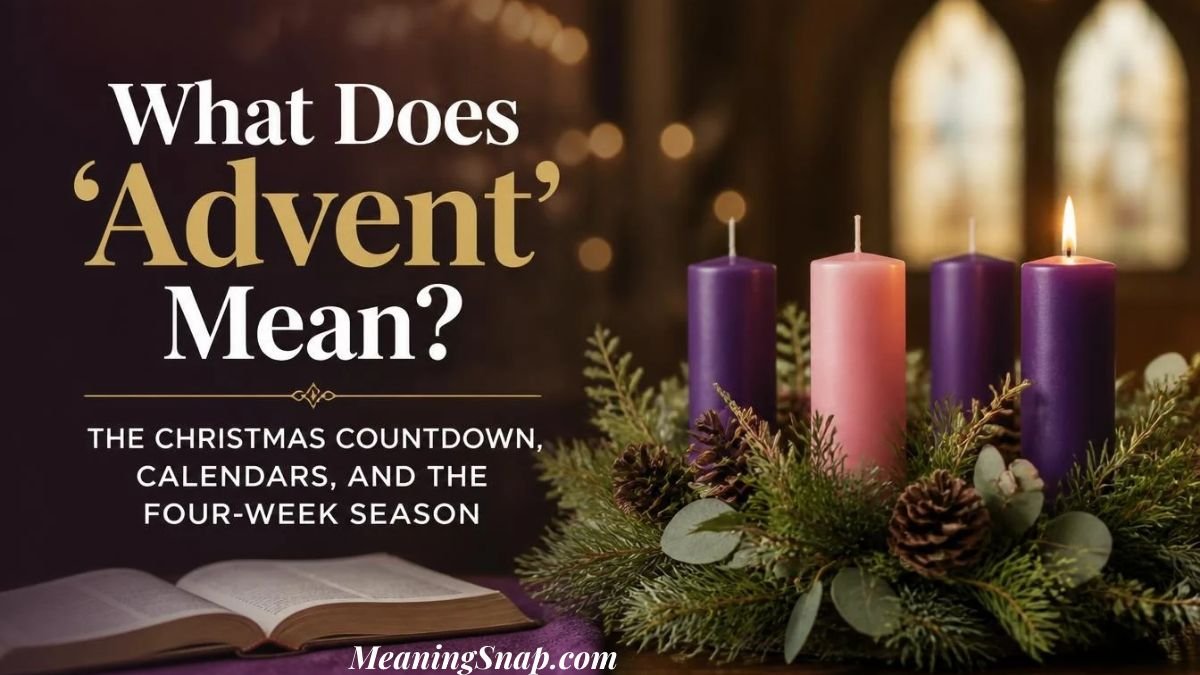
The wreath itself is a circle of evergreens with four candles, and one more gets lit each Sunday. Traditionally, three candles are purple and one is rose. Some wreaths add a white Christ candle in the middle for Christmas Eve or Christmas Day, and many Protestant churches use blue or all-white candles instead.
The wreath is younger than most people expect. In 1839, a Lutheran pastor named Johann Hinrich Wichern in Hamburg built one for the boys at his mission home. He used a wooden wagon wheel with 20 small red candles for weekdays and four large white ones for Sundays. Greenery came later.
Read More: Slang for Friends: 100+ Popular Terms People Use in 2026
Advent in Catholic, Protestant and Orthodox Churches
The advent meaning stays the same across churches, but the details change. Advent is mainly a Western Christian season.
In Catholic churches, Advent opens the liturgical year. Since around the 13th century, violet has been the usual color, with rose allowed on Gaudete Sunday. Many Protestant churches observe Advent as well, and the wreath has Lutheran roots, though candle colors and themes vary by congregation.
Eastern Orthodox churches have a parallel period called the Nativity Fast. It differs from Western Advent in meaning, length and observances, and it doesn’t start the church year. It’s often described as lasting forty days.
So when this guide says Advent, it means the Western version, with four Sundays and a start on November 29 this year.
How the Advent Calendar Started
Early Advent calendars were homemade. In 19th-century Germany, families, many of them Lutheran, found ways to count the days, such as hanging a devotional picture each day. The first known handmade wooden calendar dates to 1851.
Printed calendars came in the early 1900s, and the details get messy. A Hamburg bookseller named Friedrich Trümpler printed a “Christmas clock” in 1902. The name most people credit is Gerhard Lang, a Munich publisher. Sources date his first printed calendar to either 1903 or 1908, and they disagree on whether the early versions had real doors or pictures to paste over windows. What stays consistent is the backstory: Lang remembered a homemade cardboard countdown his mother made for him as a boy.
Calendars with doors spread in the 1920s. Production stopped during World War II because cardboard was rationed. Since then, the format has grown from a children’s paper keepsake into a retail category.
The wreath and the calendar share a purpose. Both help children, and impatient adults, see how much waiting is left.
Why Advent Calendars Are Everywhere Now: NeeDoh, Jam and Cans
Stores start stocking calendars in late summer these days. The format outgrew the church, and brands treat 24 doors as a product shape no matter what’s inside. A few 2026 examples show how far it has stretched.
| Type | Example | Behind the doors |
|---|---|---|
| Toys | NeeDoh Squishmas Advent Calendar (Schylling) | 24 mini squishy toys, about 1.25 inches tall, for ages 3 and up |
| Food | Bonne Maman 2026 Limited Edition | 24 small jars of seasonal fruit, caramel and chocolate spreads |
| Drinks | Red Bull 2026 | Energy drink cans, plus a QR code that opens a mini-game |
| Tools | Wera 2026 | 24 tools and accessories, including a screwdriver-flashlight hybrid |
The NeeDoh calendar is the one many kids and parents are hunting for this season. Stock has been patchy. As of late September, Schylling’s own store had paused new orders, and several independent toy shops listed it as sold out. Fakes circulate because the real one is hard to find, so buy from Schylling or a retailer you know. A price that looks too good from a seller you’ve never heard of is a warning sign. Check the year on the listing too, since earlier editions still circulate.
Some brands now stretch “advent calendar” to any door-by-door countdown. NeeDoh sells a Halloween version with 13 doors, for example. Strictly speaking, Advent belongs to Christmas, so that’s a borrowed label. It still shows what the advent meaning has become in stores: a countdown with a surprise behind each door.
Advent Meaning in Everyday English
Outside church, advent with a lowercase a means the arrival of something notable, usually something new. It shows up as “the advent of” in news and essays, as in “the advent of smartphones” or “the advent of spring.” The everyday advent meaning reads formal, even a little literary, so you’ll rarely see it in a text message.
Capitalize it for the church season, as in Advent Sunday. Keep it lowercase in the general sense.
Several synonyms overlap with advent, though each has its own feel.
| Word | Feel | Example |
|---|---|---|
| Advent | Formal, a notable new arrival | The advent of AI tools changed how our team plans content. |
| Arrival | Neutral and everyday | The arrival of the new phones sent people lining up outside stores. |
| Dawn | Big, hopeful new era | The dawn of streaming changed how we watch TV. |
| Onset | Often something unpleasant | The onset of winter meant scraping the car every morning. |
| Emergence | Gradual appearance | The emergence of short-form video reshaped social media. |
If advent sounds stiff in a casual message, swap in “arrival” and nobody will blink.
AdventHealth and Advent International: Same Word, Different Story
You might land here after searching “advent health” or “advent company,” so here’s the quick sort.
AdventHealth is a U.S. health system. It took that name in January 2019, replacing Adventist Health System. It’s sponsored by the Seventh-day Adventist Church but isn’t owned directly by it. The church’s name centers on the hope of Christ’s Second Coming, so the root word is the same Latin “coming.” Even so, the health system has no tie to the advent calendar or the December season. For appointments or care questions, its official site is the place to go.
Advent International is a different organization entirely. It’s a private equity firm in Boston, founded in 1984. The name shares the Latin root, but the firm invests in companies and has no link to the church season. Neither name changes the advent meaning for the season itself.
Read Also: Hood Slang Meaning: Words, Phrases & Terms Explained
Advent Meaning in Real Chats and Captions

Here’s how the advent meaning plays out in real conversations, with a different tone each time.
Casual:
Mia: wait, is advent the same as december 1st?
Dev: Nope. Advent starts the 29th this year. The calendar doors just begin on the 1st.
The church season and the calendar start on different days, and Dev keeps the two apart.
Sarcastic:
Priya: Cool, the grocery store put out advent calendars in September.
Leo: Advent’s still two months away. Retail doesn’t wait.
Priya is joking about stores selling countdown products long before the season. Leo answers in the same dry tone.
Sincere:
First Sunday of Advent. Lit the first candle tonight and thought about everyone I’m grateful for.
A caption like this treats Advent as a season of reflection. The first candle usually stands for hope.
Surprised:
Noah: Wait, there’s a Halloween advent calendar?
Ana: Yep. Stores use advent for any countdown with doors now.
Noah just learned that retail stretches the word past Christmas. Ana confirms it without making a big deal of it.
Frustrated:
Jess: I’ve checked five sites and the NeeDoh advent calendar is sold out everywhere.
Sam: Stick with Schylling or a store you trust. Sketchy resellers sell fakes.
Jess is venting about stock. Sam gives the practical fix.
Playful:
Eli: Day 1 of my advent calendar and I already ate the chocolate from day 4.
Zoe: That’s not how a countdown works.
Eli is joking about impatience, which is the exact problem the calendar was built to solve.
FAQs
Is Advent the same as Christmas?
No. Advent is the run-up, and Christmas is the celebration on December 25.
Does Advent end on Christmas Eve or Christmas Day?
It ends on Christmas Eve, which is Thursday, December 24 in 2026. Christmas Day begins the Christmas season.
Is Advent meaning only religious?
No. The word means “arrival” in general English, and the church season is one specific use of it.
Do you have to be religious to use an advent calendar?
No. Most store-bought calendars are simple countdowns to Christmas, and people of any background use them.
Why is one Advent candle pink?
The third candle is rose-colored for Gaudete Sunday, a Latin name meaning “rejoice.” It marks the theme of joy, while the other three candles are purple.
Is AdventHealth connected to the Advent season?
Not directly. The name comes from the health system’s Seventh-day Adventist heritage, not the December season.
Before Advent Starts on November 29
Mark Sunday, November 29 for the church season and open the first calendar door on Tuesday, December 1. If you see Advent on a church bulletin, it’s the season. On a box with numbered doors, it’s a countdown. In a line like “the advent of streaming,” it just means arrival. Context settles the advent meaning every time.

Alex Morgan is a writer focused on explaining slang, words, phrases, acronyms, and popular expressions in a simple and easy-to-understand way. Through clear explanations and helpful examples, Alex helps readers quickly understand what words and phrases mean and how they’re commonly used.