Last month, my cousin sent me a text out of nowhere: “wyf?” No punctuation, no other context, nothing. I stared at my phone for a good ten minutes trying to work out if she wanted my location, my favorite show, or something else entirely. If you’ve landed here wondering the same thing, you’re in good company. The WYF meaning in text trips up more people than you’d think, and the confusion makes sense once you see why. Three letters, three fairly different questions, depending on who sends them and where.
Here’s the thing: WYF isn’t one of those slang terms with a single locked-in definition. It shifts depending on the app, the person, and the mood of the conversation. This guide breaks down every version of WYF you’re likely to run into, from Snapchat DMs to dating apps to group chats with friends who talk in nothing but abbreviations, so you never have to guess again.
What Does WYF Mean in Text?
The short answer: WYF meaning in text points to “Where You From?” more often than anything else. It’s the version you’ll see most, especially when you’re chatting with someone new online or meeting people through mutual friends on social media platforms like Snapchat, Instagram, or TikTok.
Quick Answer: WYF most commonly stands for “Where You From?” It occasionally means “What’s Your Favorite?” or “What You Feeling?” depending on who’s texting and why.
People send WYF as a fast way to ask about your hometown, city, or country without typing the whole question out. It fits the casual, friendly tone most online conversations run on, and it works as a natural conversation starter between two people who don’t know each other well yet.
Here’s what this looks like in a real exchange:
Maya: hey! new follower lol Jordan: hii, thanks for the follow Maya: wyf? Jordan: Chicago, you? Maya: Toronto! nice to meet you
In this exchange, the WYF text meaning is exactly what it looks like: a quick question about where Jordan lives. No hidden agenda, no confusion, simply two people getting to know each other through casual texting. If you’ve ever typed “whats wyf mean” into a search bar mid-conversation, this is the answer nine times out of ten.
WYF fits naturally into text messages, DMs, and other casual, friendly settings. It fits less naturally into professional emails, business meetings, or academic writing, where spelling the full question out reads as more appropriate. Save the abbreviation for informal, relaxed conversations rather than formal ones, and the tone will land the way you intend.
Where Did WYF Come From?
Texting abbreviations like WYF didn’t appear overnight. They grew out of a simple problem: early text messages had character limits, and every letter counted. People started shortening common questions to save time and effort, and “Where You From” became “WYF” somewhere along the way, the same path “Where You At” took to become WYA and “What You Doing” took to become WYD.
Spoken English already drops words in casual conversation. Nobody says “Where are you from” to a stranger at a party. They say “Where you from,” dropping “are” without thinking about it. WYF text meaning follows this pattern exactly, simply compressed further for typing speed.
As texting culture moved from SMS to apps like WhatsApp, Snapchat, and Instagram, the abbreviation stuck around because it still does its job. It’s short, it reads as friendly rather than formal, and it works across nearly every messaging platform without needing explanation, at least among people already familiar with internet slang. Understanding the origin also explains why the WYF meaning in text stays consistent across platforms even as texting habits change.
This is part of a bigger pattern in modern communication. Abbreviations like WYF, WYA, WYD, and WYLL exist because typing full sentences on a phone screen slows conversations down. Once a shorthand catches on with younger internet users, it spreads fast through group chats, comment sections, and online gaming chats, until it becomes part of the default vocabulary for an entire generation of texters.
WYF Meaning on Snapchat, Instagram, and TikTok
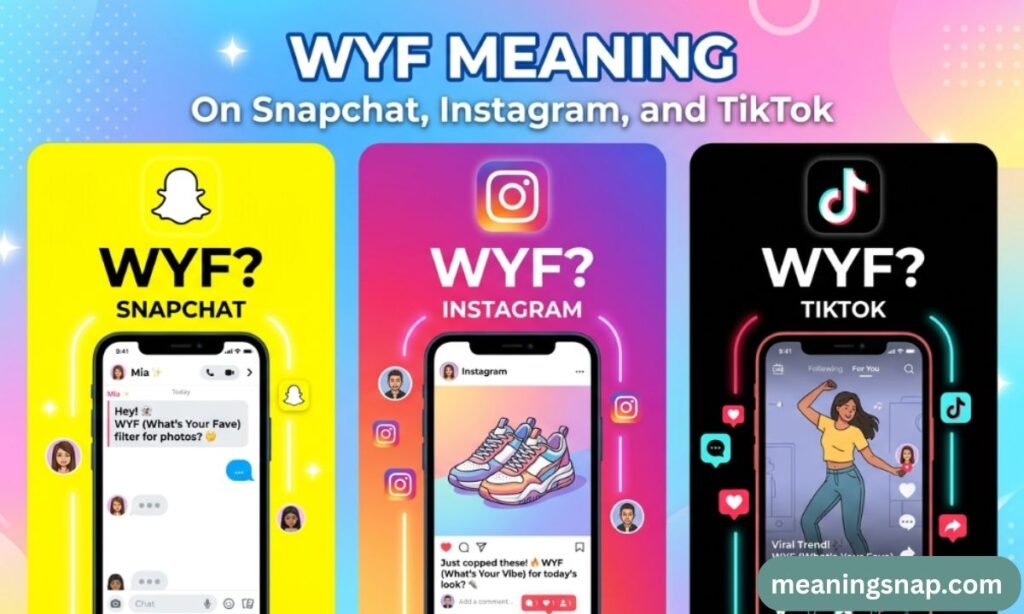
Ask ten people where they see WYF most, and Snapchat comes up first almost every time. Between Quick Add features and friend-of-friend connections, Snapchat throws strangers together constantly, and WYF becomes the go-to opener when two people match through mutual friends but have no other context about each other.
Priya: hey, we have mutual friends lol Noah: oh nice, hey! Priya: wyf Noah: LA, you? Priya: NYC! small world
On Instagram, WYF meaning Snapchat-style behavior carries over almost exactly. It shows up in DMs after someone follows a new account, comments on a post, or replies to a story. The tone stays light and curious rather than intense.
TikTok adds a small twist. Because comment sections are public, WYF often turns into a mini icebreaker thread under a video, with several people replying to a creator’s post asking the same question at once. WhatsApp and Facebook Messenger see it too, though usually between people who already know each other loosely through work, school, or shared friend groups.
Group chats add another layer. When a few people ask WYF around the same list of names, it doubles as a fast way to sort out who lives where before planning a trip, without anyone typing a full paragraph. Online gaming chats follow a similar rhythm, players tossing WYF into lobbies while waiting for a match to load.
Across every platform, the core idea stays consistent: WYF is a low-effort way to ask about someone’s location, background, or hometown without sounding overly formal. This consistency is part of why the WYF meaning in text rarely confuses people once they know the platform, since the underlying question stays the same even when the app changes. What shifts is the setting, not the intention behind it.
Other Meanings of WYF You Should Know
While “Where You From” covers most cases, WYF abbreviation meanings shift depending on tone and context. Three other versions show up often enough to matter, and these alternate readings are exactly why the WYF meaning in text isn’t fixed the way some other abbreviations are.
Here’s a quick breakdown of the alternate meanings and where you’re likely to run into them:
| Context / Example | What It Means |
|---|---|
| “wyf song right now?” | What’s Your Favorite (asking about preferences) |
| “wyf tonight, you good?” | What You Feeling (checking in emotionally) |
| “wyf work today?” | When You Finish (asking about timing or schedule) |
| “wyf, seriously?” | Rare, sarcastic tone, closer to disbelief |
“What’s Your Favorite” shows up between friends comparing tastes:
Chris: wyf movie of all time Ava: honestly, Inception, you? Chris: gotta go Interstellar
“When You Finish” leans practical, often between coworkers or classmates:
Sam: wyf work today? Taylor: around 6, why? Sam: wanna grab food after
Context does most of the heavy lifting here. A question about a song, a movie, or a schedule signals something different than a stranger asking on Snapchat. Once you notice the surrounding words, the intended meaning usually becomes obvious within a message or two.
Early SMS plans often capped messages around 160 characters, and phone keypads before touchscreens made every extra letter a small cost in time and effort. Shorthand wasn’t so much a trend as a workaround for those limits, and abbreviations with several possible readings, like WYF, grew out of this same drive to type less while still getting a full question across.
WYF on Dating Apps: Icebreaker or Red Flag?
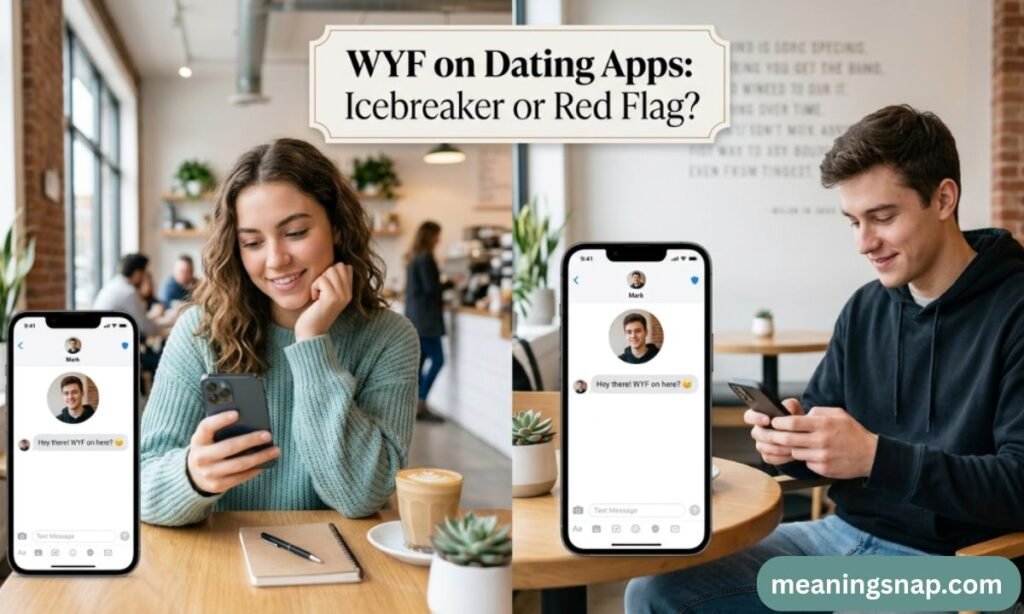
Dating apps changed how people use WYF meaning in text almost as much as Snapchat did. On Hinge, Tinder, and Bumble, WYF shows up constantly as an opening line, right after a match, before either person has shared much of anything.
Used early and paired with a genuine follow-up question, it reads as a normal, low-pressure conversation starter. Plenty of people prefer it to a generic “hey” because it gives the other person something specific to respond to.
Liam: hey! wyf originally? Zoe: born in Seattle, you? Liam: Denver, small world we matched lol
Where it turns into a mild red flag is repetition without follow-through. If someone sends WYF and then goes quiet after your answer, or asks it again in a different phrasing a few messages later, it usually signals a lack of real interest rather than genuine curiosity. Dating app etiquette generally rewards questions building on your answer, not ones existing purely to fill silence.
Timing matters too. A flirty icebreaker tone works fine on match day one. The same question three weeks into a conversation, after you’ve already covered the basics, reads as though the other person wasn’t paying attention.
Dating conversations often move between apps too, starting on Hinge or Bumble and shifting to Instagram or WhatsApp once a match feels comfortable. WYF tends to travel along with the conversation, showing up again on the new platform as a light, familiar way to keep the momentum going rather than starting over from scratch.
How to Reply to WYF (By Situation)
Replying to WYF gets easier once you know which meaning applies, and a few options exist depending on how much you’d like to share.
If the meaning is location-based, several comfortable responses work well:
- Answer with your city or region: “Denver, you?”
- Keep it broader if you’d rather not get specific: “US, you?”
- Turn the question back around before answering: “Guess first, then I’ll tell you”
If the meaning is preference-based (“What’s Your Favorite”), a specific answer keeps the conversation moving better than a vague one. Naming an actual movie, song, or food gives the other person something to respond to, rather than a flat “I don’t know.”
If the meaning leans emotional (“What You Feeling”), a short, honest answer works best. Something like “tired but okay, you?” keeps the exchange natural without overexplaining. Getting the WYF meaning in text right before you reply saves you from an awkward mismatch.
One general rule applies across every version: match the tone you received. A playful WYF deserves a playful reply. A more sincere one, especially from someone checking in on you emotionally, deserves a genuine answer rather than a joke.
Riley: wyf, you good? Devin: honestly kinda drained today, you? Riley: same here, long week for both of us
Notice how Devin’s reply skips small talk and answers the real question behind the abbreviation. Reading the tone correctly before replying keeps conversations feeling natural instead of mismatched.
WYF vs WYA vs WYD vs WDF: Don’t Mix These Up
Texting abbreviations which look similar trip people up constantly, and WYF sits right in the middle of a cluster of easily confused terms.
Here’s how they break down side by side:
| Abbreviation | Meaning | Typical Use |
|---|---|---|
| WYF | Where You From | Asking about location or background |
| WYA | Where You At | Asking about current location |
| WYD | What You Doing | Asking what someone’s up to right now |
| WYLL | What You Look Like | Asking about appearance |
| WDF | What Da Freak / What the… | Expressing shock or confusion |
The easiest mix-up is WYF vs WDF, since the letters look close at a glance and both start with W. WYF asks a calm question about someone’s background. WDF, on the other hand, reads as an outburst, closer to “what on earth happened” than a genuine question about anyone’s hometown. Confusing WYF with WDF changes the WYF meaning in text entirely, shifting a calm question into an outburst, so double-checking before you hit send saves an awkward moment.
Is WYF Safe for Teens? What Parents Should Know

On its own, WYF isn’t offensive or inappropriate. It’s a standard piece of internet slang, and asking where someone’s from doesn’t carry harmful intent by default.
The concern isn’t the abbreviation itself, it’s how much personal information gets shared in response. A general answer like “the US” or “somewhere in Texas” carries little risk. An exact address, school name, or specific neighborhood shared with a stranger online is a different situation entirely, regardless of how casual the question sounded. Parents don’t need to worry about the WYF meaning in text itself, only about how much detail gets shared in response.
A few practical habits help here:
- Stick to general answers (country, region, or nearby city) rather than exact addresses
- Treat WYF from unfamiliar accounts the same as any other question from strangers online
- Keep conversations with new contacts inside platforms with reporting and blocking tools
Gen Z and Millennial texting habits differ slightly here too. Younger users tend to treat WYF as background noise, a question asked and answered without much thought, since it appears constantly across Snapchat and TikTok. Millennials, who grew up with slower-paced texting, sometimes read the same question as more pointed or personal. Neither read is wrong; it’s simply a generational difference in how casual texting feels.
Slang usage trends like this rarely spread through any official rulebook. One group chat borrows a phrase from another, a comment section picks it up, and within a few months it’s part of everyday casual texting across an entire platform. WYF followed this exact path, moving from small pockets of texters into a shorthand most social media users now recognize on sight.
Frequently Asked Questions
What does WYF mean in texting?
The WYF meaning in text is most commonly “Where You From?” It’s used as a casual way to ask about someone’s hometown, city, or country.
What does WYF mean on Snapchat vs Instagram?
The meaning stays the same across both platforms. WYF meaning Snapchat and Instagram DMs both default to “Where You From?” unless the surrounding conversation points to a different context.
Does WYF always mean “Where You From”?
No. While it’s the most common meaning, WYF occasionally stands for “What’s Your Favorite,” “What You Feeling,” or “When You Finish,” depending on the conversation.
Is it normal for a stranger to ask WYF?
Yes, it’s one of the more common openers strangers use on social media and dating apps. It reads as casual rather than invasive in most cases.
What’s a good way to answer WYF without oversharing?
Stick to a general location like your country, state, or region instead of an exact address, especially with someone you’ve only recently started talking to.
Final Thoughts
Three letters, several possible meanings, and a lot of context clues in between. This is the WYF meaning in text in one sentence: mostly simple, occasionally surprising. Most of the time, it’s a low-stakes question about where you’re from, sent by someone curious enough to ask instead of scrolling past your profile in silence.
The next time WYF shows up in your DMs, you won’t need to pause and guess. Check the platform, check the conversation around it, and reply in the tone you were given. My cousin, by the way, wanted my location for a group trip she was planning. Mystery solved, no ten-minute stare-down required.
Slang like this changes fast, and WYF won’t be the last three-letter question to leave you staring at your screen. The pattern stays the same though: look at the platform, look at the words around it, and the meaning almost always shows up before you need to ask.

Alex Morgan is a writer focused on explaining slang, words, phrases, acronyms, and popular expressions in a simple and easy-to-understand way. Through clear explanations and helpful examples, Alex helps readers quickly understand what words and phrases mean and how they’re commonly used.