You’re scrolling through your phone and a text pops up from your best friend, completely out of nowhere. Just three letters: “MYF.” No photo attached, no explanation, nothing before it that gives you a clue. You sit there for a second trying to decide if you’re supposed to feel touched or if you owe someone an apology. The MYF meaning in text actually splits into two very different directions, and figuring out which one applies comes down to reading what happened right before that message landed in your chat.
That’s the annoying part about texting slang. Three letters can carry a completely different weight depending on who sent them and why, and getting it wrong means either missing a sweet moment or brushing off someone’s apology.
What Does MYF Mean in Text?
So, what does MYF mean in texting? The MYF meaning in text comes down to two real phrases people actually use in daily conversation: “Miss Your Face” and “My Fault.” Those are the two you’ll run into in real texts, DMs, and comments. A handful of thin slang sites throw around other guesses, but most of those don’t hold up once you look at how the abbreviation is actually used online.
Quick Answer: MYF usually means one of two things. It’s Miss Your Face, a warm way of saying you miss seeing someone, or My Fault, a fast and casual apology, basically the texting version of “my bad.” Same three letters, two unrelated meanings. Context decides which one you’re looking at.
One acronym covering two unrelated phrases isn’t unusual in texting slang. People shorten whatever phrase fits the moment, and sometimes two completely different phrases just happen to share the same first letters. That’s exactly what happened with the MYF abbreviation.
Outside of texting, the MYF acronym shows up in a couple of unrelated, more formal contexts too. Some Methodist church youth groups use it as shorthand for Methodist Youth Fellowship, and in business or finance settings, MYF can refer to a Multi-Year Forecast. Neither of those has anything to do with the slang version, so if you spot MYF in a spreadsheet or a church bulletin, it’s not the same MYF your friend just texted you.
That’s actually a useful thing to keep in mind with texting acronyms in general. The same three or four letters often get reused across completely different communities, gaming groups, workplaces, church groups, sports fandoms, and none of them are wrong exactly, they’re just speaking different dialects of shorthand. When someone drops MYF into a casual chat, though, you can be pretty confident they mean one of the two slang versions, not a forecast document.
Miss Your Face vs. My Fault: How to Tell Which One They Mean
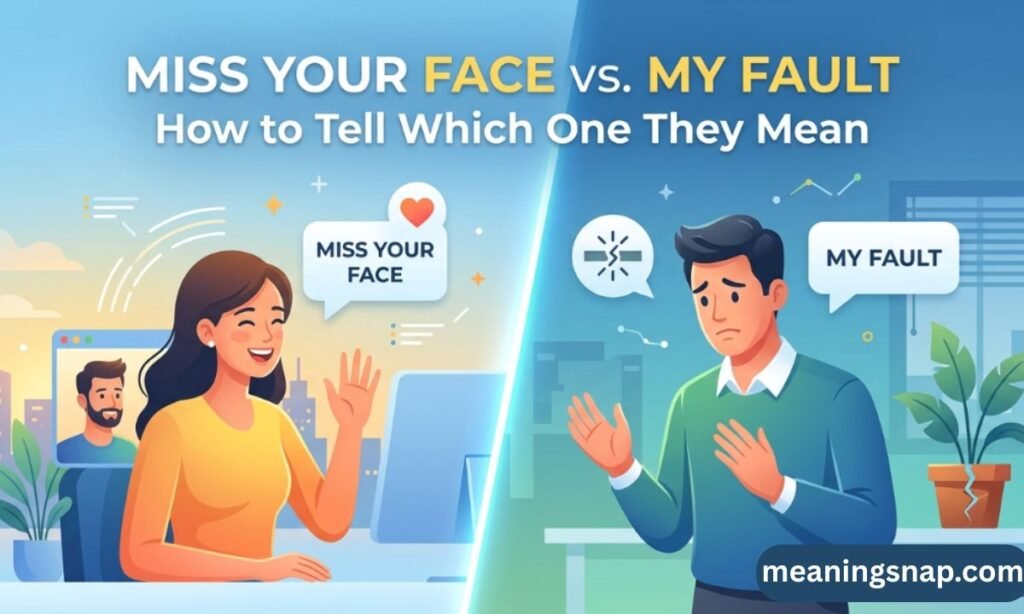
Here’s the thing: the MYF meaning in text doesn’t come with a label attached. You have to read the room, or in this case, read the chat thread. The good news is that once you’ve seen a few real examples, the pattern gets easy to spot.
What “Miss Your Face” Looks Like in a Real Text
This version shows up when someone’s feeling sentimental, nostalgic, or just wants to say they wish they could see you. It’s common between friends who live far apart, and it shows up plenty in romantic texting too.
“Found this photo from last summer and now I’m sad. MYF so much 😭”
“Just landed and already miss it there. MYF though, see you in two weeks ❤️”
What “My Fault” Looks Like in a Real Text
This version is a quick, low-effort apology, usually for something small. It reads almost exactly like “my bad,” just three letters instead of two words.
“Wait, I told you the wrong time. MYF, it’s actually 7, not 6 😅”
“MYF, I totally forgot to send you the link earlier”
It can get a little sarcastic too, especially between people who joke around a lot. “Oh MYF for existing near your fries” reads as teasing, not a real apology, and most people can tell the difference immediately from the tone of the group chat it’s sitting in.
Quick Reference Table: Context Clues for Each Meaning
Before replying, run the message through a couple of quick checks. Emojis, timing, and whatever the conversation was about right before MYF showed up all count as evidence. This table breaks down the clues that usually point to one meaning or the other.
| Clue in the Message | Likely Meaning | Why |
|---|---|---|
| Sent after a photo, memory, or “haven’t seen you in a while” | Miss Your Face | Triggered by something emotional or visual |
| Follows an explanation of a mix-up or wrong info | My Fault | Owning a mistake, not expressing feelings |
| Paired with ❤️ or 🥺 | Miss Your Face | Affectionate emoji reinforces the sentiment |
| Paired with 😬 or 😅 | My Fault | Awkward or embarrassed tone |
| Sent in a group chat about scheduling or plans | My Fault | Usually points to a logistics slip-up |
| Sent one-on-one, no lead-up, just a check-in | Miss Your Face | Reads as a sentimental, out-of-the-blue message |
Read Also: BTA Meaning in Text: What It Really Means (Don’t Get It Wrong)
Where MYF Actually Shows Up (and Where It Came From)

The MYF meaning in text doesn’t change from one app to another, but how often you see it, and which version shows up, does shift depending on where you’re chatting. It isn’t tied to one single platform. It moves around wherever casual texting happens, which these days is basically everywhere.
Here’s a quick breakdown of where each version tends to show up most, and what a typical message looks like on that platform.
| Platform | How MYF Typically Shows Up | Example |
|---|---|---|
| iMessage / SMS | Direct one-on-one texts, either version | “MYF, call me later?” |
| Snapchat | Captions on Memories or old snaps | “This just reminded me. MYF” |
| DMs and comments on throwback posts | “MYF, we need to hang out soon” | |
| TikTok | Comments under nostalgic or emotional videos | “MYF, this one hit different” |
| Long-distance friend and family chats | “MYF, when are you visiting?” | |
| Discord / gaming chats | Quick apologies after a bad play or bad callout | “MYF, I called the wrong lane” |
Facebook Messenger and Reddit see their share of it too, though usually the second someone posts a comment asking what does MYF mean after spotting it somewhere unfamiliar.
Texting etiquette shifts a bit from platform to platform as well. A caption on a public Instagram post gets read by a wider audience than a private iMessage thread, so the same three letters can feel more exposed depending on where they’re posted. Something that reads as sweet in a DM might feel a little too personal sitting in a public comment section.
As for where it came from, there’s no clean origin story here, and any site claiming an exact year or a single inventor is guessing. MYF fits the same pattern as older shorthand from the MSN Messenger and early SMS days, when character limits and slow typing pushed people to compress whatever phrase they wanted to say. It’s part of a long line of texting acronyms built the same way, not a term with a documented birthday.
Is MYF Flirty, Friendly, or Just an Apology?
This depends entirely on who sent it and which meaning they’re using. My Fault almost never carries romantic weight. It’s just an apology, casual and low stakes, no matter who it’s sent to. Miss Your Face is where things get more interesting, since it can land anywhere between platonic and romantic depending on the relationship.
Between friends, especially ones who don’t see each other often, MYF as Miss Your Face reads as warm and sincere, nothing more. There’s usually no second layer to unpack, it’s just genuine affection between people who care about each other. Between people with romantic history or an active crush, the same three letters can feel like a soft, flirty nudge. Tone, timing, and whatever came before the message all shape how it lands. Long-distance friendships and long-distance relationships both lean on this version a lot, since it’s a quick way to express affection without writing out a whole paragraph.
Group chats are the exception. MYF sent to a whole group almost never reads as romantic, since it’s usually aimed at everyone in the thread rather than one specific person. It’s worth glancing at who’s actually in the conversation before deciding how to read the tone.
How to Reply If They Meant “Miss Your Face”
Match the warmth. A short “MYF too” works fine on its own, or lean in a little more if you want to.
“Aww MYF too. We need to video call this weekend”
“Same honestly, it’s been way too long”
If you actually want to see them, say so directly instead of leaving it vague. A reply like “MYF too, let’s find a weekend that works” does more than just mirroring the message back.
How to Reply If They Meant “My Fault”
Keep it light. This isn’t a moment for a long response, since the whole point of using MYF here is fast, casual accountability.
“All good, happens to everyone”
“Lol no worries, see you at 7 instead”
There’s no need to overthink a reply here. Matching the same casual energy is usually the right move, since drawing it out longer than the original message can make a small mix-up feel bigger than it actually was.
Read Also: IBVS Meaning: What It Stands For in Text, Science & More (2026 Guide)
Common Mistakes and When Not to Use MYF
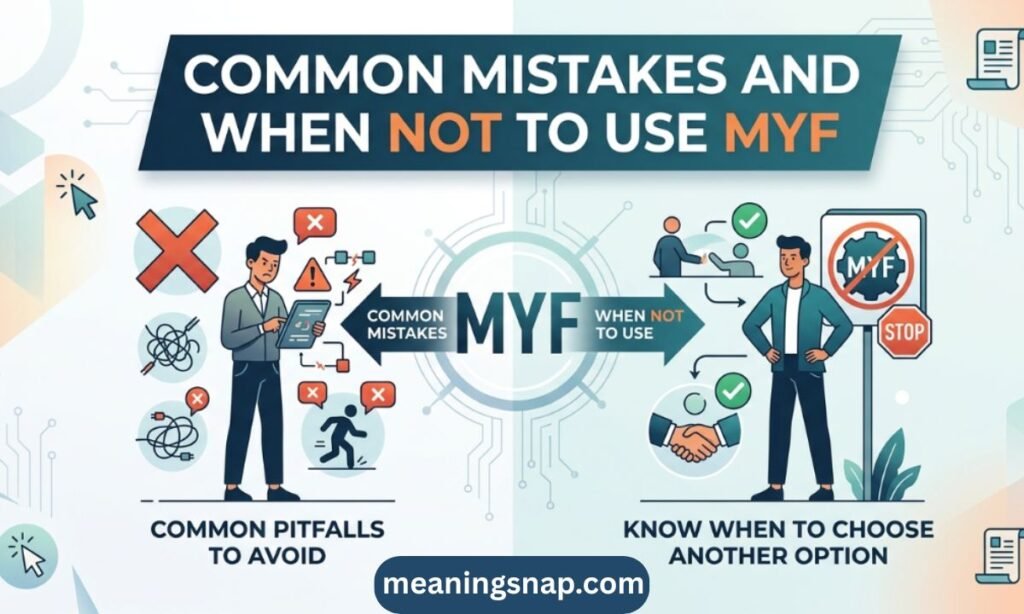
A few situations turn MYF from casual and fun into confusing or even a little careless. Getting the MYF meaning in text right matters just as much as knowing when to use it, since the wrong moment can make a sweet or harmless message land badly.
Sending it to someone who doesn’t text much slang is the most common misstep. Grandparents, new coworkers, or anyone outside your usual circle might just stare at the message with zero context, same as you did the first time you saw it.
Using MYF for a real, serious apology is another one to skip. If you missed a friend’s birthday dinner or genuinely upset someone, “MYF” can come across as dismissive, like you’re brushing past something that actually mattered to them. Save the shorthand for small stuff, wrong times, minor mix-ups, that kind of thing.
Professional and formal messages are off-limits too. A work email, a message to a professor, or anything tied to school or a job application should stick to full words. “MYF, missed the deadline” reads as unprofessional no matter how casual your workplace culture is.
Public comments are worth a second thought too. Dropping MYF on someone’s serious or emotional post, a job loss, a loss in the family, anything heavy, can come across as careless even when that’s the last thing you meant. Abbreviated slang feels light by design, and light doesn’t always fit the moment.
One more thing worth watching for: don’t assume the other person will read the same meaning you intended. If there’s any real chance the message could go either way, add a word or two of context, or just spell it out. It takes two extra seconds and skips the confusion entirely.
Similar Slang Terms to Know
The MYF meaning in text isn’t the only short acronym doing double duty in your messages. A few others overlap in tone or purpose, and knowing how they differ helps you avoid mixing them up. All of these live in the same corner of Gen Z and Millennial texting vocabulary, quick, casual, and built for speed over formality.
| Term | Meaning | How It Differs from MYF |
|---|---|---|
| IMY | I Miss You | Same sentiment as MYF’s “Miss Your Face,” just spelled out and more direct |
| LYSM | Love You So Much | Stronger and more affectionate than either MYF meaning |
| HMU | Hit Me Up | An invitation to reconnect, not an apology or a feeling on its own |
| MYOB | Mind Your Own Business | Dismissive in tone, nothing to do with affection or apology |
| WYD | What You Doing | A casual check-in opener, unrelated to either MYF meaning |
None of these replace MYF exactly. They just sit near it in the same casual texting vocabulary, which is why people sometimes mix them up or use them interchangeably without thinking twice.
Read Also: SFW Meaning Explained: Safe For Work Content Guide
Frequently Asked Questions
What does MYF mean in a text message?
The MYF meaning in text usually comes down to one of two things: “Miss Your Face,” a way of saying you miss seeing someone, or “My Fault,” a quick casual apology. The surrounding conversation tells you which one applies.
Is MYF more common with romantic partners or just friends?
Both, honestly. Miss Your Face gets used plenty between friends, especially ones who live far apart, and it also shows up regularly in romantic texting. My Fault doesn’t lean romantic or platonic either way, it’s just an apology, so it shows up just as often between coworkers or teammates as it does between partners.
Is it okay to use MYF with a crush?
Yes, as long as the context makes sense. Sending MYF after a video call or a shared memory reads as sweet, not weird. Sending it with zero context to someone you barely know might just confuse them, so save it for after you’ve already got some rapport going.
What’s the difference between MYF and IMY?
They carry a similar feeling when MYF means “Miss Your Face,” but IMY spells that feeling out more directly. MYF feels a little more casual, and it can also mean something totally different, “My Fault,” depending on the moment, which is the main thing that sets it apart from a single-meaning term like IMY.
Can MYF mean something other than Miss Your Face or My Fault?
Outside of everyday texting slang, yes. Some Methodist youth groups use it for Methodist Youth Fellowship, and it shows up in business settings as Multi-Year Forecast. In casual chat and social media, though, those two main meanings cover almost every real use you’ll come across, and you’ll rarely need to think about the formal versions unless you’re reading a church newsletter or a financial report.
Bottom Line on MYF
The MYF meaning in text really comes down to one factor: context. Three letters, two completely different meanings, and one simple trick to sort them out: look at what came right before the message. If it followed a photo, a memory, or a moment of missing someone, you’re looking at Miss Your Face. If it followed a mix-up or a mistake, it’s My Fault. Either way, the reply doesn’t need to be complicated, just match the tone you were given.
Next time MYF shows up in your messages, you’ll know exactly what it means and exactly how to reply.

Alex Morgan is a writer focused on explaining slang, words, phrases, acronyms, and popular expressions in a simple and easy-to-understand way. Through clear explanations and helpful examples, Alex helps readers quickly understand what words and phrases mean and how they’re commonly used.