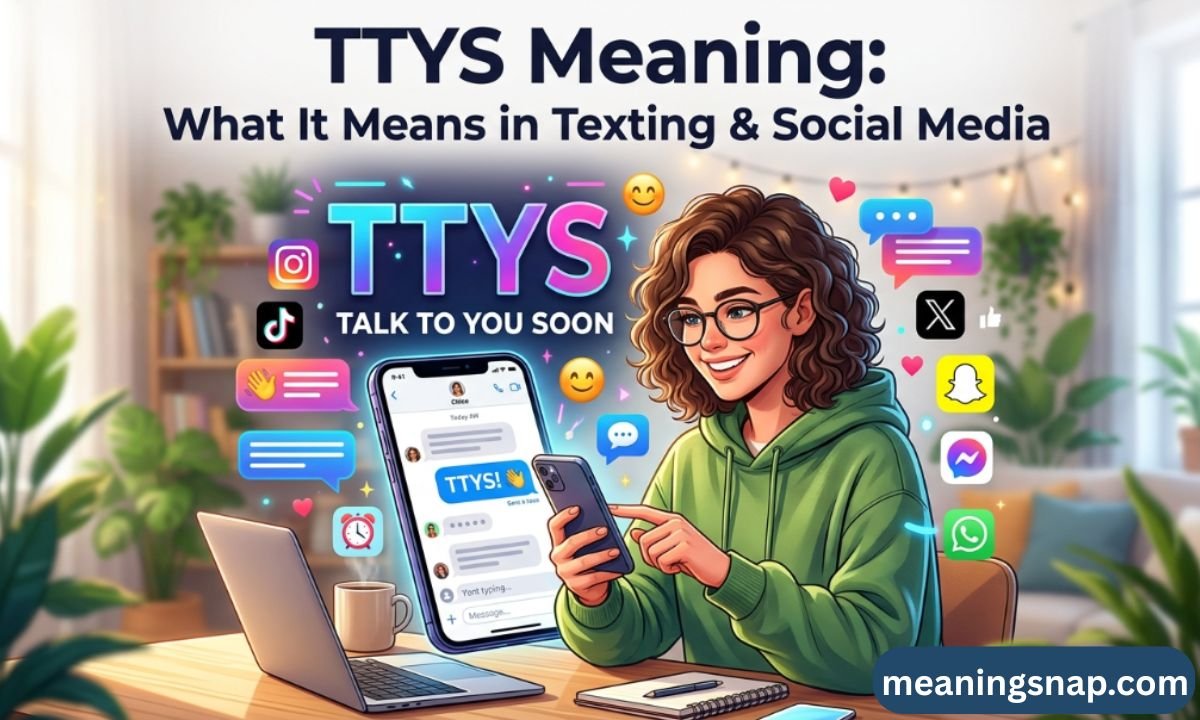
You’re mid conversation with someone, things are going fine, and then they send “ttys” and go quiet. No emoji, no explanation, nothing. Are they mad? Busy? Did you say something wrong? If you’ve stared at a text like that wondering what just happened, you’re not the only one. TTYS stands for “talk to you soon,” and it’s one of those texting abbreviations that shows up constantly but rarely gets explained. It’s not rude, and it’s not a red flag. It’s just a fast, casual way to end a chat without making a big deal out of it. Here’s exactly what TTYS means, where it came from, and how to reply without overthinking it.
Quick Answer
The TTYS meaning, in short: it means “talk to you soon.” People use it to end a text conversation casually, usually when they plan to pick the chat back up later that day or fairly soon after. It’s less final than “bye” and a bit more specific than TTYL (talk to you later), which doesn’t promise any particular timeframe.
What Does TTYS Actually Mean?
The TTYS meaning is pretty simple once you break it down. It’s a texting abbreviation for “talk to you soon,” and people use it the same way they’d use “catch you later” in a spoken conversation. It signals that the chat is wrapping up, not that the relationship or the topic is done for good.
What makes TTYS different from a flat-out goodbye is the tone. It’s soft. It leaves the door open without locking in a specific time to talk again. Nobody’s checking a calendar before they type it. The TTYS abbreviation just tells the other person, “I’ve got to go, but this isn’t over.”
This is where a lot of confusion comes from. People treat TTYS meaning in text as a hard promise, like the sender is definitely coming back to the conversation within the hour. In practice, it’s more of a vibe than a commitment. Someone might send TTYS and reply five minutes later, or not until the next day. The abbreviation communicates intent, not a guarantee.
That soft, noncommittal quality is exactly why TTYS slang works so well in casual conversation. It lets people exit a chat gracefully without needing to explain why, what they’re doing next, or when exactly they’ll be back. Think of it as digital small talk for ending a conversation, low effort, low pressure, and universally understood.
Compare that to how people end conversations in person. Nobody schedules the exact minute they’ll see a friend again after hanging out, they just say “catch you later” and trust it’ll happen naturally. TTYS does the same job in text form. It’s a friendly goodbye that keeps the relationship warm without turning a simple sign-off into a whole negotiation about timing.
It’s also worth noting that TTYS carries almost no formality at all. You won’t see it in a work email or a customer service chat, and that’s by design. The whole point of the abbreviation is that it feels effortless, the texting equivalent of a quick wave instead of a handshake.
Also Read: MYF Meaning in Text: What It Really Stands For and How to Use It
Where Did TTYS Meaning Come From?
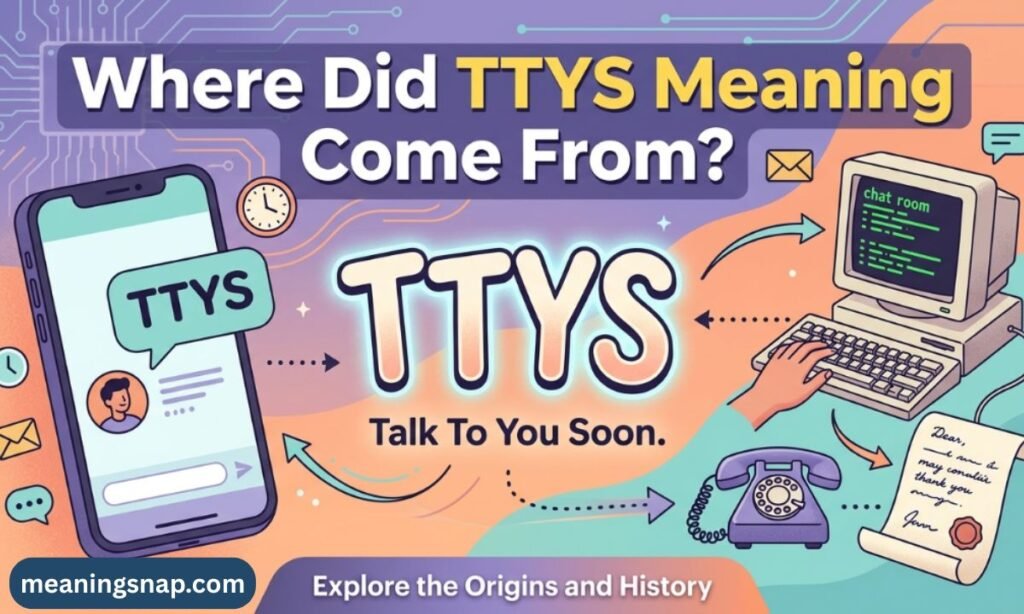
The TTYS meaning didn’t start on TikTok or Instagram. It goes back to the early days of instant messaging, back when AOL Instant Messenger (AIM) and MSN Messenger were how most teens and young adults chatted online. Typing was slower, screen names were a whole personality, and shorthand wasn’t optional, it was survival.
Around the same era, flip phones and early texting plans charged by the character or the message. T9 typing (tapping a number key multiple times to land on a letter) made every extra keystroke annoying. Abbreviations like TTYS, BRB, and GTG weren’t just casual choices. They saved time and effort on phones that made typing genuinely tedious.
Smartphones eventually solved the character limit problem and gave everyone full keyboards, autocorrect, and unlimited texting. Turns out, the habit stuck around anyway. TTYS, along with a whole library of internet abbreviations, survived because it’s fast to type and instantly recognizable. Nobody has to think twice about what it means.
The short answer is that TTYS is a leftover from an era of digital communication built around speed and limits, and it’s held on because it still fits how people naturally end casual conversations today. Even with full keyboards and voice-to-text, a quick TTYS still feels more natural than typing out “I’ll talk to you again soon.”
There’s also a generational layer to this. Millennials picked up TTYS during the AIM and early cell phone era and carried it into group texts and social media DMs as those platforms took over. Gen Z didn’t necessarily grow up typing on flip phones, but they inherited the abbreviation anyway, through older siblings, parents, or just general texting culture that got passed down online. That’s how a lot of internet slang survives, it outlives the technology that created it because the shorthand itself becomes part of how people communicate, not just a workaround for a slow keyboard.
TTYS in Texting vs. TTYS on Social Media
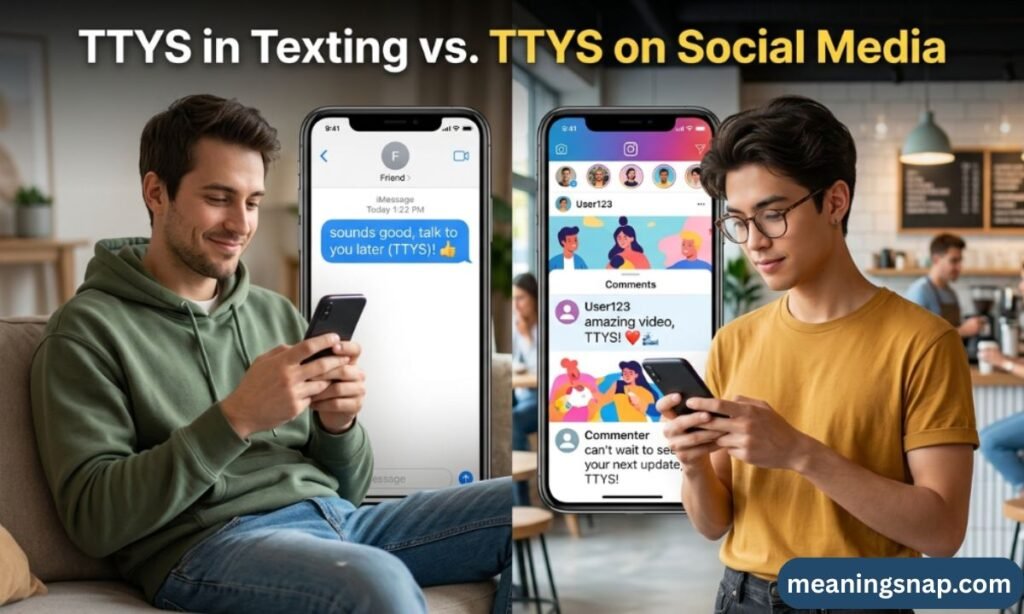
TTYS shows up in two slightly different worlds: everyday texting and messaging apps, and social media platforms where conversations happen alongside posts, stories, and public feeds. The meaning stays the same in both, but how casually it’s used can shift a little.
TTYS in Regular Texting
In regular text messages, TTYS is a common way to close out a conversation with a friend or family member, especially when you’re stepping away from your phone for a while. On WhatsApp, it works the same way, often paired with an emoji to soften the exit. Snapchat conversations tend to be quicker and more back-and-forth, so TTYS there usually signals someone’s about to lose their streak-chat momentum but plans to pick it back up.
TTYS on Social Media
On social media, TTYS mostly lives inside private messaging, not public posts or comments. Instagram DMs and Facebook Messenger see TTYS used almost identically to regular texting, since both function like extended group chats. On Twitter/X, it’s rare in public replies but still shows up in DMs when a one-on-one conversation is winding down. TikTok comment sections almost never see it, since that space is built for public reactions, not back-and-forth chat, though it’s common in TikTok’s own DM feature.
Discord sits somewhere between the two. In gaming servers or community-style social media spaces, people use TTYS to step away from an active group chat without making a whole announcement, letting the group know they’re not abandoning the conversation for good.
Across texting apps and social media alike, the TTYS meaning doesn’t really change. It’s the context, how well you know the person and how the conversation’s been going, that shapes how it lands.
Online gaming chats and community forums are another place TTYS pops up a lot, especially in voice-adjacent text chats where players step in and out of a session. Someone might type TTYS in a Discord server before hopping off a call, letting the group know they’re not abandoning the conversation, just stepping away from the keyboard for a bit. It functions almost like a placeholder, a way to keep a spot in an ongoing conversation without formally signing off.
The one place TTYS rarely shows up, on texting or social media, is workplace messaging apps like Slack or Microsoft Teams. Even in casual company cultures, most people default to something more direct when signing off from a work conversation. That’s less about the abbreviation being inappropriate and more about it simply not matching the tone people expect from professional communication.
Read Also: BTA Meaning in Text: What It Really Means (Don’t Get It Wrong)
TTYS in a Sentence: Real Examples
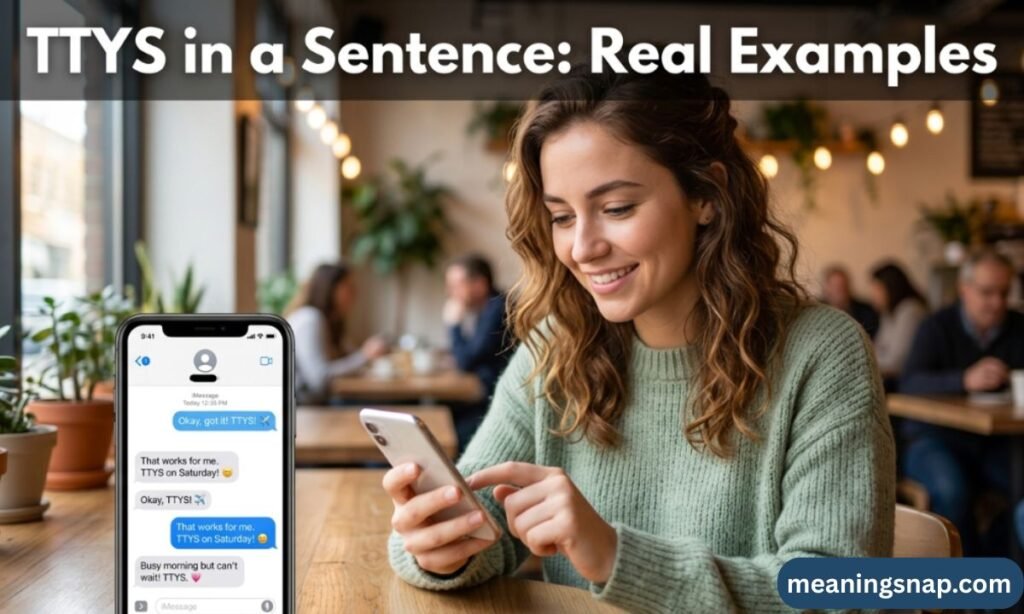
Seeing the TTYS meaning in action makes it click faster than any definition can. Here are a few real-sounding exchanges that show how it plays out in different moods and situations.
Casual friend chat:
Mia: omg I have to go my mom’s calling me Mia: ttys! Jordan: okay lol good luck
Group chat:
Dev: gtg guys, dinner’s ready Dev: ttys, don’t plan the trip without me lol Priya: no promises 😂
Texting a crush (sincere tone):
Alex: this was actually really fun to talk about Alex: ttys? I want to hear how your interview goes Sam: definitely, ttys 🙂
Sarcastic tone:
Kayla: “ttys” she said, before disappearing for 3 days Ravi: lmaooo classic
Snapchat, casual and quick:
Ty: bro I’m about to lose battery Ty: ttys, charge is at 2% Noah: lol go go go
Coworker chat, still informal but a bit more measured:
Reese: I’ve got a meeting starting, can we finish this after lunch? Reese: ttys, I’ll message you around 1 Jamie: works for me
Notice how the tone shifts based on punctuation, emojis, and context, not the abbreviation itself. TTYS stays flexible enough to fit a rushed exit, a flirty pause, a scheduling note, or even a joke about someone who never actually follows through.
TTYS vs TTYL vs Other Sign-Offs
TTYS gets mixed up with TTYL constantly, and honestly, that mix-up makes sense since both are texting abbreviations for ending a conversation. Here’s how TTYS actually compares to the other common sign-offs people use in chat slang.
| Abbreviation | Full Form | Typical Wait Implied | Common Vibe |
|---|---|---|---|
| TTYS | Talk to you soon | Short, often same day | Warm, a little more intentional |
| TTYL | Talk to you later | Open-ended, could be hours or days | Casual, no real commitment |
| BRB | Be right back | Minutes | Temporary pause, staying in the chat |
| GTG | Got to go | Immediate | Abrupt exit, often mid-task |
| TTFN | Ta-ta for now | Open-ended | Playful, a bit old-school |
| BBL | Be back later | Hours | Similar to BRB but longer |
The key difference between TTYS and TTYL comes down to how soon “soon” actually feels. TTYS leans toward a same-day, keep-it-going kind of energy, while TTYL is genuinely vague, it could mean later tonight or later next week. Neither one is more polite than the other. They just carry slightly different expectations about when the conversation picks back up.
Is TTYS Rude, Polite, or Just Casual? (And How to Reply)
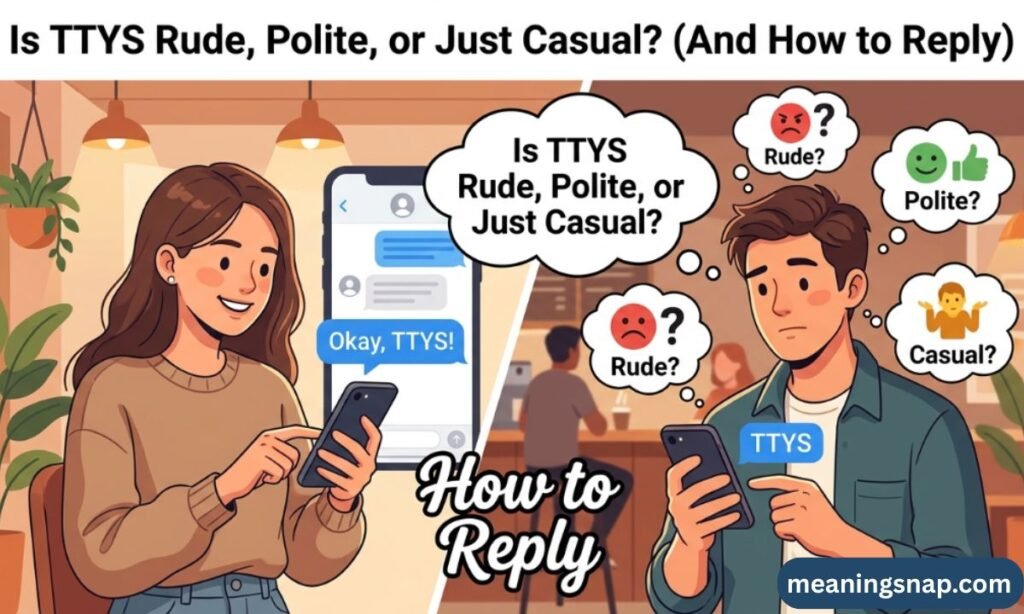
TTYS isn’t inherently rude or polite, it’s neutral by default. What actually shapes the tone is everything around it: punctuation, timing, and how well you know the person you’re texting.
Something like “ttys!! this was fun 😊” reads as warm and genuine. A flat “ttys.” with a period and nothing else can feel a little cold, especially mid-argument or right after someone shared something vulnerable. Context does most of the work here, not the abbreviation itself. Sent at a natural pause in conversation, TTYS is just efficient, friendly shorthand. Sent abruptly in the middle of something important, it can come across as dismissive, even if that’s not the intent.
Timing matters just as much. If TTYS shows up right after a real question or a heavier topic, it can feel like an exit rather than a pause. The same message sent after a natural lull, like when the conversation’s already slowing down, reads as totally normal.
Replying to TTYS doesn’t require much thought. A simple “ttys!” or “okay talk soon” mirrors the tone and wraps things up cleanly. If you want to keep things a little warmer, tossing in an emoji or a quick “sounds good” works fine too. There’s no need to overanalyze a reply here, matching the energy of the original message is really all it takes.
One thing worth keeping in mind: TTYS says nothing about how someone feels about you, only that they’re stepping away from the conversation for now. Reading it as a sign of disinterest usually says more about the anxiety of the moment than the actual message. If someone consistently follows through and starts the next conversation like they said they would, that pattern matters far more than the specific words they used to end the last one.
Read Also: IBVS Meaning: What It Stands For in Text, Science & More (2026 Guide)
Common Mistakes People Make With TTYS
A few habits tend to trip people up when it comes to using TTYS correctly, and most of them come down to mismatched expectations rather than the abbreviation itself.
The most common mix-up is confusing the TTYS meaning with TTYL, treating them as interchangeable. They’re close, but TTYS implies a shorter, more specific gap before the next conversation, while TTYL leaves that timeline wide open. Using them the wrong way isn’t a huge deal, but it can create a slight mismatch between what someone says and what they actually mean.
Another mistake is sending TTYS without any real intention of following up soon. It’s a small thing, but doing this repeatedly can make the phrase feel hollow, especially to close friends or a partner who starts noticing the pattern. If “soon” keeps turning into days of silence, the words stop matching the behavior.
The last one is context-related: using TTYS in formal emails, professional communication, or messages to clients and coworkers. It’s built for informal communication between friends and family, not for business communication. Workplace messaging apps like Slack or Teams call for a more direct sign-off, something like “talk soon” or “I’ll follow up later today” reads far more professional than a casual acronym, even in a relatively relaxed office culture.
A smaller but real mistake is overusing TTYS as a way to avoid a conversation altogether. Sending it repeatedly right when a topic gets serious or uncomfortable can start to feel like a pattern rather than a coincidence, and the person on the other end will usually pick up on it eventually. Bottom line, TTYS works best when it matches what’s actually happening, a real pause in a real conversation, not an easy exit from one you’d rather not have.
Frequently Asked Questions
What does TTYS mean in texting?
The TTYS meaning is “talk to you soon.” It’s a casual way to end a text conversation while signaling you plan to pick it back up before too long, rather than saying goodbye for good.
Is TTYS the same as TTYL?
Not quite. TTYS (talk to you soon) usually implies a shorter gap before the next chat, while TTYL (talk to you later) is more open-ended and doesn’t suggest any specific timeframe.
Is TTYS used on Snapchat?
Yes. TTYS shows up on Snapchat, WhatsApp, Instagram DMs, and regular texting pretty much the same way. The meaning stays consistent, only the pace of the conversation tends to shift by app.
Is TTYS polite?
It can be. TTYS is neutral on its own, and things like punctuation, emojis, and timing shape whether it reads as warm and friendly or a little abrupt.
Can TTYS be used in professional communication?
It’s best avoided in formal emails or messages to clients and coworkers. TTYS fits informal communication with friends and family, not business communication or workplace messaging apps.
Final Thoughts
The TTYS meaning isn’t complicated once you see it for what it is, a quick, low-pressure way to pause a conversation without making it feel final. It’s held on through decades of digital communication, from AIM to group texts to Snapchat, because it does exactly what it needs to: wrap things up fast and keep the door open. Next time someone sends you a TTYS, you’ll know it’s not a goodbye. It’s just a “see you soon.”
You May Also Like: Snowball Kiss Meaning: Ultimate Guide to This Intimate Practice

Alex Morgan is a writer focused on explaining slang, words, phrases, acronyms, and popular expressions in a simple and easy-to-understand way. Through clear explanations and helpful examples, Alex helps readers quickly understand what words and phrases mean and how they’re commonly used.