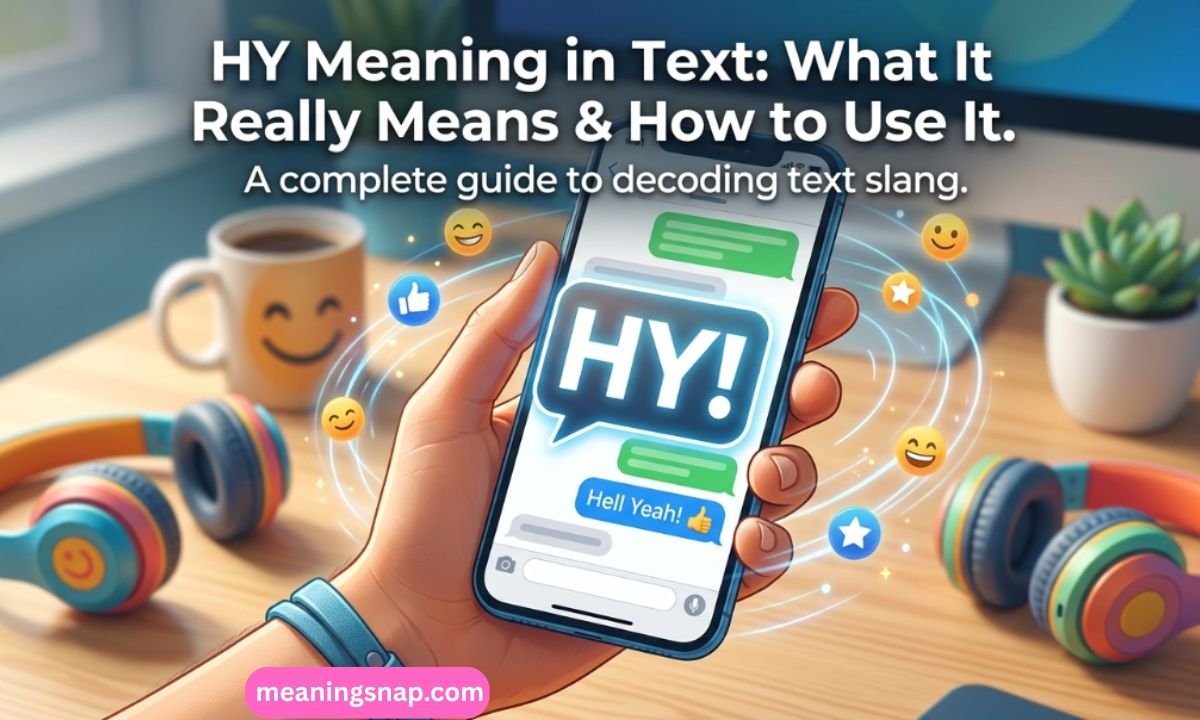
You’re texting a friend about weekend plans and they answer with two letters: HY. No emoji, no extra words, just those two letters sitting on your screen. Is that a low-key hello, or are they hyped about the plan? HY meaning in text splits into two genuinely different answers, and mixing them up changes the whole tone of a conversation. One version is a casual greeting. The other is a full-on excited yes. Neither is wrong, and neither is rare. The trick is knowing which one someone means, and that comes down to a few small context clues most people never think to check.
Quick Answer
HY has two common meanings in texting. It works as a stylized, phonetic spelling of “Hi” or “Hey,” used as a casual greeting. It also stands for “Hell Yes” or “Hell Yeah,” used to show excitement or strong agreement. There’s no single correct HY meaning in text, both readings are widely used across texting, Snapchat, Instagram, and group chats. Which one someone means usually depends on where HY lands in the conversation. As an opener, it’s almost always a greeting. As a reply to a question or invitation, it’s almost always enthusiastic agreement.
What Does HY Really Mean? (Two Definitions, Not One)
Most single-word or two-letter HY meaning in text searches turn up one of two separate answers, and honestly, both are correct depending on who’s texting and why.
The first is simple. HY works as a stylized spelling of “Hi” or “Hey,” the same way people write “hru” for “how are you” or “wyd” for “what are you doing.” Swapping the “i” for a “y” saves a keystroke and reads as more casual than a full “hi.” This version shows up most at the start of a conversation, especially with someone a person doesn’t text every day.
The second meaning is louder. HY stands for “Hell Yes” or “Hell Yeah,” an enthusiastic way to agree with something. This shorthand grew out of the same texting habit that turned “be right back” into BRB and “shaking my head” into SMH, compressing an everyday spoken phrase into fewer keystrokes. A flat “yes” reads pretty neutral. HY reads like someone’s genuinely excited.
Neither definition beats the other, so there’s no single agreed-upon HY full form. Some corners of the internet insist HY only means one thing, but pull up enough real conversations and both show up constantly. A smaller, less common reading floats around too, where HY gets read as “Hey You,” usually in a flirty or teasing opener, though this version shows up far less than the other two.
Also Read: GNG Meaning: What It Means in Text, TikTok & Slang
HY Meaning on Urban Dictionary
Urban Dictionary hosts several separate entries for HY, and they land on the same two meanings covered above. The most upvoted entries define it as short for “hell yeah,” while others describe it as a phonetic spelling of “hi,” often paired with other casual shorthand in the same message.
That split matches what shows up everywhere else online, HY doesn’t have one crowd-agreed definition, even on a site built entirely around crowdsourced slang. A few random or joke entries pop up too, which is normal for Urban Dictionary, where anyone can submit a definition regardless of how common it actually is.
The takeaway stays the same as everywhere else: check the context of the message before deciding which HY meaning fits, rather than trusting a single source to settle it.
How to Tell Which Meaning Someone Means
Since the HY meaning in text depends entirely on context, the real skill isn’t memorizing a definition, it’s reading the message around it. A few small details give it away almost every time.
Start with position. If HY shows up as the very first message in a conversation, or right after someone says hello, it’s almost always a greeting. Nobody opens a chat with excited agreement about nothing. If HY shows up as a reply to a question, invitation, or statement, it’s almost always the “Hell Yes” version.
Punctuation and formatting matter too. A plain “HY” or “hy.” with no exclamation point tends to read as low-key, which fits a casual greeting. Multiple letters, all caps, or extra punctuation, like “HYY!!” or “HY!!!”, almost always signals excitement, which points to agreement. Emojis attached to the message help too, a wave or heart usually pairs with a greeting, while fire or celebration emojis usually pair with agreement.
Here’s a simple way to check it:
- Was the last message a question or invite? Read HY as agreement.
- Is this the first text in the thread? Read HY as a greeting.
- Does it come with extra letters, caps, or exclamation points? Read it as excitement.
- Is it flat, lowercase, and standalone? Read it as a greeting.
- Does the energy match the message before it? A hyped-up question usually gets a hyped-up HY back.
None of these rules work perfectly alone, but stacked together they clear up almost any confusing HY text in a few seconds. When genuinely stuck, asking “wym?” back never hurts.
Read Also: LFG Meaning Explained: What It Really Means in Text, Gaming and Online Slang
HY in Real Conversations

As a Greeting
When HY opens a message, it’s doing the same job as “hi” or “hey,” just shorter. This shows up a lot in DMs from people who aren’t super close, or group chats where someone’s dropping in for the first time.
Person A: HY! just got home, you?
Person B: same lol just sat down
That flat, low-energy HY isn’t hiding excitement. It’s a quick, casual hello.
As Enthusiastic Agreement
When HY answers a question or invite, it carries way more energy than a plain “yes.” This is the version that shows up when someone’s genuinely excited about a plan, a decision, or an idea.
Person A: u still tryna go to the concert tonight?
Person B: HY!! grabbing tickets rn
Person A: i think i’m gonna quit my job and try freelancing
Person B: HY, do it. you’ve got this
Both replies use HY to show real support and enthusiasm, not polite agreement for the sake of it.
In a Group Chat Opener
Group chats mix both uses constantly, which is exactly why context matters so much. Someone new dropping into a chat usually uses HY as a greeting, while someone reacting to a plan already in motion uses it as agreement.
Sarah: HY everyone, sorry I’m late to this chat lol
Mike: no worries! we’re doing pizza Friday
Sarah: HY that works for me
Same person, same thread, two different meanings within three texts.
HY Meaning on Instagram, Snapchat, TikTok, WhatsApp, and Gaming Chats

People often assume the HY meaning in text changes depending on the app, as if the platform itself decides what the letters stand for. It doesn’t work that way. HY carries the same two meanings everywhere, greeting or enthusiastic agreement, but usage habits shift a little depending on where someone’s texting from. Here’s how that plays out platform by platform.
HY Meaning on Instagram
On Instagram, HY splits pretty evenly between both readings. DMs from someone new, especially after a follow or a story reply, usually open with HY as a plain greeting. Comments and quick replies to a post tend to lean the other way.
Comment: new drop is 🔥, you copping?
Reply: HY, already added to cart
That reply lines up with the agreement meaning, not the greeting one, since it’s answering a question instead of opening a conversation.
HY Meaning on Snapchat
HY meaning on Snapchat leans toward “Hell Yes” more than on most other platforms. Snap chats move fast and casual, often revolving around quick reactions to a photo or a plan, and that environment favors the excited version over the greeting one. It still opens a chat sometimes, especially with someone outside a person’s close friend group, but expect the enthusiastic reading by default.
HY Meaning on TikTok
On TikTok, HY shows up almost entirely in comment sections, reacting to a video, a take, or someone else’s comment, which makes the “Hell Yes” reading by far the most common one there.
Comment: unpopular opinion but pineapple belongs on pizza
Reply: HY it does, fight me
TikTok’s comment culture runs on quick, punchy reactions, and HY fits right into that pace without needing a full sentence to back it up.
HY Meaning in WhatsApp
HY meaning in WhatsApp tips more toward the greeting version than Snapchat or TikTok do. WhatsApp covers a wider mix of people, family group chats, coworkers, older relatives, so a casual “hi” often makes more sense there than an enthusiastic “Hell Yes.” The agreement version still shows up between friends, just less consistently than on faster, younger-skewing apps.
Read Also: TTYS Meaning: What It Means in Texting & Social Media
HY Meaning in Gaming (Discord and Gaming Chats)
HY meaning in gaming almost always points to enthusiastic agreement rather than a greeting. Gaming chats, whether on Discord, in-game text, or voice-to-text logs, are usually already mid-conversation by the time someone types HY, so there’s rarely a cold open to greet.
Person A: queue up for one more match?
Person B: HY, let’s run it back
Discord servers built around a specific game lean on this meaning constantly, since most messages react to something already happening rather than starting a fresh conversation.
HY vs. Similar Text Slang
HY doesn’t sit alone. It’s part of a whole cluster of short, punchy ways people say yes or agree without typing a full sentence. Seeing how it compares to similar slang makes the enthusiasm level behind it easier to gauge.
| Term | Meaning | Intensity | Example |
|---|---|---|---|
| HY | Hell Yes / Hi | High (agreement) or neutral (greeting) | “HY!! let’s go” |
| HYFR | Hell Yes For Real | Very high | “HYFR that’s the move” |
| Fr | For real | Medium | “fr that’s crazy” |
| Yh / Ye | Yeah | Low-medium | “yh sounds good” |
| K | Okay | Low, sometimes flat | “k see you then” |
HYFR pushes the same “Hell Yes” energy further by adding “for real” on top, usually when someone wants to double down on how much they agree. Fr and Yh sit lower on the excitement scale, closer to a standard yes than an enthusiastic one. K sits at the bottom, and depending on tone, can even read as short or annoyed rather than agreeable.
Stacked next to these, HY lands in the middle. It carries more excitement than a plain “yeah,” but doesn’t carry the extra emphasis HYFR adds. That middle ground is exactly why it works so well as a quick, expressive reply.
Is HY Rude or Flirty?
When It’s Totally Fine
HY reads as friendly almost everywhere it shows up. As a greeting, it’s no different from texting “hey.” As enthusiastic agreement, it’s a positive response, not a confrontational one. The “Hell Yes” version does contain mild profanity, which makes some people wonder if it comes across as rude, but in casual texting between friends, it almost never does. It reads the same way “hell yeah” sounds out loud, upbeat and a little extra, not aggressive.
As for flirty, HY isn’t inherently romantic on its own. It picks up a flirty tone the same way any casual, enthusiastic reply does, especially paired with emojis or sent to someone a person’s interested in.
Person A: wanna grab coffee sometime? 👀
Person B: HY 😊 name the day
The emoji and the follow-up do the flirting there, not the HY itself. Sent between platonic friends, the exact same reply reads as nothing more than an excited yes.
When to Think Twice
Context still changes things. Sending HY to someone who doesn’t use texting slang, like an older relative, a teacher, or a supervisor, risks landing as confusing rather than casual. The mild profanity in “Hell Yes” also makes it a poor fit for formal or professional messages, customer support chats, or anything work-related, even if the overall tone stays friendly.
It’s worth reading the room in heavier conversations too. Replying HY to something emotionally serious, like bad news or a genuinely difficult question, tends to land wrong, since the term is built for excitement and casual agreement, not depth. Saving it for lighter, upbeat exchanges keeps it doing what it does best.
HY Meaning in Text From a Girl or a Guy
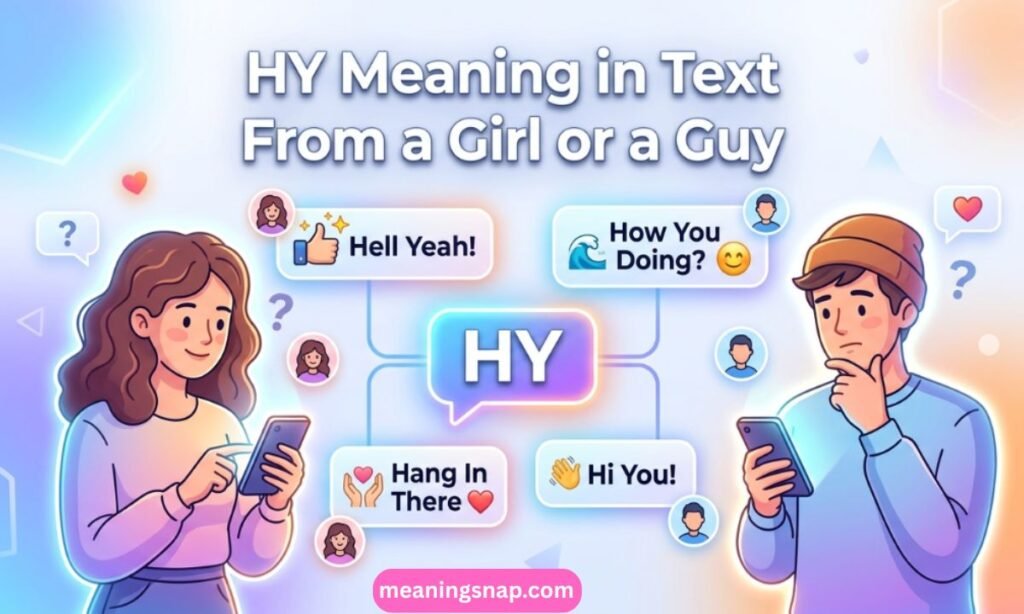
Searching HY meaning in text from a girl or HY meaning in text from a guy usually comes from the same place, wondering if the sender’s gender changes what the message actually means. It doesn’t. HY carries the same two meanings, greeting or enthusiastic agreement, no matter who sends it.
What actually shifts the read isn’t gender, it’s the relationship and the rest of the message. A HY from a longtime friend usually reads as plain and platonic, whether that friend is a girl or a guy. A HY loaded with emojis, sent by someone a person’s already into, can pick up a flirty edge, again regardless of gender.
Person A: hey, been thinking about you 👀
Person B: HY 😊
That reply reads the same way whether it comes from a girl or a guy, the flirty tone comes from the message before it and the emoji attached, not from who typed it.
Common Mistakes People Make With HY
Even once someone understands both meanings, a few habits still trip people up in practice. Most of them come down to skipping the context check instead of doing it.
Assuming It Only Has One Meaning
Even after learning the HY meaning in text, people still trip up here the most. Reading every HY as “Hell Yes” leads to genuinely confusing exchanges when someone meant “hi.” The reverse happens too, someone reads a clearly excited HY as a flat greeting and misses the enthusiasm entirely. Checking the context around the message solves this almost every time.
Using It in Professional or Formal Messages
HY doesn’t belong in work emails, client messages, or anything meant to read as professional. Beyond the casual tone, the mild profanity baked into the “Hell Yes” meaning makes it a rough fit for business communication, no matter how relaxed the workplace feels. Sticking to “Sure,” “Absolutely,” or “Sounds good” keeps the same positive energy without the risk.
Mixing It Up With Similar Abbreviations
HY gets confused with lookalike abbreviations fairly often, especially HYFR, HYHY, or IHY. Each one carries a different meaning and intensity, and swapping them changes the tone of a reply more than people expect. Taking a second to double check before firing off a similar-looking abbreviation avoids sending a message that reads way more intense, or way more casual, than intended.
Read More: ANR Meaning Explained: Full Form, Legal & Medical Uses
How to Reply When Someone Sends You HY
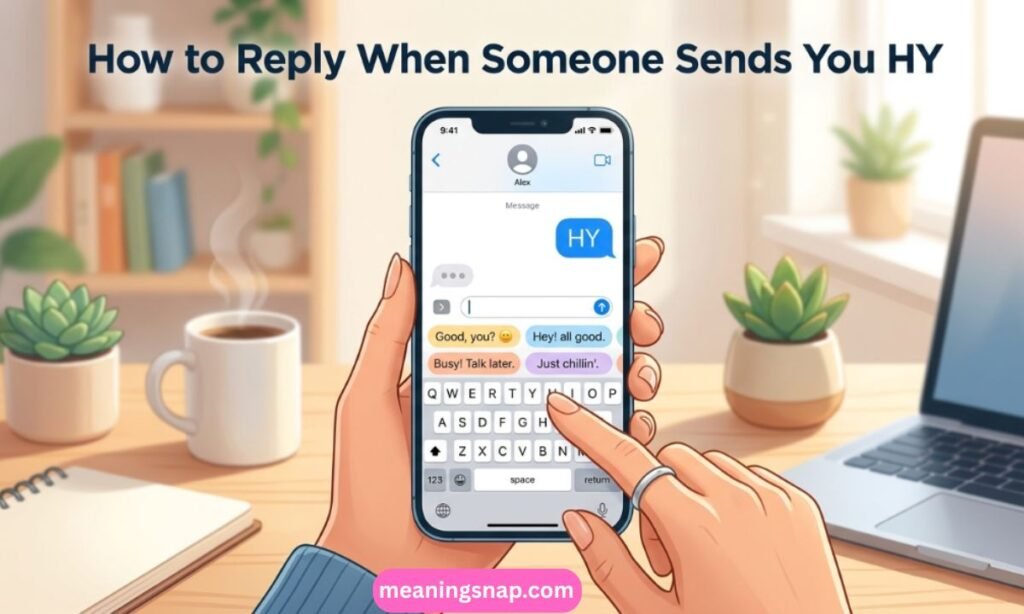
If They Mean It as a Greeting
When HY opens a conversation, treat it exactly like any other hello. A simple “hey! what’s up” or “HY, how’s it going” keeps the exchange moving naturally.
Person A: HY, haven’t talked in a while
Person B: HY! I know, it’s been a minute, how are you?
There’s no need to overthink a reply here, matching the same casual, low-key energy works fine.
If They Mean It as “Hell Yes”
When HY answers a question or plan, it’s already carrying enthusiasm, so matching that energy keeps the exchange feeling natural instead of flat.
Person A: raid starts in 5, you in?
Person B: HY, logging on now
Person A: let’s gooo
A short “let’s go,” “same,” or a matching exclamation point keeps the momentum going. Replying with a flat “ok” after someone sends an excited HY tends to read as unenthusiastic, even when that’s not the intent.
Frequently Asked Questions
What does HY stand for in texting?
The HY meaning in text usually points to either “Hi/Hey,” used as a casual greeting, or “Hell Yes,” used to show excitement or strong agreement. Context decides which one fits, opening messages usually mean the greeting, while replies to a question or invite usually mean the enthusiastic version.
What does HY mean on Snapchat specifically?
On Snapchat, HY leans toward “Hell Yes” more often than not, since Snap chats tend to be fast, casual, and reaction-heavy. It can still open as a greeting, especially in a new or infrequent chat.
Is HY rude or offensive?
No. HY reads as casual and friendly in almost every situation. The “Hell Yes” version contains mild profanity, so it fits better with friends and casual chats than with formal or professional messages.
Can HY just mean “Hi”?
Yes. HY works as a stylized, phonetic spelling of “Hi” or “Hey,” and this greeting version is equally common as the “Hell Yes” meaning, especially at the start of a conversation.
Is HY okay to use at work?
It’s best avoided in professional communication. Between the casual tone and the mild profanity in its more common meaning, HY doesn’t fit work emails, client messages, or conversations with supervisors.
Bottom Line
The HY meaning in text isn’t complicated once the context clicks. It’s either a quick, casual hello or an excited, all-in yes, and the conversation around it almost always makes clear which one someone means. Check whether it opens a chat or answers one, glance at the punctuation, and the right reading shows up fast.
Next time HY lands in your texts, you won’t need to guess. You’ll already know whether someone’s saying hello or hyping up your plans, and you can reply with the same energy right back, no awkward “wait, what do you mean?” required.

Alex Morgan is a writer focused on explaining slang, words, phrases, acronyms, and popular expressions in a simple and easy-to-understand way. Through clear explanations and helpful examples, Alex helps readers quickly understand what words and phrases mean and how they’re commonly used.