
Grandma hands you her recipe card, the edges soft from decades of use, and says, “This one’s tried and true.” You nod along, though part of you wonders what she means exactly. An old saying? A specific kind of praise?
The tried and true meaning is more precise than the casual moment lets on, and once you notice the phrase, it shows up everywhere: product labels, your manager’s emails, a friend’s text when she vouches for something reliable. Below is where this expression came from, what it communicates, and how to use it without stumbling over the grammar (yes, the hyphen question trips up plenty of confident writers).
What Is the Tried and True Meaning?
Simple Definition
The phrase describes something tested many times and proven dependable over the long run. It’s reserved for things earning trust through actual use, not hype or a marketing promise. A method built on this idea works because people used it again and again, and it held up every single time.
Two older words carry the weight here. “Tried” points to testing and repeated use. “True” points to genuine, dependable, and trustworthy. Combine them and you get something with a demonstrated success rate, proven through direct experience rather than a guess.
Quick Answer
The tried and true meaning, in short: something tested many times and proven dependable. It describes methods, products, habits, or approaches with a solid track record and positive results, not something new or unproven.
Your family’s go-to lasagna recipe fits the description. So does the route you always take to dodge traffic. Anything already earning its keep through repeated, real-world use qualifies, whether it’s a kitchen habit, a piece of gear, or a decade-old business tactic.
Worth noting: the phrase leans positive almost every time. It rarely shows up as a neutral or negative label, which sets it apart from a word like “old,” carrying either warmth or a jab depending on delivery. Calling something tried and true nearly always means the speaker respects it.
Read More: IHHT Mean in Text: What Does IHHT Mean? Complete Guide 2026
Is Tried and True Considered Slang?
No, it isn’t slang. Slang usually refers to informal, often short-lived language tied to a specific group, generation, or subculture, wording tending to come and go within a decade or two. Tried and true works differently. It’s an established idiom with roots stretching back centuries, used comfortably in formal writing and casual texting alike, without the generational or regional narrowness real slang carries.
The mix-up likely comes from how naturally the phrase fits into modern conversation, which makes it feel current even though the wording predates today’s slang trends by well over a hundred years. A useful test for telling the two apart: genuine slang tends to fade out of fashion fast. This phrase has held steady usage across generations, which points to idiom rather than slang.
What Does “Tried” Mean on Its Own?
On its own, “tried” is the past tense of “try,” meaning attempted, tested, or put through a trial. “She tried the new recipe” simply means she attempted it. Outside the full idiom, the word carries no built-in promise of success. Trying something doesn’t guarantee success, only confirms it was tested.
Inside tried and true, the word picks up added weight. Paired with “true,” it shifts from a neutral report of an attempt into a signal the attempt succeeded and kept succeeding on repeat. The real difference comes down to context. Alone, “tried” stays neutral. Combined, it turns into a stamp of approval, similar to “tested and approved” but with the warmth this particular idiom carries.
Read Also: TYSM Meaning: What It Means in Text & Online Chat
Where Does Tried and True Come From? (Origin & History)

The expression traces back further than most people expect. “True” comes from the Old English word “triewe,” which originally meant faithful or loyal rather than factually correct. “Tried” comes from the Old French “trier,” meaning to sift or separate out, a sense eventually evolving into testing something’s quality.
Language historians generally place this pairing into common English usage by the 19th century, showing up in poetry, hymns, and proverbs where loyalty and reliability got praised side by side. Writers of the period liked words with matching rhythm, and repetition in old sermons, songs, and speeches helped the saying settle into everyday speech rather than staying confined to formal writing.
By the 20th century, the expression had moved from poetic language into ordinary conversation, landing in the role it still plays today: describing anything with a proven history behind it. American and American English speakers alongside British readers adopted this common expression without much variation in meaning, which explains why it reads identically on both sides of the Atlantic.
A closely related form, tried and tested, developed around the same period, especially in British English. The two sayings coexisted for generations rather than one replacing the other, and both remain common today depending on region and formality. Some etymologists also connect the underlying idea to older Middle English concepts of testing loyalty and quality through trial, though the exact three-word phrasing settled into its modern shape much later.
Part of the reason the saying stuck around for so long comes down to how useful it is. English has plenty of single words for reliable, but few carry the specific implication of something proven through repeated, hands-on testing rather than a claim taken on faith. This gap in the language kept the older idiom alive well past the era it was coined in, and it moved easily from formal writing into casual speech without losing its meaning along the way.
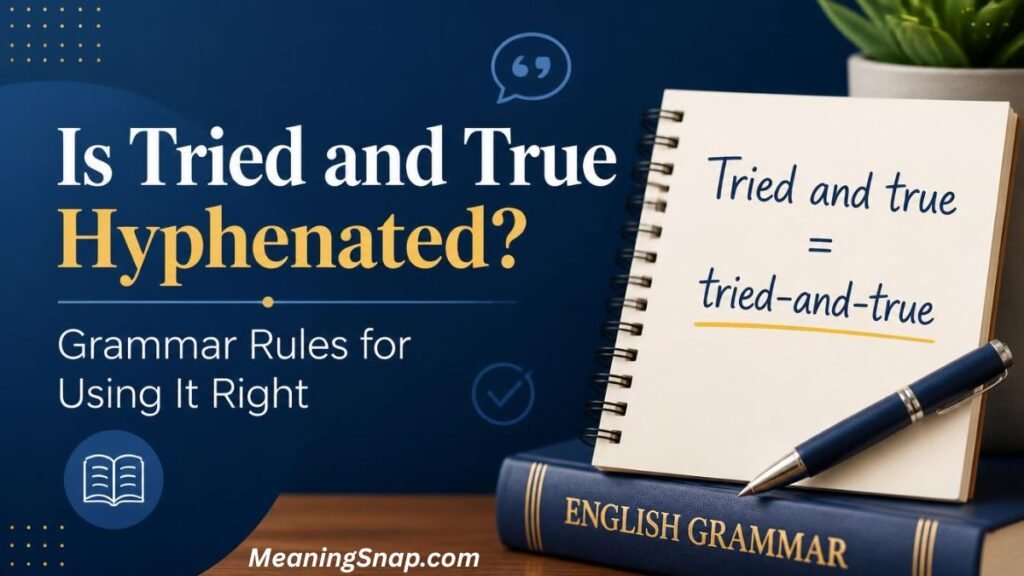
Is Tried and True Hyphenated? Grammar Rules for Using It Right
Before a Noun
When the expression sits directly before a noun, hyphenate it: a tried-and-true method, a tried-and-true recipe. The hyphens signal to readers the three words function as one descriptive unit, known in grammar terms as a compound modifier, similar to how “well-known” or “state-of-the-art” get hyphenated before a noun.
After a Verb
When the phrase follows a verb like “is,” “seems,” or “proved,” skip the hyphens. “This method is tried and true.” “Her advice proved tried and true over the years.” No noun follows directly, so the open form is correct.
Quick Grammar Note
Style guides including AP and Chicago generally agree on this rule for compound modifiers, though neither addresses this specific phrase by name. A quick test: ask whether a noun follows right after. If yes, hyphenate. If no, leave the phrase open.
A few side-by-side sample sentences make the pattern easy to remember:
| Sentence | Correct? | Why |
|---|---|---|
| We stuck with our tried-and-true approach. | Yes | A noun (“approach”) follows directly |
| Our approach is tried and true. | Yes | Comes after a verb, no noun follows |
| We stuck with our tried and true approach. | No | Missing hyphens before the noun |
| Our approach is tried-and-true. | Informal only | Hyphens aren’t needed here, though widely tolerated in casual writing |
Native speakers slip on this constantly in emails and social captions, mostly because the spoken version sounds identical either way. Reading the sentence out loud won’t catch the error. Checking whether a noun sits right after the phrase will.
Autocorrect tools and grammar checkers sometimes miss this distinction too, since the open form technically reads fine on its own outside a noun-modifying position. A quick manual check beats relying on software here, especially in a headline or subject line where the noun sits right next to the phrase.
Read Also: What Does MH Mean in a Text? Every Meaning Explained (2026 Guide)
Tried and True in Real Life: Conversation, Business & Marketing Examples

In Everyday Conversation
People drop this expression into casual chats more often than you’d think, usually to vouch for something without over-explaining. Here’s what it looks like across a few different tones:
- Casual: “Bro use my playlist, it’s tried and true for study sessions.”
- Sincere: “I know it’s not fancy, but this skincare routine is tried and true for my sensitive skin.”
- Sarcastic: “Oh sure, let’s skip the tried and true method and wing it instead, sounds like a fantastic idea.”
- Reassuring: “Don’t stress about the interview, stick with your tried and true answers from practice.”
- Nostalgic: “Nothing beats grandma’s tried and true pancake recipe on Sunday mornings.”
Notice how the phrase shifts weight depending on delivery. Sincere use leans warm. Sarcastic use flips the meaning into a jab at someone ignoring good advice. Context, punctuation, and tone of voice carry a lot of the actual meaning in texting.
In Business & Marketing Copy
Brands lean on this language when they want to sound dependable rather than experimental. A tried and true strategy in marketing often signals a low-risk, proven approach with a track record, as opposed to a brand-new campaign concept nobody tested yet. This matters more than it sounds, since customers, investors, and managers all respond well to language suggesting a lower chance of failure.
A few realistic workplace language examples:
- “Our email marketing team stuck with tried and true subject lines instead of testing a risky new format.”
- “The sales strategy driving most of our revenue is dependable and proven, not flashy.”
- “For customer retention, this kind of outreach beats trendy tactics nine times out of ten.”
- A product listing reading “Made with a tried-and-true formula trusted by three generations” signals reliability without needing extra explanation.
- An internal memo noting “We’re keeping the onboarding process tried and true this quarter instead of rolling out the new software” signals a deliberate, low-risk choice rather than a lack of ambition.
This kind of business writing works because the phrase sets expectations fast. Readers know exactly what they’re getting: something with proven effectiveness, not a gamble, which matters a lot in professional communication where trust needs to be earned quickly rather than argued for at length. Marketers specifically reach for it in email subject lines, product descriptions, and testimonials, since it reassures a reader without requiring proof upfront the way a specific statistic would.
What Makes a Method “Tried and True”?
A method earns this label through repetition across different conditions, not a single lucky result. Cooks call a recipe tried and true after making it dozens of times with consistent results. Engineers and developers reach for similar language when a process holds up across multiple projects without failure.
A few real-world examples across different fields:
- Cooking: “This bread recipe is tried and true, I’ve made it every week for three years.”
- Home repair: “Try the tried and true method for unclogging a drain before buying anything expensive.”
- Teaching: “My tried and true way of explaining fractions works with almost every student.”
- Software: “We kept the tried and true deployment process instead of switching to the new pipeline mid-project.”
What separates a tried and true method from a merely popular one comes down to consistency. Popularity measures how many people use something. This phrase measures how reliably it performs once people put it to use, across enough repetitions to rule out luck.
Read Also: MYF Meaning in Text: What It Really Stands For and How to Use It
Can Tried and True Describe a Person? Compliment or Cliché?

Yes, and it usually reads as a genuine compliment. Calling someone tried and true suggests reliable and trustworthy behavior built through repeated interactions, not flashy or exciting necessarily, but steady in a way people value over time.
A “tried and true friend” sticks around through hard times. This kind of coworker shows up, delivers, and doesn’t need constant supervision, which is exactly why managers use the phrase in performance reviews and recommendation letters more often than people realize. The phrase carries warmth alongside its practicality, unlike a colder synonym like “reliable” used on its own without any personal history behind it.
Some writers avoid the phrase in formal writing since it edges toward cliché territory, especially in headlines and marketing copy leaning on it too often. Using it once in an article or conversation lands fine. Repeating it every paragraph starts sounding lazy, or like filler standing in for a more specific compliment the writer didn’t take the time to think through.
A fair rule of thumb: reach for this phrase when describing something earning trust through history and repetition, and swap in a plain word like dependable or consistent when the writing needs a fresher feel.
Tried and True vs Similar Phrases: What’s the Real Difference?
Comparison Table
Several phrases circle the same idea of reliability, though small differences separate them. Here’s a side-by-side look:
| Phrase | Core Meaning | Example Sentence |
|---|---|---|
| Tried and true | Tested repeatedly and proven dependable, with emotional warmth | “This is my tried and true morning routine.” |
| Tried and tested | Nearly identical meaning, more common in British English, slightly more formal | “The equipment went through a tried and tested inspection process.” |
| Proven | A neutral statement of demonstrated success, without added warmth | “The medication is proven effective for most patients.” |
| Time-tested | Emphasizes duration and history over repeated testing | “Time-tested farming techniques still work today.” |
| Old reliable | Informal, often affectionate, used for objects or people | “My old reliable truck started right up in the cold.” |
Read Also: Snowball Kiss Meaning: Ultimate Guide to This Intimate Practice
Tried and True or Tried and Tested: Which Should You Use?
For everyday writing, the phrase and tried and tested work interchangeably, with the latter leaning slightly more common in the UK. Reach for “proven” in technical writing wanting a neutral, well-established method without extra personality. Save “time-tested” for situations emphasizing history specifically, like traditions or long-standing practices passed down through generations. “Old reliable” fits casual, affectionate descriptions of objects and people more than formal writing ever will.
None of these alternatives are wrong exactly. They carry different amounts of warmth, formality, and specificity, so picking the right one comes down to matching tone rather than chasing a single correct answer. A résumé leans toward “proven” or “established.” A birthday card leans toward “old reliable.” The phrase itself sits comfortably in the middle, working for both a group chat and a company newsletter.
Common Mistakes People Make With Tried and True
A few errors show up again and again:
- Writing “try and true” instead of the correct past-tense form. The verb needs to reflect something already tested, not an instruction to test it now.
- Forgetting the hyphens before a noun, which trips up even careful writers who know the rule in theory.
- Overusing the phrase in copy until it stops meaning anything specific and starts reading as filler.
- Assuming the phrase always signals excitement. It signals reliability, not innovation, so pairing it with words like “revolutionary” in the same sentence creates a contradiction readers notice right away.
- Misspelling it as “trial and true,” a common mishearing since the two phrases sound close when spoken quickly. Only “tried” is correct here.
- Dropping the “and,” writing “tried true” as a single compressed unit. The conjunction holds the phrase together grammatically and shouldn’t be cut for the sake of brevity.
Catching these small slips keeps writing sounding sharp instead of careless, especially in professional writing where small grammar choices signal a lot about attention to detail. None of these mistakes are catastrophic on their own, but they add up in a resume, a pitch deck, or a piece of published content where precision reflects on credibility.
Tried and True Synonyms and Similar Phrases
Synonyms
When the phrase feels overused, plenty of alternatives carry similar weight: dependable, trustworthy, reliable, established, well-established, effective, verified, consistent.
Similar Idioms
A few idiomatic expressions land close to the same meaning:
- Stood the test of time
- Old faithful
- Proven track record
- Time-honored
- Battle-tested
Swapping in one of these now and then keeps writing varied without losing the original meaning. Each carries a slightly different flavor. “Battle-tested” leans more intense and high-stakes, often showing up in tech and engineering contexts, while “old faithful” leans warm and familiar, closer to how you’d describe a favorite coffee mug than a business process.
Picking between these options usually comes down to audience. A technical readme benefits from “battle-tested” or “verified.” A birthday toast benefits from “old faithful” or “tried and true.” Matching the phrase to the room matters more than picking the objectively strongest synonym.
Frequently Asked Questions
What is the tried and true meaning?
The tried and true meaning comes down to this: something tested repeatedly and proven reliable, whether a method, product, habit, or person.
Is tried and true a positive phrase?
Yes, it’s a compliment, signaling trust and dependability earned through actual use rather than assumption.
Is tried and true an idiom?
Yes, it functions as an idiomatic expression, and its meaning goes beyond a literal reading of the individual words.
Can tried and true describe a person?
Yes, calling someone this means they’ve proven dependable and trustworthy over repeated interactions.
What’s the difference between tried and true and tried and tested?
Both share nearly the same meaning, with tried and tested appearing more often in British English and slightly more formal contexts.
Is tried and true hyphenated?
Only before a noun, as in “a tried-and-true method.” After a verb, like “this method is tried and true,” no hyphens are needed.
The Bottom Line
Next time someone calls their go-to recipe, playlist, or work strategy tried and true, you’ll know the tried and true meaning goes deeper than a casual saying. It’s shorthand for something earning trust the hard way, through testing, repetition, and results holding up under real conditions. Save the phrase for the things in your life genuinely holding up under real use, and it keeps doing its job the same way it’s done for everyone who used it before you.

Alex Morgan is a writer focused on explaining slang, words, phrases, acronyms, and popular expressions in a simple and easy-to-understand way. Through clear explanations and helpful examples, Alex helps readers quickly understand what words and phrases mean and how they’re commonly used.