You’re scrolling through your messages, and a friend signs off with “ok bye luv.” No heart emoji, no “I love you,” just three letters. So what’s behind it?
The short answer on luv meaning in text: it’s a casual spelling of “love.” Between friends and family, it reads as warm and easygoing. From a British shopkeeper, it’s a friendly way to say “hey.” From a crush, the word alone settles little, and the context does the rest.
This guide to luv meaning in text covers what the word means, how to read its tone, how it differs from love, and where to skip it. It also sorts out the Ramayan and tennis searches that keep landing on this word.
Luv Meaning in Text: The Short Answer
Luv is an informal spelling of “love.” In plain English, luv means love, written the way it sounds. Merriam-Webster labels it a nonstandard spelling of love, and Dictionary.com tags it as eye dialect, which means a spelling that copies how people say a word. Say “luv” or “love” out loud and you’ll hear no difference. The luv meaning in text stays the same in a DM, a caption, or a comment. Only the tone changes.
The spelling is older than your phone. Etymonline traces luv as an informal spelling back to 1825, and Grammarly gives the same date. Texting didn’t invent it. Phones just made it easier to spot.
Oxford Learner’s Dictionaries splits luv into two uses, and they cover nearly everything you’ll run into:
- Affection: an informal spelling of love, such as when you sign off a note or message.
- Address: a British way to speak to someone, as in “Never mind, luv.”
Most luv meaning in text conversations land in the first group, which is plain affection with a shortcut spelling. Grammarly adds that people tend to read luv as lighter than love, somewhere between like and love. That’s a perception, not a rule. Your relationship with the sender matters more.
You Also Like: LML Meaning in Text: What It Really Means, Plus Real Examples
How to Read the Tone Behind Luv
The same three letters can sound sweet, bored, or sarcastic. Luv meaning in text depends on the mood around it, because the spelling carries little on its own. Look at what surrounds it. Four things shift the tone the most:
- Who sent it. A sibling, a coworker, and a stranger can type the same words and mean three different things.
- What’s attached. “Luv you” and “luv ya” carry more feeling than a bare “thanks, luv.” A name, a heart, or an emoji adds warmth.
- Punctuation. A period cools things down. “Sure, luv.” reads clipped, while “luv u!!” reads bubbly.
- Audience. A luv in a group chat spreads across everyone. A luv in a one-on-one thread points at one person.
Friends and family get the benefit of the doubt, and that’s the safe default. When the sender is a stranger or a business, think friendly politeness first. When the sender is an annoyed friend, check the punctuation.
Common Mistake: Reading luv meaning in text as a confession. A single luv at the end of a text works as a casual sign-off, and it usually doesn’t carry the weight of “I love you.” Reply to the rest of the message and let the person show you what they meant.
Luv Meaning in Text From a Guy or a Girl

Does a guy’s luv mean something different from a girl’s? No. The word works the same whoever types it. Gender doesn’t change the luv meaning in text, so the relationship and the pattern do the work.
If you’re trying to tell whether a crush hides behind the spelling, watch for these signs:
- The luv shows up in your thread only, not in every chat.
- It comes with personal attention, like remembering your day or asking follow-up questions.
- It started recently, when this person never texted that way before.
- The rest of the conversation leans flirty instead of practical.
One luv won’t settle it. A steady run of them, paired with attention and one-on-one messages, tells you more. If you want a straight answer, ask directly. A guess that drags on for a week costs more than an awkward question that takes ten seconds.
Luv vs Love: What Changes When You Swap the Spelling
Out loud, nothing changes. In writing, the spelling sets the mood, and the luv meaning in text leans casual while love stays neutral. This table shows where each version fits:
| Situation | Better choice | Why |
|---|---|---|
| Wedding vows, formal cards | Love | Dictionaries mark luv as informal or nonstandard |
| Text to a close friend | Either | Both read as warm, and luv feels more casual |
| Work email or job application | Love, or skip it | Luv looks out of place in professional writing |
| Note or sign-off to family | Either | Oxford lists this sign-off use as an informal spelling |
| Social media caption | Luv, if the mood is casual | The spelling matches a relaxed tone |
| Message to a UK customer or stranger | Luv or love | Both work as a friendly address in British English |
Because luv is a respelling, it travels well into short captions and quick replies, where speed and mood matter more than polish. Love keeps the edge anywhere a reader might judge your writing.
You May Like: Lumon Meaning Explained: Severance & Hidden Symbolism
Luv Meaning in the UK: A Friendly Way to Address Someone
“Alright, luv?” If you’ve watched British TV, you’ve heard it. A bus driver says it, a café worker says it, and nobody blinks.
Oxford Learner’s lists this address use as British English, and it has nothing to do with romance. It sits next to the usual luv meaning in text without replacing it. Staff in shops, bakeries, and cafés call customers luv or love as a quick, warm greeting. The closest US cousin is “hon” or “sweetie.”
People often link the habit to northern England. A 2022 paper by Nicole Baumgarten on love as an address term notes that link, but it also reports that a 2018 corpus study by Culpeper and Gillings found no evidence of more frequent endearment use in the north. So treat “it’s a northern thing” as popular belief, not proven fact.
The tone depends on who says it to whom. In a YouGov UK write-up on terms like “love” and “babe,” respondents split. Some called them patronizing, especially when men use them toward women. Others called them ordinary social friendliness. A text from a British contact that says “no worries, luv” usually falls in the friendly camp. The same word from a colleague in a tense meeting can sound condescending.
Luv Meaning in Text Messages: Six Real Examples
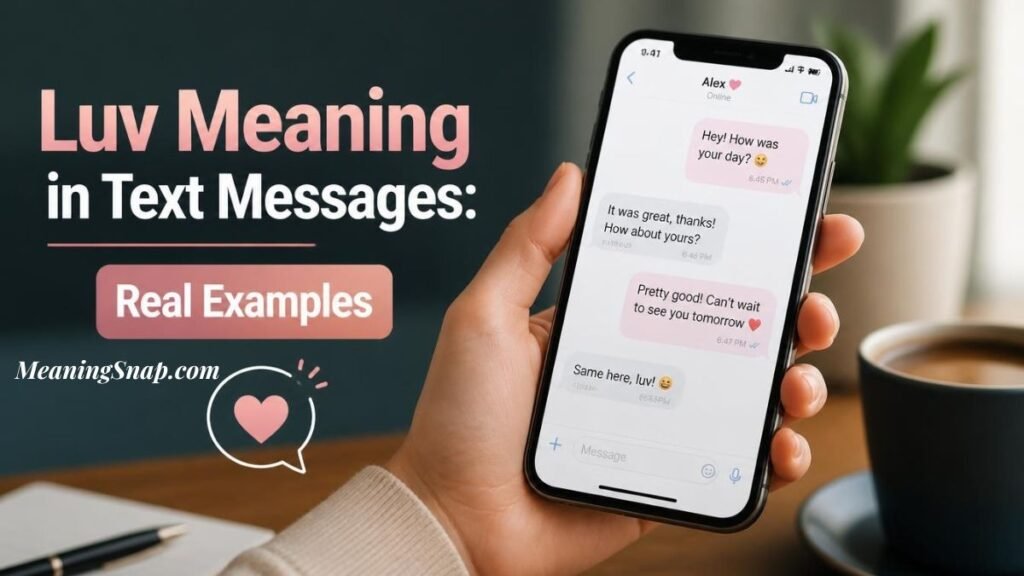
Context decides everything with this word. These chats show how luv meaning in text shifts from sweet to sarcastic.
Mia: Thanks for staying on the phone with me last night. Jordan: Anytime. Luv you, get some sleep.
Jordan means plain, sincere affection between friends. The “get some sleep” part tells you the feeling is care, not romance.
Dev: Pizza at 7? Sam: Yes! See you there, luv ya 🍕
Here luv ya works like a casual “see you soon.” Sam says it out of habit, and nothing deeper hides in it.
Priya: Who’s bringing the speaker Saturday? Marcus: Me. Luv you all, see you at the lake.
Marcus aims the word at the whole group, so the warmth spreads thin on purpose. Nobody in that chat should hear a private message.
Leo: I said I’d call after the meeting. Kara: Sure, luv. Whatever you say.
This one stings. The period after “Sure,” the “luv,” and the “Whatever you say” turn a warm word into a barb. Kara is annoyed, and the spelling just carries the sarcasm.
Ana: The bakery texted me “Your cake’s ready, luv.” Beth: Aww, did they just flirt with you? Ana: Ha, no. That’s just how they talk.
Ana nails it. This is the British address use, the same one a bakery worker would say across the counter.
Noah: Goodnight luv 🌙 Elle: Goodnight! Did you mean to send that to me? 😄 Noah: Yes, to you.
Elle’s playful question clears the fog in one line. When a luv leaves you unsure, a light, direct reply beats a week of decoding.
Other Things People Mean by Luv: Ramayan, Tennis, and Urban Dictionary
Some searches around this word have nothing to do with texting, and none of them change the luv meaning in text. Here’s how each one sorts out.
Luv in the Ramayana
In the Hindu epic Ramayana, Luv (also written Lava) is one of the twin sons of Rama and Sita. His brother is Kusha, and they appear together as Luv and Kush. Luv Kush is also the name of a TV series by Ramanand Sagar based on the Uttara Kanda, the epic’s last book. If you saw “Luv Kush” in a search, it’s about the twins, not affection.
Luv in tennis
In tennis, “love” means a score of zero. Umpires and scoreboards say love, so luv shows up only as a casual respelling. The popular story says the word comes from the French l’œuf, meaning egg, because a zero looks like one. Merriam-Webster calls that folk etymology, since it found no evidence that French speakers used l’œuf for zero. The real origin stays unsettled.
Luv on Urban Dictionary
Anyone can submit entries on Urban Dictionary, so it shows how people use a word, not what the word officially means. The entries for luv describe affection, such as telling someone they’re special to you. That matches the dictionaries and adds no hidden meaning.
You Also Read: SML Meaning in Chat: Screw My Life or So Much Love? (2026)
When to Use Luv (and When to Skip It)
Luv meaning in text works best where the relationship already feels relaxed. Use it when you’re:
- Texting friends, family, or a partner.
- Writing casual captions or comments.
- Signing off a note to someone you know well.
- Answering someone who sent luv first, in the same warm tone.
Skip it when you’re:
- Writing a work email, cover letter, or school assignment.
- Messaging someone new when you can’t tell how it will land.
- Handling a tense conversation, since a stray luv reads as sarcasm.
- An American calling a stranger luv, which can sound put on.
A simple rule covers most cases. Friends get luv, and work gets love.
How to Reply When You’re Unsure of the Luv Meaning in Text
Say someone sends a luv and you freeze. Skip the rewrite-it-five-times spiral. Match the energy you got and add nothing extra. Here are the replies that work in the common spots:
- Friend or family member: send one back, or reply to the message itself. “Luv you too” or “ha, same” both land fine.
- Group chat: answer the question or plan, and leave the luv alone unless you feel like joining in.
- British shop or service text: say thanks. Nobody expects luv in return.
- Someone you might like: reply warmly, then ask something personal and see how they respond.
- Someone who sounded sarcastic: skip the spelling and address the actual issue.
If none of that fits, a plain “thanks” keeps things friendly. Keep the answer short and let the next message show you more. A second exchange usually shows which way the luv meaning in text was intended.
Luv U, Luv Ya, Love You: How They Compare
Luv meaning in text also covers a whole family of phrases. This table lines them up from lightest to heaviest:
| Phrase | What it says | How it lands |
|---|---|---|
| luv it | “Love it,” about a thing, not a person | Light, about taste |
| luv | Informal love, or a friendly address | Light and casual |
| luv ya | “Love you” with a relaxed sound | Easygoing and chatty |
| luv u | “Love you” in shortened form | Warm and quick |
| ily | “I love you” as initials | Quick, text-native |
| love you | The standard spelled-out version | Clear and sincere |
| I love you | The full sentence | The strongest and most deliberate |
Treat that order as a guide, not a rule. A sincere “luv u” from a best friend can outweigh a formal “I love you” from someone who says it on autopilot.
Decode Any Text in Seconds
Got a message that makes no sense? Paste it into the decoder and read it back in plain English, word by word.
More free tools: Slang Search · Word Counter · All Tools
FAQs
What does luv mean in text messages?
It’s a casual spelling of love. Depending on the sender, it signals warmth between friends and family or a friendly “hey” in British English.
Is luv the same as saying I love you?
No. A lone luv works as a sign-off or address, while “luv you” or “I love you” states a feeling directly.
Can luv be flirty?
Yes, when it comes with personal attention, one-on-one messages, and other flirty cues. On its own, the word doesn’t flirt.
Is luv okay in work emails or school writing?
Skip it. Merriam-Webster calls it nonstandard and Oxford Learner’s labels it informal, so formal writing calls for “love” or different wording.
Why do British people call strangers luv?
It’s an everyday friendly address, common in shops and cafés, and it signals politeness instead of romance. Some listeners find it patronizing, so the speaker and the tone matter.
Is luv spelled wrong?
It’s a recognized informal variant, not a typo. Use it in casual messages and switch to “love” when the writing gets formal.
Reading Luv Meaning in Text Without Overthinking It
Start with the safe assumption: luv is friendly warmth in a shorter spelling. Then check three things, which are who sent it, what surrounds it, and whether they send it to everyone. If those point to a friend, a group chat, or a British shopkeeper, relax and reply in the same energy. If they point to a crush, answer the message and ask directly when you want clarity. Keep luv for people who already text you casually, and save the standard spelling for anything a boss or teacher might read.

Alex Morgan is a writer focused on explaining slang, words, phrases, acronyms, and popular expressions in a simple and easy-to-understand way. Through clear explanations and helpful examples, Alex helps readers quickly understand what words and phrases mean and how they’re commonly used.