A friend’s message starts with “TW: spoilers,” and you freeze for a second. Is it a joke, a warning, or something you were supposed to know? The tw meaning in text is simpler than it looks.
TW stands for trigger warning. It’s a short label that says “sensitive stuff ahead,” so you can decide whether to read, watch, or scroll past. People type it in TikTok captions, Snapchat stories, Instagram posts, and plain old group chats.
This guide covers how TW works, where you’ll see it, how it differs from CW, and the few other things TW can mean away from social media.
TW Meaning in Text: The Short Answer
In text, TW means trigger warning. It’s a quick heads-up typed before content that might upset someone, so they can choose whether to engage. Most people follow it with a colon and the topic, like “TW: spoilers.”
The word “trigger” comes from trauma language, where a reminder of a past event can bring back distress. That’s why the label sounds serious. Some people also use TW more casually, for things like spoilers or loud noises.
Capital letters or lowercase, the tw meaning in text stays the same. What matters is the topic after the label, because that tells you what you’re choosing to see.
Read Also: WTW Meaning in Text: What It Really Stands For and How to Reply in 2026
TW Meaning in Text vs CW, Content Note, and NSFW
TW has a few close relatives, and people mix them up all the time. This table shows how they line up.
| Label | Stands for | Typical use |
|---|---|---|
| TW | Trigger warning | Heads-up before distressing or trauma-related topics |
| CW | Content warning | Broader label for anything a viewer might want to know about first |
| Content note | Content note | A softer, more descriptive take on the same idea |
| NSFW | Not safe for work | Adult or explicit material, which has nothing to do with distress warnings |
| Spoiler alert | Spoiler alert | Plot reveals in shows, games, and books |
In practice, the line between TW and CW blurs. Some creators use CW as the umbrella and save TW for heavier topics, while others treat the two as twins. Either way, the topic you name matters more than the two letters you pick.
TW Meaning in Text on TikTok, Instagram, Snapchat, and X

The tw meaning in text doesn’t change from app to app, but the placement does. This table shows where the label usually lands.
| Platform | Where TW shows up | Example |
|---|---|---|
| TikTok | Text overlay in the opening seconds, or the caption | “TW: flashing lights” |
| First line of a caption, or a text slide before a carousel or Reel | “TW: medical talk” | |
| Snapchat | Story caption or the first line of a chat | “tw: scary clip” |
| X | First words of the post | “TW: spoilers” |
| Group chats and DMs | Opening line before a long message | “TW: sad news about a pet” |
No app has its own private definition. The same trigger warning meaning carries over from TikTok to Snapchat to your family group chat. The only difference is timing. Stories move fast, so a warning in the first frame is easier to catch than one buried in a long caption.
TW Meaning in Text Among Gen Z
TW isn’t a Gen Z invention. It started in online communities and spread outward from there. One researcher, in an interview with the Association for Psychological Science, dated the peak of public attention to around 2013 or 2014. Gen Z grew up with the label, so the tw meaning in text feels as ordinary as a hashtag does.
That familiarity shows in how people play with the format. You’ll see jokes like “tw my existence,” where someone slaps TW on themselves for a laugh. There’s no dictionary entry for it and no fixed definition. It’s user-generated humor that borrows the TW format to say “brace yourself for me.”
Tone depends on who’s talking. Between friends, it usually reads as a self-deprecating bit. If it ever sounds like a real cry for help, a quick, kind check-in goes further than a laugh emoji.
Read More: BRB Meaning in Text: What It Stands For and How to Use It (2026)
Real Chat Examples of TW Meaning in Text
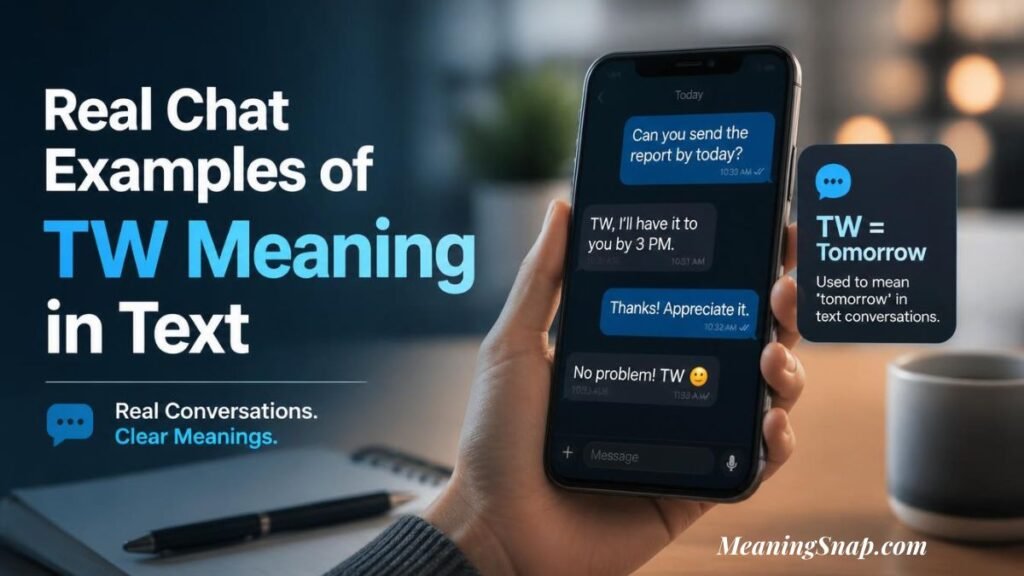
These six chats show the tw meaning in text across different moods and apps. Each one gets a one-line explanation.
Sincere:
Maya: TW: hospital stuff. Dad’s surgery went fine, but I need to talk it through. Jordan: Thanks for the heads-up. Go ahead, I’m here.
Maya tags the topic first so Jordan can choose to listen now or later. Jordan’s reply confirms the warning landed.
Casual:
Sam: tw spoilers, finale thoughts in 3, 2, 1 Riley: Wait, I’m on episode 6. Text me tomorrow.
Sam uses TW lightly, and Riley uses it exactly as intended, to skip the topic for now.
Frustrated:
Priya: You posted that clip with no TW at all. I wasn’t ready for it. Dev: My bad. I’ll add one next time.
Priya’s complaint shows why the label only works when it comes first. Dev owns the slip and moves on.
Surprised:
Chris: Wait, TW? I thought that meant Taiwan. Ana: Nope, trigger warning. It’s a heads-up label.
Chris’s guess isn’t random, since TW is also the country code for Taiwan. In chats and captions, though, the warning meaning wins.
Playful:
Lena: TW: my cooking. Smoke alarm included. Tom: Ordering pizza as we speak.
Lena borrows the format for a joke. Nobody’s getting a real warning here, and Tom knows it.
Practical:
Story caption: tw: loud noises, fireworks at the end Friend: Thanks, turning my volume down first.
The caption flags a sensory surprise instead of a heavy topic, and the friend uses the time to get ready.
How to Read TW Meaning in Text: Real Warning or Joke?

Context tells you which one you’re looking at. Three quick checks help.
First, look for a named topic. A real warning usually names what’s coming, such as “TW: spoilers” or “TW: medical talk.” A joke often attaches TW to something harmless, like cooking or a bad haircut.
Second, check the tone of the rest of the message. Emojis, exaggeration, and punchlines point to a bit. Plain wording and a calm tone point to a warning.
Third, think about who’s sending it. A friend who jokes constantly is likely kidding. A creator posting to a public audience usually means it.
If you’re still unsure, treat it as real. Skipping a joke costs you nothing, and brushing off a real warning can cost someone a rough evening.
Why People Add a TW Before Posting
At its core, a TW gives the viewer a choice. Instead of springing a heavy topic on someone mid-scroll, the poster puts a short label up front, and the viewer decides whether to keep going. On a public account, where the poster has no idea who’s watching, that label costs a few seconds.
The term started in online communities, where people used it to look out for readers with PTSD. How it traveled from there to your feed isn’t well documented, and researchers who’ve studied it say the exact origin is unclear. From those spaces it spread to social media, college classrooms, and everyday chats.
Group chats add another reason. When one person shares a story, everyone in the thread gets it whether they asked or not. A one-line TW at the top lets each person decide for themselves, without anyone having to say “I’d rather not hear this.”
What Topics Usually Get a TW?
There’s no official list, but the pattern is easy to spot. Sources that explain trigger warnings tend to cite heavier subjects first, such as violence, abuse, and other trauma-related topics. Serious illness and medical talk, loss, and grief also earn a label from many posters.
Then there’s the lighter end. People add a TW for flashing lights, loud noises, or sudden jump scares, because those can startle or bother anyone, not only people with a painful history. Spoilers sit at the most casual edge, and that’s where the tw meaning in text starts to overlap with a plain “spoiler alert.”
Where you draw the line is up to you and your audience. A creator with a large public following might label more often than someone texting a close friend. When you’re unsure, name the topic in a word or two and let people choose.
How to Write a TW the Right Way
A clear label helps people who know the tw meaning in text and people who don’t. It takes about five seconds to write, and here’s what works.
- Put it first. The label belongs before the content, since a warning that arrives after the fact doesn’t warn anyone.
- Name the topic. “TW: violence” tells people more than a lone “TW.”
- Keep it short. One or two words after the colon is enough.
- Cover video and images. On video, put the warning in text and say it out loud in the opening seconds. Add it to alt text so screen reader users get it too.
Save the label for things people would want to know about in advance. If every small annoyance gets a TW, the ones that matter get lost in the noise.
What to Do When a Post Has No TW
Even people who know the tw meaning in text well get caught off guard sometimes. A post lands without a warning and hits harder than you expected. You can scroll away, close the app, or mute the account for a while. If you feel up to it, a polite note to the poster, like “Please add a TW next time,” helps the next viewer.
If the content stays with you afterward, talking to someone you trust can help. A mental health professional can give personal guidance if it keeps weighing on you.
Read Also: OFC Slang Meaning: What It Means in Text, Chat & Social Media 2026
Do Trigger Warnings Work? What the Research Says
Did You Know: The word “trigger” comes from PTSD vocabulary, where a reminder of a past event can bring back a traumatic experience.
Knowing the tw meaning in text is the easy part. Whether the label helps is a livelier debate. In a set of six experiments with 1,394 people, researchers found that trigger warnings didn’t reduce negative feelings after people saw disturbing material, and didn’t help them cope better with it. Some researchers also raise a worry that expecting distress can make it stronger.
Other voices push back. One of the psychologists behind that line of research, Benjamin Bellet, has said warnings can still show people that their experiences are recognized. Researchers also point out that no study captures every person, and they call for more work with people who’ve lived through the most severe trauma.
Where does that leave you? Trigger warnings are a courtesy, not a treatment. This is general information, not medical advice.
When TW Meaning in Text Isn’t Trigger Warning
Trigger warning is the dominant meaning in text by a wide margin. TW does turn up elsewhere, though. Wiktionary, a crowd-edited dictionary, lists the following alongside it.
| Meaning | Where you’ll see it | How common in texts |
|---|---|---|
| Trans woman | LGBTQ+ community spaces | Niche |
| Older shorthand for the platform now called X | Dated | |
| Taiwan | ISO country code and the .tw web domain | Technical |
| Terawatt | Science and energy, equal to a trillion watts | Technical |
| Total weight | Gemstone listings, measured in carats | Technical, niche |
Context sorts these out fast. A TW followed by a topic is a warning. A TW tucked inside a sentence about a person is a community abbreviation, and a quick question clears it up.
You might also see longer lists that add Trust Wallet, tomorrow, or this week. Those come from sites that contradict each other and don’t name a source, so we’re leaving them out.
FAQ: TW Meaning in Text
What is the full form of TW?
Trigger warning is the full form behind the tw meaning in text and on social media. Away from chats, TW can also stand for things like Taiwan or terawatt.
Does TW mean tomorrow?
No. Tomorrow is usually shortened to tmrw or tmr, and none of the dictionary sources we checked list TW for it.
Does TW mean weight?
Not in everyday chat. “Total weight” shows up in niche listings like gemstones. If TW is followed by a topic word, it’s still a trigger warning, and that word names the topic.
Does TW mean something different from a girl or a guy?
No. The words around it set the meaning, not the sender’s gender.
What should I say when someone sends me a TW?
A simple “thanks for the heads-up” works. Then read or skip as you like, and if a friend is sharing something heavy, ask whether they want advice or just a listener.
Do I have to add a TW to my posts?
Rules vary by platform and community, so check the group’s guidelines. Even where it’s optional, a TW is a considerate habit for heavy topics.
Next Time You See TW in Your Feed
When TW shows up in a message or caption, read the topic after it before anything else. That one word tells you whether the post is for you right now, and skipping it is always fine. If you’re the one posting, flip the habit. Type TW first, name the topic in a word or two, then share the rest. It’s a small step, and it’s the whole point of the tw meaning in text: giving people a choice before they hit play.

Alex Morgan is a writer focused on explaining slang, words, phrases, acronyms, and popular expressions in a simple and easy-to-understand way. Through clear explanations and helpful examples, Alex helps readers quickly understand what words and phrases mean and how they’re commonly used.