You’re typing a quick note to the class group chat: “Reminder, two pop quizes this week.” A red squiggle shows up under the word. You stare at it for a second. Is it quizes or quizzes?
The short answer is quizzes, with two z’s. Quizes is a misspelling, and Merriam-Webster and Oxford Learner’s Dictionaries list only quizzes as the plural of quiz. The extra z protects the short i sound, so the word doesn’t turn into something that rhymes with “size.”
It looks like a tiny detail, but it shows up in school emails, work chats, and public posts, where a wrong spelling sticks out. Below, you’ll find why the rule works, what the dictionaries say, how the verb forms behave, and a two-second test for next time.
Quizes or Quizzes: Why the Z Doubles
Here’s the thing: quiz is a regular noun. Most plurals just add s. Nouns that end in s, ss, sh, ch, x, or z add es instead, which is why we write buses, boxes, and watches. So far, quiz plus es looks fine.
The catch is the vowel. According to the proofreading service Proofed, writing quizes pushes the i toward a long “eye” sound, the way it sounds in “size.” Doubling the last consonant keeps the i short, so quiz becomes quizzes. It’s the same reason hop turns into hopping instead of hoping.
You can run the same check on other short words. Sit becomes sitting, plan becomes planning, and quiz becomes quizzing, because each has a short vowel followed by a single consonant. When the vowel is long or a second consonant already follows it, as in hope or help, the extra letter stays out. That one habit settles most quizes or quizzes doubts before they start.
Two small exceptions help the rule stick. If a consonant already sits before the z, as in waltz or quartz, nothing needs doubling, so you get waltzes and quartzes. And a word that already ends in zz, like buzz, simply takes es: buzzes.
Read More: Rapport or Repore? The Correct Spelling Explained
Quizes or Quizzes at a Glance
Here’s a side-by-side check of the noun and the verb forms, since the quizes or quizzes question comes up for all three.
| Correct | Incorrect | Why |
|---|---|---|
| quizzes | quizes | The doubled z keeps the short i sound |
| quizzed | quized | Same doubling before -ed |
| quizzing | quizing | Same doubling before -ing |
Why Quizes or Quizzes Trips People Up

After years of writing boxes and buses, quiz plus es feels like the obvious move. Two z’s in a row, on the other hand, can look like a slip, especially in the middle of a word. Spell checkers usually flag the wrong version, but hashtags, usernames, and file names rarely get checked at all. Typing fast on a phone adds one more chance to let a small slip through, and a message sent at 11 p.m. rarely gets a second read.
Wrong versions of the quizes or quizzes spelling tend to fall into a few distinct buckets:
- Quizs. Adding only s leaves a clumsy ending that’s hard to say, which is why the es is needed.
- Quizes. The es is right, but the vowel sound is left unprotected.
- Quiz’s. An apostrophe never builds a plain plural. It belongs to possession, covered further down.
- Quizzies. The ies ending is for words like story and stories. Quiz doesn’t end in y, so it never applies.
Quizes or Quizzes in the Dictionary: Is Quizes Ever Correct?
When you’re stuck between quizes or quizzes, the dictionaries settle it. Merriam-Webster gives quizzes as the plural of quiz and lists quizzed and quizzing for the verb. Oxford Advanced Learner’s Dictionary shows “plural quizzes” as well, and WordReference lists quizzes both as the plural noun and as the third-person verb form. None of them lists quizes.
Some crowd-edited word sites show quizes next to quizzes. That doesn’t make it standard. In school work, workplace messages, and anything you publish, treat quizes as a misspelling. It isn’t a US versus UK split or a style-guide preference, so there’s no gray area to argue about.
Read More: Hassle vs Hastle: Which Spelling Is Correct?
Quized or Quizzed: The Verb Side of Quizes or Quizzes
Quiz works as a verb too, meaning to question someone closely. Merriam-Webster lists quizzed and quizzing as its forms, so “quized” and “quizing” are the same mistake as quizes in different clothes. The logic matches the plural: a short i followed by one consonant doubles that consonant before an ending that starts with a vowel.
One form overlaps with the plural. The third-person verb, as in “She quizzes us every Monday,” is spelled exactly like the plural noun. Context tells you which job the word is doing.
Quizzes Meaning: Noun, Verb, and an Older Sense
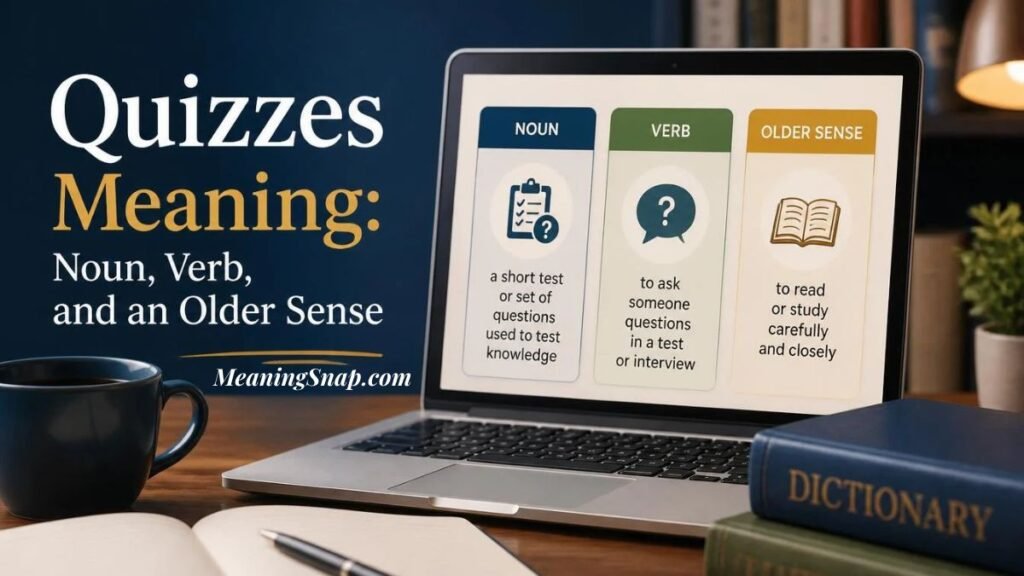
As a plural noun, quizzes usually means short tests (Merriam-Webster calls a quiz a short oral or written test) or question games, which Oxford describes as competitions where people try to answer questions to show what they know. As a verb, it means asking someone a series of pointed questions.
Seen in action, the first sense looks like this: “The teacher handed back the quizzes after lunch.” The second looks like: “The library hosts two trivia quizzes a month.” And the verb sense looks like: “The reporter quizzes the mayor about the budget.”
Merriam-Webster also lists an older noun meaning, an eccentric person. You’ll mostly meet that one in historical writing, not in a group chat.
Quiz Plural and Singular: Where the Apostrophe Goes
Apostrophes don’t make plurals. Write quizzes when you simply mean more than one, never quiz’s. The apostrophe shows up only when something belongs to the quiz or the quizzes.
For a singular noun that doesn’t end in s, like quiz, add apostrophe plus s. For a plural that already ends in s, add just the apostrophe after it. The Chicago Manual of Style gives that plural rule in section 7.16. Chicago and AP only split on singular names ending in s, such as Charles, which doesn’t affect this word.
Here’s how the four forms look in a sentence.
| Form | Spelling | Example |
|---|---|---|
| Singular | quiz | The quiz starts at nine. |
| Plural | quizzes | The quizzes start at nine. |
| Singular possessive | quiz’s | The quiz’s last question was tricky. |
| Plural possessive | quizzes’ | The quizzes’ answer keys are online. |
Quizzes Pronunciation: How to Say It
Oxford Learner’s Dictionaries gives quiz as /kwɪz/ for both US and UK speakers. The plural adds one syllable: KWIZ-iz, with the stress on the first part. Think of “fizzes” with a kw at the start.
Say it out loud once and the double z feels natural. You hear a clear z, then the short iz ending. A spelling like quizes hints at a different vowel in the middle, which is exactly what the second z prevents.
Read More: Hola or Ola: What’s the Difference and Which Is Correct?
Quizzes in a Sentence: Quizes or Quizzes in Real Use
Here are six everyday examples, including three wrong-to-right fixes. Each one is explained once.
- Text message. Wrong: “We have two pop quizes on Friday.” Right: “We have two pop quizzes on Friday.” Two tests means a plural, and the plural needs both z’s.
- Email. “Please bring a pencil, since the weekly quizzes are on paper.” Formal writing uses the same spelling as casual writing, so there’s nothing to switch.
- Caption. “Pub quizzes with this crew never end well.” Captions feel relaxed, but the spelling doesn’t loosen up with them.
- School. Wrong: “Mr. Lee quized us on the periodic table.” Right: “Mr. Lee quizzed us on the periodic table.” The past tense doubles the z, just like the plural.
- Work chat. “The onboarding quizzes’ results are in the shared folder.” This is a plural possessive, so the apostrophe lands after the s.
- Social post. Wrong: “Take our new personality quizes!” Right: “Take our new personality quizzes!” Product pages and posts are public, so this one’s worth getting right.
How to Spell Quizzes: A Two-Second Test for Quizes or Quizzes

Spell it out once: q-u-i-z-z-e-s. That’s seven letters, with the two z’s sitting side by side in the middle.
Here’s a memory trick. Quiz rhymes with fizz, and the plural of fizz is fizzes. If you can picture fizzes, you can picture quizzes, same shape and same double z. You can also say the word out loud. If you hear KWIZ-iz with a short i, the spelling needs the doubled z to match.
Want to test yourself on the noun and its verb forms? Fill in the blanks.
- The teacher gave us three ___ this month. (quizes or quizzes)
- She ___ the new hires on safety rules. (quized or quizzed)
- Did you see the ___ answer key? (quiz’s or quizzes’)
- Our ___ night starts at seven. (quizzes or quiz)
- He ___ his sister about her weekend plans. (quizes or quizzes)
The answers are quizzes, quizzed, quizzes’ (assuming several quizzes share one key), quiz, and quizzes. In item 4, quiz works like an adjective and stays singular. In item 5, quizzes is the verb, spelled the same as the plural noun.
The Odd Story Behind Quizes or Quizzes
Nobody can say for certain where quiz comes from. Merriam-Webster dates its first known use to around 1781 and lists “an eccentric person” as its first noun meaning. Oxford Learner’s notes that the verb sense possibly comes from an older quiz meaning to look curiously at someone through an eyeglass, with influence from the word inquisitive.
Then there’s the famous legend. Richard Daly, a Dublin theater manager, supposedly bet that he’d make a meaningless word the talk of the town overnight, so he had “quiz” chalked on walls across the city. It’s a fun story, and it spreads easily because it makes a plain word feel mysterious. It also doesn’t hold up, since the Museum of Hoaxes points out that the word shows up in print before 1791.
Did You Know: The legend puts the bet in 1791, but Merriam-Webster traces quiz back to about 1781, roughly a decade earlier.
Quizes or Quizzes in Texts, Hashtags, and Page Titles
Casual spaces tempt people to relax about spelling, but quizes or quizzes isn’t a question of formality. The correct form is the same in a group chat, a school portal, and a company newsletter. Where it does matter more is anywhere the text stays visible for a long time.
A hashtag like #quizzes is easy to share and easy to search, and the doubled z is part of the word, not a stylistic choice. Page titles, course names, and folder names work the same way. A label such as “Weekly Quizes” gets copied into emails, slides, and links, and one small slip multiplies each time someone pastes it.
Web addresses add another wrinkle. Once a link with a wrong spelling is shared around, fixing the page later means setting up a redirect so the old link doesn’t break. It’s easier to type quizzes the first time than to repair it later.
If you run a site, a classroom page, or a team wiki, a quick look at your own headings is worth a minute. Titles like “Practice Quizzes” and “Quizzes by Topic” read as polished, and the spelling costs nothing to get right.
Read More: How-To vs. How-Tos: Which One Is Correct?
FAQs
Do British and American English spell quizzes differently?
No, both use quizzes. The difference is usage. Oxford Learner’s Dictionaries says North American English also calls a brief, informal classroom test a quiz, while in both varieties a quiz can be a question contest, like a pub quiz.
What’s the difference between a quiz and a test?
A quiz is a short test, usually a handful of questions with a quick result, according to Merriam-Webster and Vocabulary.com. Test is the broader word, and a quiz is the short, lower-pressure version of it.
Is it quiz shows or quizzes shows?
Quiz shows. When quiz describes another noun, it stays singular, as in quiz show, quiz night, or quiz questions.
What do you call a person who quizzes others?
A quizzer, a form Merriam-Webster lists. It keeps the double z, and the plural is quizzers.
Is quiz a countable noun?
Yes. You count quizzes the way you count any regular noun: one quiz, two quizzes, ten quizzes. It has no special plural form beyond the doubled z.
Is quizzical related to quiz?
Yes. Vocabulary.com says the older meaning of quiz, an odd or unconventional person, eventually gave rise to quizzical, which also carries the double z.
Quizes or Quizzes: Always Pick the Double Z
Next time the quizes or quizzes question pops up, hold onto one detail: quizzes has two z’s, and so do quizzed, quizzing, and quizzer. Add an apostrophe only when something belongs to the quiz or the quizzes. If you hesitate, think of fizz and fizzes, say the word aloud, and let the short i guide the spelling. Whether you’re texting a classmate, emailing a team, or labeling a page on your own site, that small habit gets you the right form in a few seconds, with no dictionary tab open.

Alex Morgan is a writer focused on explaining slang, words, phrases, acronyms, and popular expressions in a simple and easy-to-understand way. Through clear explanations and helpful examples, Alex helps readers quickly understand what words and phrases mean and how they’re commonly used.