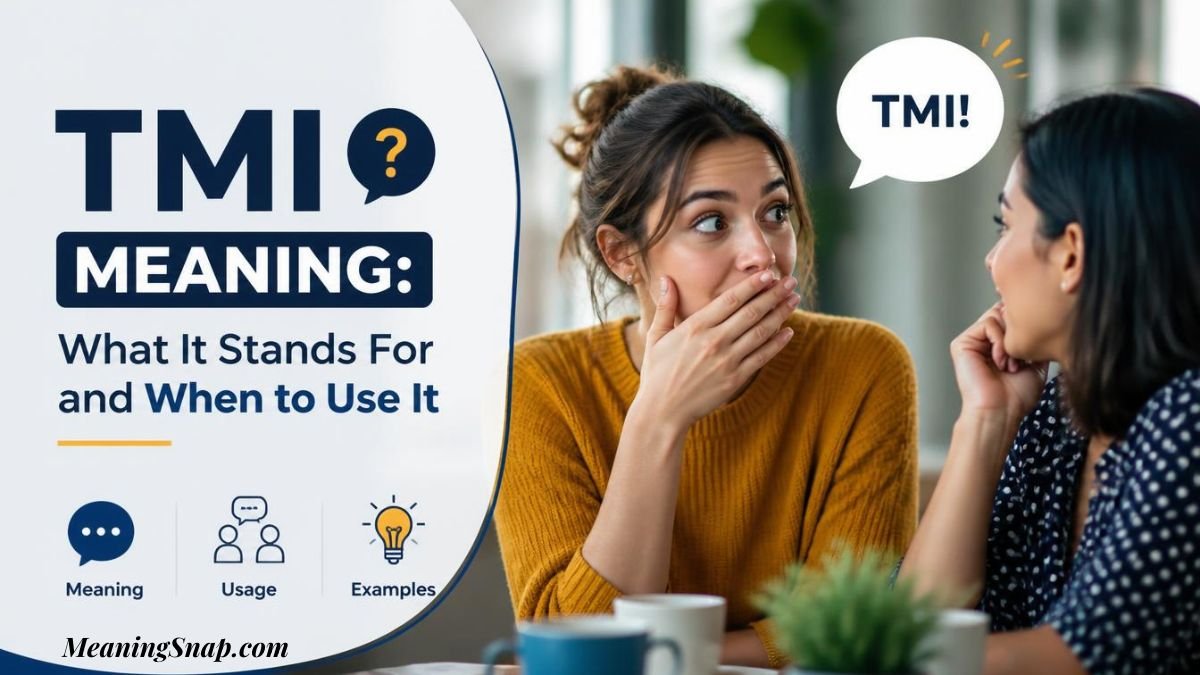
Your friend texts you ten messages about her dentist appointment, right down to the numbing shot. Your thumb hovers over the keyboard. Do you type “TMI” and risk sounding rude, or let her finish?
The TMI meaning is “too much information.” People type it when someone shares a personal detail the listener never asked for. Some people aim it at themselves, as in “TMI, but I slept in my jeans.” Either way, it flags a limit in the conversation.
Here’s the thing. Three letters sound playful in one chat and sharp in another. This guide shows how tone and audience change the TMI meaning, how to reply, how to say it kindly, and where the term turns up in K-pop, at work, and even in nuclear history.
TMI Meaning: The Short Answer
TMI stands for “too much information.” Merriam-Webster says people use it to suggest someone has revealed personal information better kept private. Oxford Learner’s Dictionaries describes the information as embarrassing. Dictionary.com describes it as a response to an inappropriate disclosure or a reaction to information overload.
In texts, comments, and DMs, this is the meaning you’ll meet in practice. Other readings exist, but they live in science, medicine, and history. We cover them near the end.
Think of TMI as a speed bump, not a stop sign. It slows the story down. It doesn’t end the friendship.
Read Also: TM Meaning in Text: What It Really Means & How to Use It
Two Ways People Use the TMI Meaning
People aim TMI in two directions, and a third version is pure joking. This table shows all three.
| Use | Who types it | What it signals | Example |
|---|---|---|---|
| Reaction | The listener | “This is more than I wanted to hear” | “Wow, TMI.” |
| Warning | The sharer | “Heads up, I’m about to overshare” | “TMI, but I cried at a commercial.” |
| Joke | Either person | Teasing, with no real discomfort | “tmi lol, keep going” |
Punctuation shifts the mood. In our reading, “TMI!” sounds loud and playful, “TMI.” sounds flat and firm, and “tmi lol” sounds light. A stretched-out “TMIIII” is dramatic fun.
A warning TMI works like a courtesy. The sharer hands you a choice before the story starts. A reaction TMI works like a brake, applied after the story has already begun.
Where the TMI Meaning Draws the Line
No dictionary lists every TMI topic, because the line moves with the listener. A Merriam-Webster example sentence makes the same point: one parent’s TMI is another parent’s ordinary sharing.
The line isn’t only about private or embarrassing details, either. Collins’ British entry describes TMI as an expression of distaste or boredom. Sometimes the detail is simply dull.
This table shows how the same topic changes with the audience.
| Topic | Usually fine with | Often TMI with |
|---|---|---|
| Health updates | Close friends and family | Coworkers, mixed group chats |
| Dating and relationship details | A best friend | Coworkers, a partner’s family, public comments |
| Money troubles | A partner or trusted friend | Coworkers, social feeds |
| Family arguments | One close friend | A group chat, clients, an online audience |
| Work complaints | A peer you trust | Your manager’s chat, a public post |
| A play-by-play of an ordinary day | Anyone who asked | Anyone in a hurry |
Run these three questions before you send a long message, or before you type TMI at someone else.
- Who’s reading? Would you say it out loud to everyone in this chat?
- Did they ask? Detail nobody asked for is the usual trigger.
- Does it help them? Good detail explains, warns, or connects. Weak detail only unloads.
If two answers come back no, trim the message or send it to someone closer.
Read More: TML Meaning in Text: What It Stands For and How to Reply
TMI Meaning in Real Chats
Six chats, six moods. Each gets one short explanation.
Playful, in a WhatsApp group chat:
Maya: Not to be TMI, but I ate cereal for dinner three nights in a row.
Jordan: TMI! Also, same.
Maya warns first. Jordan answers with mock shock, then admits to the same habit, so nobody feels uncomfortable.
Sincere, in an Instagram DM:
Sam: Sorry, TMI, but I’ve been stressed about the move all week.
Priya: Not TMI at all. Want to talk about it?
Sam uses TMI as an apology. Priya rejects the label, which tells Sam the sharing is welcome.
Dry, in a work chat:
Lena: Update: my landlord and I are now fighting about the dishwasher. Here are the photos.
Omar: TMI, Lena. Save it for lunch. Budget numbers by noon?
Omar sets a limit but offers a way forward. The redirect keeps the tone friendly.
Frustrated, in a family group chat:
Tara: Dad posted our entire argument in the family chat.
Dev: TMI, Dad. Take it to a private message.
Dev doesn’t object to the topic. The problem is the audience, which is question one of the test above.
Surprised, in a TikTok comment section:
Comment: I quit my job on camera and I’m crying in a parking lot.
Reply: Okay, TMI, but I’m invested. Update us!
Here TMI works as a hook. The replier signals surprise and keeps watching. Confessional videos invite the label, and the label invites more attention.
Affectionate, in a text between friends:
Nina: Then I moved the receipt to my left pocket, then back to my right, then…
Chris: Nina. Too much information. I love you. Skip to the end.
This is the boring sense Collins describes. Chris spells out the phrase and adds affection so it lands warmly.
How to Reply When Someone Says TMI

Their TMI lands in one of three ways. Match your reply to the one you got.
- Playful: Keep it light. “Fair, I’ll spare you the details.” Or “Okay, okay, I’ll stop. Mostly.”
- Uncomfortable: Apologize briefly and change the subject. “Sorry, got carried away. How was your weekend?”
- Annoyed: Step back without defending yourself. “Got it. Didn’t mean to overshare.”
Want the story to keep going? Tell them so. A friendly “Not TMI, go on” gives the sharer a green light.
Typed TMI and felt it came out harsh? Send a follow-up: “Sorry, bad timing. I’m glad you told me.” One sentence repairs most of the damage.
Read Also: What Does TTM Meaning in Text? Everything You Need to Know
How to Say TMI Without Sounding Rude
A bare TMI works between close friends. Everyone else deserves a softer version. This table gives four options.
| Tone | Try saying | Best for |
|---|---|---|
| Soft | “This is a lot for my brain right now. Want to switch topics?” | Friends in a rough moment |
| Funny | “I need a warning label before the next part.” | Close friends, group chats |
| Firm | “I’d rather not hear the details, but thanks for trusting me.” | Repeat oversharers |
| Work-safe | “Let’s keep it to the project. I hope things get easier.” | Coworkers |
Thank the person for the trust before you draw the boundary. Many people who overshare want to connect, so a kind exit keeps the connection alive.
When the TMI Meaning Doesn’t Fit
TMI is built for awkward or excessive detail. It is the wrong reply to a serious disclosure. If a friend tells you about a loss, a health scare, or a safety problem, answering “TMI” shuts the door at the moment they opened it.
Listen first. Ask what they need. If they sound unsafe or in crisis, take it seriously and help them reach someone ready to support them.
The difference comes down to purpose. A play-by-play of lunch is TMI. A hard truth shared with trust is not.
TMI Meaning on Instagram, TikTok, Snapchat and in Group Chats
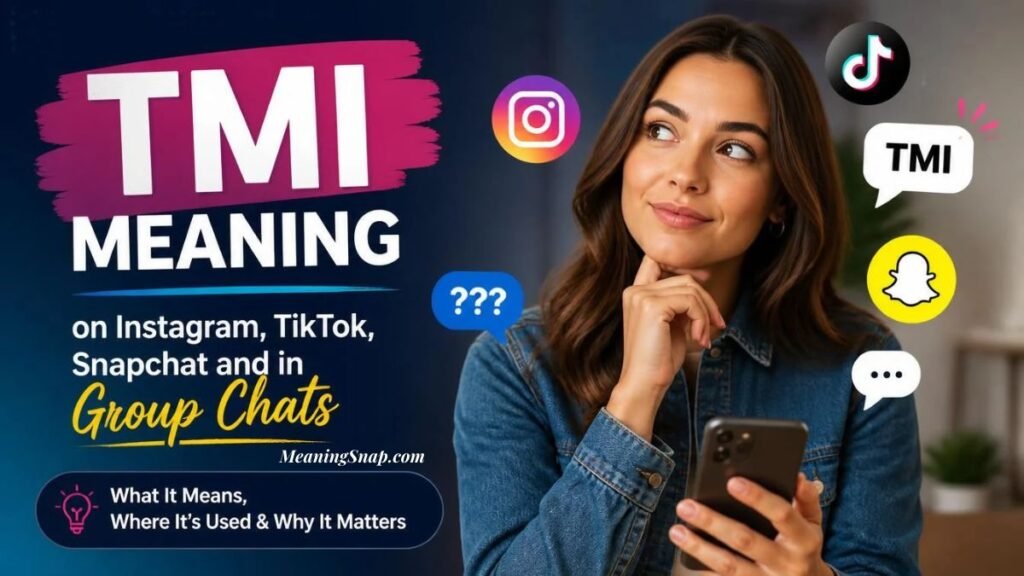
The TMI meaning stays the same on every app. We found no source giving Snapchat, Instagram, or TikTok its own definition. Only the pace and the audience change.
| Platform | How it shows up | Example |
|---|---|---|
| Replies to stories, comments on captions | “ok TMI but I love this” | |
| TikTok | Warning captions on confessional videos, comments | “TMI warning: story time” |
| Snapchat | Quick replies to snaps | “tmi 😭 send the whole story” |
| Group chats | Reaction to sharing with a mixed audience | “TMI, Dad” |
| Forums | A label in the post title | “TMI: my first week at college” |
The forum habit is old. According to Know Your Meme, posters were already using TMI as a warning label in subject lines by 1998.
TMI Meaning From a Girl, From a Guy, and Between Friends
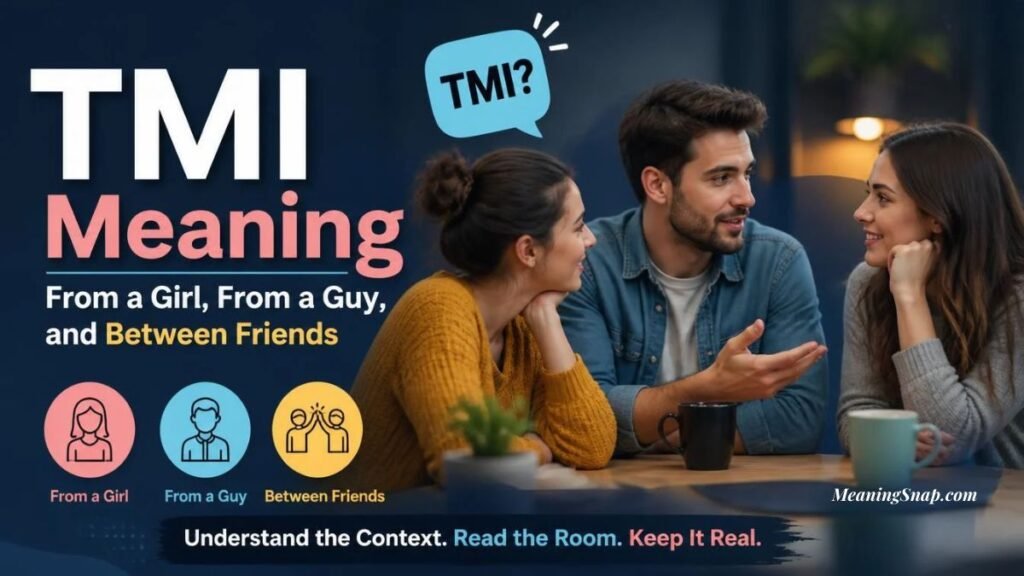
Does TMI mean something different from a girl or a guy? No. We found no dictionary or reliable source giving it a gendered meaning. The relationship changes the message, not the sender.
Between close friends, TMI is normal teasing, because trust is high and awkward stories are part of the bond. With a crush or a new match, a quick “TMI” after you overshare often reads as playful teasing. The next message tells you more than three letters do.
A reply with a question or an emoji means the chat is fine. A reply with a fast subject change is a signal to share a little less next time.
Read Also: TMP Meaning in Text | What It Really Means in Chats, Texts & Online Conversations in 2026
TMI Meaning in K-pop
Fans searching for the TMI meaning in K-pop notice something odd. An idol is asked for a TMI and answers with what they ate for breakfast.
Here’s why. Koreaboo notes English speakers use TMI for deeply personal or embarrassing stories, while Korean usage leans toward small, random details from someone’s day. Wiktionary’s Korean entry agrees. It calls TMI unnecessary information and says it isn’t taboo the way it is in English.
K-pop media leans into the fun version. Mnet launched a show called TMI News, and the network said the name also stood for “Thursday Mnet Idol,” per Soompi. The South China Morning Post’s youth edition notes fans ask idols for TMIs to peek into their private lives. BTS also explained TMI as Korean slang for too much information in an Entertainment Weekly clip, according to SBS Star.
So in fan spaces, “tell us a TMI” is an invitation, not a complaint.
TMI Meaning at Work and School
TMI fits peer chats with an informal culture. With a manager, professor, or client, spell out your boundary instead. These swaps keep the meaning and drop the slang.
- “Let’s focus on the project.”
- “This is more detail than I need, but thanks for telling me.”
- “I’ll leave it there so we stay on schedule.”
If you overshare yourself, a quick recovery works: “Sorry, too much detail. Back to the agenda.” Keep TMI out of formal emails, cover letters, and essays.
TMI Meaning vs Oversharing, TLI, TL;DR and Spill the Tea
Several terms sit close to TMI. This table separates them.
| Term | Meaning | How it differs from TMI |
|---|---|---|
| Oversharing | Sharing or revealing too much information | The act itself. TMI is the label or the reaction. |
| TLI | Too little information | The opposite. Dictionary.com shows a Wall Street Journal line about balancing TMI and TLI. |
| TL;DR | Too long, didn’t read | About length, not privacy. |
| Spill the tea | Share gossip | Usually about other people, and the listener wants it. TMI is unwanted detail, often about yourself. |
Why People Share Too Much
Oversharing isn’t always bad manners. It has a measurable pull. In a 2012 study in the Proceedings of the National Academy of Sciences, Harvard researchers Diana Tamir and Jason Mitchell reported people spend 30 to 40 percent of their speech on their own experiences. Brain scans showed reward regions responding during self-disclosure, and participants gave up money for the chance to talk about themselves.
So the friend with the ten-message dentist story isn’t being cruel. Sharing feels good, and the urge to tell someone is built in. The TMI meaning gives the listener a polite way to say “enough for now.”
TMI isn’t always negative, either. When someone asks how you’re doing and wants the honest answer, a long reply isn’t oversharing. When trust is high, details build closeness. The three-question test above sorts out which case you’re in.
Where the TMI Meaning Comes From
Nobody has documented a first use we’ve verified. Know Your Meme reports Wiktionary points to 1988 but gives no citation, so we treat the date as unconfirmed. The same site says Urban Dictionary’s earliest definition of TMI dates to October 2002. Urban Dictionary shows when people used the term. It doesn’t prove who coined it.
Fun Fact: Merriam-Webster dates the first known use of “overshare” to 1982. Webster’s New World College Dictionary named “overshare” its 2008 Word of the Year, according to Know Your Meme.
Other TMI Meanings: Three Mile Island, Medical and More
Three other meanings show up in searches. This table sorts them by reliability.
| Meaning | Where it appears | Verdict |
|---|---|---|
| Three Mile Island | History and energy news | Real. Dictionary.com lists it in its American entry. The accident happened on March 28, 1979, in Pennsylvania. |
| Total Marrow Irradiation | Transplant medicine | Real but niche. It appears in a registered clinical trial protocol for a transplant conditioning regimen. |
| Trimethylindium | Chemistry | Real but niche. Wiktionary lists it. |
Wiktionary also lists a psychology term and a space-travel term, both niche. Context settles every case. A chat reply reading “TMI” is slang. A headline about a nuclear plant is about Three Mile Island. A hospital document names a treatment.
What about TMI meaning stroke and other medical guesses? We found no standard stroke meaning. Searchers often mean TIA, a transient ischemic attack, also called a mini-stroke. Sites listing heart-related expansions don’t cite sources, so we left them out. If someone shows sudden weakness, numbness, vision loss, or slurred speech, seek emergency care right away, as Sutter Health advises, instead of searching for acronyms.
Read Also: WTMS Meaning in Text: A Complete Guide About Viral Slang
How We Checked the TMI Meaning
We compared Merriam-Webster, Oxford Learner’s Dictionaries, Dictionary.com (which includes Collins’ British entry), and Wiktionary for the core meaning. For origin we used Know Your Meme as a pointer and treated Urban Dictionary as evidence of usage, never proof.
For K-pop, we read Soompi, Koreaboo, the South China Morning Post’s youth edition, and SBS Star. For the psychology, we used the original study in the Proceedings of the National Academy of Sciences. For Three Mile Island and medicine, we used Britannica, a Pennsylvania heritage page, and a registered clinical trial document.
Where no source existed, such as a Snapchat-only meaning, a gendered meaning, or a standard stroke meaning, we said so instead of guessing.
Frequently Asked Questions
Is TMI rude?
Not by default. A bare TMI aimed at someone sharing something serious stings, so add a kind line when the topic matters.
Is it okay to say TMI to close friends?
Yes. Close friends are the audience the term was made for, and teasing each other about oversharing is normal.
Is TMI okay at work?
Among peers in an informal chat, it’s fine. With managers, clients, or professors, spell out your boundary in plain words.
What is the opposite of TMI?
TLI, short for “too little information.” It describes the reverse problem: a message too vague to follow.
Is TMI a real word?
It’s an initialism, not a word, but Merriam-Webster, Oxford Learner’s Dictionaries, and Dictionary.com all list it. Oxford labels it informal.
Does TMI need capital letters or periods?
No. Oxford Learner’s Dictionaries and Dictionary.com list both TMI and tmi. The New York Times styled it as T.M.I. in a 2023 piece, according to Wiktionary, but most writers skip the periods.
Use the TMI Meaning to Draw Your Own Line
Bottom line: TMI is a nod to the other person’s comfort. Type it when a story outruns the setting, and soften it when the topic matters.
Before you hit send on a long message, run the three questions. Who’s reading? Did they ask? Does it help them? Two no answers mean it’s time to trim the story or pick a closer audience.

Alex Morgan is a writer focused on explaining slang, words, phrases, acronyms, and popular expressions in a simple and easy-to-understand way. Through clear explanations and helpful examples, Alex helps readers quickly understand what words and phrases mean and how they’re commonly used.