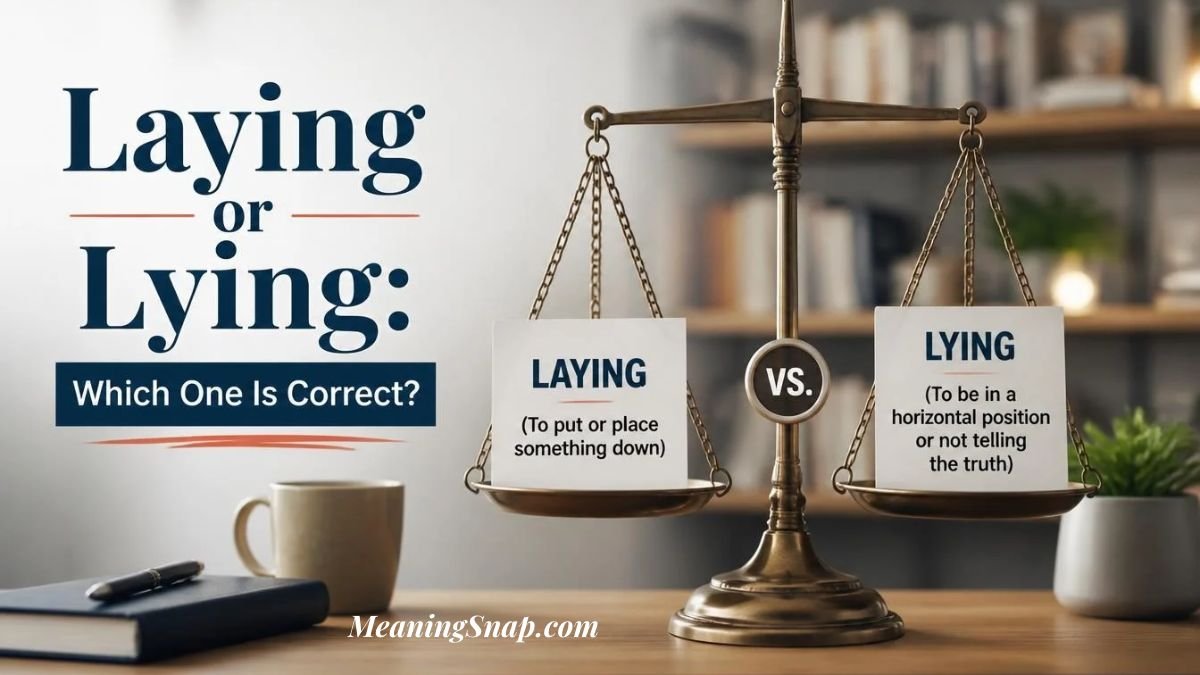
You’re typing a caption under a photo of your couch on a rainy Sunday. “Laying in bed all day” looks off, so you delete it, retype it, and stare at the screen. Laying or lying, which one belongs there?
Here’s the thing. Both words are spelled correctly, so spellcheck stays quiet. The mix-up comes from two different verbs wearing similar clothes.
The short answer: use lying when someone or something rests flat, or when someone tells a fib. Use laying when you place something down. If a thing gets put somewhere, pick laying. If nothing gets put anywhere, pick lying. Merriam-Webster, Cambridge, and the Chicago Manual of Style all back this rule.
The sections below show why it works, with a test, tables, and sentences to borrow.
Laying or Lying: The Core Difference at a Glance
Think of it this way. Laying acts on a thing. Lying never does.
Lying shows up twice in the table because English has two unrelated verbs spelled “lie,” and Merriam-Webster treats them separately. Here’s how the three jobs compare.
| Word | Meaning | Needs an object? | Example |
|---|---|---|---|
| Laying | Putting or placing something down | Yes | She’s laying the tiles in the kitchen. |
| Lying (resting) | Being in a flat or resting position | No | He’s lying on the couch. |
| Lying (untruth) | Saying something false | No | I know you’re lying about the pizza. |
Context settles which lying you mean. Words like on, in, or around point to resting. A topic after about points to a fib.
Laying or Lying: What Laying Means
Laying is the -ing form of the verb lay. Merriam-Webster defines lay as putting or setting something down. Cambridge’s English Grammar Today puts it plainly: the verb lay must have an object. The object is whatever gets placed.
So laying always answers a question. Laying what?
A builder is laying bricks. A hen is laying eggs. You’re laying a blanket over the sofa. Bricks, eggs, blanket. Each sentence names something placed or produced.
The same logic holds in figurative phrases. A team lays the groundwork for a launch. A speaker lays out a plan. A friend lays out her clothes the night before. Groundwork, plan, and clothes play the role of the object every time.
Read Also: Tries vs Trys: Which Spelling Is Correct? (2026 Guide)
Laying or Lying: What Lying Means (Two Jobs, One Spelling)
Lying does double duty. Merriam-Webster lists two separate verbs. The first, lie, means to rest in a flat position, and its forms run lie, lay, lain, lying. The second, lie, means to say something untrue, and its forms run lie, lied, lied, lying.
Both verbs share the -ing form, so “she’s lying” might mean she’s resting or she’s fibbing. Context decides. “She’s lying on the sofa” shows rest. “She’s lying about the sofa” shows a fib.
Neither verb takes an object. You never lie a thing somewhere. You lie somewhere, or you lie about something.
Objects rest too. Your keys are lying on the table, which describes where they sit, not what anyone is doing to them.
Read Also: Peice or Piece: Which Spelling Is Correct?
The Object Test for Laying or Lying
Here’s the quick test I run before hitting send. It takes about five seconds.
- Find the -ing word in your sentence.
- Ask what is being placed.
- If a real thing answers (bricks, a blanket, a phone), write laying.
- If nothing answers, write lying.
Still stuck? Try a swap. Replace the word with placing. If the sentence still works, laying is right. If resting or fibbing fits better, lying is right. “I’m placing in bed” falls apart, while “I’m resting in bed” works, so lying wins.
Laying or Lying in Bed, on the Floor, and Down

Three phrases drive most of the searches on this topic, and one rule covers all of them.
In bed: “I’m lying in bed” is correct. No object appears, so lying fits. “Laying in bed” drops the object, which is why it reads like an error.
Down: “lying down” is the standard form for resting, as in “I’m going to lie down for ten minutes.” “Laying down” works only when something gets placed. The Chicago Manual of Style’s Q&A notes you lay down your burdens, your money, or the law. It also allows “lay your body down,” since “body” serves as the object.
Down in bed: put the two together and the rule stays put. “I’m lying down in bed” is standard. “I’m laying down in bed” is nonstandard, because no object appears.
On the floor: one room shows both verbs. “The toddler is lying on the floor” has no object. “Dad is laying a rug on the floor” has one. The floor stays the same, while the verb follows the action.
Laying or Lying Verb Forms: Lay, Laid, Lain, and Lied
Past tenses are where the real trouble starts. Here’s every form in one place.
| Verb | Meaning | Present | Past | Past participle | -ing form |
|---|---|---|---|---|---|
| lay | place something | lay / lays | laid | laid | laying |
| lie | rest flat | lie / lies | lay | lain | lying |
| lie | tell an untruth | lie / lies | lied | lied | lying |
Spot the overlap. Lay is the present tense of one verb and the past tense of another. This single quirk causes most of the headaches.
Yesterday you lay on the couch, which is resting. You laid a blanket over it, which is placing. Both sentences are correct, and neither is a typo. The fib verb behaves more simply, so the past tense of lying about something is lied.
A Memory Trick for Laying or Lying Past Tenses
The object test handles the -ing forms. Past tenses need a second trick, and a day swap does the job.
Say the sentence with today and yesterday. “Today I lie down. Yesterday I lay down.” Then try the other verb. “Today I lay the book down. Yesterday I laid the book down.”
Notice the second pair carries a book, and the first pair carries nothing. Where an object appears, you’re in the lay family: lay, laid, laid. Where no object appears, you’re in the lie family: lie, lay, lain. The same split holds after have or has. “I have laid the book down” places it, while “I have lain down” rests.
Laying or Lying in Real Sentences
Eight sentences, eight settings. Each one shows the verb choice in action.
- Text message: “Give me ten minutes, I’m still laying out my clothes.” Clothes are the object, so laying.
- Caption: “Lying on the beach with zero plans.” Nothing gets placed, so lying.
- Email: “I laid the signed forms on your desk this morning.” Past tense of lay, with forms as the object.
- School essay: “The old map lay hidden in the attic for years.” Past tense of lie, with no object.
- Work chat: “Our crew is laying new cable along the north wall.” Cable is the object.
- Travel post: “We spent the afternoon lying in a hammock by the lake.” Resting, so lying.
- Group chat: “He’s lying about the score, since I watched the whole game.” A fib, so lying.
- Family chat: “My passport has lain in this drawer since March.” Past participle of lie.
Laying or Lying in Texts, Captions, and Group Chats

Casual writing gives you room, but a caption stays on your feed for good. Autocorrect won’t flag this slip either, since both words are real.
Here’s the thing about status updates. Most start with “I’m” plus an -ing word, which is exactly where the mix-up lives. “I’m laying on the couch” and “I’m lying on the couch” differ by a single letter, so the wrong one slides past on a quick read.
Pets and objects trip people up too. “The dog is lying by the door” is standard, because the dog is resting. “The phone is lying on the table” is standard for the same reason. If you place the phone there on purpose, the verb switches: “I’m laying the phone on the table.”
Short on time? Swap the verb and skip the debate. “Chilling in bed,” “resting on the couch,” and “lounging around the house” all sidestep the choice. They work for a quick caption. For anything longer, the object test takes five seconds and keeps the post clean.
Laying or Lying Around, Low, and in Wait
Idioms keep their own habits. Here are the three phrases people look up most.
| Phrase | Base form | Past tense | Meaning |
|---|---|---|---|
| lying around | lie around | lay around | Doing nothing, or sitting where someone left it |
| lying low | lie low | lay low | Staying out of sight |
| lying in wait | lie in wait | lay in wait | Hiding to surprise or catch someone |
Oxford Learner’s Dictionaries lists lie around for spending time idle, and adds lie about as the British variant. Nothing gets placed in any of these phrases, so “laying around” is the common slip.
Lying low causes the most arguments. Merriam-Webster’s thesaurus lists “lay low” as the past tense of “lie low,” so “he lay low for a week” is standard. Using “lay low” in the present tense, as in “I’m going to lay low tonight,” is a popular swap. “Laying low” follows the same pattern.
Did You Know: Linguist Anne Curzan, speaking on a Michigan Public language podcast, described “lay low” as gaining on “lie low” in both speech and writing. Merriam-Webster still lists “lie low” as the standard entry.
Don’t mix up “lie low” with “laid low.” “Laid low” is its own idiom for being knocked down, as when the flu lays thousands low. The flu acts on people, so lay is the right verb there.
Lying in wait follows the same logic. The past tense is “lay in wait,” as in “The cat lay in wait behind the curtain.” Merriam-Webster lists lie in wait as its own entry.
Why “I’m Laying Down” Sounds Right
You’ve heard it in songs and group chats, and nobody blinks. So why do editors flinch?
Part of the answer is the overlap above. Lay is also the past tense of lie, so the word shows up everywhere. Another part is habit. “I’m going to lay down for a nap” is everyday speech.
The reference books split on how to label it. Merriam-Webster’s usage note says lay is often used where lie is considered standard. American Heritage labels the same use nonstandard. The Chicago Manual of Style says lie down is correct and laying down needs an object.
So the laying or lying call depends on the setting. In texts and casual chat, “laying down” is widely used and rarely misread. In school essays, work emails, and published writing, stick with “lying down.”
You Also Read: Cocoon or Cacoon? Which Spelling Is Correct?
Laying or Lying: US vs UK Differences
The core rule holds on both sides of the Atlantic. A few phrases around it differ.
- Lay of the land vs. lie of the land: Oxford Learner’s, the Britannica Dictionary, and Merriam-Webster all list “lay of the land” for US English and “lie of the land” for British English.
- Lie in: Oxford Learner’s defines lie in as staying in bed after the time you usually get up, with the related noun lie-in. A British speaker might say, “I’m having a lie-in on Sunday.”
- Lie about: Oxford Learner’s gives lie about as the British version of lie around.
Common Mistakes With Laying or Lying
Most slips fall into six patterns. Here’s each one with its fix.
| Incorrect | Correct | Why |
|---|---|---|
| I’m laying in bed. | I’m lying in bed. | Nothing is being placed. |
| Yesterday I laid down for a nap. | Yesterday I lay down for a nap. | The past tense of lie is lay. |
| I’ve laid here since noon. | I’ve lain here since noon. | The past participle of lie is lain. |
| He’s laying about his age. | He’s lying about his age. | A fib never uses laying. |
| She’s lieing on the couch. | She’s lying on the couch. | Lie drops the e and becomes lying. |
| The hen is lying an egg. | The hen is laying an egg. | The egg is the object, so lay applies. |
Quick Self-Test: Laying or Lying?
Fill each blank with laying, lying, lay, laid, or lain. Answers follow the list.
- “I’m ___ on the couch watching the game.”
- “She’s ___ the new carpet in the office.”
- “Stop ___ to me!”
- “Last night I ___ awake until two.”
- “He ___ his keys on the counter an hour ago.”
- “Our cat has ___ in the sunny spot all morning.”
Answers: 1. lying (resting). 2. laying (carpet is the object). 3. lying (fibbing). 4. lay (past of lie). 5. laid (past of lay, keys as the object). 6. lain (past participle of lie).
Read More: Chief vs Cheif: Which Spelling Is Correct?
FAQs
Is it laid or lain?
Use laid when you placed something, as in “I’ve laid the plates out.” Use lain when you rested, as in “I’ve lain here all morning.”
Is “layed” ever correct?
No. Merriam-Webster gives laid as the past tense and past participle of lay, so write laid.
Is “lieing” a word?
No. The -ie in lie changes to a y before -ing, which gives lying. Grammarly’s usage guide also warns against “lieing.”
Is it laying out or lying out?
Laying out takes an object: you lay out a plan, a garden, or an outfit. Lying out means resting flat outdoors, as in lying out on the deck.
Is it “the answer lays in” or “lies in”?
Lies in. Nothing is being placed, so the answer simply sits in something, as in “The problem lies in the timing.”
Bottom line
When laying or lying trips you up, ask what is being placed. If a thing is, write laying. If nothing is, write lying.

Alex Morgan is a writer focused on explaining slang, words, phrases, acronyms, and popular expressions in a simple and easy-to-understand way. Through clear explanations and helpful examples, Alex helps readers quickly understand what words and phrases mean and how they’re commonly used.