You’re posting a photo of your friend buried under three blankets. The caption starts, “Living in my cozy cacoon all weekend.” Then you stop and stare, because something about that spelling looks off.
So, cocoon or cacoon? Cocoon is the one you want. Here’s the twist, though. Cacoon is a real word, just not the one you’re thinking of. It’s a dictionary entry for a tropical plant, so the slip can sail past a quick read.
This guide settles the cocoon or cacoon question by explaining what each spelling means, how to say it, and how to keep them straight. You’ll also see how the word behaves as a verb, what it means in medicine, French, and Farsi, and where butterflies fit in.
Cocoon or Cacoon: The Short Answer
Cocoon is the correct spelling for the silky case an insect spins and for any cozy, protective wrapping. Cacoon is a different, rare word for a tropical plant and its bean. If your sentence involves blankets, moths, or staying in, write cocoon with two o’s.
Is Cacoon a Real Word?
Yes, and that’s what makes this pair tricky. Merriam-Webster lists cacoon as its own entry. It names a West Indies term for the snuffbox bean, plus a tropical American plant called Fevillea cordifolia.
The word has nothing to do with insects. Dictionaries don’t list it as a variant of cocoon, so using it for a caterpillar’s silk case is a plain error, not a style choice. Other references describe the plant and its seed in slightly different ways, which tells you it’s a niche botanical term. Older references even call the plant the “antidote cacoon.” You’ll meet the word in plant references and almost nowhere else. So in the cocoon or cacoon debate, cacoon is a real word that simply answers a different question.
What about slang? The dictionaries we checked list no slang meaning for either spelling. The closest thing is casual use of the verb, as in “cocooning on the couch,” which we’ll get to below.
Read Also: Chief vs Cheif: Which Spelling Is Correct?
Cocoon or Cacoon: A Side-by-Side Look
Here’s how the two spellings stack up at a glance.
| Spelling | Status | Meaning | Use it when |
|---|---|---|---|
| Cocoon | Correct, standard spelling | A silk case spun by an insect larva, a cozy protective cover, or to wrap and shelter | You’re writing about insects, comfort, or protection |
| Cacoon | Real but rare, and a different word | A West Indies snuffbox bean and a tropical American plant | You’re writing about that plant, which is almost never |
| Cacoon (for an insect or a blanket) | Misspelling | Nothing in this sense | Never |
What Does Cocoon Mean?
Before you settle cocoon or cacoon, it helps to know what the correct word covers. It has three jobs, and they all share one spelling.
The Insect Meaning
Merriam-Webster defines a cocoon as an envelope, mostly silk, that an insect larva forms around itself while it passes through the pupa stage. English speakers have used it that way since the late 1600s.
Picture a small silky pouch hanging from a twig or tucked into leaf litter. Some moths weave bits of leaves or twigs into theirs, and the shape and size change from species to species.
The Cozy, Protected Meaning
Dictionaries also list a figurative sense: anything that wraps you in protection or shuts out the outside world. A “cocoon of blankets” is the classic example.
When someone says they’re living in a cocoon, they mean they’re sheltered from the outside world. Depending on the sentence, that sounds comforting or a little cut off. A quiet hotel room can be a cocoon in a good way. A person who never hears another opinion lives in one in a worse way.
Cocoon as a Verb
To cocoon is to wrap or surround something, or to settle in snugly, usually at home. Both Merriam-Webster and Dictionary.com list the verb.
The related word “cocooning” got a second life in 1981, when trend forecaster Faith Popcorn used it for people choosing to stay home when the outside world felt too tough. That’s the sense you hear when a friend says they’re cocooning this weekend.
Cocoon in Fashion and Home Design
Style writers borrow the word too. Fashion coverage describes a rounded, enveloping silhouette as a cocoon coat, and Merriam-Webster’s example sentences show design writers calling a snug room cocoon-like. Both uses stay close to the cozy meaning, and both keep the double o.
You Also Like: Knaw or Gnaw: Correct Spelling Explained (2026 Guide)
Cocoon or Chrysalis: What’s the Difference?
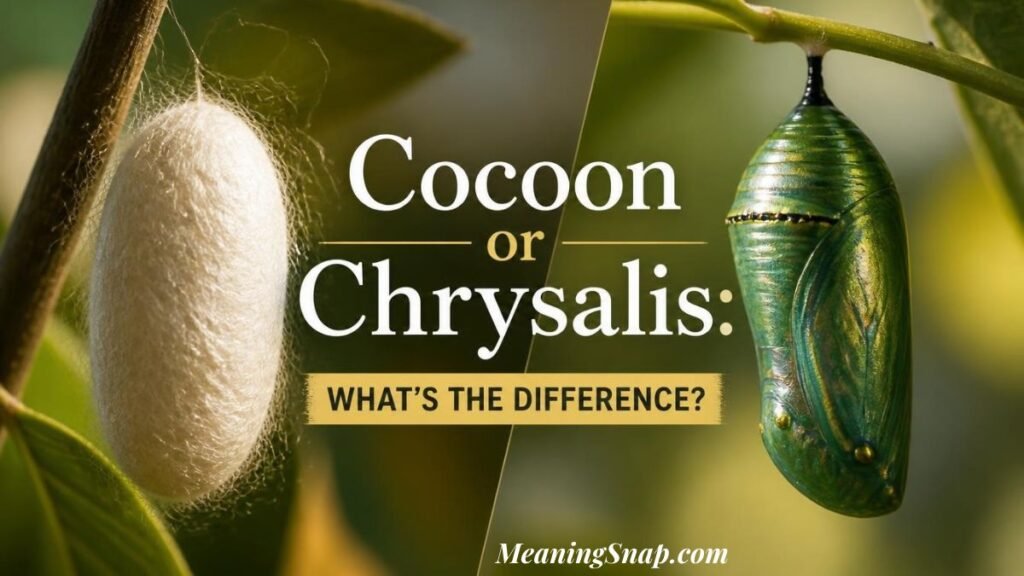
People swap these two words all the time, especially for butterflies. Insect sources keep them apart. A chrysalis is the hardened pupa of a butterfly. A cocoon is a silk covering that a larva spins before it pupates, and moths are the classic cocoon makers.
That means a “butterfly cocoon” is usually a chrysalis, since most butterfly caterpillars skip the silk case. Some other insects, including certain wasps and ants, do spin cocoons.
In casual writing, nobody will flag “butterfly cocoon.” In a science class or a nature caption, chrysalis is the precise word.
How to Pronounce Cocoon (and Why It Trips People Up)
Sound drives most of the cocoon or cacoon confusion, so start there. Say it like this: kuh-KOON. The stress lands on the second syllable. Merriam-Webster and Oxford Learner’s Dictionaries show the same sound, and US and UK speakers say it alike.
The first syllable is a weak “uh,” so a “ca” and a “co” sound identical there. Even the plant word cacoon can be pronounced kuh-KOON, according to Merriam-Webster. That overlap explains why people who spell by ear land on the wrong vowel.
English took the word from French cocon, which traces back to a Provençal word meaning shell. Merriam-Webster and Oxford name slightly different root words, but both point to “shell.” So if you’ve seen “cocon” with one o in English text, you’ve met the French spelling.
Cocoon, Cocoons, Cocooned, Cocooning
Every form keeps the double o. Here are the forms side by side, each with an example.
| Form | Spelling | Example |
|---|---|---|
| Noun, singular | cocoon | The moth left its cocoon. |
| Noun, plural | cocoons | We found three cocoons on the fence. |
| Verb, present | cocoon / cocoons | They cocoon at home on Sundays. |
| Verb, past | cocooned | She cocooned herself in a blanket. |
| Verb, -ing form | cocooning | He’s cocooning with a movie. |
Notice that cocooning has one n, not two. The usual doubling rule says to double a final consonant when the last syllable is stressed, and cocoon is stressed on its last syllable. But the rule skips words with two vowels before the final consonant, the same way remain becomes remaining. The double o puts cocoon in that group.
Read Also: Potato vs Potatoe: Which Spelling Is Right? (guide 2026)
Where Else You’ll See the Word
Cocoon pops up outside spelling debates too. This table covers the contexts people search for most. None of them change the cocoon or cacoon answer, since every one uses the double-o spelling.
| Context | What it means |
|---|---|
| Medicine | “Cocooning” is a vaccination strategy. Family members and caregivers get vaccinated so a newborn, who is too young for their own shots, has a protective circle around them against whooping cough. Public health agencies such as the CDC have recommended it since the mid-2000s. |
| Pokémon | “Cocoon Pokémon” is the category label for Kakuna, Metapod, Silcoon, and Cascoon. |
| Film | Cocoon is a 1985 American sci-fi comedy-drama directed by Ron Howard. |
| Equipment storage | A protective covering placed or sprayed over military or naval equipment while it’s in storage. |
The medical use is a public health term, not personal advice. Ask a doctor or pharmacist about vaccines for your own family.
Cocoon in French and Farsi
In French, the word is cocon, pronounced roughly “ko-KOHN” with a nasal ending. French also has the idiom vivre dans un cocon, which means living a sheltered life, the same idea as the English phrase.
In Farsi, the usual word for a cocoon is پیله, said roughly “pileh.” You’ll see it in everyday talk about silkworms and in the Persian name for the Cocoon Nebula.
Cocoon or Cacoon in Real Sentences
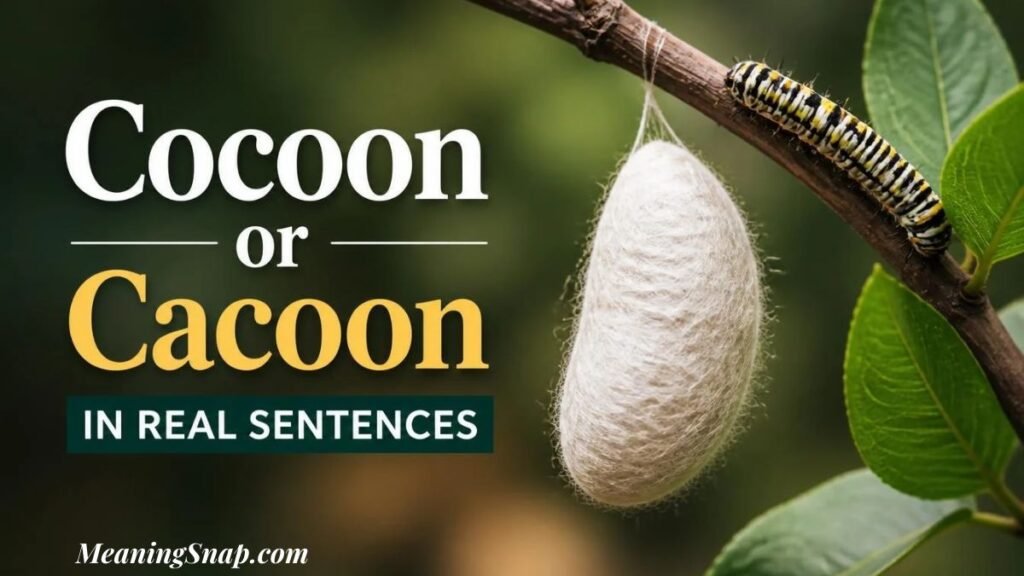
Seeing the word in context locks the spelling in, so here’s the cocoon or cacoon choice in real sentences. Start with five correct uses.
- Caption: “Rainy Sunday, fuzzy socks, and a blanket cocoon. Not moving until Monday.” This is the cozy, figurative meaning.
- Text message: “Found a cocoon on the porch rail. I think a moth made it.” Here it’s the literal insect meaning.
- School: “Our science project follows a moth from caterpillar to cocoon to adult.” Same insect meaning, in a plain classroom setting.
- Work email: “We want the new reading room to feel like a quiet cocoon, not a classroom.” This is the protective-space meaning, which is perfectly fine in a professional message.
- Verb use: “After a long week, she cocooned on the couch with a book.” The past tense keeps both o’s and adds -ed.
Now three common mix-ups, each with its fix.
- Wrong: “The caterpillar spun a cacoon on the branch.” Right: “The caterpillar spun a cocoon on the branch.” Cacoon names a plant bean, so it can’t be the insect’s case.
- Wrong: “I’m cacooning at home this weekend.” Right: “I’m cocooning at home this weekend.” The verb forms follow the noun, so the first vowel stays an o.
- Wrong: “She hid in a cocon of blankets.” Right: “She hid in a cocoon of blankets.” English needs the second o, even though the French source word doesn’t have it.
A Quick Memory Trick
Memory Trick: Cozy cocoon. Both start with “co,” and a cocoon wraps you in comfort. Then say the ending out loud. It rhymes with moon and spoon, and those words carry the double o too.
Want a second check? Try the swap test. Replace the word with “protective wrap” or “snug shelter.” If the sentence still makes sense, spell it cocoon. Only a sentence about a West Indies bean or its plant calls for cacoon. Run the test whenever cocoon or cacoon pops up in a draft, and the answer lands fast.
Mistakes Worth Watching For
Four slip-ups show up again and again around the cocoon or cacoon choice. The first is writing cacoon, because the first syllable sounds like “kuh” and the wrong vowel feels natural. The second is typing cocon, the French spelling, with one o. The third is doubling the wrong letter and ending up with coccoon.
The fourth hides in the verb. Writers add an extra n and produce cocoonning, forgetting that the double o blocks the doubling rule.
One more trap: a spell checker only asks whether a word exists, not whether it fits your sentence. Since cacoon is a genuine dictionary word, check the meaning yourself before you hit publish.
How to Proofread Cocoon or Cacoon in Your Own Draft
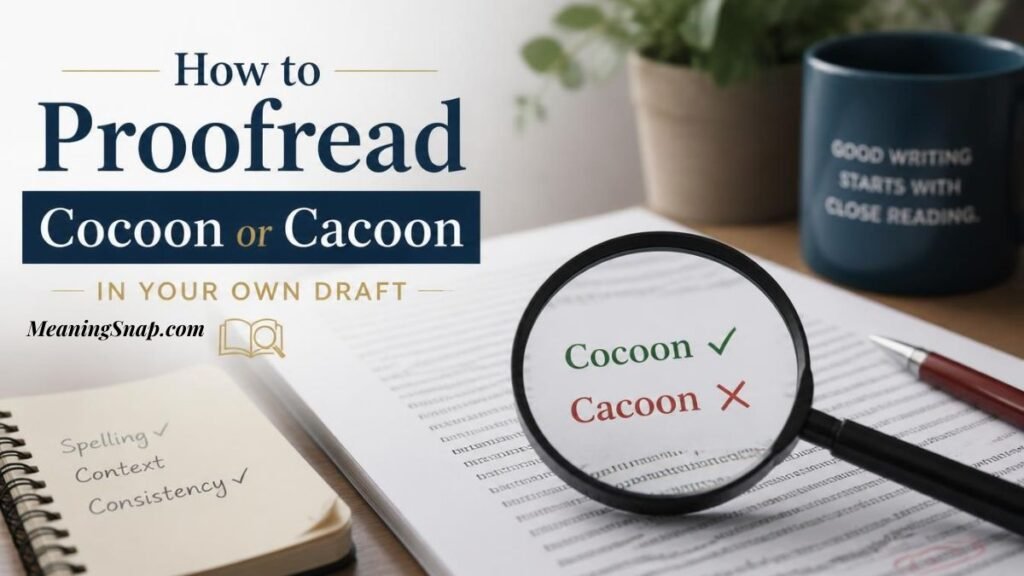
Spotting the mix-up in your own writing takes about a minute. Run these checks in order.
- Search the draft for “cac” and look at every hit. Real words like cacophony will show up, so read each one in context.
- Search for “cocon” with one o and for “coccoon” with two c’s.
- Read the sentence aloud and ask what the word means. A silk case, a snug shelter, or a protective wrap points to cocoon.
- Check the verb forms. Cocooned and cocooning each need two o’s and a single n.
- Check any hyphen. If you write cocoon-like, keep the hyphen to match published usage.
If a draft passes all five, your cocoon or cacoon call is solid.
Quick Self-Test
Try these five cocoon or cacoon checks, then compare your answers with the ones right below.
- The caterpillar spun a ___ on the branch. (cocoon / cacoon) Answer: cocoon, because it’s the insect’s silk case.
- She’s ___ at home with tea and a blanket. (cocooning / cocoonning) Answer: cocooning, with two o’s and one n.
- Which spelling names a West Indies snuffbox bean? Answer: cacoon, and only in plant references.
- True or false: a butterfly spins a cocoon. Answer: Mostly false. Butterflies form a chrysalis, and moths spin cocoons.
- Fix the typo: “cocon of blankets.” Answer: cocoon, with the second o restored.
Read Also: Hola or Ola: What’s the Difference and Which Is Correct?
Frequently Asked Questions
Is the spelling different in UK English?
No. The cocoon or cacoon answer is the same on both sides of the Atlantic, since US and UK dictionaries use cocoon and give the same kuh-KOON pronunciation.
Is it cocoon-like or cocoonlike?
Merriam-Webster’s example sentences, drawn from magazines, use the hyphenated “cocoon-like.” Check your style guide if you write for a publication.
Do only insects make cocoons?
No. Merriam-Webster also lists other protective coverings that animals make, and spiders spin silk cases for their eggs.
Can cocooning be an adjective?
Yes. Magazines use it for soft, enclosing things, as in “cocooning sofa beds” and “cocooning knits.”
Is cocoon too casual for formal writing?
No. The dictionaries we checked give it no informal label, and major publications use it in both the literal and figurative senses.
Does cocoon always sound positive?
No. It sounds cozy in “a cocoon of blankets” but can hint at isolation in “living in a cocoon.”
Cocoon Is the Spelling to Keep
Next time you’re typing a caption, a lab note, or a work email, run one quick check. If the word means a protective wrap, a cozy retreat, or the case a moth spins, it’s cocoon with two o’s. Cacoon belongs to a Caribbean bean and a tropical plant, so save it for botany talk. Say the word out loud as kuh-KOON, think of the moon in the ending, and the spelling follows. That’s the whole cocoon or cacoon decision, and you can make it in about two seconds from now on.

Alex Morgan is a writer focused on explaining slang, words, phrases, acronyms, and popular expressions in a simple and easy-to-understand way. Through clear explanations and helpful examples, Alex helps readers quickly understand what words and phrases mean and how they’re commonly used.