You’re in a work Slack channel. Someone drops a link and asks, “is this SFW?” You freeze. You have no idea what they mean, and now you’re too embarrassed to ask out loud. Sound familiar? Thousands of people hit this exact wall every week, usually right before opening something in front of coworkers or a family group chat. Here’s the good news: the SFW meaning is simpler than you think, and once it clicks, you’ll never second-guess a link again. In this guide, we’ll break down what SFW stands for, how it differs from NSFW, where it came from, and how to use it correctly in texts, on Reddit, and at the office.
What Does SFW Stand For, Exactly?
SFW stands for Safe For Work. It’s an internet abbreviation people use to label content which is fine to open around coworkers, family, or anyone in a public setting. The SFW meaning boils down to one simple idea: no nudity, no profanity, no graphic violence, and nothing which would make a supervisor raise an eyebrow.
The term grew out of internet forums in the early 2000s, back when file sharing and image boards exploded in popularity. Regular users needed a fast way to warn each other before clicking a link, so a texting abbreviation was born. Today, dictionaries including Merriam-Webster recognize SFW as standard internet terminology, not internet slang confined to niche forums.
Here’s the thing: SFW isn’t limited to one platform or one type of media. You’ll see it attached to images, GIFs, videos, memes, and even webpages. Anyone sending a link in a work email, a school group chat, or a Slack channel benefits from knowing whether the content behind it counts as work-safe content or something riskier.
Think of SFW as part of a wider content classification system. Content warning labels, age restrictions, and moderation tools all work together with SFW tagging to protect audience safety online. Whether you’re scrolling Reddit, browsing YouTube, or checking a shared link at the office, this shared vocabulary keeps online communication smoother for everyone involved.
A quick way to picture it: if your manager, your grandmother, and a stranger on the bus would all feel comfortable seeing it on your screen, it’s SFW. If any of them would wince, it’s not.
Read Also: OPEL Meaning Explained: Brand Origin & Hidden Story
SFW vs NSFW: The Real Difference (With Examples)
SFW and NSFW sit on opposite ends of the same scale. While SFW means content is safe for public viewing, NSFW (Not Safe For Work) flags content with nudity, pornography, graphic violence, gore, hate speech, racial slurs, or other explicit imagery. You’ll sometimes spot two rarer cousins too: NSFA (Not Safe For Anyone) and NWS (Not Work Safe), both used the same way as NSFW on certain forums and subreddits.
Here’s the thing: the SFW meaning isn’t only about sex or nudity. Loud profanity, disturbing content, jump scares, and even aggressive political rants sometimes get tagged NSFW too, because employers and content moderation teams treat “inappropriate for the office” as a wider category than “explicit.”
A side-by-side comparison makes the difference clear:
| Content Type | SFW or NSFW? |
|---|---|
| A cooking tutorial video | SFW, safe for any audience |
| A meme with a curse word blurred out | SFW, borderline but generally fine |
| An uncensored gore clip from a horror movie | NSFW, graphic violence |
| A motivational quote graphic | SFW, family-friendly content |
| An adult content subreddit post | NSFW, explicit content |
| A product review video for headphones | SFW, appropriate for public settings |
Notice the pattern: SFW content lines up with clean humor, educational content, and public-friendly content, while NSFW content includes anything which needs an age restriction or a content warning before viewing. Reddit and other online communities rely heavily on this labeling system, because it keeps subreddits organized and protects users browsing from a work computer or a school library.
Content moderation teams treat this line seriously too. Large platforms hire entire teams dedicated to content tagging, sorting explicit content away from family-friendly content before it reaches the main feed. Without this ongoing sorting, safe browsing would fall apart fast, and parents, teachers, and employers alike would lose trust in the platforms their kids and staff use daily.
Read Also: HG Meaning Explained: Text, Snapchat & Slang Guide
Where Did SFW Come From? A Quick Look at Its Origin
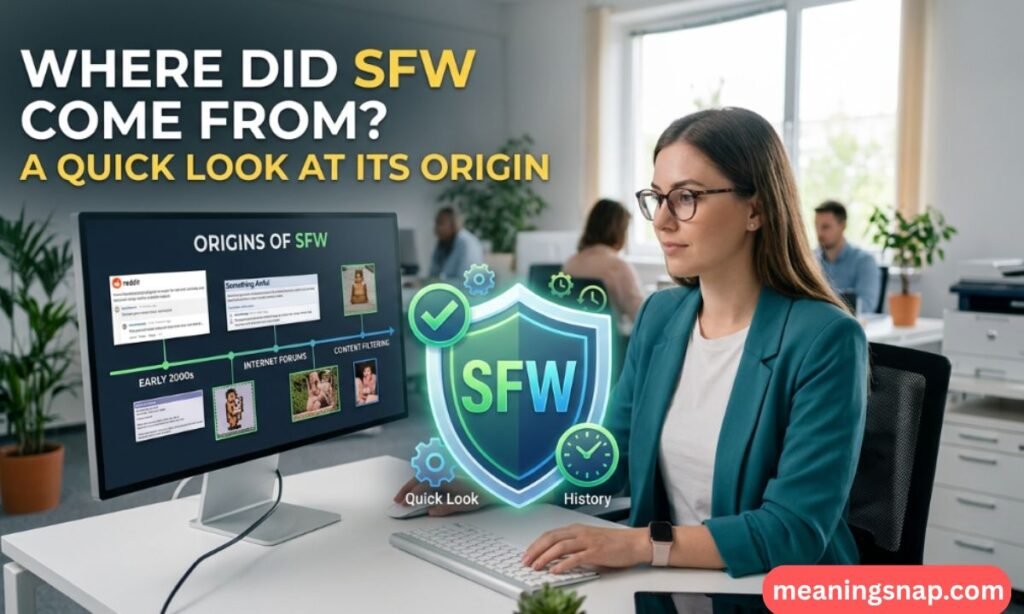
Long before Instagram or TikTok existed, internet forums and image boards ran the show. Early web communities and pre-2010 Reddit used SFW and NSFW tags to help members filter content fast, without needing to click through and find out the hard way.
Reddit turned the labeling system into a structural feature. Subreddit moderators started adding NSFW flags directly onto posts, blurring thumbnails automatically and letting users toggle a setting which hides adult content from work computers or shared devices entirely. This single feature turned SFW into a formal content classification, not a casual internet abbreviation anymore.
By the mid-2010s, the SFW meaning had spread far past image boards. Twitter (now X), Tumblr, and DeviantArt adopted similar content warning systems, letting artists and creators mark galleries as SFW or NSFW depending on the material. Patreon later built entire membership tiers around this distinction, separating SFW content from adult content behind paywalls.
Today, younger audiences on TikTok and Snapchat still use the abbreviation constantly, even though the platforms themselves rarely allow genuinely NSFW material. The term outlived its forum origins and became a piece of everyday online etiquette, showing up in texts, captions, and casual chat abbreviation lists everywhere.
Even AI-generated content follows this pattern now. Image and video generation tools slap SFW filters onto their default output, blocking explicit imagery unless a user deliberately overrides the setting. The abbreviation moved from a scrappy forum habit into a built-in feature of internet infrastructure itself, proof of how deeply the SFW meaning became woven into everyday online culture.
How to Tell If Something Is SFW (Quick Checklist)
Not every piece of content comes with a label attached, so you’ll need to judge it yourself sometimes. A few quick questions help you figure out the SFW meaning behind any link before you hit send.
Ask yourself these questions before sharing anything in a work email, a virtual meeting chat, or a group text with colleagues:
- Does it include nudity, profanity, or sexual content?
- Does it show graphic violence, gore, or disturbing imagery?
- Does it contain hate speech, slurs, or content targeting a group of people?
- Would your employer, manager, or a client feel uncomfortable seeing it?
- Does it need a content warning or age restriction on the platform it came from?
If you answered no to every question, the content counts as SFW. If you answered yes to even one, treat it as NSFW and keep it away from professional environments.
Quick Answer: SFW content passes a simple test. It’s appropriate to view in an office, a classroom, or in front of family, with zero explicit material and zero content which needs a warning label.
This checklist works across every platform, from Reddit threads to YouTube videos to random links a coworker drops in Slack. Digital etiquette comes down to running this mental check before clicking share, especially in professional settings where one wrong link damages your reputation with supervisors and coworkers fast.
Schools and libraries apply a version of this same test, usually through firewall filters instead of personal judgment. Students browsing on a school network hit blocked pages automatically when content trips an NSFW filter, which explains why so many teenagers first learned the abbreviation from a blocked-page error message rather than a friend’s explanation.
Read Also: What Does ATP Mean in Text? (Real Examples + How to Reply)
SFW at Work: Why Getting It Wrong Matters
The SFW meaning genuinely matters at your job, not only in casual chats with friends. HR departments treat inappropriate content shared over work channels as a real problem, and plenty of companies have policies covering workplace communication on email, Slack, Teams, and other tools.
Picture this: a coworker shares an unlabeled link in a team channel, and it opens to something graphic on a shared screen during a virtual meeting. Managers and supervisors notice. Employers sometimes escalate these situations to formal write-ups, especially if the content includes anything resembling harassment, offensive content, or explicit imagery.
Workplace etiquette around SFW content isn’t only about avoiding trouble either. It’s about respect. Coworkers browsing a work computer in an open office deserve to trust their screen won’t suddenly show something inappropriate because someone skipped a quick check. The same logic applies to schools, libraries, and any shared public setting.
Here’s a simple rule which keeps you safe: when unsure, don’t share it on a work device at all. Save questionable memes, videos, or links for personal devices and private group chats instead. Workplace safety isn’t only about physical hazards. Digital etiquette and content moderation matter equally for keeping a professional environment comfortable for everyone, including remote workers navigating work-from-home setups where boundaries blur easily.
SFW Tags on Reddit vs Twitter/X vs TikTok
Every platform handles the SFW meaning a little differently, and knowing the differences saves you from confusion.
Reddit built its entire system around this labeling. Subreddits get marked NSFW at the community level, individual posts get flagged too, and logged-out or work-safe browsing modes blur thumbnails automatically. Moderators enforce these subreddit rules strictly, since Reddit hosts everything from family-friendly hobby communities to adult content forums.
Twitter, now rebranded as X, takes a looser approach. Users self-label sensitive content through account settings, and viewers need to opt in before seeing flagged posts. The platform relies heavily on user reporting and content moderation teams rather than automatic detection, meaning SFW labeling here depends on individual honesty more than Reddit’s structured system.
TikTok and Instagram rarely need SFW tags at all, since community guidelines already restrict most explicit imagery, nudity, and graphic violence from the main feed. Still, Gen Z creators use SFW and NSFW as casual chat abbreviation in captions and comments, mostly as a joke or a heads-up about borderline humor or memes bordering on inappropriate.
LinkedIn users rarely worry about SFW tags at all, since the entire platform functions as a professional environment by default. Sharing anything outside SFW content territory there risks your professional reputation directly, unlike more casual platforms where NSFW content lives in clearly separated corners.
| Platform | How SFW Works |
|---|---|
| Subreddit and post-level tags, automatic thumbnail blurring | |
| X (Twitter) | Self-labeled sensitive content, opt-in viewing |
| TikTok / Instagram | Rare tagging, relies on platform-wide content guidelines |
| YouTube | Age restriction settings, content warnings on descriptions |
| Patreon / DeviantArt | Separate SFW and adult content tiers or galleries |
| No tagging system, professional environment by default |
Snapchat sits closer to TikTok and Instagram here too, favoring platform-wide restrictions over user-applied SFW labels.
How to Use SFW in a Sentence (Real Examples)
Understanding the SFW meaning is one thing. Using it correctly in a sentence takes seconds once you see it in context. Native speakers drop it casually into texts, captions, and comments, usually right before or after sharing a link.
Below are five real text conversation examples showing the abbreviation in everyday use:
Example 1 Sam: Check this meme out lol Sam: [link] Jordan: is this SFW? I’m at my desk Sam: yeah 100% SFW, only a dog falling into a pool
Example 2 Priya: sending you this article for the group presentation Priya: NSFW warning though, there’s a graphic image in it Coworker: got it, I’ll open it later at home
Example 3 Alex: yo this subreddit has the funniest animal videos Alex: fully SFW btw, my mom follows it too
Example 4 Maya: is it okay to post this meme on the company Instagram? Manager: only if it’s SFW, double check first Maya: already did, it’s clean humor, no issues
Example 5 Dev: found a wild thread on Twitter Dev: heads up it’s NSFW, don’t open at work Friend: appreciate the warning lol
Notice how naturally SFW fits into casual online conversations. People rarely explain the SFW abbreviation meaning out loud, since most readers already understand the shorthand.
A few grammar notes worth remembering: SFW works as an adjective (“this video is SFW”), a warning label (“SFW: cute puppies”), and a quick yes-or-no answer to a direct question (“is this safe? SFW yes”). It never changes form, no plural, no past tense, nothing complicated. This flexibility is exactly why the term spread so fast across texting, email culture, and social media platforms alike.
You May Like: What Does “SOL” Meaning in Slang? Text, TikTok & Real Examples
Common Mistakes People Make With SFW
Even fluent internet users mix this abbreviation up sometimes. Here are the most common mistakes worth avoiding.
Mistake one: assuming SFW means “boring” or “censored.” The SFW meaning has nothing to do with quality or entertainment value. Funny memes, motivational quotes, how-to guides, and product reviews all count as SFW content while staying entertaining, informative, and shareable.
Mistake two: labeling something SFW without double-checking it first. A video which starts innocent sometimes shifts into explicit content halfway through, especially compilation videos and meme reels pulled from multiple sources. Watch the whole thing before tagging it safe.
Mistake three: confusing SFW with legal or age restrictions. SFW covers workplace appropriateness, not legality. Something illegal isn’t automatically NSFW, and something legal isn’t automatically SFW either. These are separate categories entirely, even though people blend them together in casual conversation.
Mistake four: using SFW as an excuse to ignore company policy. Some employers restrict personal browsing entirely on work computers, regardless of content labels. Knowing something is SFW doesn’t override an employer’s specific workplace communication rules.
Mistake five: forgetting regional differences. Content considered mild in one culture sometimes reads as inappropriate in another, so international teams need extra care around SFW content shared across borders and time zones.
Mistake six: treating SFW as a fixed, universal standard. What counts as SFW content on a relaxed startup’s Slack sometimes reads as unprofessional at a law firm or a hospital. Read the room, and adjust your definition of “appropriate” to match the specific professional environment you’re in.
Avoiding these slip-ups keeps your online etiquette sharp and your workplace reputation intact.
Frequently Asked Questions
What does SFW stand for?
SFW stands for Safe For Work. The SFW meaning covers content appropriate to view in an office, school, or any public setting without embarrassment.
What’s the difference between SFW and NSFW?
SFW content is appropriate for public and professional environments, while NSFW content includes nudity, graphic violence, or other explicit material unsuitable for work or public viewing.
Is SFW only used at work?
No, people use SFW constantly in casual texts, social media captions, and group chats, far beyond office settings.
Is SFW content still funny or entertaining?
Yes, SFW content includes funny memes, animal videos, and motivational quotes. Safe for work never means boring, it only means appropriate.
What does SFW mean on Reddit specifically?
On Reddit, SFW marks posts and subreddits without nudity, gore, or explicit content, often triggering automatic thumbnail blurring and safe browsing filters.
Conclusion
The SFW meaning comes down to a simple idea: content safe enough for anyone to view, anywhere, without embarrassment or risk. Once you understand the difference between SFW and NSFW, plus the platform-specific ways Reddit, X, TikTok, and Instagram handle content tagging, you’ll never freeze up when someone asks “is this SFW?” again.
Use the checklist from earlier, watch out for the common mistakes covered above, and default to caution whenever you’re unsure. Whether you’re texting a coworker, posting on a subreddit, or sharing a link during a virtual meeting, understanding SFW protects your reputation and keeps everyone around you comfortable.
Bottom line: SFW isn’t complicated once you see it clearly, and now you’re equipped to use it correctly every single time.

Alex Morgan is a writer focused on explaining slang, words, phrases, acronyms, and popular expressions in a simple and easy-to-understand way. Through clear explanations and helpful examples, Alex helps readers quickly understand what words and phrases mean and how they’re commonly used.