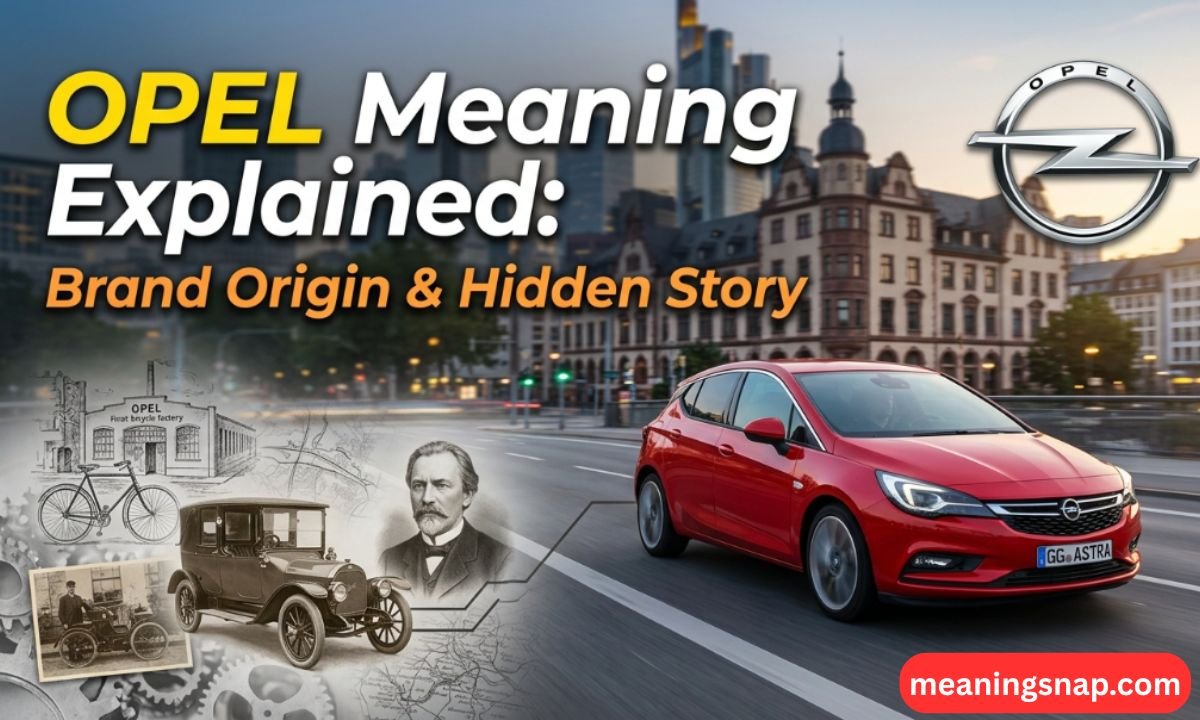
I remember standing at a rental car counter in Frankfurt, jet lagged, staring at a badge shaped like a lightning bolt inside a circle. My friend pointed at the car and said, “there’s your Opel,” like the word explained itself. It didn’t, not to me. I spent the ride to the hotel quietly typing OPEL meaning into my phone, half expecting some clever acronym to pop up. If you’ve done the same thing after spotting the badge on a rental car, a British neighbor’s driveway, or a random comment online, you’re in good company. The OPEL meaning behind the badge turns out to be simpler than most people guess, and more interesting once you know the full story.
What Does OPEL Mean?
Let’s cut straight to it. OPEL meaning comes down to one thing: a person’s last name. Opel isn’t built from initials, it doesn’t hide a secret phrase, and nobody invented it in a marketing meeting. It’s the surname of a German entrepreneur named Adam Opel, who opened a small workshop in 1862, long before anyone had heard the word “automobile.”
Here’s the thing. Plenty of car brand names come from acronyms or clever wordplay, so it makes sense people assume Opel follows the same playbook. It doesn’t. If you searched Opel name meaning instead of OPEL meaning, you landed in the same place. When someone types “what does OPEL stand for” into Google, the honest answer disappoints the treasure hunters among us. There’s no code to crack here, only a family name attached to over 160 years of engineering.
Quick Answer: Opel is a German surname, not an acronym. The company carries the name of its founder, Adam Opel, who started the business as a sewing machine workshop in 1862, long before it became the automotive brand people recognize today.
A few quick facts help ground the rest of this guide.
| Feature | Detail |
|---|---|
| Founded | 1862 |
| Founder | Adam Opel |
| Headquarters | Rüsselsheim, Germany |
| Current Parent | Stellantis |
| Popular Models | Corsa, Astra, Insignia, Grandland |
| UK Sister Brand | Vauxhall |
Between the founder’s name, the German roots, and more than a century of car production, the OPEL meaning story carries a lot more depth than a single sentence. Let’s dig into the pieces one at a time.
Is OPEL an Acronym? Busting the Backronym Myth
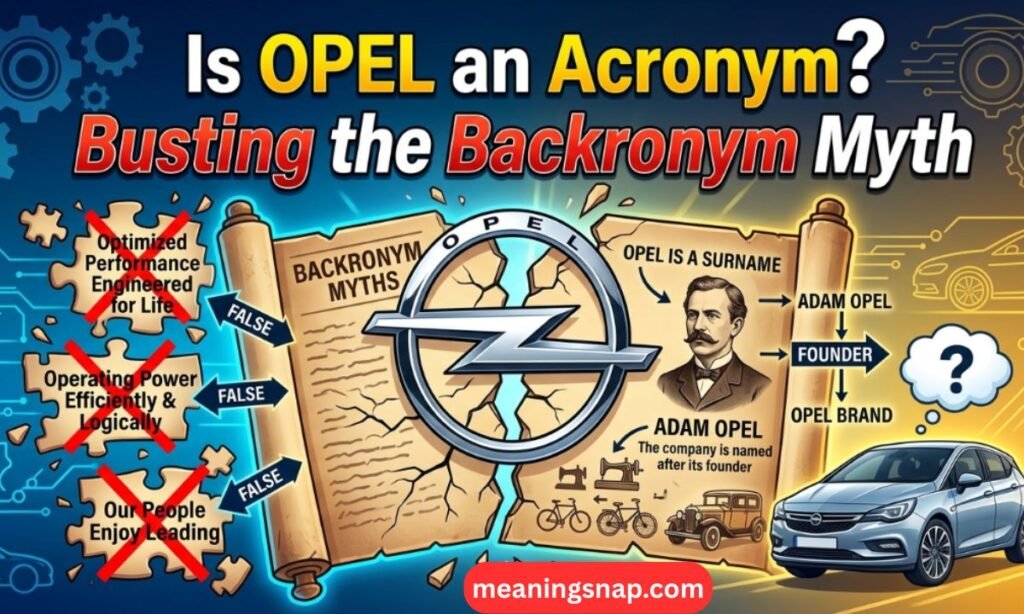
Here’s a pattern worth noticing. BMW stands for Bayerische Motoren Werke. FIAT stands for Fabbrica Italiana Automobili Torino. GM stands for General Motors. With so many car brands built from initials, why wouldn’t Opel follow suit?
The short answer: it never did. Opel is not an acronym, not an abbreviation, and not a hidden phrase squeezed into four letters. No official record from the company, from automotive historians, or from Adam Opel’s own family ties the name to anything beyond a surname.
The internet hasn’t given up trying, though. Search engines regularly suggest phrases like “Opel full form” or “Opel full meaning,” and a handful of low quality sites have published invented acronym explanations over the years, none backed by a source. If you come across a page claiming Opel secretly stands for some clever phrase, treat it the way you’d treat a chain email. It isn’t true, and it’s worth double checking against the company’s own history page before repeating it to a friend. This is exactly how thin, unverified “brand meaning” content spreads online, one copy-pasted guess at a time.
This myth matters because it shapes search behavior. A lot of the traffic behind opel meaning and does opel stand for anything comes from people who assumed, reasonably, a four letter car badge had to be short for something bigger.
Also Read: Poison Tree Tattoo Meaning: Symbolism, Origins & Design Guide (2026)
Who Was Adam Opel? The Man Behind the Badge
Every brand name has a person attached to it, and Opel’s story starts with a twenty something entrepreneur in a small German town. Adam Opel founded his company in Rüsselsheim, Germany, in 1862. He wasn’t building cars. He was building sewing machines, a booming industry at the time as households across Europe shifted toward home manufacturing. The Opel word origin isn’t complicated once you see the sequence: surname first, sewing machines second, cars a distant third.
Adam Opel had five sons, and they eventually pushed the family business into bicycles during the 1880s, riding a cycling boom sweeping through Germany. By the time automobiles started appearing on European roads in the late 1890s, the Opel family had already built a reputation for precision manufacturing, and the shift toward cars felt like a natural next step rather than a gamble. Rüsselsheim remains Opel’s headquarters today, more than 160 years after Adam Opel first opened his workshop there.
Adam Opel himself died in 1895, a few years before the company produced its first car, so he never saw the brand become the automotive name it’s known as today. His sons carried the business forward, and the family name stuck through every product change, from sewing machines to bicycles to automobiles. This continuity explains why the OPEL meaning traces back to one man’s surname rather than a corporate slogan or a design term.
From Sewing Machines to Stellantis: The Full Timeline
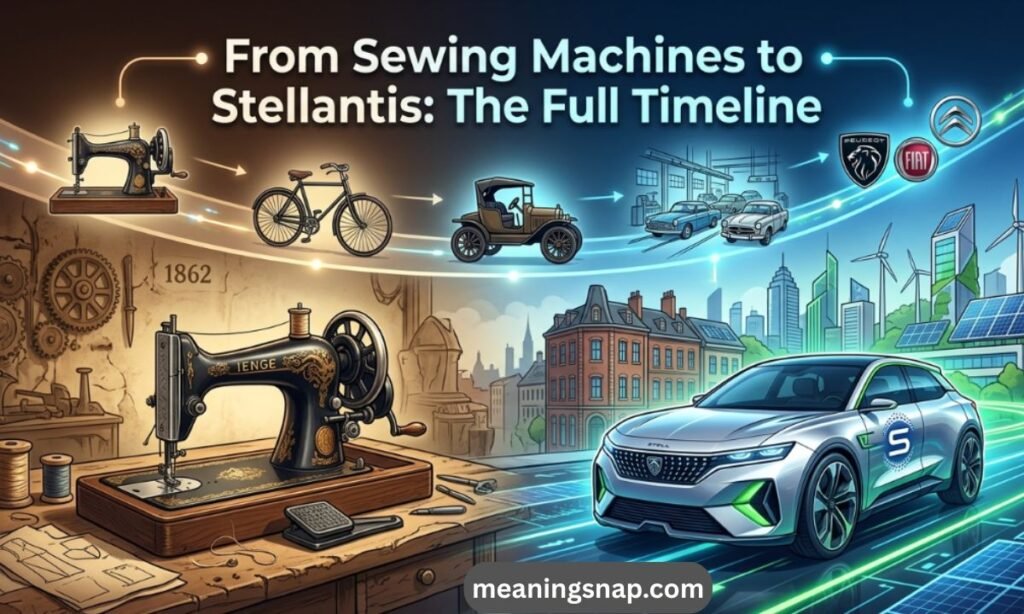
Understanding OPEL meaning gets easier once you see the full timeline, not only the founding year. Opel’s history reads less like a straight line and more like a series of reinventions, and seeing the full picture helps explain why ownership has changed hands so many times.
| Year | Event |
|---|---|
| 1862 | Adam Opel founds the company as a sewing machine manufacturer |
| 1886 | Bicycle production begins |
| 1899 | First Opel automobiles roll off the line |
| 1929 | General Motors acquires a controlling stake |
| 1930s-40s | Opel Blitz trucks become widely used commercial vehicles |
| 1982 | Opel Corsa launches, eventually selling over 10 million units |
| 2017 | PSA Group, parent of Peugeot and Citroën, buys Opel from GM |
| 2021 | Opel joins the newly formed Stellantis group |
From a sewing machine workshop to a founding member of one of the world’s largest automakers, Opel’s path shows how a single family name survived nearly every major shift in industrial history. Not many brands have a name outlasting world wars, multiple ownership changes, and a complete industry transformation from mechanical sewing to electric drivetrains.
The Lightning Bolt Logo, Decoded
Opel’s badge is instantly recognizable even to people who’ve never driven one. A lightning bolt cuts horizontally through a circle, simple enough to spot from across a parking lot.
The design ties back to the Opel Blitz, a line of trucks the company produced starting in the 1930s. “Blitz” is the German word for lightning, and the name stuck so firmly to the brand’s identity, the lightning bolt eventually became the company’s permanent symbol. The circle around it represents unity and continuity, a visual nod to a company staying in the same industry, broadly speaking, since the 1860s.
Modern versions of the logo have gone through several redesigns, moving from a chrome 3D badge to a flatter, more minimal look as part of Stellantis’s broader push toward simpler, app friendly branding. Despite the visual updates, the core Opel symbol hasn’t changed, and it still anchors the brand’s wider identity across every model in the lineup. The bolt still communicates speed and forward motion, while the circle keeps things grounded and recognizable. Here’s the short version of the Opel logo meaning: it explains why the badge still feels sturdy and simple even after several redesigns, and why you’ll know the OPEL meaning behind the lightning strike traces back to a decades old truck line, not a random design choice.
Opel vs. Vauxhall: Same Car, Different Badge
Here’s a detail most explainers skip entirely, and it matters a lot if you live in the UK. Every Opel sold across mainland Europe has a British twin: Vauxhall. The cars share the same platforms, the same engines, and often the exact same production line. Only the badge and grille design change.
General Motors bought both companies decades apart, Vauxhall in 1925 and Opel in 1929, and kept them as separate brands on purpose. After two world wars, British buyers weren’t eager to drive German badged cars, and German buyers weren’t especially fond of British ones either. Rather than merge the names, GM ran them as sister brands, letting each country keep its own sense of national identity while quietly sharing everything under the hood.
This arrangement survived the PSA takeover and continues under Stellantis today, and it changes how UK readers should think about opel meaning versus the Vauxhall name on their own driveway. A few examples make the pattern clear.
| Where You’ll See It | What’s Happening Behind the Badge |
|---|---|
| “Vauxhall Corsa” badge in the UK | Identical car to the Opel Corsa sold across Europe |
| “Opel Astra” badge in Germany | Same platform as the UK’s Vauxhall Astra |
| Vauxhall’s red griffin logo | A medieval heraldry symbol, unrelated to Opel’s lightning bolt |
| “Holden” mentioned in older forum posts | Australia’s now discontinued version of the same GM platform |
So if you’ve wondered why your UK based friend swears by their Vauxhall while your German cousin drives what looks like the exact same car under a different name, now you know. It’s the same engineering wearing two coats.
Why Opel Never Made It in America
If you’re reading this from the US, there’s a good chance you’ve never seen an Opel parked on your street, and this isn’t an accident. Opel sold cars in America briefly through Buick dealerships between the late 1950s and mid 1970s, including a sporty little coupe called the Opel GT, which built a small cult following thanks to its low price and surprisingly quick handling for the era.
A few forces pushed Opel out. Unfavorable exchange rates made European built cars expensive to import and sell competitively. US safety and emissions regulations required costly modifications to Opel’s smaller, European focused models, changes GM often decided weren’t worth the investment for a brand competing against cheaper Japanese imports at the time. Later, when GM sold Opel to outside owners, first Magna, then PSA, contractual agreements explicitly barred the new owners from selling Opel vehicles in the US or China for a period.
GM did occasionally slip Opel engineering into the US market through other badges. The Saturn Astra and certain Buick models borrowed Opel platforms without ever wearing the Opel name. For American readers researching opel meaning, this absence explains why the brand feels foreign despite being a major seller across Europe, even though plenty of US drivers have technically owned an Opel underneath the hood without realizing it.
Opel in 2026: EVs, Stellantis Platforms, and What’s New
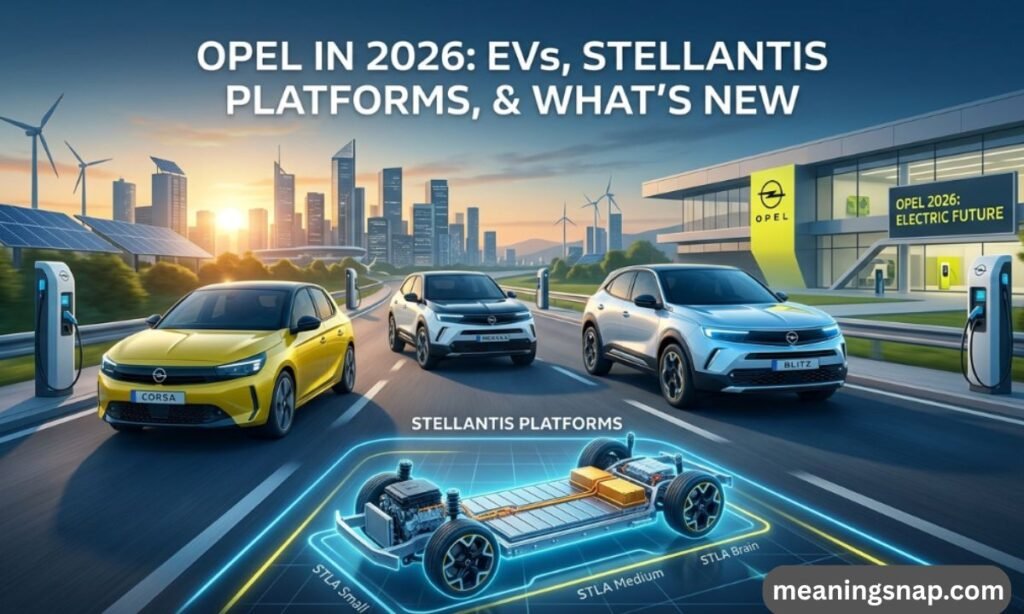
Opel’s story didn’t stop with a founder and a logo. In 2026, the brand sits inside Stellantis alongside Peugeot, Citroën, Fiat, and several other European names, pushing hard toward an all electric future. Opel has committed to selling only fully electric models across Europe by 2028, and the current lineup already reflects this shift.
The newest Opel Astra Electric, unveiled at the Brussels Motor Show in early 2026, delivers up to 454 kilometers of range on a single charge, built on Stellantis’s shared EV platforms. The Corsa Electric, Grandland Electric, and Frontera Electric round out a lineup covering everything from compact city cars to family SUVs, and Opel recently introduced its first all wheel drive electric Grandland as well. Behind the scenes, Stellantis has also explored a partnership with Chinese EV maker Leapmotor to co develop a new electric SUV under the Opel name, targeting production later this decade.
None of this changes the core OPEL meaning rooted in Adam Opel’s surname, but it shows how a 160 plus year old family name keeps adapting. From sewing machines to bicycles to combustion engines to battery packs, the brand has reinvented its product roughly every generation while keeping the same name on the badge the whole time.
Read Also: What Does “SOL” Meaning in Slang? Text, TikTok & Real Examples
Is “Opel” Used as Slang Anywhere?
Short answer: no, not in the internet slang sense most readers expect when landing on a meaning article. Opel doesn’t show up in texting abbreviations, doesn’t carry a secondary definition in urban dictionary culture, and doesn’t function as coded language the way terms like SOL or WYF do.
What happens instead is simpler. People type OPEL meaning into search bars because the word looks unfamiliar, sounds foreign, or shows up unexpectedly in a username, a word game app, or a casual conversation about cars. Since the word doesn’t carry an obvious English definition on its own, curious readers assume it must be short for something, or a piece of slang they’ve somehow missed. Knowing the real story behind the name saves a lot of unnecessary guesswork.
A few real world examples show how the word gets used in everyday conversation.
Text 1 Person A: what car did u end up getting Person B: an Opel Corsa lol, cheap and reliable
Text 2 Person A: saw “opel” pop up in my word game today, is this even a real word Person B: yeah it’s a German car brand, not a dictionary word
Text 3 Person A: my uncle in Germany drives an Opel, is it like a Toyota over there Person B: kind of, super common and practical
Text 4 Person A: why does this UK YouTuber keep saying Vauxhall when I thought it was an Opel Person B: same car, different name depending on the country
Text 5 Person A: is “opel” short for something, saw it on a license plate frame Person B: nope, only the founder’s last name, no hidden meaning
None of these conversations treat Opel as slang. They treat it the way people treat any unfamiliar brand name, with a little curiosity and a quick explanation once someone clears it up.
Frequently Asked Questions
What does OPEL stand for?
OPEL doesn’t stand for anything. The opel meaning traces straight back to founder Adam Opel’s surname, dating to 1862.
Is Opel and Vauxhall the same company?
Yes, in practice. Opel and Vauxhall share the same parent company and the same car platforms, with Vauxhall serving as the UK only badge for the same vehicles.
Why isn’t Opel sold in the US?
Opel left the US market by 1975 due to import costs and regulatory hurdles, and later ownership agreements explicitly blocked Opel sales in the US and China for years afterward.
What does the Opel logo represent?
The lightning bolt traces back to the Opel Blitz truck line, since “Blitz” means lightning in German, while the surrounding circle symbolizes unity and continuity.
Who founded Opel and when?
Adam Opel founded the company in Rüsselsheim, Germany, in 1862, originally as a sewing machine manufacturer.
Final Thoughts
So, the next time someone asks about OPEL meaning, you’ll have a better answer than “it’s a German car brand.” It’s a family name surviving sewing machines, bicycles, two world wars, four different corporate owners, and now an entire shift toward electric vehicles, all while keeping the same lightning bolt badge on the hood.
The short answer stays simple: no acronym, no hidden phrase, only Adam Opel’s surname carried forward by five sons and a company refusing to disappear. Whether you know it as Opel across Europe or Vauxhall in the UK, the badge tells the same story either way.
You May Like: Casi Algo Meaning: What “Almost Something” Really Means in Love and Life

Alex Morgan is a writer focused on explaining slang, words, phrases, acronyms, and popular expressions in a simple and easy-to-understand way. Through clear explanations and helpful examples, Alex helps readers quickly understand what words and phrases mean and how they’re commonly used.