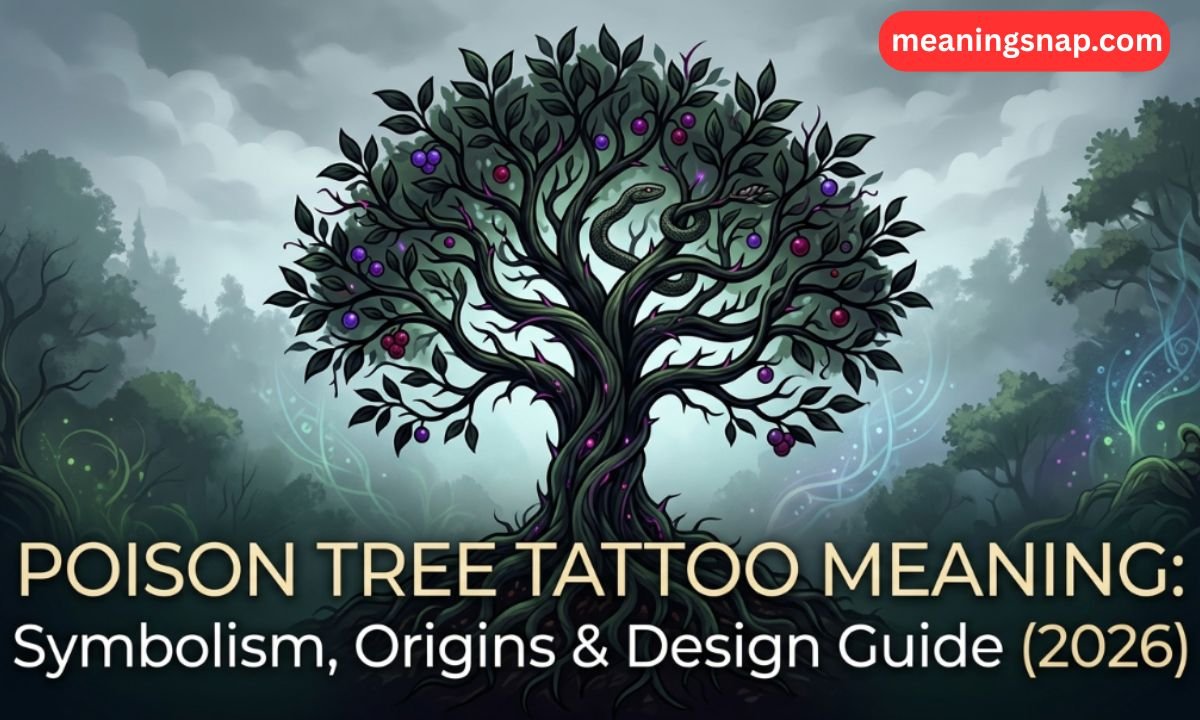
You’re at a barbecue, and the guy flipping burgers has this forearm tattoo you can’t stop staring at. A twisted black tree, bare branches, one dark fruit hanging low like it’s too heavy for the limb to hold. You ask what it means, half expecting “nothing, just liked the design.” Instead he tells you it’s from a poem about swallowing your anger until it turns into something worse. That’s usually how people first learn about the poison tree tattoo, by accident, off someone else’s skin. The meaning runs deeper than most dark botanical designs, and once you know the backstory, you’ll start noticing it everywhere.
Quick Answer: What Does a Poison Tree Tattoo Actually Mean?
Quick Answer: A poison tree tattoo represents anger or resentment that gets buried instead of spoken out loud, and how that buried feeling keeps growing underground until it finally surfaces, usually in a much uglier form than if it had just been dealt with honestly.
That’s the short version of the poison tree tattoo meaning, but it’s not the whole story. The design taps into something almost everyone has felt at some point: swallowing a feeling instead of saying it, and watching it fester instead of fade. The tree itself becomes a stand-in for that process. Roots dig in quietly. Branches twist as they grow. And the fruit at the end represents the consequence, the moment the buried feeling finally shows itself, usually at the worst possible time.
This is why the poison tree tattoo meaning tends to land differently depending on who’s wearing it. For some, it’s a warning to themselves. For others, it’s a marker of a relationship or a chapter they survived. The symbol is flexible enough to hold both, which is part of why it’s stuck around this long and shown up on so many different people.
Where the Poison Tree Symbol Actually Comes From
Most people trace the poison tree tattoo back to William Blake’s 1794 poem “A Poison Tree,” published in his collection Songs of Experience. In it, Blake describes what happens when anger toward a friend gets spoken and resolved, versus anger toward an enemy that gets hidden and left to grow. The buried version becomes something dangerous. Blake never tells you exactly what happens at the end, and that ambiguity is part of why the poem still gets tattooed over two centuries later.
But the symbolism didn’t start with Blake, and it doesn’t end with him either. The idea of a tree bearing something forbidden or dangerous shows up in the Garden of Eden story, where the Tree of Knowledge produces fruit that comes with consequences the moment it’s eaten. There’s also the older legend of the Upas tree, a supposedly poisonous tree from Southeast Asian folklore that European writers picked up and exaggerated for centuries before Blake ever wrote his poem.
Did You Know: The Upas tree legend claimed the tree’s poison was so strong it could kill anything that came near it, including birds flying overhead. The story was almost entirely myth, but it shaped how Western writers pictured a “poison tree” long before Blake gave the idea its most famous version.
So when someone gets a poison tree tattoo today, they’re usually referencing Blake directly or indirectly, but the deeper root of the symbol is older and wider than one poem. That layered history is part of what gives the design its weight.
See Also: HG Meaning Explained: Text, Snapchat & Slang Guide
The Core Symbolism, Broken Down
Strip away the literary references and the poison tree tattoo meaning comes down to a handful of consistent ideas. The tree isn’t random. Each part of it is doing symbolic work.
- The roots represent where the feeling started, often buried so deep the person barely notices it anymore.
- The trunk and branches stand for how the feeling grows over time, twisting as it gets more tangled and harder to untangle.
- The fruit is the consequence, the moment the buried anger or hurt finally shows itself.
- A leafless or gnarled tree often points to internal conflict, something that looks dead on the surface but is still very much alive underneath.
- A snake near the tree pulls in the Eden reference directly, adding temptation and forbidden knowledge to the mix.
Underneath all of it sits a psychological idea that shows up in Carl Jung’s writing too: the shadow self, the parts of ourselves we don’t want to look at directly. A poison tree tattoo can work as a kind of shadow work made visible, a reminder that suppressed emotion doesn’t just disappear, it grows roots. That’s a heavier read than most tattoo symbols carry, and it’s a big part of why this one resonates with people who’ve actually lived through the pattern instead of just liking the visual.
Poison Tree Tattoo vs Other Tree Tattoos: What’s the Real Difference?
Tree tattoos in general are common, so it helps to see how the poison tree tattoo meaning actually differs from the other tree designs people mix it up with.
| Tattoo Style | Core Meaning | Typical Audience | Visual Cues |
|---|---|---|---|
| Poison Tree | Suppressed anger or resentment that grows over time | People processing anger, betrayal, or literary fans | Twisted bare branches, single dark fruit, gnarled roots |
| Tree of Life | Growth, connection, family, fertility | People marking milestones or heritage | Full green canopy, symmetrical roots and branches |
| Dead or Bare Tree | Loss, endings, starting over | People marking grief or closing a hard chapter | Leafless branches, no fruit, stark black and grey |
| Family Tree | Lineage and generational bonds | People honoring family history | Named branches, dates, multiple root systems |
The overlap trips people up because a poison tree and a dead tree can look almost identical at a glance, bare branches and all. The difference is in the details. A poison tree almost always has that single piece of fruit hanging somewhere, which is the visual clue that separates “this is about loss” from “this is about something that’s still growing quietly.”
Who Actually Gets a Poison Tree Tattoo, and Why
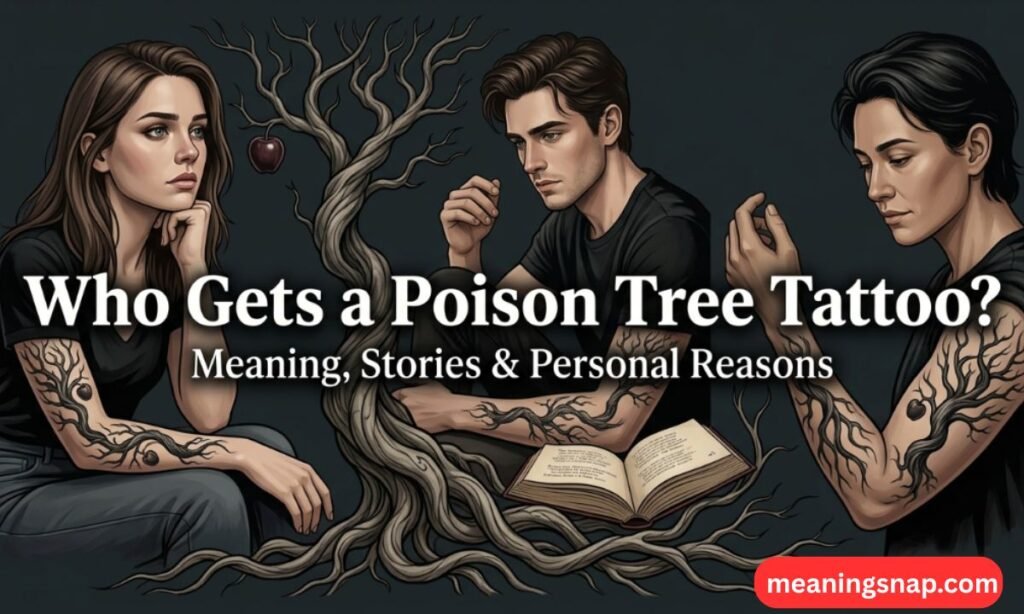
The people who choose this design tend to fall into a few overlapping groups. Some are marking the end of a toxic relationship or a period of buried anger they finally worked through. Others are drawn to it purely through Blake’s poem, especially anyone who studied it in a literature class and never forgot it. A smaller group picks it just because it looks striking, and finds out the deeper poison tree tattoo meaning after the fact, from a stranger asking about it.
Here’s what that actually sounds like in real conversations, since this comes up constantly in texts and comments once someone gets the piece:
- “wait is that a poison tree tattoo?? what’s the story behind it”
- “I got the poison tree because I spent years not saying how I actually felt. wanted something to remind me to stop doing that.”
- “oh sure, nothing says ‘I’m totally fine’ like a giant tattoo about buried rage lol”
- “does the poison tree tattoo mean something bad? saw one on my barista and got curious”
- “your poison tree tattoo is so good, is that from the Blake poem?”
Design references for this tattoo circulate heavily on Pinterest and inside tattoo artists’ Instagram and TikTok portfolios, which is usually where people first spot the exact style they want before booking. A lot of women specifically request the design after a breakup involving broken trust, using it as a private marker of emotional recovery rather than a public statement. For them, the poison tree tattoo meaning often shifts slightly, less about warning and more about proof that they survived the growing season and came out the other side.
Read Also: What Does ATP Mean in Text? (Real Examples + How to Reply)
Where People Share and Discuss This Tattoo Online
A tattoo doesn’t shift meaning from platform to platform the way a slang term does, but where people talk about it and find design ideas for it does change depending on where they’re looking.
| Platform | How the Poison Tree Tattoo Shows Up | Typical Content |
|---|---|---|
| The main hub for saved design references | Boards mixing the poison tree with other gothic tree ideas | |
| Artists posting finished pieces from their portfolios | Healed photos tagged with the artist and studio | |
| TikTok | The tattooing process filmed start to finish | POV and reveal clips, sometimes with a line from Blake’s poem in the caption |
| Threads asking what the design actually means | r/tattoos posts unpacking the symbolism before booking | |
| Discord | Niche art and literature servers | Design feedback threads and reference sharing |
| Local tattoo shop pages and groups | Client photo tags and shop portfolio posts | |
| Snapchat and WhatsApp | Personal, one-to-one sharing right after the session | Close friends getting the first look and the real story behind it |
Pinterest and Instagram tend to be where someone finds the exact style they want before ever sitting in the chair, while Reddit is usually where the actual poison tree tattoo meaning gets debated and explained in more depth. Snapchat and WhatsApp stay more private, since that’s usually where the real reason behind the tattoo actually gets shared, not just the design.
Real Example: How the Symbolism Plays Out
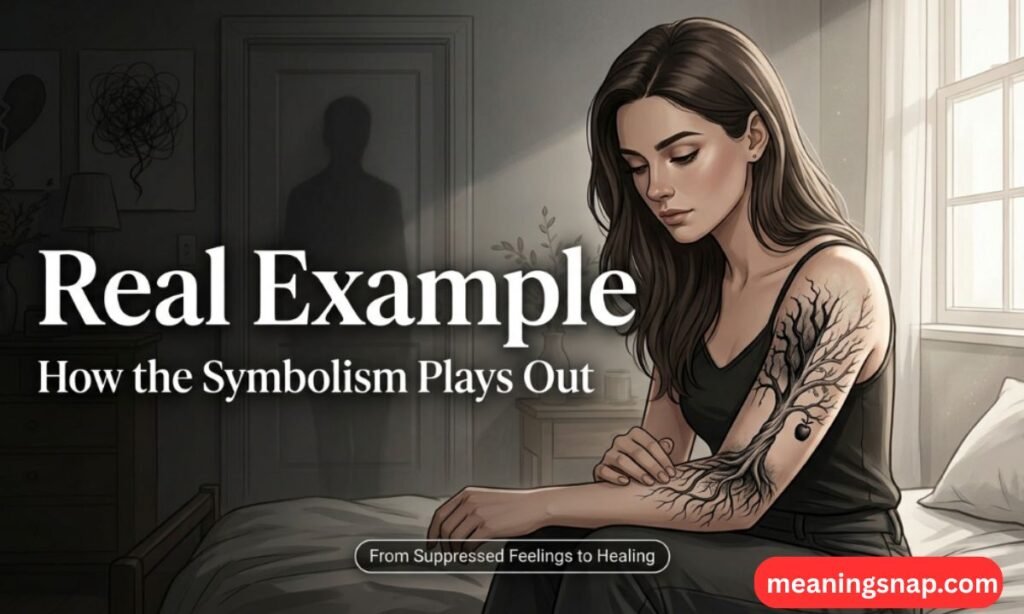
Here’s a fairly typical version of how this tattoo comes together in real life. Someone messages a tattoo artist a design brief right after ending a two-year relationship where she spent most of it swallowing her frustration just to keep the peace. She doesn’t want anything that reads as obviously angry. She wants something quiet that still carries the weight of what she went through.
The artist sketches a half-dead, half-living poison tree for her upper forearm, done in black and grey, with one small dark fruit low on the healthy side of the trunk. The dead half faces her wrist. The living half faces her elbow. There’s no snake, no color, nothing loud about it.
When people ask what it means, she tells them it’s about the moment she stopped burying things and started saying them out loud instead. That’s the poison tree tattoo meaning doing exactly what it’s meant to do, less a warning aimed at other people and more a private note to herself, one she can glance down at any time she’s tempted to go quiet again instead of speaking up.
Design Variations That Actually Change the Meaning
Not every version of this tattoo is just a style choice. Some variations shift the actual poison tree tattoo meaning, while others are purely aesthetic.
The versions that carry real symbolic weight include the half-dead, half-living tree, where one side looks decayed and the other side blooms, representing internal conflict or the balance between healing and pain. There’s also the serpent and fruit motif, which pulls the Garden of Eden reference in directly and adds temptation or forbidden knowledge to the design. And the heartfruit variation, where the fruit is shaped like a heart instead of an apple, leans the whole piece toward heartbreak and poisoned love specifically rather than anger in general.
Then there are the choices that mostly affect look, not meaning:
- Black and grey gothic rendering, with deep shadows and heavy linework
- Fine-line minimalist versions, stripped down to just the bare branches
- Watercolor style, using deep reds and muted greens instead of solid black
These three don’t change what the tattoo represents, they just change how loud or subtle it looks on skin. Someone choosing fine-line minimalist isn’t saying anything different from someone choosing full black and grey gothic, they just want a quieter version of the same idea.
Common Mistakes People Make With This Tattoo
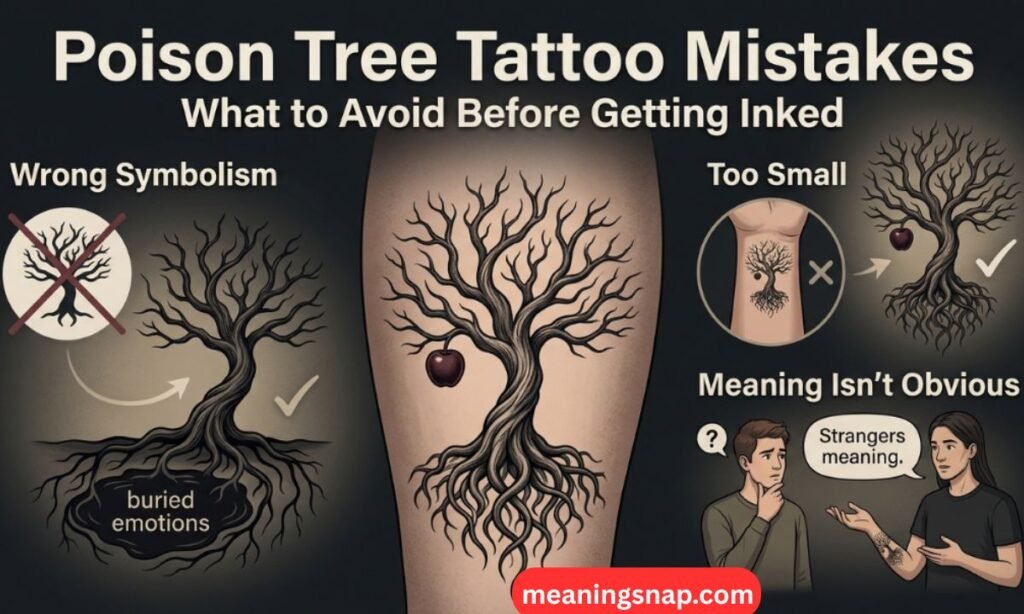
A few misunderstandings come up often enough that they’re worth flagging before anyone books an appointment.
The biggest one is treating the poison tree tattoo as a generic “evil” or bad-luck symbol, the same way people sometimes misread skull tattoos as purely dark with no nuance. That’s not really what it’s about. The symbol is about a process, buried feeling turning into consequence, not a statement that the wearer is dangerous or cursed.
The second common mistake is placement. This design relies on detail, twisted roots, individual branches, a distinct piece of fruit, and cramming it into a small space like the wrist or ankle often loses that detail within a few years as the linework softens. The third mistake is assuming the meaning is obvious to other people. Most strangers will read it as “cool dark tree tattoo” and nothing more, so anyone who wants the deeper story recognized needs to be ready to explain it themselves.
Read Also: Casi Algo Meaning: What “Almost Something” Really Means in Love and Life
Placement, Size, Pain Level, and Cost Guide
Once someone’s settled on the design, the practical questions come next: where, how big, how much it’ll hurt, and what it costs.
Forearms and calves tend to work well because they give enough flat space for the branches to spread out naturally, and both are moderate on pain since they’re away from bone. The outer thigh and upper back offer the most room for a large, detailed piece and are generally lower on the pain scale thanks to more muscle and fat coverage. Ribs, spine, and the inner arm rank higher on pain because of thin skin and bone proximity, but they suit a smaller, more compact version of the tree well.
For size, a poison tree tattoo usually needs at least four to six inches to keep the branch detail from blurring together over time. Cost depends heavily on size and shading, but a mid-size black and grey version from an experienced artist commonly falls somewhere between $150 and $500, with larger back or thigh pieces running higher based on hourly rates in the artist’s area.
FAQs: Poison Tree Tattoo Meaning
Is a poison tree tattoo a negative symbol?
Not inherently. It represents a process, buried anger growing into something worse, rather than a statement that the wearer is a bad or dangerous person. Plenty of people get it as a reminder to stop repeating that pattern, which makes it more of a warning to themselves than a negative label.
Does a poison tree tattoo have to reference William Blake?
No. Blake’s poem is the most common reference point and gives the design its modern name, but plenty of people choose it purely for the visual symbolism around suppressed emotion without ever having read the poem.
What does a poison tree tattoo mean for women?
The meaning doesn’t change based on gender, but women often choose this design after leaving a toxic relationship or working through broken trust, using it as a personal marker of emotional recovery rather than a public statement about anger.
Can a poison tree tattoo symbolize healing?
Yes. While the poem itself doesn’t end on a hopeful note, plenty of people interpret their own tattoo as the moment they stopped burying their feelings, which flips the symbol toward healing and self-awareness instead of warning.
How much does a poison tree tattoo typically cost?
A mid-size black and grey version usually runs between $150 and $500 depending on detail level and the artist’s hourly rate, with larger pieces on the back or thigh costing more due to added time.
Final Thoughts
The poison tree tattoo sticks around because it’s honest about something most people would rather not admit, that buried feelings don’t just fade quietly, they grow roots. Whether someone picks it for the Blake reference, the Eden parallel, or just the visual of a tree that looks half dead and half alive, the design carries a version of the same warning. Bury it long enough and it turns into something you didn’t intend. Say it out loud instead, and the tree never grows in the first place.
That’s part of why this symbol keeps showing up on people who’ve actually lived through the pattern it describes, not just people who liked the linework. Next time you spot a twisted black tree with one piece of fruit hanging low, you won’t just wonder what it means. You’ll already know the story it’s telling.

Alex Morgan is a writer focused on explaining slang, words, phrases, acronyms, and popular expressions in a simple and easy-to-understand way. Through clear explanations and helpful examples, Alex helps readers quickly understand what words and phrases mean and how they’re commonly used.