Your friend helped you move a couch up three flights of stairs. You text her later, and she replies with one word: “tysm.” No exclamation point. No emoji. You stare at your phone for a second, wondering if that’s warm or weirdly flat. That tiny pause, where a four-letter reply makes you second-guess the tone, is exactly why so many people search for TYSM meaning every single day. The short answer is simple. The context around it is where things get interesting, and that’s what this guide is here to sort out, one formatting quirk at a time.
What Does TYSM Mean?
TYSM stands for “Thank You So Much.” That’s the whole definition. No hidden layer, no secret second meaning floating around waiting to trip you up.
People use it the same way they’d say “thanks a ton” out loud, just typed faster. It shows up as a reply to a favor, a compliment, a gift, or anything else that makes someone feel grateful enough to want more than a plain “thanks.”
Here’s the thing about TYSM meaning specifically: it sits one notch above a basic “ty.” Where “ty” feels automatic, almost like a reflex, TYSM carries more weight. It signals the person stopped for a second to feel appreciative instead of just checking a box.
It’s not just casual chat shorthand either. Reference sites like Wiktionary list TYSM as a standard initialism for “thank you so much,” which puts it in the same category as documented internet slang rather than something made up on the spot. That’s part of why it reads as understood and safe to use, instead of confusing or overly niche.
Say it out loud and most people either spell it letter by letter, “T-Y-S-M,” or just say “thanks so much” and skip the abbreviation entirely. TYSM lives almost exclusively in written form. It was built for typing speed, not spoken conversation, which is a big part of why it never fully crossed over into everyday talk.
You’ll see it written a few different ways depending on who’s typing:
- TYSM: all caps, more emphatic
- tysm: lowercase, casual and quick
- Tysm: sentence case, fairly neutral
All three carry the exact same definition. Formatting adjusts the volume, not the meaning. Age doesn’t determine which version someone reaches for, either. It’s more about mood and how fast someone happens to be typing.
Read More: What Does MH Mean in a Text? Every Meaning Explained (2026 Guide)
Where TYSM Came From
Most articles about TYSM meaning claim it “emerged in the early 2000s” like they pulled that date from a filing cabinet somewhere. Nobody can prove that with a source, and slang almost never has a clean origin story to begin with.
What we can point to is a verifiable trail instead of a guess. Text abbreviations grew out of early chatrooms, AIM, and SMS messaging, where character limits and slow typing on flip phone keypads pushed people to shorten everything they wrote. Standard text messages capped out at 160 characters for years, and typing on a numeric keypad meant hitting the same key multiple times just to land on one letter. Shortening “thank you so much” down to four keystrokes wasn’t a trend so much as a practical fix for a slow, cramped typing experience.
Back then, away messages and buddy lists were the entire social scene, and speed mattered more than spelling. “TY” for “thank you” came first, since it’s the more obvious shortcut. TYSM followed as a natural extension once “TY” alone started feeling too thin for genuine gratitude.
The earliest publicly documented use anyone can point to sits on Urban Dictionary, dated May 2005. That’s a real, timestamped record rather than a guess pulled from thin air. It doesn’t mean TYSM didn’t exist earlier in private chats and forums nobody archived. It just means that’s the earliest paper trail available to check.
Fun Fact: Urban Dictionary also has a separate, unrelated entry for “tysm” that has nothing to do with gratitude. It defines the word as leftover scrap pieces from an art project or home renovation. It’s an odd coincidence of letters, not an alternate meaning anyone uses while texting.
By the mid 2010s, once Tumblr, Twitter, and Instagram had fully taken off, TYSM had settled into everyday digital vocabulary alongside terms like LOL and OMG. Fan communities used it constantly to thank creators, and it spread from there into ordinary group chats. It never needed a single inventor or a launch date. It just made sense to enough people, and it stuck around for good.
What Does Urban Dictionary Say TYSM Means?
Urban Dictionary is where a lot of people land when they search TYSM meaning directly, and the site has stayed consistent on this one. The oldest surviving entry, posted back in 2005, defines it as an abbreviation for “Thank You So Much,” with an example as plain as “TYSM for the compliment.” Every major entry added since then repeats the same core definition without adding any twist or alternate meaning.
A few joke or unrelated entries exist too, since anyone can submit a definition to the site, like the leftover art-scraps entry mentioned above. None of those come close to competing with the dominant definition. Search TYSM on Urban Dictionary today, and the top-voted result is still, and has always been, “thank you so much.”
Read Also: HN Meaning in Text: What It Really Means (And Why It Changes By Platform)
How Caps, Lowercase, and Punctuation Change the Tone
This is the part most guides skip entirely, and it’s the most useful thing to understand about reading TYSM meaning correctly in the wild. The letters never change. Everything surrounding them does the emotional heavy lifting.
Written in all caps, TYSM reads louder and more excited. Someone typing “TYSM!!!” after you surprised them with concert tickets means every letter of it. There’s real enthusiasm packed into those capitals.
Lowercase “tysm” reads flatter and more relaxed. It’s the version friends toss back and forth all day for small stuff, like sending a homework answer or holding an elevator door. Nothing dramatic, just polite acknowledgment between people who already trust each other.
A few other formatting quirks change the reading too:
- Stretching the letters, as in “tysmm” or “tysmmm,” adds emphasis the same way “sooo” stretches “so.” It reads playful and warm.
- Ending with a period, as in “tysm.” often lands as clipped or a little cold, depending on what came right before it.
- Pairing it with a soft emoji like 🙏 or 🥹 nudges the tone toward sincere, even without extra words.
- Stacking emojis after it, like “TYSM 🙏🙏🙏,” pushes the intensity even higher, usually reserved for something that genuinely moved someone.
None of these rules are official. They’re patterns readers pick up naturally from context, the same way tone of voice works when you’re talking face to face instead of typing.
Captions add another layer on top of this. Instagram and TikTok captions often go with sentence case, “Tysm for 10k,” since it reads cleaner against a photo or video than a wall of capital letters. Comment replies skew lowercase for the same reason. Formatting choices in these spaces are closer to design decisions than grammar rules.
TYSM in Real Conversations

Reading definitions only gets you so far. Seeing TYSM meaning play out across a few different exchanges makes the tone shifts click faster than any explanation can.
Sincere, between friends:
Mia: “I left my charger at your place, can I swing by?”
Jordan: “Already outside your door lol”
Mia: “tysm you’re a lifesaver 😭”
Casual, quick acknowledgment:
Dev: “sent you the notes from class”
Priya: “tysm”
On a social media comment:
Follower: “This tutorial fixed my problem, thank you!”
Creator: “tysm for watching, means a lot 💛”
Workplace Slack, casual but still professional:
Coworker: “Pushed the fix, should be live now”
You: “TYSM, saved me a headache before the client call”
Overwhelmed, genuine gratitude:
Sam: “Booked your flight and hotel already, details in your email”
Alex: “wait TYSM SM I owe you big time”
On a dating app, warm but early-stage:
Match: “Just so you know, I read your whole profile before swiping”
You: “tysm, that seriously made my night”
Notice how punctuation, capitalization, and emoji shift alongside the emotional weight of whatever’s being thanked for. Bigger favor, bigger reaction. Small favor, short and easy reply. That pattern holds across almost every platform, from texting to comment sections, and it’s a big part of why the exact same four letters can feel completely different from one conversation to the next.
What Does TYSM Mean on TikTok?
TikTok deserves its own quick mention, since it’s one of the biggest places TYSM shows up today. The meaning doesn’t change on the platform. What changes is how often it appears and where.
Creators use it constantly in the comment section, replying to viewers who leave kind words or ask a question. A common pattern looks like this:
Viewer: “This changed how I organize my whole closet, thank you!”
Creator: “tysm for watching 🥹”
It also shows up in captions themselves, especially after a video crosses a follower milestone or goes viral unexpectedly. Creators will caption a video “tysm for 100k” instead of writing out the full phrase, partly to save space and partly because it matches the platform’s casual tone.
Duets and stitches add one more layer. Someone reacting to a video that helped them out will often open with TYSM before getting into their own response, crediting the original creator right up front. Across all of these uses, TYSM keeps its exact meaning. TikTok just gives it more places to show up, faster than almost any other platform.
When TYSM Turns Sarcastic
TYSM isn’t always genuine, and pretending otherwise would leave out half the picture. Like most gratitude phrases, it flips into sarcasm the moment the situation itself is irritating rather than helpful.
The tell is usually context paired with a flat delivery. Text has no tone of voice built in, so readers infer sarcasm from timing and circumstance instead of hearing it directly. If someone takes forever to reply to a message and finally answers hours later, a dry “tysm for the speedy response” isn’t appreciation. That’s a jab dressed up in polite letters.
A few signals help you read the tone correctly:
- No exclamation point, and often no emoji at all
- A situation that involved delay, inconvenience, or a mistake someone else made
- A deadpan follow-up line right after the TYSM itself
Example, roommate situation:
Roommate finally takes out the trash that’s been sitting for a week.
You: “tysm for handling that so quickly”
Example, customer service:
Support rep, on hold music for forty minutes, finally picks up.
You: “tysm for the wait, love that for me”
Read out loud, both of those lines drip with sarcasm. Written as plain text with zero other context, they can go either way, which explains why the surrounding conversation matters more than the four letters themselves.
This is exactly why misreading tone over text happens so often. Spoken sarcasm leans on pitch and pacing, cues that simply don’t exist in a text bubble. Readers have to reconstruct that missing tone from everything around the words instead, which is a skill that gets sharper with practice and gets messier with strangers you don’t know well yet.
TYSM vs TY vs TYVM vs TQSM
TYSM has a handful of close relatives that mean roughly the same thing but land differently depending on formality and how much emphasis someone wants to add. Here’s how they compare side by side.
| Term | Full Form | Formality | Typical Use |
|---|---|---|---|
| TY | Thank you | Minimal, casual | Quick, low-effort replies between friends |
| TYSM | Thank you so much | Casual, warmer | Genuine appreciation in texts and comments |
| TYVM | Thank you very much | Slightly more composed | Casual but a touch more polished |
| TQSM | Thank you so much | Casual, regional | Common in parts of Asia, less common in the US and UK |
| AWTYSM | Aww, thank you so much | Playful, affectionate | Reacting to something sweet or touching |
TY works fine for small stuff, the texting version of a nod. TYSM meaning kicks in when someone wants the other person to feel the gratitude, not just register it. TYVM sits in an odd middle ground, casual but composed enough to use in a group chat with people you don’t know well yet. None of these terms are officially standardized, so spelling still varies from person to person even within the same family of abbreviations.
There’s also “thx,” which comes from a slightly different branch of the same family tree. Where TY and TYSM shorten “thank you,” thx shortens “thanks” instead, dropping the vowels rather than the words. It lands closer to TY in formality, quick and low-effort, without carrying the extra warmth TYSM adds.
Read Also: TM Meaning in Text: What It Really Means & How to Use It
Does TYSM Mean Something Different From a Girl or a Guy?
Short answer: no. TYSM means exactly the same thing regardless of who’s typing it. The definition doesn’t shift based on gender, and there’s no secret rule where it carries extra meaning depending on who sends it.
The confusion usually comes from people trying to read romantic interest into a thank-you. A girl sending “tysm 🥺” to someone she’s into might feel warmer because of the relationship behind it, not because the abbreviation itself changed meaning. The same four letters sent to a coworker or a sibling carry zero romantic weight at all.
What genuinely shifts the tone is everything covered earlier in this guide: capitalization, punctuation, emoji, and context. Those signals matter far more than the sender’s gender ever does. If someone’s TYSM feels flirty, it’s the surrounding conversation doing that work, not the letters themselves.
Is There a Dirty Meaning Behind TYSM?
No. TYSM has no sexual or explicit meaning in any common or documented use. It stands for “Thank You So Much,” full stop, whether it shows up in a text, a comment, or a caption.
The search itself is common, mostly out of general curiosity, since plenty of internet abbreviations have turned out to carry a second, less innocent meaning over time. TYSM just isn’t one of them. Across slang dictionaries, community-driven sites, and everyday usage, the definition has stayed exactly the same since the earliest recorded entry. If a message built around TYSM ever feels off, the issue lives in the surrounding conversation, not in the abbreviation itself.
Read Also: OBO Meaning: What It Means in Text, Sales & Listings
Does TYSM Have a Medical Meaning?
There’s no official medical or clinical use of TYSM. Unlike abbreviations that show up in real medical documentation, such as PRN or NPO, TYSM has never been adopted as a standard clinical term.
If TYSM shows up in a healthcare setting, like a message from a nurse or a coworker in a hospital Slack channel, it’s being used the exact same way it’s used everywhere else: casual, everyday gratitude. Some abbreviation databases list a technical-sounding “medical” category next to TYSM, but that reflects how those sites are built to catalog every possible acronym match, not a real, recognized medical definition. Outside of texting and casual chat, TYSM doesn’t exist as a term at all.
When to Use TYSM (and What to Say Instead)
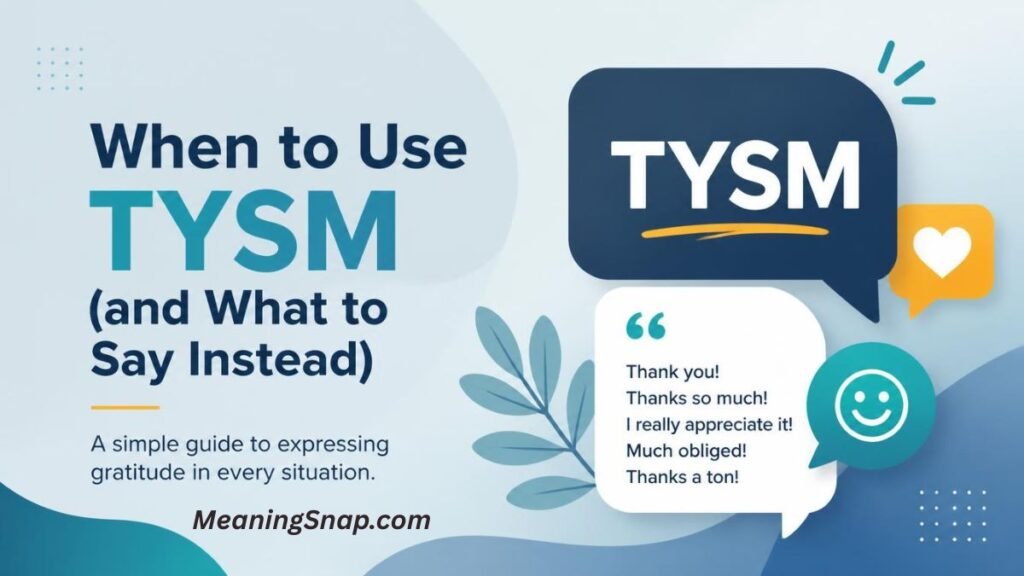
TYSM fits almost anywhere casual digital communication happens. Friends, family group chats, social media comments, dating apps, and relaxed workplace tools like Slack or Teams all work fine for it.
It starts to feel out of place in a few specific spots. Formal emails, cover letters, academic writing, and first contact with someone you’re meeting professionally all call for the full phrase instead. Typing “TYSM” to a hiring manager reads as underdressed for the occasion, the text equivalent of showing up to an interview in flip-flops. Customer service replies from a company account fall into the same category. A brand thanking a customer usually spells it out in full to sound polished.
Picture the difference side by side. A text to a friend might read “tysm, you’re the best.” The email version of that same gratitude, sent to a professor or a client, reads more like “Thank you so much for taking the time to review this, I sincerely appreciate it.” Same feeling, completely different outfit.
Brand accounts run into this constantly too. A company replying to a customer complaint on social media almost always spells the phrase out in full, since a corporate account using “tysm” can come across as trying too hard to sound relatable. An individual creator thanking followers for hitting a milestone has much more room to keep it casual, because the relationship reads as personal rather than transactional.
When TYSM doesn’t fit the moment, a few solid swaps work well:
- “Thank you so much,” spelled out in full for anything formal
- “I appreciate this a lot,” warm without leaning on slang
- “Thanks, that means a lot,” sincere and still conversational
The line generally falls at how well you know the recipient and how permanent the message feels. A text disappears into a thread within minutes. An email sits in someone’s inbox with your name attached to it for as long as they keep it. Match the abbreviation to the room you’re texting in, and TYSM will rarely steer you wrong.
Frequently Asked Questions
Is TYSM ever rude?
Not by itself. It only reads as rude or dismissive when it’s paired with a curt tone, zero punctuation, and context that points toward annoyance rather than gratitude. On its own, the phrase is neutral to warm, and most readers default to assuming good intent unless the situation says otherwise.
What’s a good reply when someone sends you “tysm”?
“You’re welcome,” “anytime,” or “of course” all work well. Matching their energy with something short like “np!” fits casual exchanges just as easily, especially in fast-moving group chats where nobody’s writing full sentences anyway.
Do older generations use TYSM too?
Yes, though less consistently than Gen Z and Millennials use it. Plenty of Gen X and older Millennial texters picked it up through everyday messaging and social media without ever treating it as youth-only slang, since it spread through mainstream platforms rather than staying inside one age group.
What does “awtysm” mean?
It stands for “aww, thank you so much,” typically dropped in when reacting to something sweet, thoughtful, or unexpectedly kind, often paired with a heart emoji or a crying-laughing face for extra emphasis.
Is it okay to use TYSM in a work email?
Generally, no. Slack messages and quick internal chats handle it fine, but a formal email reads more professional with the phrase spelled out in full, especially with clients, vendors, or anyone outside your immediate team who might not read it as casually as you meant it.
Final Thought
Next time “tysm” lands in your inbox or your group chat, you won’t have to pause and guess anymore. The letters stay the same every time. The punctuation, capitalization, and context around them tell you everything else you need to know, and now you know exactly what to look for.

Alex Morgan is a writer focused on explaining slang, words, phrases, acronyms, and popular expressions in a simple and easy-to-understand way. Through clear explanations and helpful examples, Alex helps readers quickly understand what words and phrases mean and how they’re commonly used.