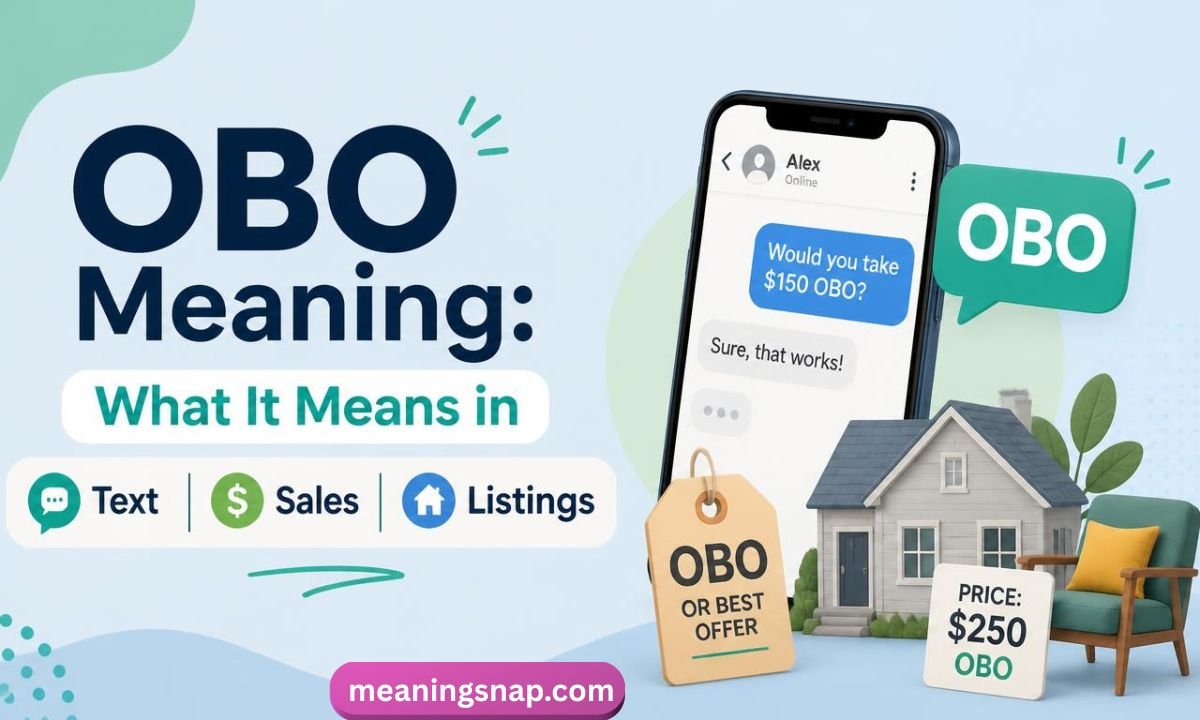
You’re scrolling Facebook Marketplace at midnight, half asleep, when a listing catches your eye. A vintage bike, decent price, and underneath it, three letters: “$150 OBO.” Your thumb hovers over the message button. The OBO meaning feels obvious at first, something tied to the price, but you’re not sure how much room you have to negotiate, or whether there’s some unwritten rule you’re about to break by even asking. Here’s the good news: OBO has one clear meaning in almost every listing you’ll ever come across, and once you know it, you won’t second-guess a price tag again.
There’s also a second, completely different version of OBO that shows up in emails and paperwork, and mixing the two up is easier than you’d think, especially if you’ve only ever seen it on a for-sale sign before.
What Does OBO Mean?
OBO stands for “Or Best Offer.” You’ll see it stitched onto price tags in classified ads, garage sale signs, and online listings everywhere from eBay to Craigslist to Facebook Marketplace. When a seller writes “$150 OBO,” they’re saying the $150 is a starting point, not a locked-in number. They’re telling buyers straight up: send an offer, and if it’s reasonable, there’s a decent chance they’ll take it.
The phrase does double duty. It sets an anchor price so buyers know roughly what the item is worth, while signaling flexibility so nobody walks away thinking the price is set in stone. That combination is exactly why OBO shows up on so many listings instead of a plain fixed price with no room to move.
Quick Answer: OBO means “Or Best Offer.” A seller lists a price but stays open to reasonable offers below it. It shows up most often in for-sale listings, classified ads, and car sales, and it always signals room to negotiate.
Sellers use OBO because it invites negotiation without them having to sound desperate to sell. Buyers see it and understand there’s wiggle room, without the seller needing to spell out “please make an offer” or “negotiable” every single time. It’s shorthand both sides already understand, which is exactly why it stuck around this long.
The abbreviation reads a little differently depending on what’s for sale. On a car listing, OBO usually signals the seller expects a real conversation, since vehicles rarely sell at the exact sticker price anyway. On something smaller like a lamp or a phone case, OBO often means even less flexibility in dollar terms, but the same willingness to knock a few bucks off rather than lose the sale over a small gap.
There’s a psychology behind it too. A price tag with no room to move tends to feel rigid, and some buyers scroll right past it without messaging at all. Adding OBO softens that wall a bit, and it often pulls in buyers who would’ve otherwise assumed the price wasn’t worth trying to talk down. Unlike a lot of internet slang, OBO didn’t get invented on social media. It’s been around far longer than most people assume, which brings up a fair question: where did it come from in the first place?
Read Also: PTSO Meaning in Text: What Does PTSO Stand For? (Full Guide)
Where Did OBO Come From?
Long before Facebook Marketplace existed, OBO lived in newspaper classifieds. Flip through an old paper’s “For Sale” section and you’d spot it constantly, tacked onto used cars, furniture, and real estate listings. Newspaper ads charged by the character or the line, so short abbreviations were the norm, and OBO fit the format perfectly. It said everything a longer phrase would say, in three letters, saving the seller a few extra cents per word.
When classified ads moved online, the abbreviation moved right along with them. eBay listings picked it up in the early 2000s as auction and fixed-price formats mixed together, Craigslist sellers adopted it soon after as their local listings exploded in popularity, and Facebook Marketplace inherited the habit when it launched in 2016. The meaning hasn’t shifted an inch through any of that. A phrase built for cramped newspaper columns turned out to work equally well in a text box on a phone screen decades later.
Readers in the UK will spot a close cousin: ONO, short for “Or Nearest Offer.” Same concept, different letters, and it tends to show up more often in British listings than OBO does. Both phrases exist for the same reason: give buyers a nudge toward negotiating without the seller having to write out a full sentence explaining it every time.
Real estate ads used a version of this shorthand too, long before cars and furniture picked it up. A house listed “$180,000 OBO” told buyers the seller wanted a quick sale and expected some back and forth on the final number, the same signal it sends today on a much smaller scale for a used couch or a bike.
OBO in Online Listings and Marketplaces
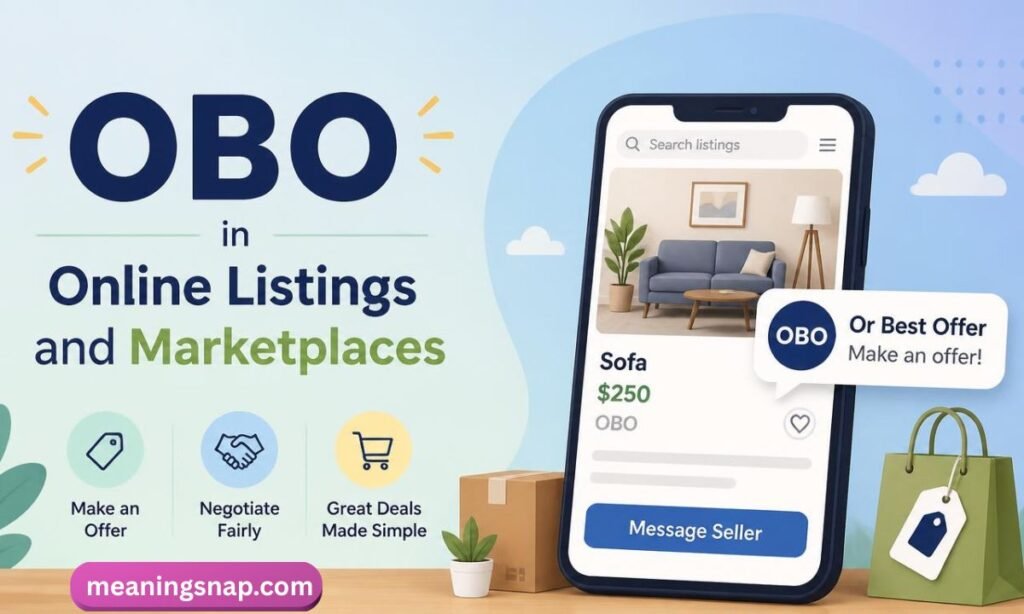
OBO shows up constantly across resale platforms, and the format barely changes from site to site. A seller lists an item, attaches a price, and tacks on OBO to invite offers. Here’s how it typically plays out across a few different platforms people use every day.
| Platform | How OBO Usually Appears | Example |
|---|---|---|
| Facebook Marketplace | In the listing title or description | “Couch, great condition, $200 OBO” |
| eBay | In “Buy It Now” listings with an offer option enabled | “$85 OBO, message with offers” |
| Craigslist | Directly next to the asking price | “2012 Honda Civic, $5,500 OBO” |
| Car sale signs | Painted or printed on the windshield | “$4,000 OBO, call for details” |
A quick table like that shows the pattern at a glance, but the real test is spotting OBO once actual messages start flying back and forth. Here’s how that usually plays out in practice.
Example 1 (casual buyer message):
Buyer: “Hey, is the desk still available? Saw it’s $60 OBO, would you take $45?”
Seller: “Yeah, $45 works. When can you pick it up?”
Example 2 (sarcastic lowball):
Buyer: “$10 for the couch since it’s OBO right?”
Seller: “Lol nice try. $150 is already the low end.”
Example 3 (sincere negotiation):
Buyer: “I know it says $300 OBO, I can only do $250 but I can pick up today if that helps.”
Seller: “Deal, cash only though.”
The format shifts slightly depending on where you’re browsing. eBay treats OBO almost like an official feature, with a built-in “Best Offer” button that lets buyers submit a number the seller is free to accept, decline, or counter. Craigslist and Facebook Marketplace keep things more informal, since OBO usually sits as plain text in the listing and every negotiation happens through direct messages instead of a structured offer system.
What OBO Signals to a Buyer
OBO tells a buyer two things at once. First, the listed price isn’t the final word, so there’s room to negotiate before anyone commits. Second, it’s a subtle hint the seller wants the item gone fairly soon, since fixed, non-negotiable prices tend to belong to sellers with less urgency to sell. It doesn’t mean the price is fake or padded on purpose. Most sellers list somewhere close to what they’d genuinely accept, then leave OBO on there so a fair offer doesn’t get automatically turned down before it’s even considered. Understanding that mindset helps explain why some offers land well and others get ignored entirely.
Read Also: PMO Meaning: What It Means in Text, Slang & More (2026 Guide)
OBO Meaning in Car Listings
Cars are where OBO shows up the most, and for good reason. Vehicles rarely sell at the exact number on the sign, so sellers add OBO to set expectations up front rather than fielding the same “would you take less” question over and over. A windshield sign reading “$4,000 OBO” or a Craigslist post for a used truck works the same way as any other listing, but the negotiation tends to run deeper because the price itself is higher and buyers usually factor in repairs, mileage, or a mechanic’s inspection before naming a number.
Private sellers lean on OBO more than dealerships do, since dealership pricing usually goes through a separate negotiation process involving trade-ins, financing, and add-ons that a plain “OBO” tag doesn’t capture. For a private car sale, a buyer bringing up a recent oil change receipt or a slightly high mileage reading has real leverage to justify an offer below the OBO price, something that rarely works on smaller household items where condition is easier to judge from photos alone.
How Much Should You Offer on an OBO Listing?
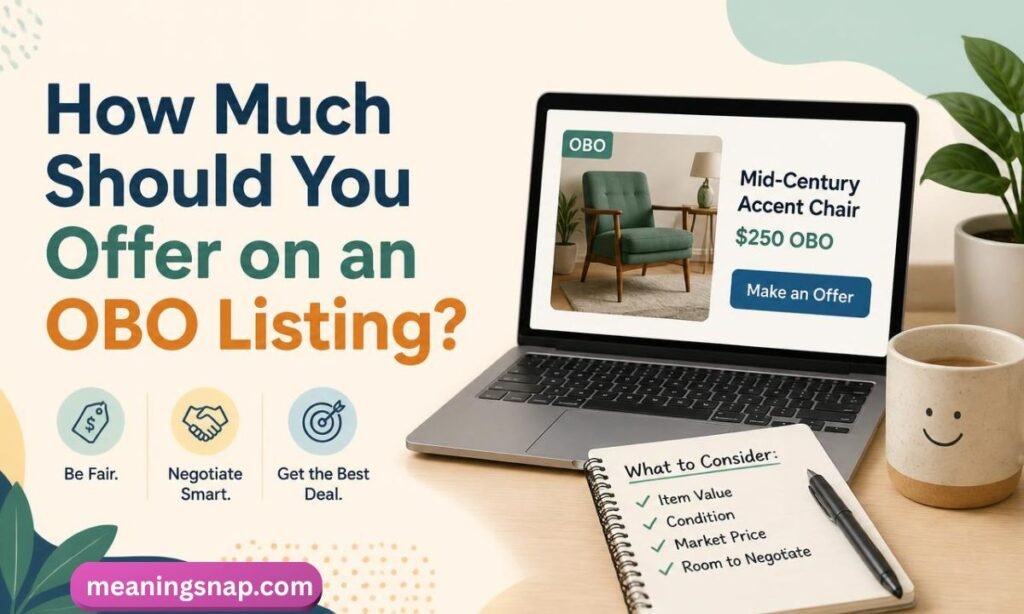
This is where most buyers get stuck. Seeing OBO feels like an open invitation to name any number, but sellers still expect offers to land somewhere reasonable. A good starting point sits around 10 to 20 percent below the listed price for most everyday items like furniture, electronics, and household goods. For higher-ticket items like cars, 10 to 15 percent under asking tends to open a conversation without insulting the seller on the first message.
Context changes things too. An item that’s been listed for weeks with no bites gives buyers more room to offer low, since the seller has had time to reconsider their price already. A brand-new listing, especially for something in high demand, usually gets less flexibility, and a lowball there is more likely to get ignored. Condition matters as well. A scuffed-up item with visible wear justifies a lower offer far more than something listed as barely used.
Timing and payment method matter more than most buyers realize too. Offering cash and same-day pickup gives a seller a reason to accept less, since it removes the hassle of storing the item, coordinating a later pickup, or fielding messages from other interested buyers. A lower number paired with a fast, easy deal tends to beat a higher number that comes with delays or conditions attached.
A message that includes a fair reason for a lower offer tends to land better than a bare number with nothing attached to it.
Example 4 (reasonable low offer with context):
Buyer: “Love the bike, noticed the OBO. Would $120 work? I can grab it tonight.”
Seller: “$120’s a bit low for me, could you do $135?”
Buyer: “Sure, $135 works.”
Example 5 (checking the boundary):
Buyer: “Since it says OBO, would you take half the asking price?”
Seller: “Half’s too steep, I’d need at least 80% of asking.”
Offering way under the listed price without any explanation attached is one of the fastest ways to get ignored entirely. Sellers who write OBO expect a negotiation, not a bidding war that starts at rock bottom and hopes for the best. A little context, and a little respect for the number they already picked, goes a long way toward closing the deal.
The Other OBO: On Behalf Of
Step outside the world of buying and selling, and OBO takes on an entirely different meaning: “On Behalf Of.” You’ll spot this version in emails, business letters, banking paperwork, and legal or corporate documents, usually sitting right next to someone’s signature or a name at the bottom of a page.
When one person signs a document for another, especially in a professional setting, they’ll often write “OBO [Name]” to make clear they’re signing with that person’s authority rather than as themselves. An assistant might sign an email OBO their manager while that manager is traveling. A representative might sign a contract OBO a company they’re authorized to act for, without being the actual decision-maker named in the agreement. Banks and finance departments use the same shorthand when a payment or transaction happens on behalf of a client rather than the institution processing it, which shows up on statements and internal paperwork more than most customers realize.
This meaning has nothing to do with price or negotiation, and it never invites a counteroffer. It’s a signal of authority and representation, showing up wherever someone acts in an official capacity for someone else who isn’t the one physically signing. A typical signature line might read “Jane Smith, OBO John Doe, Regional Director,” which tells anyone reading the document that Jane signed with John’s approval rather than her own independent authority.
In banking and legal paperwork specifically, this notation is generally understood as a way to formally record that a transaction, letter, or filing was carried out with proper authorization from the actual account holder or named party, rather than by someone acting on their own. It shows up often enough in professional correspondence that most people in office jobs run into it eventually, even if they’ve never had to sign anything OBO themselves.
How to Tell Which OBO Someone Means
Context gives it away almost instantly. If OBO sits next to a dollar amount or a listing, it means “Or Best Offer.” If it sits next to a name or a signature line, it means “On Behalf Of.” The two meanings almost never overlap or cause real confusion once you know what to look for, since one lives entirely in sales conversations and the other lives entirely in paperwork and formal correspondence.
Read More Article: What Does JSP Meaning in Text? Real Examples and Hidden Meanings
OBO Meaning in Business
In a workplace setting, OBO almost always points back to “On Behalf Of.” It shows up when someone sends a message, signs a form, or handles a task in place of a colleague or manager who isn’t available to do it themselves. An assistant firing off a client email while their boss is out might sign off “Sent OBO [Manager’s Name]” so the recipient knows the message is authorized rather than improvised.
The phrase keeps accountability clear without turning a quick email into a legal disclaimer. A team member covering for someone on leave, a coordinator submitting paperwork for a department head, or an office manager confirming an order for a company they represent all lean on the same shorthand. It tells the reader exactly who’s speaking and on whose authority, which matters more in business writing than it might seem at first glance.
OBO Meaning in Legal Documents
Legal paperwork uses OBO the same way business correspondence does, though the stakes tend to be higher. When someone signs a document “OBO” another person or organization, they’re indicating they hold the authority to act on that party’s behalf, whether through a formal arrangement like power of attorney, a corporate role, or a signed agency agreement. The notation itself isn’t a legal document, it’s a shorthand flag telling the reader that the signature represents someone other than the person physically signing.
This distinction matters because a document signed OBO someone else generally still requires that the signer genuinely hold valid authority to act for them. A signature alone doesn’t create that authority, it only discloses it. Anyone reviewing a contract, letter, or filing that includes OBO next to a name is generally well served by confirming the underlying authorization exists, rather than assuming the notation alone settles the matter.
OBO Meaning in Banking and Finance
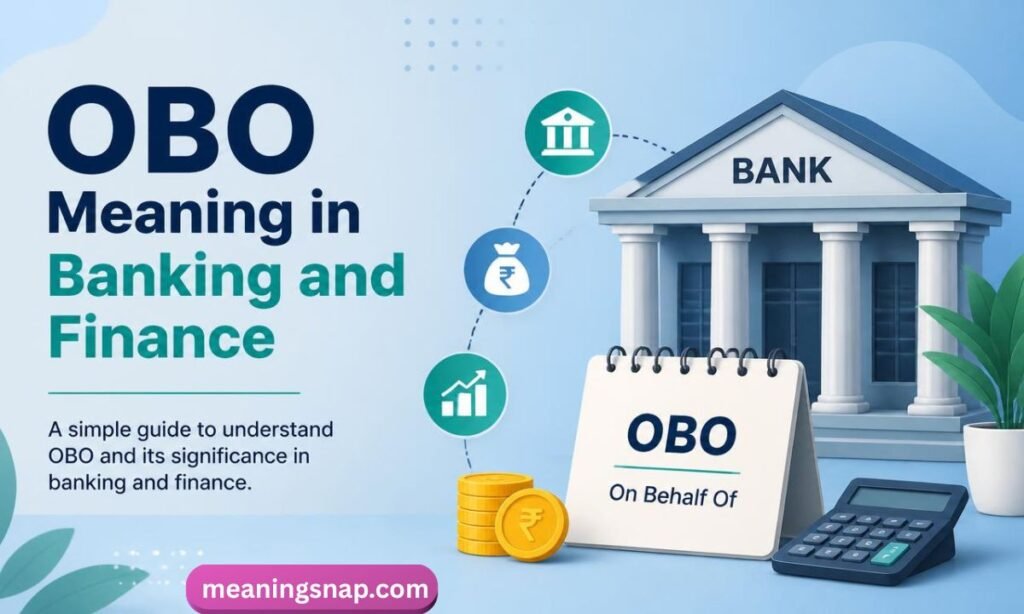
Banking and payments use OBO in a more specific way than a typical office email does. A treasury check or wire transfer made out “John Doe OBO Mary Smith” tells the bank the payment is being sent by John, on behalf of Mary, who is the actual intended party. Financial institutions rely on this notation to keep a clear paper trail of who authorized a transaction and who it was ultimately meant for, which matters for compliance and fraud prevention.
Payment networks have built this concept into their infrastructure directly. Under international messaging standards like ISO 20022, an “on-behalf-of” transaction distinguishes between the party initiating a payment and the actual debtor or creditor behind it, so banks trace exactly who’s responsible for the funds at each step. This shows up in everyday banking too, such as when a financial advisor moves funds OBO a client, or a payroll company processes wages OBO the business that employs the workers.
OBO Meaning in Banking: OBO vs FBO Accounts
Banking professionals sometimes draw a line between OBO accounts and the more familiar FBO, or “For Benefit Of,” accounts. An FBO account holds funds a bank manages for the benefit of a customer, common in fintech partnerships. An OBO arrangement, by contrast, generally describes a transaction carried out on a client’s behalf rather than a standing account structure, though the two terms get used loosely enough in casual banking conversation that the distinction isn’t always sharp.
OBO Meaning in Construction
Outside of sales and finance, OBO takes on a narrower meaning tied to a specific government body: the Bureau of Overseas Buildings Operations. This is the division of the U.S. Department of State responsible for planning, building, and maintaining American embassies and diplomatic facilities around the world. Contractors, architects, and engineers who work on U.S. embassy or consulate projects run into this abbreviation constantly, since OBO manages everything from initial design approval to long-term facility upkeep on those sites.
This meaning is far more niche than the sales or business versions, and it’s unlikely to come up outside of government contracting or international construction circles. If someone outside that industry sees OBO on a construction document, “Or Best Offer” or “On Behalf Of” are still the far more likely explanations.
OBO Meaning: Davido’s Nickname
Music fans searching for OBO have likely landed here because of Davido, the Nigerian Afrobeats star born David Adeleke. OBO is his well-known nickname, short for “Omo Baba Olowo,” a Yoruba phrase that translates to “Son of a Rich Man.” Davido has said publicly that he prefers OBO over other nicknames fans have tried to give him over the years, and it’s become closely tied to his public identity across his music, interviews, and social media.
This meaning has nothing to do with sales, business, or banking, it’s simply a stage name rooted in Yoruba language and Davido’s family background. Fans commonly use OBO as a hashtag or a shorthand way to refer to him online, which explains why the search shows up alongside far more transactional uses of the same three letters.
OBO vs Similar Selling Terms
Sellers have a handful of shorthand terms for pricing flexibility, and they don’t all mean the same thing. A seller picks the label based on how much room they want to negotiate, how fast they want the item gone, and whether they’d rather set the tone themselves or let buyers make the first move. Mixing these terms up leads to awkward offers or missed opportunities on both sides, so here’s a side-by-side look at how the most common ones compare.
| Term | Meaning | Negotiable? | Common Region |
|---|---|---|---|
| OBO | Or Best Offer | Yes | US |
| ONO | Or Nearest Offer | Yes | UK |
| Firm | Price is fixed | No | US/UK |
| Make Offer | No listed price, buyer proposes one | Yes | US |
| Asking Price (no tag) | Listed price with no flexibility stated | Usually not, unless buyer asks | US/UK |
OBO and ONO work almost identically, coming from different sides of the Atlantic, and either one tells you the seller expects a bit of back and forth. “Firm” is the clearest signal a seller will ever give: don’t bother negotiating, the number is final. “Make Offer” flips the whole process around, since there’s no starting number at all, and the buyer sets the first figure instead of reacting to one. Knowing which label you’re dealing with saves an awkward exchange before it even starts, and it tells you exactly how much wiggle room to expect before you type a single word.
Read Also: SMD Meaning in Text: What It Means & How to Use It
Common Mistakes People Make With OBO
A handful of mix-ups come up again and again with OBO, and most of them are easy to avoid once you know what to watch for.
The biggest one is confusing the business meaning with the sales meaning. Someone sees “OBO” in a work email signature and assumes it has something to do with pricing or negotiation, when the sender is simply signing on behalf of someone else entirely and there’s no offer involved anywhere in the message.
On the seller’s side, a common mistake is writing OBO without a real price floor in mind. Listing something as OBO with zero idea of the lowest acceptable offer invites a flood of lowball messages that go nowhere and waste everyone’s time on both ends of the conversation.
Buyers stumble too, usually by treating OBO as permission to offer whatever number pops into their head first. A few habits worth avoiding:
- Sending a lowball offer with no context or reasoning attached
- Assuming OBO means the seller is desperate and will take anything
- Skipping a quick check on the item’s actual market value before making an offer
- Confusing OBO with “Make Offer,” which has no starting price at all
Sellers run into trouble too when they write OBO but respond to every offer, even fair ones, with a flat no. That defeats the entire purpose of listing something as negotiable in the first place, and it tends to frustrate buyers enough that they walk away from the deal instead of countering again.
Another overlooked mistake happens when buyers skip research entirely and offer based on gut feeling alone. A quick look at what similar items sold for recently gives an offer real weight, and it turns a random guess into a number the seller is likely to take seriously.
Frequently Asked Questions
What does OBO mean in selling?
OBO stands for “Or Best Offer.” It means the listed price isn’t final, and the seller stays open to reasonable offers below it, especially from buyers who explain their number and act ready to close the deal.
What does OBO mean on Facebook Marketplace?
Same meaning as everywhere else on the platform: Or Best Offer. Sellers add it to listings to invite negotiation on the price shown, and it works the same way whether the item is furniture, electronics, or a car, with all the back and forth happening through direct messages.
What does OBO stand for in emails or business documents?
In that context, OBO means “On Behalf Of.” It shows up near a signature when one person is signing or acting with another person’s or company’s authority, and it has nothing to do with pricing or negotiation of any kind.
Is OBO the same as ONO?
Yes, functionally. ONO stands for “Or Nearest Offer” and is the UK version of OBO. Both invite offers below the listed price, and buyers on either side of the Atlantic should treat them exactly the same way when deciding what to offer.
Is it okay to offer way less than the OBO price?
Offers under 30 to 40 percent of the asking price usually get ignored outright, since most sellers already priced the item close to what they’d genuinely accept. Sticking closer to 10 to 20 percent below asking, with a short reason attached, tends to get a real response instead of silence.
What does OBO mean in banking?
In banking, OBO means “On Behalf Of.” It shows up on treasury checks, wire transfers, and payment records to show that a transaction was carried out by one party for the actual intended recipient, keeping a clear trail of who authorized the funds.
What does OBO stand for in construction?
In construction, OBO usually refers to the Bureau of Overseas Buildings Operations, the U.S. State Department division responsible for building and maintaining American embassies abroad. This meaning is mostly limited to government contracting and international diplomatic projects.
Final Words
OBO isn’t complicated once the context clicks into place. See it next to a price, and it’s an open door to negotiate. See it next to a signature, and it’s someone acting on another person’s behalf. The two versions never cross paths, so a quick glance at what’s sitting beside those three letters tells you everything you need to know. Next time OBO shows up in a listing or a text, you’ll know exactly what to type back.

Alex Morgan is a writer focused on explaining slang, words, phrases, acronyms, and popular expressions in a simple and easy-to-understand way. Through clear explanations and helpful examples, Alex helps readers quickly understand what words and phrases mean and how they’re commonly used.