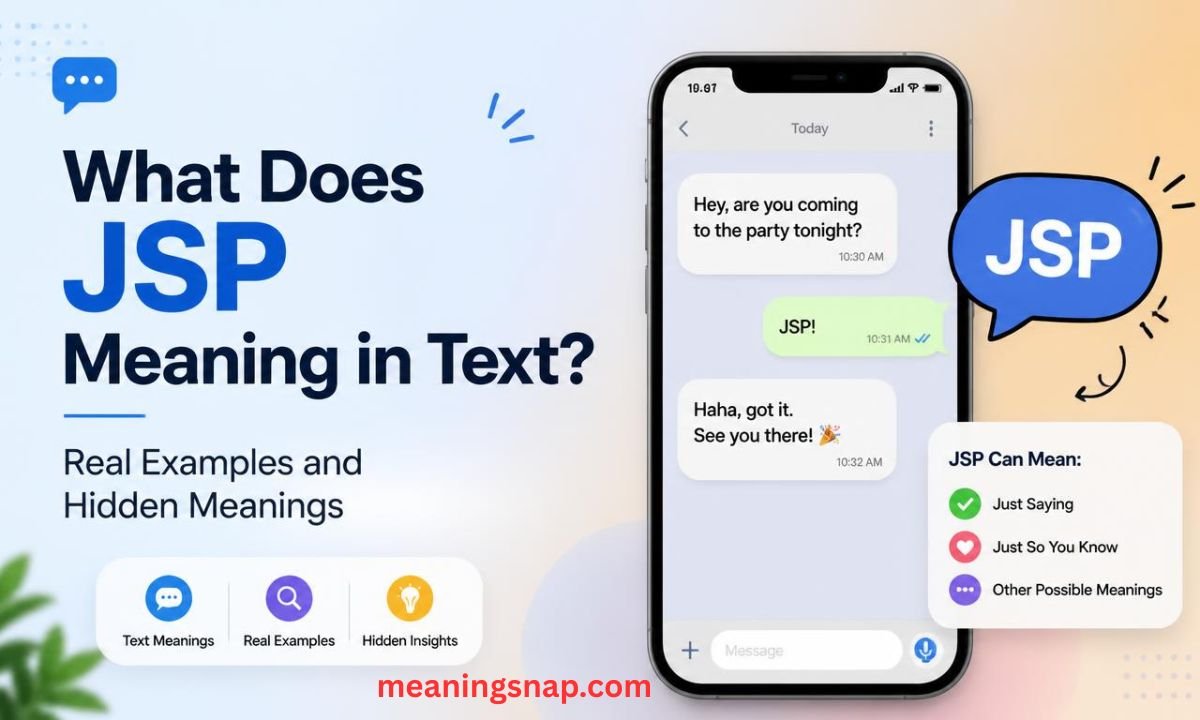
Your friend sends one word after a joke that landed a little too hard: “jsp.” No punctuation, no emoji, just three letters sitting there on their own. You stare at your phone for a second, half amused and half confused, because you’ve never seen it broken down before and you’re not entirely sure if you should laugh or apologize. That’s usually how people first bump into JSP meaning in text, and it turns out to be a bit more layered than it looks at first glance.
The short answer is JSP almost always means “just playing.” Sometimes it means “just saying” instead, and once in a while, depending on who’s texting you, it means something else entirely. It shows up in DMs, comment sections, and group chats so often that most people have seen it a hundred times without ever looking up what it stands for. Here’s what’s going on with this one, piece by piece.
JSP Meaning, Fast
Quick Answer: JSP most commonly stands for “just playing.” People drop it right after a joke, a tease, or a comment that lands harsher than intended, as a way of saying “I wasn’t being serious.” The second most common reading is “just saying,” used to tack a casual opinion onto a message without sounding like you’re picking a fight.
Both meanings work the same basic way. They soften whatever came right before them. If someone texts “you’re the worst jsp 😂” the jsp is doing the heavy lifting, turning what looks like an insult into a joke between friends. Context and tone, mostly the emoji or the lack of one, usually make it obvious which version is in play.
There’s a simple way to check it yourself. Read the sentence right before the jsp on its own, without the abbreviation attached. If it sounds like a joke or a tease, jsp is confirming that. If it sounds more like an opinion or observation, jsp is softening that instead. Either way, the JSP meaning in text almost never changes the actual content of the message, just how you’re supposed to take it.
A message like “you’d lose that fight jsp” reads completely differently depending on who’s sending it and what came before it in the conversation. Between friends already roasting each other, it’s a punchline. Sent cold, without any joking already established, it can just sound like an insult with a weak apology attached. The word only works as well as the setup around it.
Read Also: SMD Meaning in Text: What It Means & How to Use It
Where JSP Comes From
Text abbreviations like JSP exist because typing strips out everything that makes tone obvious in person. No face, no voice, no half second pause before the punchline. LOL, JK, and lmao all showed up to solve that exact problem, and JSP followed the same pattern later on, as shorthand for “just playing.”
Here’s the part that trips people up. JSP isn’t only English internet slang. In French, “je sais pas” (the casual version of “je ne sais pas,” meaning “I don’t know”) gets shortened to jsp in everyday texting, the same way English speakers shorten “I don’t know” to idk. Two unrelated phrases, from two different languages, landed on the same three letters purely by coincidence.
That overlap explains why some people online insist JSP means one thing while others swear it means something else. Both groups are right, they’re just talking about different conversations. Texting an English-speaking friend, “just playing” is the safe bet almost every time. Chatting with someone who mixes in French, or scrolling through a French-language comment section, and jsp is far more likely to mean “no clue.”
Social media sped up how fast a term like this spreads. An abbreviation that once stayed inside one friend group or one country now shows up in comment sections everywhere within weeks, which is exactly why collisions like the JSP meaning splitting into two unrelated definitions happen more often than they used to.
It helps to compare JSP to a word that changed meaning slowly over decades versus one that split in two almost overnight. Slang used to spread through word of mouth, one school or one city at a time, picking up small regional differences along the way. JSP skipped that slow spread entirely. It jumped straight from small pockets of texters into global comment sections, carrying two unrelated definitions with it the whole way, which is part of why the confusion around it feels so common today.
JSP vs JK vs JS: What’s Different
JSP, JK, and JS get used in similar spots, which is exactly why people mix them up. They’re not interchangeable though. Each one carries a slightly different energy, even when they show up in almost identical sentences.
Here’s how the three compare side by side.
| Abbreviation | Full Meaning | Tone | Best Used When |
|---|---|---|---|
| JSP | Just playing | Playful, keeps the joke going | Right after a tease you want to keep light |
| JK | Just kidding | Neutral, closer to a correction | When you need to clearly cancel what you just said |
| JS | Just saying | Casual, low-stakes opinion | Adding a side comment without starting an argument |
JK tends to shut a moment down. It reads as a clear “I didn’t mean that,” almost like hitting undo on your last message. JSP keeps the playful tone running instead of ending it, which is why it fits better in the middle of ongoing banter between friends who already joke around a lot.
JS works differently. It’s rarely attached to a joke at all. It shows up at the end of an opinion, something like “that outfit was a lot, js,” where the person wants to say their piece without sounding like they’re trying to start something.
Mixing these three up isn’t a huge deal between close friends who already know each other’s tone. The wrong pick can shift things more than expected with someone you don’t text often, though, so it helps to know the difference before you send it.
When in doubt, JK is the safest default with people you don’t know well. It’s the clearest of the three and leaves the least room for misreading. Save JSP for the friends who already joke around with you regularly, and save JS for opinions you want on record without starting a whole conversation about it.
Read Also: ICL Meaning: What It Really Means in Text & Social Media
JSP Meaning in Real Conversations
Reading a definition only goes so far. Seeing the JSP meaning play out in an actual conversation makes the tone click a lot faster than any explanation can, especially since the same three letters can shift from playful to sincere depending entirely on who’s typing them and what just happened right before.
Text message, teasing:
Maya: “You genuinely forgot my birthday, I can’t believe you” Jordan: “WHAT no I didn’t, I texted you at midnight!” Maya: “jsp 😂 I saw it, I just wanted to watch you panic for a second” Jordan: “You’re unhinged for that one”
Group chat, sarcastic:
Priya: “new fit check, be honest” Leo: “not the socks with sandals again” Priya: “wow ok” Leo: “jsp, you know I love it”
Instagram DM, sincere softening:
Sam: “ngl I think you talk too much in meetings sometimes, jsp” Aisha: “damn ok noted lol” Sam: “no but fr I mean it in a nice way”
Group chat, French usage:
Camille: “tu sais où est mon sac?” Théo: “jsp, check the kitchen, it might be by the door”
Casual, no emoji, more ambiguous:
Devon: “your plan sounds kind of chaotic jsp” Riley: “wow tell me how you feel” Devon: “lol I mean it’s giving unplanned, no shade”
Text message, dry sibling sarcasm:
Emma: “mom liked your post more than mine again” Owen: “jsp she’s just proud of you fr” Emma: “shut up 😭”
Each exchange shows a different shade of the same term. The Devon and Riley one, with no emoji attached, reads more ambiguous than the others, which is exactly why tone markers matter so much with a word this flexible. Add a laughing emoji and it softens instantly. Leave it bare and the reader has to guess.
JSP on TikTok, Instagram, and Snapchat
People searching for the meaning on a specific app usually want to know if it changes from platform to platform. It mostly doesn’t, but each app has its own flavor of how the term shows up.
| Platform | Where It Shows Up | Typical Use |
|---|---|---|
| TikTok | Comment sections, replies to jokes or challenges | Softens a teasing or sarcastic comment on someone’s video |
| DMs and comment replies | Follows a tease or a blunt opinion between friends | |
| Snapchat | Quick chat messages, often paired with a snap | Fast, disappearing context, tone leans even more casual than texting |
TikTok comments tend to use jsp the same way group chats do, right after a joke aimed at the creator or another commenter. On Snapchat, the disappearing nature of the app pushes people toward shorter, blunter messages overall, so jsp shows up bare, without an emoji, more often than it does on Instagram or in a regular text thread. None of that changes what the word means. It just shifts how often a reader has to guess the tone without extra context to lean on.
Read Also: WYA Meaning in Text: What It Really Means and How to Reply (2026 Guide)
The Other Meanings of JSP
Outside of texting, JSP means a few more things, depending entirely on who’s using it and where. None of them show up in a typical group chat, but they’re common enough in their own fields that a search for the term will surface all of them mixed together, which is exactly what makes JSP such a confusing acronym to look up cold.
The French phrase “je sais pas” is the one most likely to confuse an English speaker who stumbles across it. It translates to “I don’t know,” and gets typed as jsp constantly in casual French texting and comment sections, the same way idk gets used in English. A message like “jsp pourquoi il a fait ça” (I don’t know why he did that) has nothing to do with joking around.
In web development, JSP stands for JavaServer Pages, a technology used to build dynamic web pages on a server before they’re sent to a browser. It runs on the Java platform and lets developers mix Java code into HTML to generate pages that change based on user input or data. Files built this way generally use the .jsp extension, and the server compiles them into servlets behind the scenes before anything reaches a visitor’s browser. It’s a real, established term in programming circles, and it has nothing to do with texting slang whatsoever.
Two more industries use the same three letters for something completely different. In firearms and hunting circles, JSP stands for Jacketed Soft Point, a bullet with an exposed lead tip inside a metal jacket, built to expand on impact. It’s standard terminology on ammunition listings, and it has no connection to any meaning above it. In the UK, JSP also refers to a Joint Service Publication, an official Ministry of Defence document that sets policy and guidance across the British Army, Royal Navy, and Royal Air Force. It’s a formal term used almost exclusively by people who work in or around the UK armed forces.
None of these meanings compete with each other in daily use. Context makes the right one obvious almost instantly. A friend joking around means “just playing.” A French speaker asking a question means “I don’t know.” A developer’s forum post means JavaServer Pages. A hunter comparing ammo or a UK defence contractor citing a policy document means something else again. The overlap is a coincidence of letters, not a shared origin, and native readers in each field rarely confuse their version with anyone else’s.
When JSP Doesn’t Land
JSP works well in casual, joke-friendly conversations. It works a lot less well anywhere the stakes are higher than a group chat roast.
Serious or emotional conversations are the biggest exception. If a friend is genuinely upset and the reply comes back as a joke followed by jsp, it can read as dismissive instead of playful, even when that’s not the intent. Timing matters as much as the word itself here.
Professional settings are another clear no. JSP doesn’t belong in a work Slack message, a client email, or anything a manager might read over. It reads as too casual, and for anyone unfamiliar with the term, it’s just confusing.
Texting someone outside your usual slang circle is worth a second thought too. A parent, a grandparent, or a coworker from a different generation might not know the term at all, and dropping it into a message meant to soften something can backfire when the softening part goes completely unnoticed. In those cases, spelling out “I’m just joking” does the job a lot more reliably than three letters ever do.
Here’s a sincere version, where jsp barely holds up:
Noah: “I think you should’ve told me sooner, jsp” Zoe: “I know, jsp, I was scared how you’d react”
In that exchange jsp is doing real emotional work, not comedy, which is a narrower use case than the joking version above. It can come across as minimizing a genuine concern if the other person isn’t in the mood for softeners. The safest rule: if there’s any doubt the other person will read it as playful, skip it and say what you mean directly instead.
Read Also: CFS Meaning: Text, Social Media & Chat Slang
Common Mistakes People Make With JSP Meaning
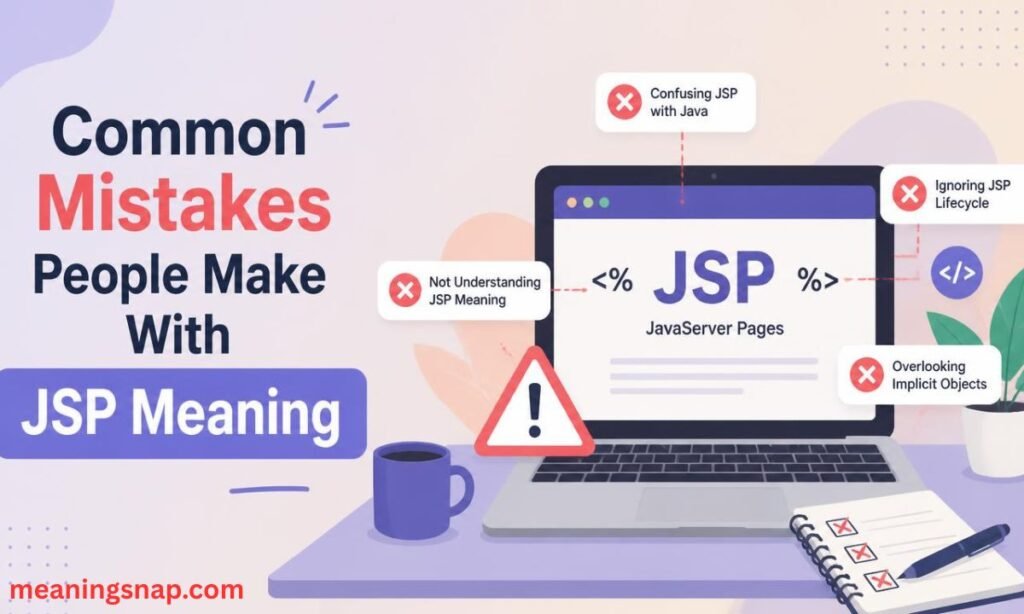
A handful of mix-ups happen constantly with this term, and most of them come down to skipping the context clues sitting right in front of you.
- Assuming JSP always means “just playing.” It doesn’t. Without more context, especially in French-adjacent chats, “I don’t know” is just as likely, and reading it as a joke in that case makes the whole message confusing.
- Confusing it with JK. They’re close cousins, but JK cancels a statement while JSP keeps the joke alive instead of shutting it down. Swapping one for the other changes how the whole exchange lands.
- Using it in professional messages. It reads as unprofessional fast, even to people who technically know what it means, and it can make a serious point sound like it wasn’t meant seriously at all.
- Assuming everyone knows the term. Plenty of people, especially outside Gen Z chat culture, have never seen it and will genuinely ask what you meant, which can stall a conversation right when you wanted it to feel casual.
- Treating it as a guaranteed tone fix. Adding jsp to a harsh comment doesn’t automatically make it land softer. Some comments need more than three letters to smooth over, no matter how much explaining follows.
Reading the full sentence around jsp, not just the abbreviation on its own, clears up most of these mix-ups on the spot. The word rarely carries meaning by itself. It leans entirely on whatever sits right next to it, which is the same trait that makes it useful in the right conversation and risky in the wrong one.
FAQs
What does JSP mean in texting?
In most English texts, JSP means “just playing.” People add it after a joke or tease to make sure the other person knows they’re not being serious.
Is JSP the same as JK?
Not exactly. JK (“just kidding”) cancels what was just said. JSP keeps the playful tone going instead of shutting the moment down.
Can JSP be used professionally?
No. It’s too casual for work emails, Slack, or any professional communication, and it can confuse coworkers who aren’t familiar with internet slang.
Does JSP always mean a joke?
No. It also means “just saying” when it’s tacked onto an opinion, and it means “I don’t know” in French slang.
What does JSP mean in technology?
In web development, JSP stands for JavaServer Pages, a technology for building dynamic web pages on a server.
Is JSP deprecated?
Not officially. JSP, now maintained under the Jakarta name, still gets updates as part of the Jakarta EE platform. Most teams building new projects reach for newer tools instead, so it’s better described as legacy than dead.
What is the latest version of JSP?
The most recent release is Jakarta Pages 4.0, part of Jakarta EE 11. It mostly cleaned up old code rather than adding new features, which fits with JSP’s current role as a maintained but aging technology.
What does JSP stand for in the military?
In the UK, JSP stands for Joint Service Publication, an official Ministry of Defence document covering policy and guidance for the armed forces. It has nothing to do with the texting meaning.
What does Urban Dictionary say JSP means?
The top entries match what’s covered here: “just playing,” the French “je sais pas,” and JavaServer Pages. User-submitted slang sites tend to confirm the same handful of meanings rather than add new ones.
Why do people use JSP instead of just saying what they mean?
It’s faster to type, and it softens a comment without needing a full sentence to explain the tone. That’s the same reason JK and lol stuck around too.
Is JSP rude to use?
Not on its own. It’s meant to soften a comment, not sharpen it. It can still land wrong if the joke underneath it was harsh to begin with, since jsp softens tone, not content.
What does “I’m jsp” mean?
Said on its own, “I’m jsp” works as shorthand for “I’m just playing” or “I’m just joking,” usually right after someone reacts to a comment like it was serious. It’s the same meaning as the tag-on version, just used as a standalone reply.
Does JSP mean something different coming from a girl?
No. The meaning doesn’t shift based on who sends it. What changes the read is the relationship and the message it’s attached to, a flirty tease between people who like each other versus a casual joke between friends, not the gender of the sender.
Does anyone still use JSP?
Yes, as texting slang it’s still common, especially in casual group chats and comment sections. The Java meaning is the one fading, since most developers now reach for newer frameworks.
Bottom Line
Next time “jsp” shows up in your texts, you’ll know exactly which version you’re dealing with, whether it’s a friend keeping a joke alive, someone softening an honest opinion, or a French speaker shrugging through a group chat. The tone around it, an emoji, the sentence before it, the person sending it, will tell you almost everything you need to know before you even reply. Three letters, a few different meanings, and now, zero confusion.

Alex Morgan is a writer focused on explaining slang, words, phrases, acronyms, and popular expressions in a simple and easy-to-understand way. Through clear explanations and helpful examples, Alex helps readers quickly understand what words and phrases mean and how they’re commonly used.