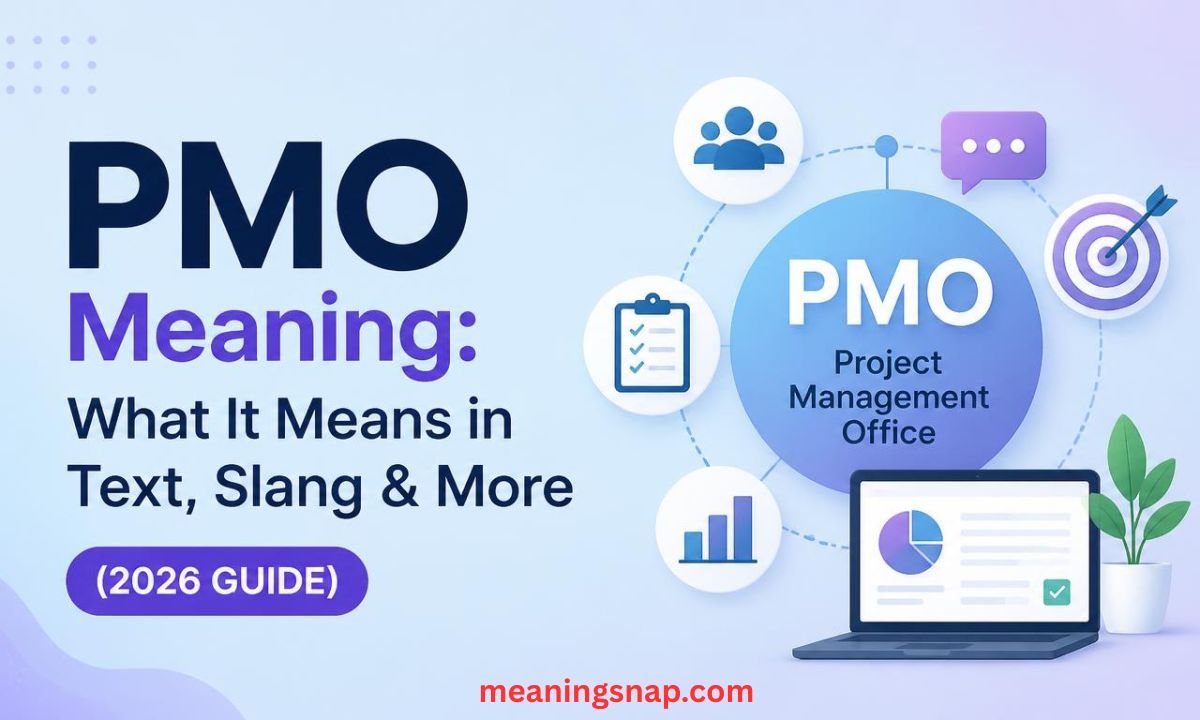
Your friend texts “the wifi keeps cutting out, it’s pmo fr” and you just stare at your phone. Good? Bad? Mad at you? Then someone comments “pmo with that playlist” on TikTok, and suddenly it sounds like a compliment. The PMO meaning flips depending on who’s typing it, and getting it wrong makes you look a little lost in the group chat.
This tiny three-letter acronym carries at least three real definitions, from pure frustration to a favor request to actual office jargon. Here’s how to tell them apart, with real examples so you never send the wrong vibe again.
What Does PMO Actually Mean?
The PMO meaning depends entirely on where you saw it and who sent it, which is exactly why it trips people up so often. There’s no single official definition. There are three or four common ones floating around different corners of your phone, and they don’t share much in common besides the same three letters.
Quick Answer: PMO usually means “pissing me off” (frustration) or “put me on” (asking for a recommendation). Less often, it means “Project Management Office” in work settings, or “private message only” in gaming spaces. Context decides which one you’re looking at.
The most common meaning right now, especially in comment sections and group chats, is “pissing me off” or “piss me off.” People use it to vent about something annoying, and it’s rarely as serious as it sounds. The second most common meaning is “put me on,” slang for asking someone to hook you up with something good, like a song, a show, or a new spot to eat. Less common but still real: PMO shows up as shorthand for “Project Management Office” in business emails, and in some gaming and Discord communities, people use it to mean “private message only.”
Trying to guess the PMO meaning from the acronym alone is basically impossible, since none of the four options look or sound more likely than the others out of context. None of these four meanings overlap much, which is what makes PMO slang so confusing without context. A single text with no other clues could genuinely go either way. Someone typing just “PMO” with no punctuation and no emoji gives you almost nothing to work with.
The trick is reading the full sentence around it, not the acronym in isolation. Once you know what to look for, figuring out which PMO meaning applies takes about two seconds, and it becomes second nature the more you see it used across different apps and conversations.
This is really just how modern internet culture works. Slang terms rarely stay locked to one definition once enough people start using them differently. PMO happened to land on two unrelated meanings that both caught on at scale, so now the acronym does double duty depending entirely on setting.
Read Also: What Does JSP Meaning in Text? Real Examples and Hidden Meanings
Where Did PMO Come From?
PMO didn’t come from one place. It grew out of two separate slang traditions that happened to land on the same three letters, which is part of why the definitions feel so unrelated to each other.
The “Piss(ing) Me Off” Origin
This version is standard texting shorthand, the same family as smh, wtf, and idc. As typing got faster and character limits got tighter on platforms like Twitter, full phrases got clipped down to their first letters. “Pissing me off” turned into PMO somewhere in early texting and forum culture, long before TikTok existed.
Gen Z revived and popularized it in the 2020s, mostly to complain about small stuff in a way that reads as funny rather than genuinely upset. It fits into the same bucket as other frustration acronyms that trade a full sentence for something faster to type and quicker to read in a group chat, and it spread the same way most text abbreviations do, through repetition in comment sections until it just became normal.
The “Put Me On” Origin
This one has deeper roots. “Put me on” comes out of hip-hop and AAVE (African American Vernacular English), where it originally meant something closer to “give me my start,” the kind of thing an artist says about a mentor who helped them break into the industry. Rappers used the phrase in lyrics and interviews to talk about putting fans onto new music, new artists, or new opportunities. Social platforms picked it up from there.
TikTok pushed it further into the mainstream, and by the 2020s “put me on” had loosened from its original meaning into everyday slang for asking someone to share a recommendation, whether that’s a song, a movie, a podcast, or even a job lead. That shift, from a phrase about mentorship to a phrase about casual recommendations, is a pretty normal path for internet slang to take once it leaves its original community and spreads across wider social media.
PMO as “Pissing Me Off”
This PMO meaning dominates casual texting more than any of the others, so it’s worth learning first. This is the version you’ll run into most in casual texting and comments. When someone types PMO on its own or right after something specific, they’re almost always venting, not asking for anything, and the annoyance is usually small enough not to matter an hour later.
What It Looks Like in Real Texts
Here’s how this shows up in an actual conversation:
Text 1:
“the printer jammed again right before my meeting, pmo so bad rn” “lol classic. deep breaths”
Text 2:
“traffic on the highway is pmo today, been stuck for 40 min 😭”
Text 3 (Twitter/X reply):
“airline lost my luggage AGAIN this year, this is so pmo, third time”
Example
Someone posts a TikTok caption that reads “when your order gets cancelled 5 minutes before it arrives, this pmo,” paired with a dramatic reaction clip. No one watching thinks they’re actually furious. It’s exaggeration for comedic effect, and that’s the whole point of using it this way.
Why Gen Z Uses It for Small, Non-Serious Annoyances
The humor is the whole appeal here. PMO rarely describes real anger. It’s for minor inconveniences, cold coffee, a slow Wi-Fi connection, a friend showing up fifteen minutes late, the stuff that’s mildly irritating but not worth an actual argument. Pairing it with “fr,” “ts,” or a crying-laughing emoji softens it even more, turning a complaint into a bit rather than a real callout. That’s a big part of what separates this PMO slang meaning from just typing “I’m annoyed.” It carries tone, timing, and a wink that a plain sentence can’t quite pull off, and it works just as well in a text to one friend as it does under a public comment where strangers can see it.
Read Also: SMD Meaning in Text: What It Means & How to Use It
PMO as “Put Me On”
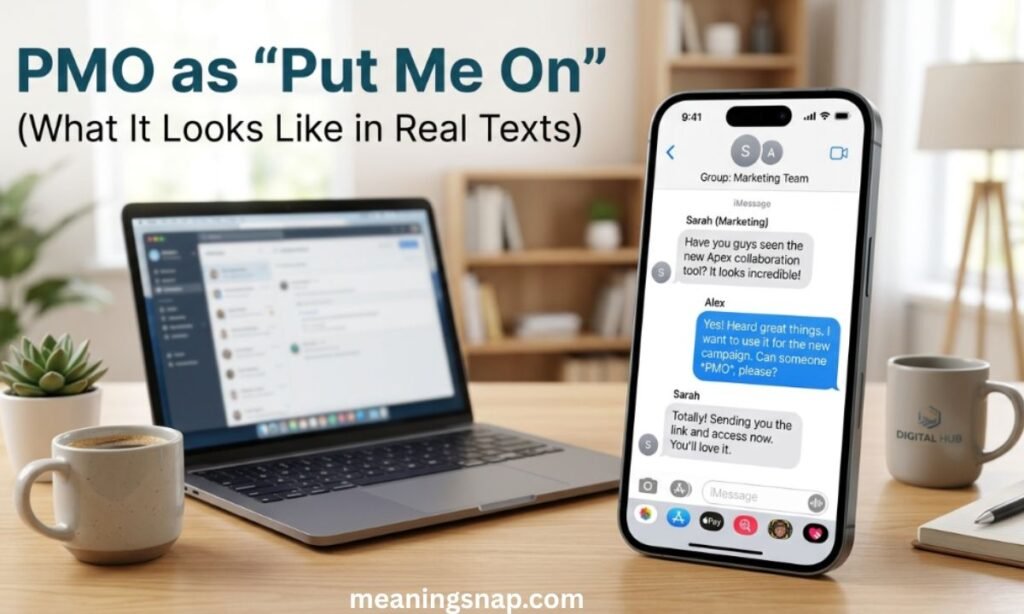
This second PMO meaning is the one most likely to make someone smile instead of side-eye their phone. It flips the emotional register completely. Instead of expressing frustration, it’s asking for access, a recommendation, or an introduction, and it usually comes from a place of genuine interest rather than annoyance.
What It Looks Like in Real Texts
This version tends to sound warmer and more casual, almost like a favor between friends:
Text 4:
“my sister pmo’d me to that true crime podcast and now I’m three seasons deep”
Text 5:
“omg where’d you get that jacket” “vintage store downtown, wanna go? I’ll pmo you to it”
Text 6 (DM):
“your Netflix queue always goes crazy, pmo to whatever you’re watching rn”
Example
Someone comments under an Instagram post of a new restaurant, “pmo pls, that plate looks insane.” They’re not upset at all. They’re asking to be let in on the recommendation, whether that’s the restaurant’s name, the artist behind a playlist, or a new movie worth watching. This is the meaning closest to plain old asking for suggestions or an introduction, just packaged into three letters instead of a full sentence. It shows up constantly in shopping-related comments too, where someone wants a product link or a brand name, and it works equally well for sharing information about small things, like a good coffee shop, or bigger ones, like a job opening at someone’s company.
Other Meanings of PMO You Might Run Into
These last two versions of the PMO meaning are far less flexible than the slang ones, since they’re tied to specific communities rather than general texting. Outside of slang, PMO shows up in a couple of other spaces where the tone is completely different from anything on TikTok or Instagram.
PMO at Work: Project Management Office
In business settings, PMO refers to a Project Management Office, a department that sets standards for how projects get planned, tracked, and delivered across a company. You’ll see it in phrases like “the PMO approved the new timeline” or “she works in the PMO,” and occasionally in a full sentence like “please send the updated budget to the PMO before Friday’s presentation.” This meaning has nothing to do with slang and shows up mostly in corporate emails, LinkedIn posts, presentations, and internal meetings, where it functions more like a formal job title or department name than an expression of any emotion.
PMO in Gaming and Discord: Private Message Only
In some gaming communities and Discord servers, PMO is also used to mean “private message only,” a request to move a conversation out of a public channel and into someone’s DMs instead. A trading post might read “selling extra skins, pmo for prices,” meaning the seller wants offers sent privately rather than posted for everyone in the server to see. Another example: “know a good build for this class? pmo me, don’t want to clutter the channel.” This usage is less widespread than the other three, and you won’t run into it much outside of gaming and trading spaces, but it’s real enough to be worth knowing if you spend time in those communities.
Read Also: ICL Meaning: What It Really Means in Text & Social Media
PMO Meaning at a Glance
Since PMO carries so many different meanings across texting, social media, and the workplace, it helps to see them side by side. Here’s a quick reference for how each one plays out in the wild.
| Meaning | Where You’ll See It | Example | Tone |
|---|---|---|---|
| Pissing Me Off | Texts, TikTok, Twitter/X, group chats | “ugh the wifi pmo rn” | Frustrated, often joking |
| Put Me On | Texts, Instagram, TikTok comments, DMs | “pmo to that show!” | Casual, friendly |
| Project Management Office | Work emails, LinkedIn, meetings | “The PMO approved the new timeline” | Formal |
| Private Message Only | Discord, gaming chats, forums | “pmo for trade details” | Neutral, practical |
Notice how the first two meanings both live in casual texting and social media, which is exactly why context matters so much more than the acronym itself. The last two are far more predictable, since they’re tied to specific settings where slang barely enters the picture. If you’re ever stuck, this table is a faster gut check than trying to remember the full PMO meaning from scratch every time.
Where PMO Actually Gets Used
Platform matters almost as much as the sentence itself. Certain apps lean hard toward one meaning over another, which is a useful shortcut before you type a reply.
On TikTok, both slang meanings show up constantly, frustration in reaction videos and rants, recommendation requests tucked under product hauls or outfit posts. Instagram leans harder toward “put me on,” especially in comments asking where an outfit, song, or location came from, since the platform is built around showing things off. Snapchat and everyday group chats carry both meanings depending on the topic, since these are the most casual, low-stakes spaces people use throughout the day. Discord and other gaming communities occasionally use the “private message only” version, alongside the usual venting use in general chat channels.
LinkedIn and work email are the outlier: PMO there almost always means Project Management Office, and slang PMO essentially never appears, since that kind of informal language would look out of place fast in professional communication. Even within texting apps, the same word can shift meaning depending on who’s on the other end. A close friend typing PMO rarely needs explaining, while a new coworker or an older relative might need the full sentence spelled out instead.
That last point matters more than people think. Dropping slang PMO into a professional email, a customer service message, or academic writing reads as unprofessional at best and confusing at worst, since coworkers or clients unfamiliar with texting abbreviations might not catch the meaning at all. Sticking to plain, formal language in those settings avoids the mix-up entirely and keeps the message clear for anyone reading it later.
Read Also: WYA Meaning in Text: What It Really Means and How to Reply (2026 Guide)
Common Mistakes People Make With PMO Meaning
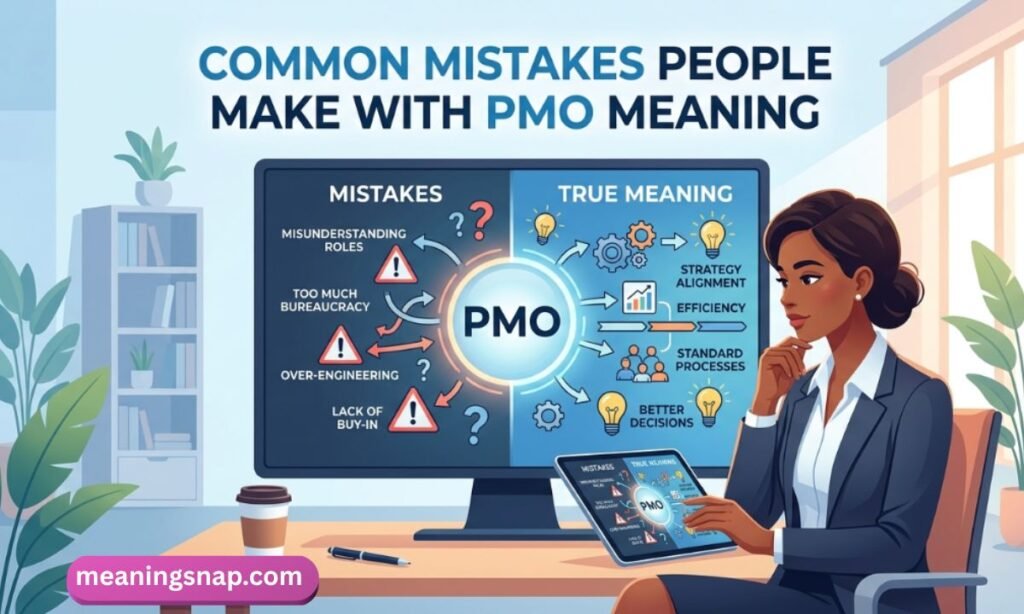
Most PMO mix-ups come down to reading the acronym without reading the room around it.
The biggest one is assuming PMO always signals frustration when it doesn’t. Someone typing “pmo to that recipe” isn’t complaining, they’re asking for it. Going the other direction, treating a frustrated PMO as genuine anger is its own mistake. Ninety percent of the time it reads closer to a shrug than an outburst, and responding with real concern to a joke about slow Wi-Fi can feel like an overreaction. A few other slip-ups worth flagging:
- Using slang PMO in professional communication. Save it for texts and social media, not client emails or academic writing.
- Missing the DPMO variant. DPMO means “don’t piss me off,” used more as a warning than a description of current frustration, as in “chill, dpmo.”
- Getting thrown by stacked acronyms. Gen Z often chains several together in one sentence, like “icl ts pmo fr ngl” (I can’t lie, this actually pisses me off, for real, not gonna lie). It looks intimidating at first glance, but it’s really just layered emphasis, one acronym building on the next.
If you’re not sure how to respond, mirror the energy of the message instead of reacting to the acronym itself. A frustrated PMO usually just wants a bit of solidarity, not a fix. A recommendation PMO wants an actual answer: a name, a link, a place. Reading the ask behind the acronym, rather than reacting to the letters on their own, is really the whole trick to using this slang well and avoiding an awkward reply.
Professional Alternatives to PMO
If you like the sentiment behind PMO but need something that works in a formal setting, swapping in a plain-language version keeps the same meaning without the slang. For the frustration meaning, “this has been frustrating” or “this keeps causing delays” lands the same point in polite, professional language. For the recommendation meaning, “could you point me toward that?” or “would you mind sharing that with me?” covers the same request as “put me on” without needing anyone to decode an acronym. These casual-to-formal swaps come in handy anytime you’re moving a conversation from a group chat into an email or a meeting, where slang alternatives just don’t carry the same weight.
Reading the words directly before and after PMO almost always clears up which meaning is in play, so when in doubt, look at the sentence, not just the letters.
Read More: CFS Meaning: Text, Social Media & Chat Slang
FAQs
Is PMO rude or offensive to use?
Not inherently. In casual conversation, PMO reads as mild frustration or a light-hearted complaint, not hostility. It only comes across as rude if the tone around it is genuinely aggressive, or if you use it in a setting where slang feels out of place, like a formal email or a conversation with someone who doesn’t know the term at all. Among friends who already understand the PMO meaning behind it, it almost always reads as harmless.
What does PMO mean specifically on TikTok?
On TikTok, the PMO meaning usually leans toward “pissing me off,” often used in captions or comments to react to something mildly annoying in a funny, exaggerated way. It also shows up as “put me on” under posts where someone is asking for a recommendation, so the specific video or comment thread usually makes the intended meaning obvious pretty quickly once you read the full caption or top comment.
Is PMO the same thing as IMO?
No. IMO stands for “in my opinion” and introduces a personal take on something. PMO doesn’t express an opinion at all, it expresses frustration or a request. Mixing them up is an easy typo to make since both are three-letter texting abbreviations, but they serve completely different purposes in a sentence and swapping one for the other would confuse most readers.
What does DPMO mean?
DPMO stands for “don’t piss me off.” It’s less common than plain PMO and works more like a warning or a boundary being set, rather than a description of existing annoyance. You’ll usually see it used semi-jokingly among friends, similar to how someone might say “don’t test me” without meaning it too literally.
Can PMO mean “Project Management Office” in a casual text too?
It’s possible but unlikely. If a coworker texts “PMO wants the report by Friday,” they’re referring to the department, and the surrounding business context makes that clear pretty fast. Outside of work-related conversations, though, the slang meanings are far more common, so a random text from a friend almost never refers to the office, and assuming otherwise usually just leads to a confused reply.
Final Thoughts
PMO is proof that three letters can carry four completely different jobs depending on where they land and who’s typing them. Now that you know the full PMO meaning behind each version, decoding it in the wild should take no time at all. Read the sentence around it, check which platform you’re on, and you’ll almost never guess wrong. Next time you see PMO in a text, you’ll know exactly how to reply.

Alex Morgan is a writer focused on explaining slang, words, phrases, acronyms, and popular expressions in a simple and easy-to-understand way. Through clear explanations and helpful examples, Alex helps readers quickly understand what words and phrases mean and how they’re commonly used.