Your friend posts a photo dump from brunch with three other people from your group chat. You open the comments and there it is: “GPI.” No caption, no explanation, three letters sitting there like a secret code. If you’ve run into GPI meaning in text and had zero idea what it stood for, you’re not alone. It looks technical, almost like an acronym from a textbook, but the real meaning is a lot more personal.
What Does GPI Mean in Text?
Quick Answer: GPI stands for Gracias Por Invitar, Spanish for “thanks for inviting me.” People drop it sarcastically online when they notice they weren’t invited to something.
The definition of GPI almost always comes down to that one phrase. It’s used the way you’d use a raised eyebrow emoji, not as a genuine thank you, but as a small, pointed comment about being left out.
Here’s the thing: nobody types GPI when they were actually included. If someone invites you somewhere and you show up, you don’t comment GPI under the photos afterward; you were there. The GPI abbreviation shows up specifically when someone posts about an event, trip, dinner, or hangout, and the person commenting wasn’t part of it.
So GPI usage works best as a sarcastic expression with a light social sting attached. It says “I saw this, I noticed I wasn’t included, and I’m going to mention it in a way that’s funnier than confrontational.”
How to Spot the Tone
Reading the meaning of GPI in text correctly comes down to context, not the letters themselves. A few signals help sort a joke from something with more edge:
- Emojis attached (😭, 💀, 😂) usually mean it’s playful
- No emoji, paired with a flat message otherwise, can mean a little more genuine annoyance sits underneath it
- Coming from a close friend, it’s almost always a bit
- Coming from someone you don’t know well, it tends to carry more weight
The short answer: GPI is rarely a real complaint. It’s a running joke that comment sections and group chats collectively agreed to keep alive, and most people using it know exactly how mild it reads.
Part of why the joke works is the built-in irony. Saying “thanks for inviting me” to someone who did the opposite flips the phrase on its head, and that flip is the entire punchline. Compare it to sarcastic phrases in English, like replying “love that for you” when you clearly don’t. GPI runs on the same mechanism, just borrowed from a different language.
Read Also: LMS Meaning: What Does LMS Mean in Text? Slang Meaning & Examples
Why GPI Reads as Funny, Not Rude
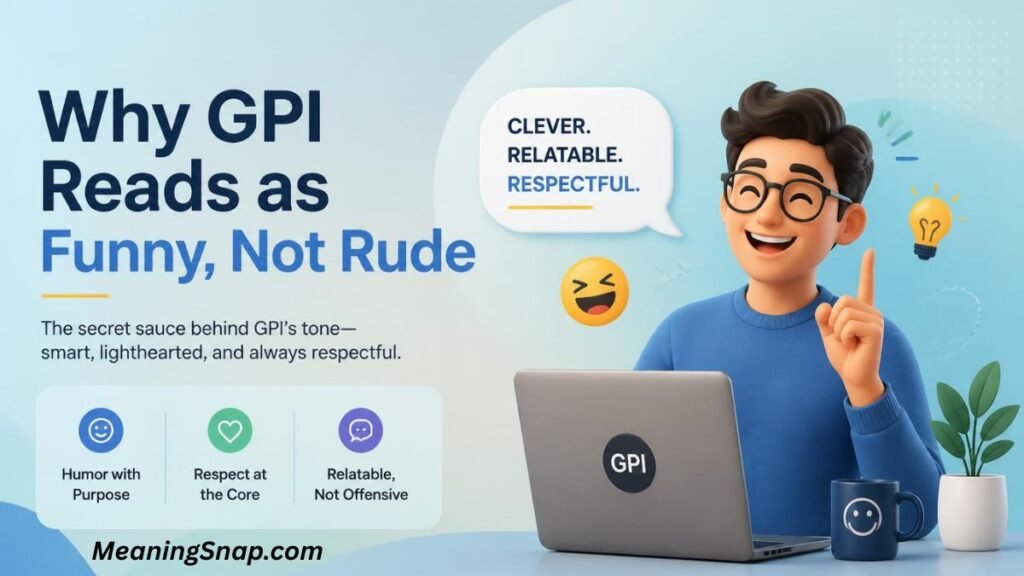
GPI meaning in text funny is a real search for a reason. Most people find it amusing rather than harsh, and that comes down to how small the “offense” is. Nobody dropping GPI actually thinks the poster owes them an apology for a taco run or a Saturday hangout.
The humor sits in the exaggeration. Treating a minor, harmless thing like a personal slight is a familiar internet comedy setup, and GPI plays right into it. A reply like “GPI, I’m telling my therapist about this” leans into the joke on purpose, stretching a tiny grievance into mock drama. That gap between the actual stakes and the dramatic reaction is what gets the laugh.
GPI Meaning in Spanish
In Spanish, gracias por invitar reads plainly. Said with sincerity, it just means “thanks for inviting,” the kind of thing you’d say leaving someone’s dinner party. Attach it to a screenshot of an event you weren’t part of, and the same three words flip into a joke instead.
A quick example: your cousin texts “fuimos a la boda ayer, estuvo hermosa” (we went to the wedding yesterday, it was beautiful). You reply “wow, GPI 🙃.” Same phrase, opposite intent.
GPI Meaning in English
Translated directly, GPI meaning in English comes out to “thanks for inviting me.” English speakers who use the abbreviation usually know that one phrase without necessarily speaking Spanish otherwise, similar to how words like “siesta” or “fiesta” get borrowed into English on their own.
An English-only version of the same joke looks like this:
Text 1: “we went axe throwing last night lol”
Text 2: “GPI, guess I wasn’t cool enough 😂”
Where GPI Comes From
The GPI abbreviation isn’t new. Gracias Por Invitar has existed as an everyday Spanish phrase for a long time, used sincerely when someone genuinely wants to say thanks for an invite. The sarcastic, internet-slang version is the newer part.
This is a Spanish phrase rooted in bilingual internet culture, not a random string someone invented for a meme. It gained traction first in Spanish-speaking communities across Mexico and other parts of Latin America, where dropping “GPI” under a friend’s party post has been a running bit for years. Turns out, sarcasm about missing the guest list translates pretty easily across language barriers, which is part of why it spread so quickly once English-speaking users caught on.
Bilingual users, especially teens and young adults active on TikTok, tend to be the bridge. A bilingual friend uses it in a group chat, someone asks what it means, and now it’s in rotation with people who don’t speak a word of Spanish beyond that one phrase. TikTok creators explaining Spanish texting culture and Spanish abbreviations to English-speaking audiences sped this up further, turning GPI into one of those terms people pick up from a thirty-second video rather than a classroom.
The result is a term with real linguistic roots that gets used pretty loosely now by people with no connection to Spanish-speaking culture at all. That pattern shows up constantly in digital culture. Slang tied to one language rarely stays contained once short-form video gets involved, and GPI followed the same path plenty of Spanish texting culture terms have taken before it, moving from group chats to comment sections to explainer videos in a matter of months. The origin matters less over time than the job the term does inside a chat.
Also Read: NMMS Meaning in Text: What It Really Means in Messages & Social Media
GPI Meaning in Text: What Urban Dictionary Says
Urban Dictionary’s earliest entry for GPI goes back to 2018, well before the term picked up its recent TikTok wave. It matches the sarcastic definition covered above almost exactly: a comment left under someone else’s post about a party, wedding, or get-together the commenter wasn’t invited to.
That timing matters for anyone wondering whether this is a brand new invention. The 2018 date shows the sarcastic use has been sitting in casual online slang for years, quietly circulating in comment sections long before it became a widely searched term.
How People Use GPI in Real Conversations
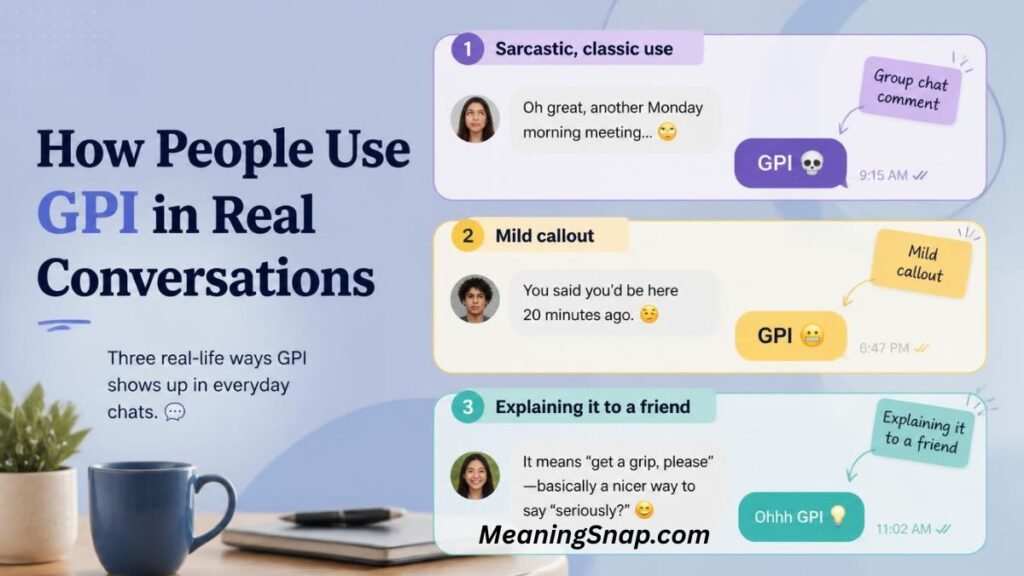
GPI usage today lives mostly in comment sections, DMs, and group chats. It shows up most under TikTok comments and Instagram comments, especially on posts that show a group of people clearly having a good time without you. WhatsApp group chat threads and Snapchat see plenty of it too, usually right after someone drops photos from a trip or dinner the rest of the group wasn’t part of.
It’s not limited to friend groups either. GPI turns up in dating app conversations, when someone shares a story about a night out and the person on the other end jokes about not being invited. It works as a low-stakes way to flirt with a complaint without actually complaining.
You won’t find it in gaming communities or professional settings, at least not with this meaning. Drop GPI in a workplace Slack channel and it would read as a stray acronym rather than a joke, since workplace communication doesn’t share the same cultural reference point as a friend’s comment section. The slang stays inside social spaces, casual DMs, and personal chats, not the places where formal or professional communication happens.
Here’s how that plays out in real digital conversations, across a few different tones:
Sarcastic, classic use:
Text 1: “just got back from Sarah’s engagement party, the food was unreal 😭”
Text 2: “wait what party?? GPI”
Playful, between close friends:
Maya: “we grabbed tacos after practice, you should’ve come”
Jordan: “GPI 😂 next time text me first”
Group chat comment, mild callout:
Comment on a trip photo dump: “gpi, y’all didn’t even tag me in the story 💀”
Sincere confusion, someone new to the term:
Text 1: “she keeps commenting GPI on my posts, is she mad at me?”
Text 2: “no lol it’s a joke, it means thanks for inviting me but sarcastic. she’s messing with you”
Explaining it to a friend:
Text 1: “what does gpi mean, my cousin keeps texting it”
Text 2: “it’s spanish, gracias por invitar. means she noticed she wasn’t invited to something lol”
Across all five, the pattern holds. Someone posts or mentions an event. Someone else, who wasn’t there, drops GPI as a mix of humor and a small nudge that says “next time, include me.”
GPI Meaning Slang on TikTok
TikTok is where a lot of English-speaking users first run into GPI, usually in the comment section under a video rather than the video itself. Squad content, get-ready-with-me clips, and trip recaps draw it out fast, especially when the video makes a group hangout look like a good time.
A typical example: someone posts a duet or a “outfit check before the party” video with friends. A comment underneath reads “not y’all looking cute without me, GPI 💀.” The video itself doesn’t need to say anything about being left out. The comment section supplies that on its own.
What Does GPI Mean on Snapchat?
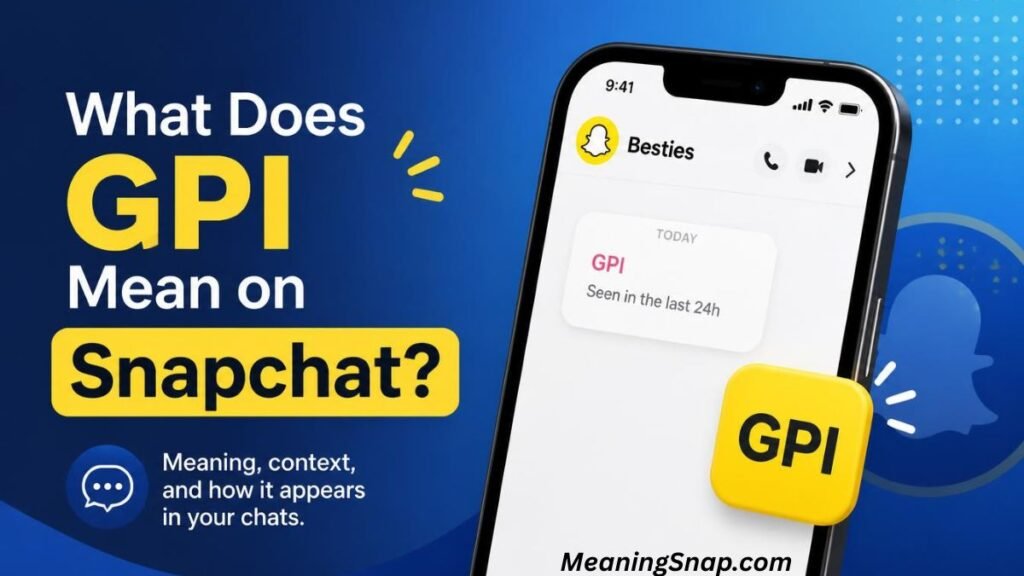
On Snapchat, GPI shows up in a more private version of the same joke, usually in reply to a story rather than a public comment thread. Since Snapchat stories disappear and mostly reach close friends, the tone tends to run a little more personal than a TikTok comment from a stranger.
A typical exchange looks like this:
Snap story: friend at a concert with the group
Reply: “GPI, guess I’ll just stay home then 😭”
Same joke, same sarcasm, just delivered one-on-one instead of out in a public comment section.
Does GPI Mean Anything Else? (Outside of Slang)
Outside of texting, the GPI acronym has several legitimate, well-documented meanings across totally different fields. None of them have anything to do with a missed invite, so context does most of the work here. If GPI shows up in a news article, a research paper, or a piece of technical documentation instead of a comment section, it almost certainly points to one of these instead of the slang.
In global affairs, GPI usage shifts completely. The Global Peace Index ranks countries by relative peacefulness and shows up regularly in news coverage and policy research, nowhere near a group chat. In electronics and hardware design, General Purpose Input refers to an input pin on a circuit board or integrated circuit, a basic building block in embedded systems that engineers configure at runtime. That usage lives in technical documentation and professional communication among engineers, never in casual texting.
In biochemistry and cell biology, Glycosylphosphatidylinositol, usually shortened to a GPI anchor, is a glycolipid molecule that attaches certain proteins to the outside of a cell membrane. It’s an established term in immunology and biochemistry research, tied to protein anchoring on cell surfaces.
Medically, GPI points to an older clinical term tied to untreated syphilis, covered in more detail in its own section below.
In aviation, a Glide Path Indicator is a lighting system that helps pilots judge their approach and descent path during landing, especially common at helipads and smaller airports without a full instrument landing system.
Here’s how those compare at a glance:
| Field | What GPI Stands For | Where You’ll See It |
|---|---|---|
| Texting and social media | Gracias Por Invitar | TikTok comments, Instagram, group chats |
| Global affairs | Global Peace Index | News coverage, policy reports |
| Electronics and hardware | General Purpose Input | Circuit boards, embedded systems documentation |
| Biochemistry | Glycosylphosphatidylinositol | Immunology and cell biology research |
| Historical medicine | General Paresis of the Insane | Older medical literature |
| Aviation | Glide Path Indicator | Helipad and airport landing systems |
None of these technical meanings show up by accident in a text message. If a friend sends GPI, they mean the Spanish phrase, not an engineering term.
Read More: DBL Meaning: Definition, Abbreviation & Common Uses
What Does GPI Mean in School?

In an academic setting, GPI usually stands for Grade Point Index, and it’s genuinely different from a GPA. A GPA averages your grades across every term you’ve completed. A GPI, used by some colleges and universities, measures just one term, calculated by dividing the grade points you earned by the number of units you attempted that semester.
Here’s why the distinction matters: a student could post a strong GPI of 3.6 for the current semester while their overall cumulative GPA still sits lower at 3.1, dragged down by a rough term earlier on. Schools that track both use the GPI to flag academic standing term by term, rather than waiting for the cumulative average to catch up.
GPI Meaning in the Medical Field
In medicine, GPI historically stands for General Paresis of the Insane, an older term for a severe, late-stage neurological decline caused by untreated syphilis affecting the brain. It’s a term you’re far more likely to run into in older medical textbooks, case histories, or licensing exam material than in a modern doctor’s note, since it largely fell out of everyday clinical use once antibiotics made the underlying infection treatable.
A typical mention might look like this in older case literature: a patient’s progressive memory loss and personality changes get noted as “consistent with GPI,” pointing doctors toward the underlying, long-untreated infection.
Common Mistakes People Make With GPI
A few misunderstandings pop up around this term regularly.
Mistaking it for sincere thanks trips people up the most. Someone unfamiliar with the slang might read “GPI” as an actual thank you and reply with “you’re welcome,” which lands a little confusing for everyone involved. Miss the sarcastic meaning, and the whole exchange reads backward.
Confusing GPI with GPS is another one, especially on a small phone keyboard where the letters sit close together. Autocorrect doesn’t always catch it, and a mistyped “gps” instead of “gpi,” or the reverse, shows up more often than you’d think in casual texts.
People also assume GPI is a brand new invention, when Gracias Por Invitar has existed in everyday Spanish for a long time. The sarcastic, internet-slang version is newer, but the underlying phrase isn’t.
One more misconception worth flagging: assuming everyone knows what it means. GPI usage is heavily concentrated among younger, bilingual, or Spanish-adjacent internet users. Plenty of people, including English speakers outside that circle, see it and have no clue, which explains the steady stream of “what does this mean” searches.
Most of these misreadings happen for a simple reason: the letters alone carry zero context. A word like FOMO wears its meaning right there in the sound of it. GPI doesn’t. It only makes sense once someone explains it, or you’ve seen it enough times in comment sections to pick up the pattern yourself.
There’s also a smaller mistake worth mentioning: treating every GPI the same way regardless of who sent it. A close friend dropping GPI under your story carries a different weight than an acquaintance doing the same thing. Reading the relationship along with the message avoids most of the awkward misreads people run into.
Read Also: Tried and True Meaning: Definition, Examples & Usage
How to Reply to a GPI Comment
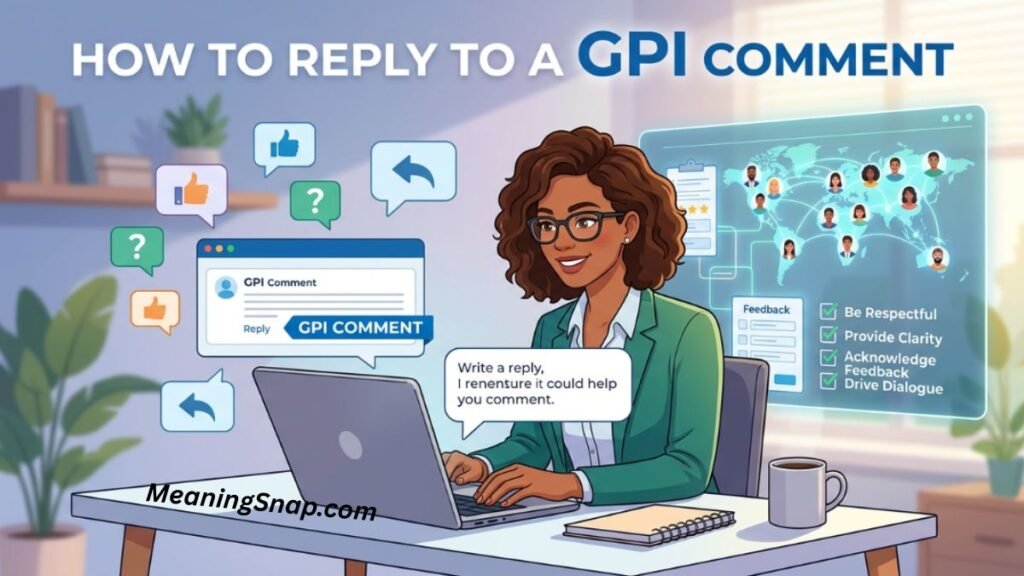
Replying to a GPI comment doesn’t need to be complicated. Since it’s almost always playful, matching that same lighthearted tone works best.
A simple acknowledgment does the job most of the time. Something like “lol next time I promise” or “GPI is fair, my bad” keeps the joke going without over-explaining yourself. If there’s a real reason the person wasn’t included (a small hang, limited spots, whatever it was), a quick explanation with a joke attached softens it without turning into a full apology.
If a comment feels sharper than usual, like real hurt sits underneath the joke, that’s worth reading differently. A short, sincere note lands better there than another joke stacked on top.
A few example replies depending on the tone you’re picking up:
- Playful: “GPI 😭 you know you’re always invited”
- Explaining: “it was a last minute thing honestly, next one you’re first on the list”
- Turning it into a plan: “say less, this weekend?”
- Sincere, if it seems to matter more: “didn’t mean to leave you out, let’s grab food soon”
One thing worth avoiding: ignoring it completely, especially in a group chat where other people saw the comment. A quick reply, even a one-word joke, closes the loop and keeps things friendly. GPI is built to stay low stakes. Treating the reply the same way keeps it that way.
It also helps to remember that most people commenting GPI aren’t looking for a formal invite in return right then and there. They’re looking for acknowledgment. A reply that shows you noticed the comment, whether that’s a joke, a laughing emoji, or an actual plan to hang out soon, covers what the moment calls for.
Frequently Asked Questions
What does GPI mean in a text message?
GPI meaning in text is almost always Gracias Por Invitar, a Spanish phrase meaning “thanks for inviting me.” People use it sarcastically when they notice they were left out of an event, trip, or hangout someone else posted about.
Is GPI always sarcastic?
Pretty much, yes. Genuine thanks for an invite doesn’t usually get shortened to GPI. The abbreviation exists specifically for the sarcastic version, used as a lighthearted callout rather than a real thank-you note.
Is it rude to comment GPI on someone’s post?
Not typically. Among friends, it reads as a joke rather than a jab, and most people who use it expect a joke back. It can land differently coming from someone outside your close circle, where the same three letters might carry a bit more weight.
How do you pronounce GPI?
It’s said letter by letter, “G-P-I,” not as one word. Same as texting abbreviations like ASAP or FYI, it stays in its acronym form even when read out loud.
Does capitalization change what GPI means?
No. Lowercase “gpi” and capitalized “GPI” mean the same thing. Lowercase tends to read a little more casual, while all caps can feel slightly more emphatic, but the meaning underneath stays identical.
Do all Spanish speakers use GPI the same way?
Mostly, yes, though it’s more of a casual internet habit than a formal expression. It’s especially common in Mexico and other parts of Latin America, and while it travels well across Spanish-speaking regions, it stays firmly in the category of internet slang rather than everyday spoken Spanish.
What does GPI mean outside of texting, like in medicine or aviation?
Outside slang, GPI carries several unrelated technical meanings, including General Paresis of the Insane in older medical literature, Glide Path Indicator in aviation, General Purpose Input in electronics, and Global Peace Index in global affairs reporting. Each field uses the acronym on its own, with no connection back to the texting slang.
Quick Answer Before You Go
GPI meaning in text, boiled down, is a Spanish phrase turned inside joke. Gracias Por Invitar, said with a wink, whenever someone notices they weren’t part of the fun. It isn’t an insult, it isn’t a real complaint, and it definitely isn’t asking for an apology tour. It’s more of a digital nudge, a way of saying “I see you, I wasn’t there, no hard feelings” in three letters instead of a full sentence.
Next time GPI shows up under one of your posts, or in a reply from a friend who spotted photos they weren’t in, you’ll know exactly what’s going on. Toss back a joke, make a plan for next time, and move on from there.

Alex Morgan is a writer focused on explaining slang, words, phrases, acronyms, and popular expressions in a simple and easy-to-understand way. Through clear explanations and helpful examples, Alex helps readers quickly understand what words and phrases mean and how they’re commonly used.