Someone in your group chat drops “YFM” right after venting about their terrible day, and you just sit there staring at the screen. You ask what it means and get a laughing emoji back instead of a real answer. That’s the thing about YFM: everyone types it, almost nobody explains it, and you’re left guessing whether it’s an insult, a compliment, or just noise tacked onto the end of a sentence. Here’s the short version: it’s way simpler than it looks. Once you know the YFM meaning in text, you’ll start noticing it everywhere, from Instagram comments to your cousin’s late-night texts.
Quick Answer: What Does YFM Mean in Text?
YFM stands for “You Feel Me,” a casual way of checking whether someone understands or relates to what was just said. Most of the time it isn’t a real question. It works more like a verbal nod tacked onto a sentence for emphasis, close to saying “know what I mean” out loud. You’ll spot the YFM abbreviation in text messages, social captions, and comments whenever someone wants a quick sense of agreement or shared understanding without spelling it all out. That’s the plain YFM meaning in text, and it rarely means anything deeper than “you get it, right?”
Where “YFM” Comes From
“You feel me” isn’t a texting invention. People have said it out loud in casual, spoken English for decades, especially within African American Vernacular English and hip-hop culture, where checking in on shared feeling mid-sentence is common. A rapper pauses a verse, asks “you feel me?”, and keeps going without missing a beat. It’s rhythm as much as it is meaning, a way of pulling the listener into the moment instead of just talking at them.
Texting eventually trimmed it down the way texting trims everything. Once messaging apps made typing speed and character limits matter, “you feel me” turned into the shorter YFM abbreviation, following the same pattern that turned “laughing out loud” into “lol” and “to be honest” into “tbh.” The phrase kept its original meaning. It just lost the vowels and the extra keystrokes along the way.
By the time TikTok and Instagram comments took over from flip-phone texting, YFM had already settled into everyday digital communication as shorthand for emotional understanding, not literal physical feeling. Nobody’s asking if you can feel something with your hands. They’re asking if you get it, if you’re picking up what they’re putting down, if there’s a relatable connection between what they said and whatever’s going on in your head too. That small shift, from a spoken phrase to a typed acronym, is basically the entire story behind the YFM meaning in text you see today.
It’s also worth pointing out that YFM never really replaced saying “you feel me” out loud. People still say the full phrase in conversation all the time, especially in the U.S., across English-speaking communities where the expression has been common for years. Texting just gave it a second, shorter life online, running alongside the spoken version instead of retiring it.
How People Actually Use “YFM” in Texts and Chats
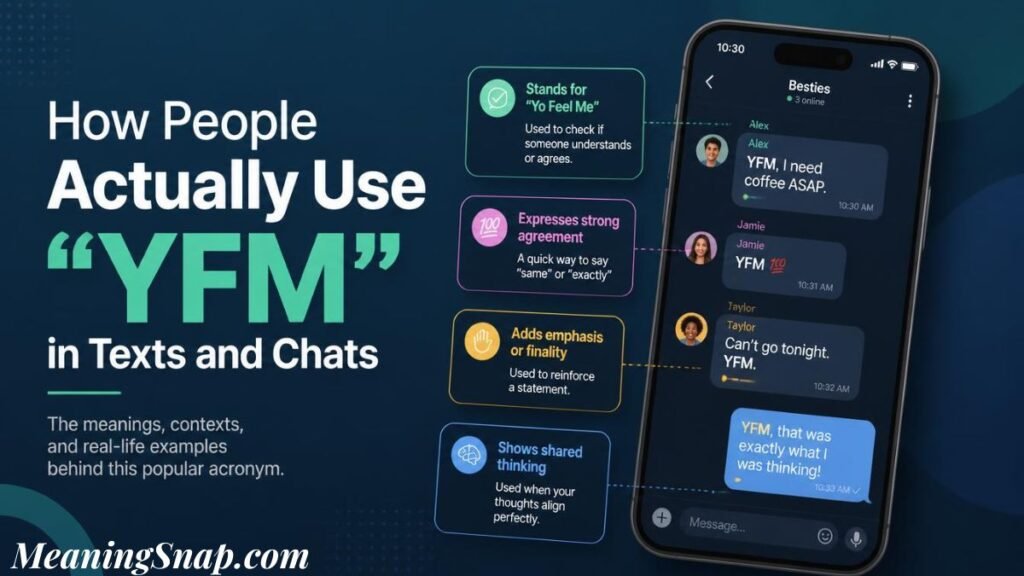
YFM shows up more as punctuation than as an actual question most of the time. Someone says something they feel strongly about, tacks on “YFM?” or just “YFM” with no question mark at all, and moves on without expecting a detailed reply. It’s less about getting an answer and more about confirming you’re both on the same page before the conversation keeps rolling.
The tone shifts depending on where you run into it. In personal chats with close friends, it often reads sincere, sometimes even a little vulnerable, especially when someone’s sharing something emotional or frustrating. In casual exchanges between acquaintances, or in gaming chats after a rough match, it leans more sarcastic or joking. On dating apps, it tends to show up when someone’s testing for a relatable connection early on, almost like a compatibility check dressed up as slang. A first-date story retold to a friend afterward often ends with a YFM too, less a question and more a way of saying “back me up here.”
It also shows up constantly in social captions, where someone posts about a universal frustration (Monday mornings, dating red flags, adulting struggles) and adds “YFM” instead of writing out a full caption explaining the joke. The acronym does the heavy lifting of saying “you already get this, I don’t need to spell it out.”
One thing worth flagging early: YFM almost never belongs in professional settings or formal writing. It sits firmly in casual tone territory, fine for texting friends or replying in a group thread, not fine in an email to your manager.
Platform also shapes how much weight the acronym carries. On WhatsApp and in direct texts, YFM usually caps off a personal thought shared with one specific person, so it tends to feel more sincere. On public social media like Instagram or TikTok, it’s doing a different job entirely, inviting strangers and followers to nod along with a shared experience rather than checking in on one friend’s reaction. Same three letters, slightly different purpose depending on who’s actually reading them.
What Does YFM Mean on TikTok, Instagram, and Snapchat?
The letters don’t change from app to app, but the way YFM gets used shifts a bit depending on where you’re scrolling. Here’s what to expect if you’re wondering what YFM means on TikTok, Instagram, or Snapchat specifically.
On TikTok, YFM shows up constantly in captions and comment sections under videos about universal frustrations, like early alarms, expensive groceries, or chaotic family group chats. It works as a caption-ending tag that invites everyone watching to relate at once, rather than a question aimed at any single viewer.
On Instagram, YFM mostly turns up in comments on relatable posts (moving out, breakups, big life changes) or in replies to close friends’ stories. It reads more personal there, since it’s usually one person responding directly to another rather than a caption meant for a wide audience.
On Snapchat, YFM tends to caption a photo or short video sent to a smaller, closer circle, closer to an inside joke than a public statement. Because Snapchat feels more private by design, the tone often leans sincere or self-deprecating instead of performative.
Across all three, the core meaning stays exactly the same. What actually shifts is the audience: a caption meant for followers reads differently than a comment meant for one specific friend.
Also Read: SH Meaning in Text: What It Really Means & How to Use It
Does “YFM” Mean Something Different From a Guy or From a Girl?
Short answer: no. YFM doesn’t carry a separate definition depending on who’s sending it. The meaning stays fixed at “you feel me,” checking for shared understanding. What actually changes from message to message is context, not gender.
When it comes to YFM mean in text from a guy, it usually functions the same way it does for anyone else, closing out a complaint, a joke, or an observation with a quick check for agreement. During a getting-to-know-you conversation or on a dating app, it can also double as a soft way of gauging compatibility without asking something more direct.
The same logic applies to YFM meaning from a girl. It isn’t inherently flirtier or more emotionally loaded coming from a girl than a guy. What actually signals interest or emotional weight is the sentence sitting right before the acronym, not the acronym itself or who happened to type it.
Reading too much into a sender’s gender usually leads to overanalyzing a pretty low-stakes piece of casual slang. The relationship, the platform, and the topic being discussed say far more than three letters ever could.
“YFM” in Real Conversations
Reading a definition only gets you so far. Seeing YFM used across different tones is what actually makes the YFM slang click.
- Text between friends after a bad day at work: “My manager threw me under the bus in the meeting, in front of everyone, YFM?” / “lmaooo yes, I’ve been there, that’s brutal.”
- Instagram comment on a friend’s moving-out post: “This is exactly how I felt leaving home the first time, YFM on all of this.”
- Sarcastic text about an early flight: “Waking up at 4am for a flight is SO fun, YFM?” / “no, I do not feel you at all, some of us like sleep.”
- Dating app message, early in a conversation: “I hate when people cancel plans last minute, YFM?” / “wait, we might genuinely be the same person.”
- TikTok caption under a video about adulting: “paying rent and still eating cereal for dinner, YFM.”
- Gaming chat after a frustrating ranked match: “bro why does every match end with someone raging in chat, YFM” / “fr, it’s exhausting every single time.”
- Snapchat caption on a photo of an empty bank account after payday: “gone in three days, YFM.”
Notice how none of these actually need a literal answer. The reply, when there is one, usually just confirms the feeling (“fr,” “same,” “lmaooo yes”) rather than treating YFM as a texting response that demands a full explanation.
Other Things “YFM” Could Stand For
YFM isn’t a one-meaning acronym, though the texting sense is by far the most common one you’ll run into across online spaces. A few other meanings exist, just in much narrower, unrelated contexts.
YFM is also the name of a well-known youth radio station based in Johannesburg, South Africa, along with a related network of stations in Ghana that share the same call letters. Neither has anything to do with texting slang, but if a search for “YFM” lands you on a station’s website instead of a slang definition, that’s why.
There’s also “Your Favorite Martian,” a hip-hop comedy act that older internet users might remember from early YouTube, which occasionally gets shortened to YFM in fan spaces and old forum threads. You might also spot the letters used inside usernames on gaming platforms or social media, where people repurpose the initials as a personal tag rather than an actual message meant to be read as slang.
None of these alternate meanings come up often enough in day-to-day casual chats to compete with “You Feel Me.” If a friend sends you YFM in a text, a comment, or a caption, they mean the slang version. Save the radio station and the acronym-list trivia for a different conversation entirely.
It’s also worth being skeptical of generic acronym databases that list dozens of obscure, unverified expansions for YFM just to pad out a page. Most of those never actually get used in real online conversations, in gaming communities, or in personal communication of any kind. If it doesn’t show up in an actual sentence you can imagine someone texting, it’s probably not worth remembering.
Is There a Different “YFM” Meaning on Urban Dictionary?
Search YFM meaning urban dictionary and you’ll land on a mix of results, since crowdsourced slang sites let anyone submit a definition. Some entries line up with “you feel me,” while others stretch into joke submissions, outdated inside references, or one-off definitions that basically nobody else actually uses.
That’s normal for user-submitted dictionaries, but it also means treating every single entry as equally accurate is a mistake. The most commonly cited, most upvoted definition on sites like that does track with “you feel me,” which matches exactly how YFM shows up in real text messages and comments across social media today. If you land on an entry with a wildly different definition, it’s more likely a low-traffic joke submission than an accurate reflection of how people actually text.
When in doubt, the context of the message beats any dictionary entry anyway. If someone follows a statement with YFM and it reads naturally as “do you get what I’m saying,” that’s what it means, regardless of what one random crowdsourced page happens to claim.
Related Article: Cerote Meaning in Spanish: Slang, Origin & Usage
What Does “YF” Mean in Text? (Not Quite the Same as YFM)
It’s easy to mix up “YF” and YFM, especially typing fast or skimming a message quickly, but they’re not the same thing. Unlike YFM, which has one dominant, well-established meaning, YF on its own doesn’t settle on a single definition. Depending on the sentence around it, it can act as shorthand for “your friend,” show up as a quick typo-adjacent stand-in for “you,” or appear inside a username or gaming tag with no slang meaning attached at all.
Context makes the difference obvious fairly fast. “YF said she’s running late” reads as “your friend,” not as anything related to checking for agreement. Meanwhile, “That test was brutal, YFM?” only makes sense as “you feel me,” since none of YF’s other possible meanings fit that sentence.
If you spot a lone “YF” and the message doesn’t seem to be asking for agreement or relating to anything, it’s probably unrelated to YFM entirely. Treat the extra “M” as the whole point: it’s the letter that turns a vague, context-dependent two-letter tag into one specific, recognizable piece of texting abbreviation shorthand.
“YFM” vs. Similar Phrases
YFM has a handful of cousins that get mixed up constantly, mostly because they’re all short, casual, and used to signal some kind of agreement or shared context. Here’s how they actually differ once you line them up side by side.
| Term | What It Means | Tone | Example |
|---|---|---|---|
| YFM | “You Feel Me,” checking for shared understanding | Casual, often sincere | “That traffic was insane, YFM?” |
| FYM | An intensified, sharper version of “what do you mean,” used when someone’s confused or annoyed | Blunt, confrontational | “FYM you’re not coming anymore?” |
| IYKYK | “If You Know You Know,” pointing to an inside joke without explaining it | Playful, exclusive | “That summer was wild, IYKYK.” |
| FR | “For Real,” used to agree with or emphasize something already said | Casual, affirming | “This weather is unbearable, fr.” |
The easiest way to keep them straight: YFM checks for emotional understanding, FYM expresses frustration or disbelief, IYKYK protects a shared inside joke, and FR simply agrees with whatever was already said. They all function as slang alternatives to longer phrases, but the feeling behind each one is different enough that swapping one for another can quietly change the tone of an entire message.
Common Mistakes People Make With “YFM”
Most of the confusion around this term disappears once the actual YFM meaning in text is clear, but a few habits keep tripping people up anyway. The biggest misread is treating YFM as harsh or confrontational, when it’s almost always the opposite. Because it’s short, lowercase-friendly, and often shows up without much punctuation, some people assume it’s demanding or curt. In reality, it’s usually an invitation to relate, not a challenge to defend yourself.
Another mix-up is confusing YFM with FYM, especially while scrolling fast through comment sections where both acronyms look similar at a glance. Mixing them up in a reply can send the wrong tone entirely, agreeing with someone’s sharp frustration when they were actually just checking whether you related to something lighter.
Here’s a common misconception worth clearing up directly: some acronym-list sites claim YFM has an established meaning in fields like physics, the medical field, or aviation. It doesn’t. There’s no recognized technical use of YFM in any of those industries. If the letters show up on a form, in a manual, or inside workplace documentation, that’s almost certainly an unrelated, company-specific abbreviation, not the texting term at all.
Lastly, people sometimes assume YFM always requires a direct answer. Since it usually functions as a rhetorical question, ignoring it or replying with a simple “fr” or “same” is completely normal and won’t come across as dismissive or rude.
There’s one more small trap worth mentioning: reading too much into who uses it. YFM isn’t tied to one age group, one platform, or one type of relationship. Treating it as a red flag, or assuming it signals something deeper about the sender’s mood, usually says more about overthinking the text than about the actual message.
How to Respond When Someone Sends You “YFM”
There’s no single correct texting response to YFM, since it really depends on whether the person wants genuine confirmation or is just venting with a bit of flair.
- If you genuinely relate, a short “fr” or “same, honestly” does the job without overexplaining.
- If you want to keep things light or teasing, a playful pushback works too: “no cap, I don’t feel you at all” turns it into a joke instead of a disagreement.
- If it was clearly rhetorical, like a caption or a one-off comment with no real question behind it, you can skip a reply entirely and just react with an emoji or a like.
- In more sincere, personal chats, especially around something emotional, a fuller reply (“yeah, I get it, that actually sounds rough”) lands better than a one-word answer.
The context clues matter more than the letters themselves. A YFM sent after a joke is looking for a laugh, not analysis. A YFM sent after someone opens up about something difficult deserves a real reply that shows you were actually listening, not just a reflexive “fr.” Even a first-date story recapped for a friend afterward, something like “he showed up twenty minutes late without a text, YFM?”, is looking for validation rather than a debate, so match that energy back instead of overthinking your response.
If you’re ever unsure which register to use, read the message right before the YFM, not the acronym itself. The acronym almost never carries the emotional weight of the exchange. The sentence in front of it does, and that’s the part your reply should actually respond to.
FAQs
What does “YFM” mean in a text message?
YFM stands for “You Feel Me,” used to check if someone understands or relates to what was just said. It’s more of a casual add-on than a genuine question most of the time.
Is “YFM” rude or aggressive?
No, YFM is almost always friendly or neutral in tone. It’s easy to misread as sharp because it’s so short, but it’s meant to invite agreement, not create conflict.
What’s the difference between “YFM” and “FYM”?
YFM checks for shared understanding in a casual, often sincere way, while FYM expresses confusion or frustration with a much sharper edge. The two aren’t interchangeable, even though the letters look similar.
Can I use “YFM” in professional or work messages?
It’s best to avoid YFM in professional settings or formal writing. It reads as casual slang and doesn’t really fit workplace communication, even in fairly relaxed office chats.
Does “YFM” always need a reply?
Not usually. Since it’s often a rhetorical question, a like, an emoji, or no response at all is perfectly normal, especially when it shows up in captions or comments rather than direct texts.
Is “YFM” only used by Gen Z?
Millennials use it plenty too, since “you feel me” has been part of casual spoken English long before texting ever shortened it. It’s more about casual tone than any one specific generation.
Where did the “YFM” abbreviation actually start?
It grew out of “you feel me,” a phrase rooted in AAVE and hip-hop speech patterns, then got shortened once messaging apps made brevity the norm across texting and social media.
The Bottom Line on “YFM”
The full YFM meaning in text isn’t complicated once you strip away the guessing. It’s just “you feel me” trimmed down for messaging apps, group chats, and quick captions, a small nod asking if you’re both on the same page rather than a loaded question demanding a perfect answer. It doesn’t change meaning based on the platform, the sender’s gender, or whether it shows up in a text, a TikTok caption, or an Instagram comment, and it definitely doesn’t have some secret technical meaning hiding in a science textbook.
The letters do one job: they check for a relatable connection without making anyone spell out the whole feeling in full sentences. Next time YFM shows up in your texts, comments, or captions, you’ll know exactly what it means, and exactly how to reply.

Alex Morgan is a writer focused on explaining slang, words, phrases, acronyms, and popular expressions in a simple and easy-to-understand way. Through clear explanations and helpful examples, Alex helps readers quickly understand what words and phrases mean and how they’re commonly used.