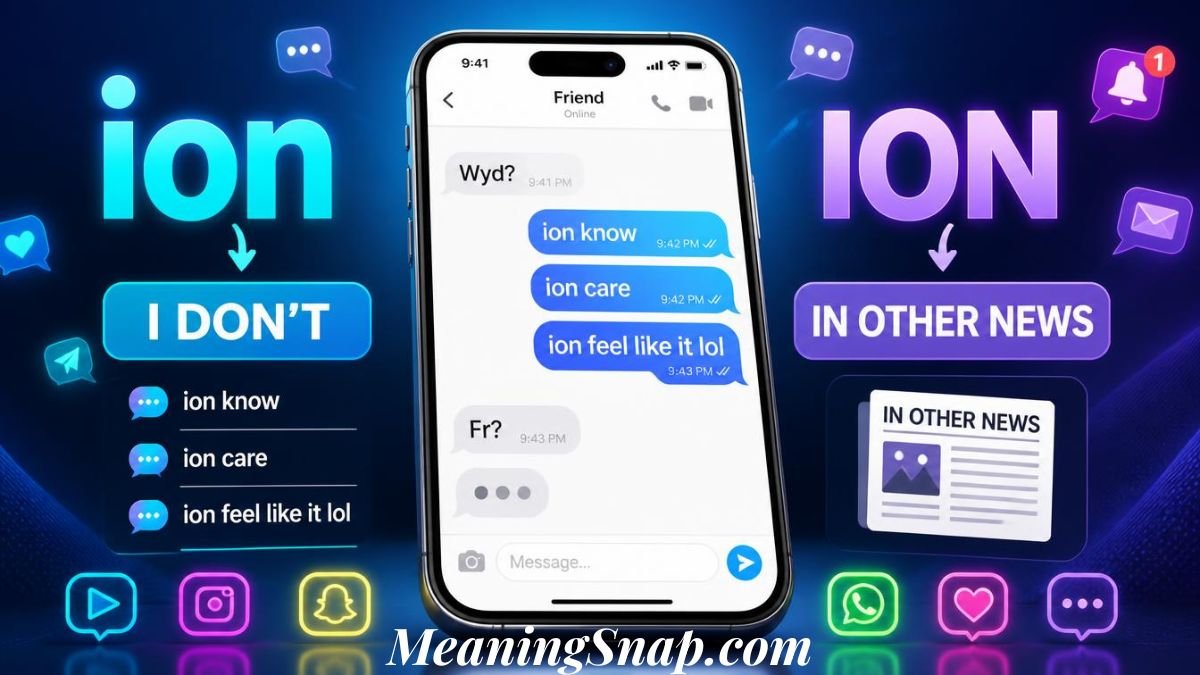
Someone texts you “ion feel like it lol” and you just stare at your phone. Is that a typo? An autocorrect glitch? A new emoji code you missed? You’re not alone, and figuring out ion meaning in text trips up more people than you’d think, especially anyone outside the group chats where this slang lives. The short version: it’s not really an abbreviation at all, more like a phonetic shortcut for a phrase you already say every day. But there’s a twist. Written in capital letters, those same three letters mean something completely different, and mixing the two up is an easy way to misread a whole conversation.
Here’s what ion actually stands for, where it came from, and how to use it without sounding like you just picked up texting yesterday.
What “Ion” Actually Means in a Text
In texting, ion is a phonetic spelling of “I don’t.” That’s it, no hidden letters standing for separate words despite looking like a shortened phrase. Say “I don’t know” out loud fast in casual spoken English and it collapses into something that sounds a lot like “ion-oh.” Someone decided to spell it exactly how it sounds, and it stuck.
This is different from “ion” the actual English word, which refers to a charged particle in chemistry. That’s pure coincidence; the slang term and the science term share letters and nothing else. Autocorrect doesn’t know the difference, which is why phones sometimes flag it or try to “fix” it into something else entirely.
In practice, ion in texting works as a stand-in for “I don’t” plus whatever comes next: “ion know,” “ion care,” “ion like that.” It slots in wherever “I don’t” would normally go, which makes it more flexible than most texting shorthand. You’re not memorizing one fixed phrase; you’re swapping three letters for two words and building the rest of the sentence normally.
This is also why context does more of the work here than the word itself. On its own, “ion” doesn’t mean anything; it needs the rest of the sentence to land. That’s typical of a lot of internet slang that comes from spoken language rather than written abbreviations; it depends on being read the way it would be said out loud.
Read Also: SH Meaning in Text: What It Really Means & How to Use It
Where “Ion” Came From
The meaning of the ion slang didn’t start online; it started with how people already talk. “Ion” comes out of African American Vernacular English (AAVE), where fast, casual pronunciation of “I don’t” naturally contracts down to something close to “ion.” That kind of contraction is a normal feature of conversational English, not a corruption of it, the same way “gonna” or “wanna” work.
Written slang tends to lag behind spoken slang, and “ion” followed that pattern. It existed in speech long before it showed up regularly in text, picking up traction on Black Twitter through the mid-to-late 2010s before spreading into wider social media slang. TikTok accelerated that spread hard. Once captions, comments, and video audio started using it constantly, non-AAVE speakers picked it up fast, sometimes without knowing where it came from. It’s a good example of how informal language moves from spoken word to written spelling.
That origin matters a bit for how you use it. A lot of slang gets flattened into “it’s just internet slang” with no real backstory, but “ion” has a specific linguistic root tied to a specific community, and it entered mainstream casual texting the way a lot of AAVE-rooted slang does, through visibility on platforms rather than credit.
By 2026, ion sits pretty comfortably as generic Gen Z and millennial texting slang, used across TikTok, Instagram comments, Snapchat captions, WhatsApp threads, and group chats without much thought about where it started. That doesn’t erase the origin, it just means the word has moved through the usual pipeline: spoken language, niche online community, viral platform, general use.
Lowercase “ion” vs. Uppercase “ION”: Two Different Meanings
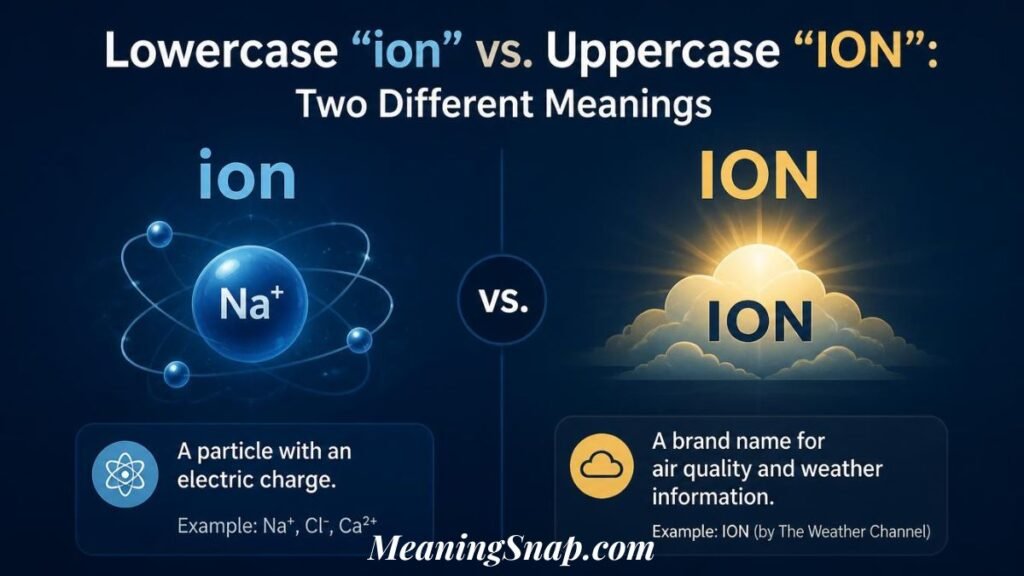
Case matters more than people think here. Written lowercase, “ion” is almost always the “I don’t” slang covered above. Written in all caps, ION usually means something else: “In Other News,” an older piece of internet slang that predates the AAVE-derived “I don’t” usage by a good stretch, used to pivot a conversation or caption toward a new topic.
You’ll see this show up as a caption opener more than mid-sentence: “ION my dog learned a new trick today” reads as “in other news, my dog learned a new trick today,” a quick way to change subject without a full transition sentence. It’s a texting abbreviation in the more traditional sense, letters standing for words, which puts it in a different category from the phonetic “ion.”
The two rarely get confused in context because they behave differently. “In other news” ION tends to open a sentence or a new thought. “I don’t” ion tends to sit inside a sentence, right where “I don’t” would normally go. If you see “ion” doing the job of a subject or a topic shift, it’s probably the older acronym. If it’s doing the job of a verb phrase, it’s the slang contraction.
Autocorrect and predictive text don’t reliably distinguish between the two, so if a message reads oddly, checking which job the word is doing in the sentence clears it up faster than guessing. This dual meaning is honestly the part most guides skip, but it’s the detail that actually resolves confusion when a text doesn’t parse the way you expect.
“In other news” didn’t start as internet slang either, it’s a phrase lifted from television news transitions, later borrowed by early forums and message boards long before texting existed. That older acronym usage predates the AAVE-derived “ion” by decades, which is part of why the two coexist without much overlap, they came from completely different corners of language history.
How People Actually Use It (Real Examples)
Once you know what to listen for, ion meaning in text gets easy to spot fast. It shows up constantly in DMs, comments, group chats, and captions, almost always doing the same basic job: standing in for “I don’t” before whatever comes next. It’s common enough now that half a text thread can run through it without anyone commenting on it, that’s genuinely how normal the word has become in casual texting circles.
Here’s what that looks like across a few different tones, from low-stakes to more sincere:
- Casual: “you tryna get food later?” → “ion know yet, lemme see”
- Sarcastic: “you still mad about last night?” → “ion even remember why we were fighting lol”
- Sincere: “hey you good?” → “nah ion feel like talking rn tbh”
- Social media caption: “ion care what anyone says this song goes hard 🔥”
- Dating app: “so what are you looking for on here?” → “ion really do labels, just seeing where it goes”
- Group chat: “who’s driving tonight” → “ion have gas money ngl”
Notice none of these need extra punctuation or explanation to land, that’s part of why the slang spread so fast, it reads exactly the way it sounds when someone says it out loud. It works fine bare or dressed up with emojis, tone comes from context more than punctuation. That flexibility is part of why it became such common social media slang rather than staying limited to one platform or one kind of app.
Ion vs. Similar Negation Slang
Ion isn’t the only shorthand doing this kind of work, and it’s worth knowing how it differs from other similar texting terms it usually gets lumped in with, especially IDK and IDC, which get used interchangeably by people who haven’t clocked that they mean different things.
Here’s how they stack up side by side:
| Term | What It Replaces | How Broad It Is | Example |
|---|---|---|---|
| ion | “I don’t” | Broad, works before almost any verb | “ion want to go” |
| idk | “I don’t know” | Narrow, only covers not knowing | “idk what to wear” |
| idc | “I don’t care” | Narrow, only covers indifference | “idc what we watch” |
| nah | “No” | Broad, works as a standalone reply | “nah I’m good” |
| ngl | “Not gonna lie” | Different job, adds honesty rather than negation | “ngl that was funny” |
The main difference is flexibility. IDK and IDC are locked to one specific phrase each, you can’t really stretch “idk” to mean “I don’t want” the way you can stretch “ion” to cover almost any verb after it. That’s part of why ion caught on as broadly as it did, one piece of shorthand does the job several separate abbreviations used to split up.
None of these are interchangeable with tbh or imo either, which aren’t negation words at all, they’re more about framing an opinion honestly than saying what you don’t do or feel. Mixing those up is a common way texting shorthand gets misread by anyone who didn’t grow up texting in this particular slang.
There’s also a structural difference worth noting. IDK and IDC are true acronyms, each letter stands for a specific word in a fixed phrase. Ion isn’t an acronym at all, it’s a phonetic respelling, which is part of why it can flex to cover so many different sentences while idk and idc stay locked in place.
When “Ion” Isn’t Slang at All
Outside of texting, ion picks up entirely alternative meanings in science and technology. In chemistry and physics, ion is a real word describing an atom or molecule that has gained or lost an electron, giving it a positive or negative electric charge. That charge is the whole reason ions matter scientifically, they’re what makes chemical bonding possible, and they show up constantly in fields far beyond a chemistry classroom.
In medicine and biology, ions are the reason nerves and muscles work at all. Ion channels, tiny gateways in cell membranes, control how sodium, potassium, and calcium ions move in and out of cells, which is what triggers nerve signals and muscle contractions. Without that movement, almost nothing in the body would fire correctly.
Ions also matter in space technology. Ion propulsion, sometimes called ion engines, uses charged particles to generate thrust, a method that’s been used on real spacecraft because it’s far more fuel-efficient than traditional chemical propulsion, even though the thrust itself is gentle.
Did You Know? The slang “ion” and the scientific “ion” share nothing but spelling. The science word traces back to the Greek word for “going,” describing how charged particles move toward oppositely charged ones, a term coined in the 1830s.
None of this overlaps with the texting slang meaning, and that’s kind of the point, context does all the work. Nobody texting “ion know” is talking about electrons, and nobody in a physics lecture means “I don’t.” The spelling collision is just that, a collision, not a connection.
Common Mistakes With “Ion”
The most common mix-up isn’t even about meaning, it’s autocorrect. Phones often try to “fix” ion into “I’m” or “on,” which flips a sentence into nonsense or the opposite meaning entirely. “Ion going” reads very differently from “I’m going,” so a missed autocorrect swap can send a genuinely confusing text.
Another mistake is tone misreading. Because ion often shows up in short, blunt replies, it can come across as dismissive or cold even when that’s not the intent, especially over text, where tone doesn’t carry the way it would out loud. “Ion care” read flat looks harsh, said out loud with a laugh it usually isn’t.
There’s also a respect issue worth naming plainly: some people use AAVE-rooted slang like this purely for aesthetic, without any awareness of where it comes from or the community it comes from. That doesn’t make casual use off-limits, slang spreads and shifts hands constantly, but it’s worth knowing the origin instead of treating it as generic internet slang with no roots.
Finally, people sometimes use ion in spots where it just doesn’t fit: formal writing, professional messages, or a first message to someone with no exposure to texting slang at all. It reads as either confusing or unprofessional there, which is really a formality mismatch more than anything wrong with the word itself.
Overcorrecting is its own mistake too. Manually swapping ion back to a full “I don’t” mid-conversation can read as oddly formal or even sarcastic if the rest of the thread is casual. Matching the tone of whoever you’re texting matters more than picking one style and sticking to it everywhere.
Is It Okay to Use? (Dating Apps, Work Chats, and Respecting Where It Came From)
Short answer: it depends entirely on where you’re texting and who you’re texting. In casual communication and other relaxed online spaces, group chats, DMs, dating apps, comments under a video, ion fits right in and reads as a normal, relaxed tone rather than anything to think twice about. That’s typical of digital communication more broadly, formality depends on the space you’re in.
On dating apps specifically, it tends to read as low-key and unbothered, which is often exactly the vibe someone’s going for early on: “ion really do labels” or “ion mind either way” both come across as casual rather than cold, assuming the rest of the conversation matches that tone.
Professional messages are the clear line. Work email, job applications, formal writing, or a first message to someone who doesn’t know your texting style, that’s where ion doesn’t belong, the same way you wouldn’t casually say “gonna” or “wanna” in a cover letter. It’s not that the slang is wrong, it’s a formality mismatch, same as any other piece of texting shorthand.
The AAVE origin is worth carrying into that judgment call too. Using it with friends in a group chat is different from performing it for aesthetic without any sense of where it comes from. Slang moves and changes hands constantly, that’s normal, but a little awareness goes further than none.
Millennials tend to use it more selectively than Gen Z, often saving it for friends already fluent in this kind of texting shorthand rather than defaulting to it everywhere the way younger texters sometimes do. Neither approach is wrong, it’s just a generational difference in how casually the slang gets treated.
What Does Ion Mean on Snapchat?
On Snapchat specifically, ion mostly shows up in chat replies and captions rather than on-screen Snap text, since Snapchat conversations tend to be quick and disposable by nature. A caption under a Snap like “ion even remember posting this” or a chat reply like “ion have plans yet” works exactly the same way as texting anywhere else, standing in for “I don’t.”
Because Snaps disappear by default, conversations there skew even more compressed than other apps, so ion often shows up stacked next to other short slang like “fr,” “lowkey,” or “no cap” without anyone slowing down to explain it. If a friend sends something confusing with ion in it on Snapchat, it’s almost always this same casual “I don’t” meaning, not the science term or the “in other news” acronym.
What Does Ion Mean in Text on Instagram?
On Instagram, ion shows up across three different spots, DMs, comments, and captions, and the tone shifts slightly depending on which one. In a DM, it reads like any other text: “ion know if I’m free that day.” In a comment under someone else’s post, it usually reacts to the content itself: “ion care this is actually so funny.” In a caption, it can open the whole post the same way it works on TikTok: “ion have words for this outfit.”
The one place it shows up less is Instagram Stories, where quick reaction stickers and short taps tend to replace full slang phrases. When ion does show up in a Story, it’s usually part of a longer caption someone typed out rather than a one-word reply.
Ion Meaning in WhatsApp
WhatsApp works the same way as any other messaging app when it comes to ion, it’s still shorthand for “I don’t,” used in one-on-one chats and group threads alike. The difference is audience. WhatsApp tends to mix more international and multi-generational contacts in one chat list than apps like Snapchat or TikTok, so ion shows up less consistently there, some threads use it constantly, others never see it at all.
That makes WhatsApp a good example of the formality question covered earlier. In a group chat full of friends who all text the same way, “ion have cash for that” reads completely normal. In a family group chat or a work-adjacent WhatsApp group, the same message might land oddly simply because not everyone in the thread uses or recognizes casual texting slang.
Ion Meaning as Slang on TikTok
TikTok is where this slang picked up the most speed, and it still shows up constantly across captions, comments, and even spoken in video audio itself. A caption like “ion make the rules I just follow em” or a comment replying to a video with “ion even mad tbh” both fit right into how the app’s comment culture works, quick, reactive, and casual.
Because TikTok trends move fast, ion sometimes gets paired with whatever slang or sound is trending that week, which is part of why the word keeps circulating instead of fading out. If you’re seeing ion a lot in one specific corner of TikTok right now, it’s usually tied to whatever video format or audio is currently popular in that space, not a different meaning.
Read More Related Article: IMY Meaning in Text: What It Really Means and How to Use It
What Does Ion Mean in Text From a Girl?
The meaning of ion doesn’t change based on who’s sending it, it means “I don’t” whether it’s from a friend, a match on a dating app, or anyone else. The reason this specific search comes up so often is context, not definition: when a text like “ion know, we’ll see” arrives from someone you’re interested in, it’s natural to look for hidden meaning in it.
Realistically, ion carries the same weight as any other short reply would, casual and often noncommittal by nature. “Ion know” from anyone usually means exactly what it says, they genuinely don’t know yet, rather than a coded signal one way or the other. Reading too much into three letters is easy to do, but the word itself isn’t gendered or loaded, the rest of the conversation is what actually carries the tone.
Ion Meaning in Text, Urban Dictionary Style
Urban Dictionary entries for ion tend to agree on the core meaning, “I don’t,” but like most crowdsourced slang sites, you’ll find several competing definitions with different levels of accuracy, plus a few joke entries mixed in. That’s normal for a site anyone can contribute to, and it’s worth treating with a bit of skepticism rather than as a definitive source.
The most upvoted entries generally land on the same phonetic “I don’t” explanation covered here, sometimes with looser attempts at the AAVE origin story. If you’re checking Urban Dictionary and see a definition that doesn’t match how the word gets used in your own texts or group chats, the crowdsourced nature of the site is usually why, not a sign that the common definition is wrong.
How to Pronounce “Ion” (Slang Pronunciation)
Ion is pronounced the same way the “I don’t” contraction naturally sounds when spoken fast, roughly “eye-uhn” or “eye-on,” said as one quick syllable rather than two separate words. It’s not pronounced like the science word “ion” (a clearer, more separated “EYE-on”), even though they’re spelled identically, the slang version blends closer together because it’s mimicking rushed speech.
The easiest way to get it right is to say “I don’t” out loud a few times fast, without over-enunciating. Whatever that sounds like is basically the pronunciation, which is exactly how the spelling came about in the first place, someone wrote down what they were already saying instead of inventing a new word.
FAQs
What does “ion” mean in a text message?
The ion meaning in text comes down to one thing: it’s a phonetic spelling of “I don’t,” used before almost any verb, like “ion know” or “ion care.”
Is “ion” the same thing as “idk”?
No. “Idk” only replaces “I don’t know,” while ion is broader and can replace “I don’t” before almost any verb.
Does “ion” ever mean something other than “I don’t”?
Yes, written in all caps as ION, it usually stands for “in other news,” an older, unrelated piece of internet slang.
Is “ion” okay to use in professional messages?
No. Understanding ion meaning in text also means knowing where it doesn’t belong, and formal writing or work email is exactly that, it’s casual slang, not something for job messages.
Where did “ion” come from?
It comes from African American Vernacular English, where “I don’t” is naturally pronounced quickly enough to sound like “ion.”
Is “ion” rude or dismissive to use?
Not inherently, tone comes from the rest of the message rather than the word itself. A short “ion care” can read blunt over text even when it isn’t meant that way.
Can you use “ion” around people who don’t text in slang?
It’s better not to. If the other person doesn’t already use casual texting slang, spelling out “I don’t” avoids confusion entirely.
The Bottom Line
Ion is one of those slang terms that seems confusing right up until it clicks, then it’s obvious every time you see it. It’s not an acronym, not a typo, and not related to the science word it happens to share a spelling with, it’s just a fast, casual way of writing “I don’t” the way it actually sounds out loud. Once you can tell the lowercase version from the “in other news” ION, and once you’ve got a feel for where it fits and where it doesn’t, the rest is just repetition. Next time “ion” shows up in a text, you’ll know exactly what’s being said, and probably reply just as fast.

Alex Morgan is a writer focused on explaining slang, words, phrases, acronyms, and popular expressions in a simple and easy-to-understand way. Through clear explanations and helpful examples, Alex helps readers quickly understand what words and phrases mean and how they’re commonly used.