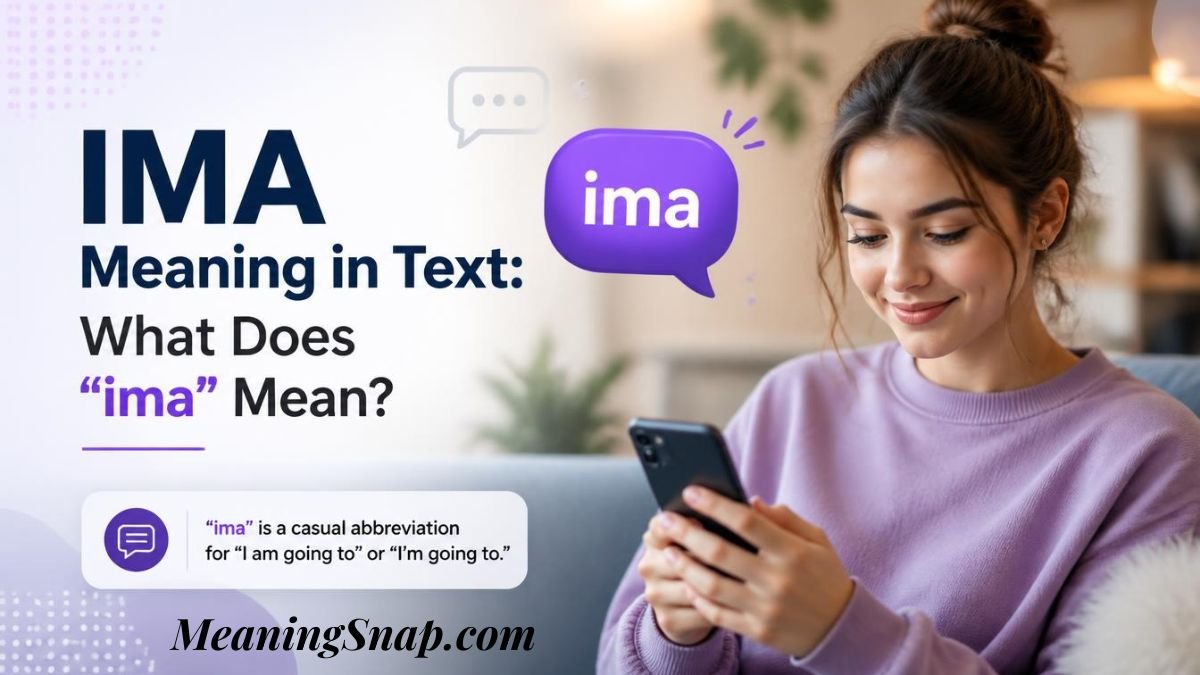
You’re mid-text with a friend, half paying attention to something else, and they send: “ima call you in five.” No punctuation, no capital letter, just three lowercase characters doing the work of an entire sentence. If you’ve ever paused on that word and wondered whether it’s a typo, a new abbreviation, or something you’re supposed to already know, you’re not alone. The meaning of ima is simpler than it looks, and once you know what it does, you’ll never misread it again.
Quick Answer: In texting, ima means “I’m going to” or “I’m about to.” That’s the ima meaning almost everyone searching this term wants. Ima is also the Hebrew word for “mother,” and IMA is a real medical and accounting acronym in totally unrelated fields. This guide covers all of it, starting with the one you’re here for.
What Does “ima” Mean in Text?
The core ima meaning in text is a squished-together way of writing “I’m going to” or “I’m about to.” Someone typing “ima head out” means the same thing as “I’m about to leave.” It’s not an abbreviation in the way LOL or BRB are abbreviations. It’s closer to a phonetic spelling of how people already talk out loud, just written the way it sounds instead of the way a textbook would spell it out.
That’s also why you won’t find total agreement on Urban Dictionary or similar crowdsourced sites about the exact ima meaning. Search it there and you’ll see dozens of near-identical entries, all circling the same core idea with slightly different wording. That’s normal for a spoken contraction. It confirms the basic meaning without adding much beyond it.
A few real examples make the pattern obvious:
- “ima grab food, want anything?” (I’m going to grab food)
- “ima be there in 20” (I’m going to be there)
- “ima need you to explain that again” (I’m about to need, used as emphasis)
That last one is worth noticing. Sometimes ima doesn’t point to a future action at all. It’s a sentence-starter people use for emphasis, almost like clearing their throat before saying something important. You’ll see that usage a lot in the tone section further down.
Read Also: WBU Meaning in Text: Slang, Uses & Examples
“ima” vs “imma”: What’s the Difference?
Short answer: they’re the same word, spelled two different ways by two different people typing fast. Neither spelling changes the ima meaning. It comes down to habit and how someone’s brain converts sound into letters, and on a phone keyboard, ima is also one letter shorter to type than imma.
| Spelling | Pronunciation | Common Where | Example |
|---|---|---|---|
| ima | “eye-muh” | Quick casual texts, DMs, comments | “ima text you later” |
| imma | “ih-muh” | Song lyrics, captions, more emphatic statements | “imma be honest with you” |
Both trace back to the same source phrase, and you’ll see people switch between the two spellings depending on their mood, not the meaning. If a friend texts you one version this week and the other next week, nothing’s changed about what they mean.
Where Does “ima” Come From?
Ima isn’t an internet invention. It’s a written version of a contraction that existed in spoken English long before texting did. Linguists trace it back through a chain: “I am going to” shortens to “I’m going to,” which shortens further to “I’m gonna,” and eventually the middle consonants blur together into “I’ma” or “I’mma.” Say “I’m gonna” fast enough out loud and you’ll hear yourself land somewhere close to “ima” without trying.
Wiktionary and multiple linguistic sources tie this pattern closely to African American Vernacular English, where it’s been common for decades, showing up in music and spoken dialogue long before it became a texting shorthand. One Harvard linguist has traced the pattern even further back, to Gullah creole, where a similar sound swap marks the immediate future tense. Texting didn’t invent the sound or the ima meaning behind it. Phones just gave people a reason to spell out something they’d already been saying, and a shorter spelling saves a few keystrokes every time you type it.
What changed with texting is visibility. A contraction that used to live almost entirely in speech, easy to hear but rarely written down, suddenly needed a spelling the moment people started typing the way they talk. Ima is one of several results of that shift, alongside similar contractions that turned spoken shortcuts into standard written slang.
How “ima” Is Used in Real Conversations

Ima doesn’t belong to one platform. It shows up anywhere people are typing the way they’d talk, which changes the flavor slightly depending on where you see it, even though the underlying ima meaning stays the same everywhere.
Friends & Casual Texting
This is where ima lives most naturally. Between friends, it’s just efficient shorthand with zero baggage attached.
“ima call you when I’m off work”
Nobody reads extra meaning into that. It’s a plan, stated quickly.
Instagram, Snapchat & TikTok
On social platforms, ima often shows up in captions, comments, and Stories replies, usually announcing an intention or reacting in the moment.
“ima need everyone to see this video” (comment on a TikTok)
Here it’s less about a literal future plan and more about reacting with emphasis, almost like “I have to point this out.”
Dating Apps & Flirty Texts
On dating apps, ima can carry a little more weight because tone matters more when you don’t know someone well yet.
“ima be real with you, I don’t usually match with people this fast”
Said early in a conversation, that reads as playful honesty. The same words from someone you’ve been talking to for weeks might just read as a normal update.
Gaming & Online Communities
In game chat and voice comms, ima shows up as quick, tactical shorthand, announcing a move before making it.
“ima flank left, cover me”
Nobody’s overthinking grammar mid-match. The point is speed, and ima gets the plan across in one breath, exactly the same ima meaning as any other casual context, just applied to a controller instead of a phone.
Is “ima” Rude, Flirty, or Just Lazy?
Ima itself carries no built-in emotion. The tone comes entirely from what follows it and who’s sending it, which is exactly why the same three letters can land completely differently depending on context.
When It Feels Friendly
Paired with a casual plan, ima reads as relaxed and easygoing.
“ima swing by later if that’s cool”
When It Can Sound Dismissive
Stack it with clipped, short follow-up words and it can come across as short-tempered.
“ima need you to stop”
That one isn’t announcing plans. It’s frustration wearing the shape of a sentence.
When It Feels Playful or Flirty
In a lighthearted exchange, ima softens a bold statement into something teasing instead of aggressive.
“ima steal your hoodie, and you can’t stop me”
When It Can Come Off as Lazy
In a longer or more serious message, dropping into ima mid-sentence can read as low effort, especially to someone who doesn’t text casually themselves.
“so ima just wing the whole presentation lol”
To a close friend, that’s funny. To a coworker who prefers full sentences, it can land as careless.
How to Respond When Someone Texts You “ima…”

What you send back usually depends on whether you’re matching their energy or redirecting it.
Casual Replies
“bet, lmk when you’re close”
Funny Replies
“ima be waiting with a snack in hand, don’t play”
Neutral Replies
“okay, sounds good”
Professional Replies
“Sounds good, talk soon.” (dropping the slang entirely, matching a more formal tone)
Read Also: IYKYK Meaning: What Does IYKYK Mean in Text?
Common Mix-Ups With “ima”
Most confusion around the ima meaning comes from one of three places.
Mistaking It for a Typo
New texters sometimes assume ima is a dropped apostrophe, as if someone meant to type “I’m a” and missed a key. It’s not a typo. It’s a deliberate contraction with its own consistent meaning.
Confusing It With “LMA” and Other Look-Alikes
Skim a text too fast and ima can blur together with similarly shaped strings like lma. Worth noting: even sites dedicated to decoding slang can’t agree on what lma stands for, with some claiming “laughing my ass off” and others claiming “leave me alone.” That disagreement is a sign it’s not a stable, established term the way ima is. If you see it, context will tell you more than the letters will.
Assuming It’s Rude
Because ima can sound curt in isolation, some readers assume it’s inherently short-tempered. It isn’t. The tone lives in the sentence around it, not the contraction itself, as the section above shows.
“ima” as a Hebrew Word
Outside of texting, Ima has a completely separate identity, and this is where the ima meaning changes entirely: it’s the everyday modern Hebrew word for “mother.” Written אִמָּא and pronounced “ee-mah,” it’s the term Israeli kids call their mothers, the equivalent of “mom” rather than the more formal “mother.” You’ll hear it constantly in Israeli households, children’s books, and everyday conversation across Hebrew-speaking communities.
Hebrew also has a more formal, older word for mother, em, which shows up more in literary, poetic, and religious Hebrew rather than daily conversation. That distinction explains a related search people run into: whether ima appears “in the Bible.” English Bible translations render the word simply as “mother”; they don’t keep the Hebrew transliteration, but the more formal em is the term more often tied to biblical and literary Hebrew, while ima is the modern conversational word most Hebrew speakers grow up using.
English texting slang and the Hebrew word for mother are unrelated beyond sharing a spelling, so if you see “ima” in a Hebrew-language or Jewish cultural context, it means the latter, not the texting one.
Other Things “IMA” Can Stand For
Written in capitals, IMA is also a real acronym in a couple of unrelated professional fields, verified rather than guessed at.
| Field | What IMA Stands For | Where You’ll See It |
|---|---|---|
| Medicine | Inferior Mesenteric Artery | Vascular and colorectal surgery discussions, radiology reports |
| Accounting & Finance | Institute of Management Accountants | The professional body behind the CMA (Certified Management Accountant) credential, founded in 1919 |
Neither of these has anything to do with the texting contraction or its casual ima meaning. If you’ve landed here searching “IMA meaning” from a medical chart or a finance course rather than a text thread, that’s your answer, and it’s worth double-checking context clues around the acronym before assuming which field it belongs to.
Slang Terms Similar to “ima”
Ima belongs to a small family of contractions that all compress a longer spoken phrase into something faster to type.
| Term | Meaning | Example |
|---|---|---|
| gonna | going to | “gonna be late” |
| finna | fixing to/about to | “finna head out” |
| boutta | about to | “boutta lose it” |
| tryna | trying to | “tryna focus rn” |
They all share the same instinct behind the ima meaning itself: write the word the way it sounds when spoken quickly, rather than the way a dictionary would spell it. Finna and boutta tend to carry a slightly stronger Southern and AAVE association than gonna, which reads as more regionally neutral at this point. Ima and tryna sit somewhere in between, common enough across regions and platforms that most readers won’t clock them as tied to any one place. None of these words are interchangeable in tone even when they’re interchangeable in meaning, so swapping ima for finna in a sentence can shift how the message feels even though the literal translation barely changes.
When You Should Avoid Using “ima”
Ima works well in casual spaces, but a few settings call for spelling things out.
Professional & Work Settings
Even relaxed workplace Slack channels tend to expect complete words. “I’m going to send that over” reads as more careful than “ima send that over,” and careful is usually the safer default with coworkers or clients.
Formal Writing
Emails, cover letters, reports, and anything with your name attached to a formal outcome should stick to standard grammar. Ima has no place there, regardless of how well the reader might know the ima meaning already.
Cross-Cultural or Unfamiliar Conversations
If you’re texting someone who isn’t a native English speaker or isn’t familiar with casual American texting shorthand, ima can genuinely confuse rather than save time.
Sensitive Situations
When a conversation is heavy, someone’s upset, grieving, or dealing with something serious, casual contractions can feel out of place regardless of how close you are. “I’m going to call you” simply reads as more considered than “ima call you” when the stakes of the conversation are higher.
Read Also: BSF Meaning in Text: What It Stands For (Updated 2026)
FAQs
What does ima mean in a text message?
The ima meaning in a text message is “I’m going to” or “I’m about to.” It’s a written version of how people already say that phrase out loud.
Is ima the same as imma?
Yes. They’re spelling variations of the same contraction, not two different words with different meanings.
Is ima proper English?
No. It’s informal, spoken-style shorthand, fine for texting and casual chat but not for formal writing.
Why do people type ima instead of “I’m going to”?
It matches how the phrase sounds when spoken quickly, and it’s faster to type than the full version.
Does ima mean something different from a girl?
No. There’s no evidence the ima meaning changes based on who sends it. Tone comes from the rest of the message, not the sender’s gender.
Is ima only used by Gen Z?
No. Its roots go back decades before Gen Z existed, though Gen Z and Millennials are the ones texting it the most today.
Should you use ima in work emails?
No. Save it for texts and casual DMs. Work emails read better with full words like “I’m going to.”
So, Should You Use “ima” in Your Texts?
If you’re texting a friend, replying to a comment, or keeping a conversation light, ima is a completely normal, low-stakes way to write. It’s not slang with a hidden meaning or a trend that’ll disappear next year; it’s just a spelled-out version of a contraction people have been saying for a long time. Now that you know the full ima meaning across texting, Hebrew, and even medical and finance contexts, you’ll never second-guess it again. Save the texting version for casual spaces, spell things out fully when the setting calls for it, and you’ll never send it in the wrong context again.

Alex Morgan is a writer focused on explaining slang, words, phrases, acronyms, and popular expressions in a simple and easy-to-understand way. Through clear explanations and helpful examples, Alex helps readers quickly understand what words and phrases mean and how they’re commonly used.