You’re texting a friend about something absolutely unhinged that happened at work, and they hit you back with just three letters: ofn. No punctuation, no follow-up, just those three letters sitting there on the screen. A lot of people end up typing “OFN meaning” into a search bar the exact moment this happens, mid-scroll, trying to figure out if that reply was agreement, sarcasm, or something else completely.
Here’s the thing. OFN isn’t random keyboard noise. It’s real internet slang with actual roots, and depending on how someone drops it into a conversation, it can mean three different things. One version means “I swear it’s true.” Another means “that’s old news.” A third one is basically a polite way of yelling into the void. Sorting out which one you’re looking at is easier than it sounds, and once you know the full OFN meaning behind each version, you won’t have to guess again.
What Is the OFN Meaning?
At its core, the OFN meaning most people are searching for comes from “On Foenem,” sometimes written as “on foe nem.” It’s a way of backing up something you just said, kind of like swearing on your life, except swapped in for the people closest to you instead. When someone types OFN, they’re telling you they’re not exaggerating and they’re not lying.
Foenem itself predates the abbreviation. It’s slang for close friends, or people you’d genuinely go to bat for, similar in spirit to “my people” or “my crew.” Saying “on foenem” puts your word on the line using the people you care about most as the stakes. OFN just compresses that whole phrase down to three letters for faster typing.
Quick Answer: OFN most often means “On Foenem,” a slang way of saying “I swear” or “for real.” It can also mean “Old Fing News” or “Oh F No” depending on the context.
This first version shows up constantly in casual texting, group chats, and comments sections. If a friend tells you something wild and follows it with “ofn,” they’re doubling down on it. It’s less about literal truthfulness and more about emphasis, the texting equivalent of putting a hand over your heart.
Almost nobody says OFN out loud as its own word. It stays a written abbreviation, read letter by letter if it’s ever spoken at all, which is fairly typical for texting shortcuts that never crossed over into speech. That’s also part of why the OFN meaning stayed a little fuzzy for so long. A phrase that lives mostly on screens has fewer chances to get corrected in real time the way spoken slang does.
Read Also: HWY Meaning: What It Means in Text, Maps & Slang
Where OFN Comes From
OFN traces back to Chicago, where “foenem” developed as slang rooted in African American Vernacular English (AAVE), tied to closeness and loyalty within a group. Because it comes from a specific community’s way of speaking, it’s worth treating as more than just a random internet meme, even though that’s mostly how it circulates now.
What’s clearer than the exact origin is how it spread. Chicago hip-hop artists used “on foenem” in lyrics through the 2010s, and the phrase moved from rap music into everyday speech the way a lot of AAVE-rooted slang eventually does. From there it landed on social media, got clipped down to OFN, and reached audiences who’d never heard the full phrase spoken out loud.
That jump matters, because it’s part of why OFN carries more than one meaning today. As slang travels beyond the community it came from, people sometimes pick up the abbreviation without the backstory and start applying it their own way. “Old F***ing News” likely grew out of exactly that gap, since three bare letters on a screen are easy to reinterpret once nobody remembers the full phrase behind them.
This term really took off with Gen Z texting culture, spreading fast through TikTok and Twitter/X rather than settling in gradually. Millennials picked it up later and less universally, which is part of why it can still catch people outside that younger group off guard the first time they see it.
Slang moving from a specific community into wider internet culture is nothing new. It happened with “no cap,” it happened with “bet,” and it’s happening with OFN too. The pattern usually looks the same: a phrase starts meaning one very specific thing, spreads through music and video, then picks up looser interpretations the further it travels from where it started. Knowing that background doesn’t just satisfy curiosity. It also explains why the OFN meaning splintered into three directions instead of staying locked to one.
The Other Meanings of OFN
OFN doesn’t stop at “I swear.” Two other meanings show up often enough that you need to recognize both before you fire back a reply.
The first is “Old F***ing News.” This version is dismissive on purpose. Someone uses it when you tell them something they already knew, usually with a little attitude baked in.
Priya: did you hear Jenna and Marcus broke up?? Devon: ofn, that happened like two weeks ago 😭
The second is “Oh F*** No.” This one carries shock, refusal, or straight-up disbelief, and it usually functions as a reaction on its own rather than part of a longer sentence.
Sam: bro just asked me to cover his shift AND drive him there Jordan: OFN. absolutely not
Turns out, all three versions get typed exactly the same way. Nothing in the letters themselves signals which one you’re getting. Tone and context carry the entire weight, which is why reading the rest of the message matters more than the abbreviation on its own.
None of these meanings is “the real one” everyone should switch to. Slang doesn’t usually work that way. OFN just happens to be one of those rare abbreviations that split into genuinely different directions instead of settling into a single universal meaning.
Read Also: HY Meaning in Text: What It Really Means & How to Use It
How to Tell Which OFN Someone Means
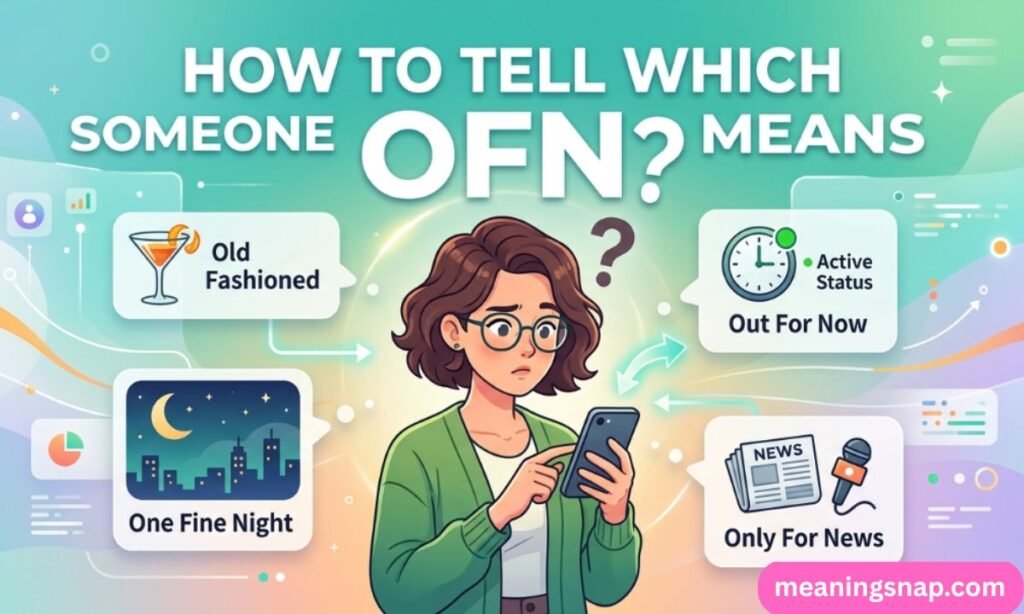
Since OFN can’t be told apart by spelling, context does all the work. A few patterns make this easier than it first seems.
If OFN follows a claim, especially something surprising or hard to believe, it’s almost always the “I swear” version. It’s backing up a statement, not reacting to one. If OFN follows news you already knew, and especially if it comes with a laughing or unimpressed emoji, it’s the dismissive “old news” version. And if OFN stands completely alone as a reply, often in all caps, it’s usually the shocked “oh no” version reacting to something someone else just said.
Punctuation and capitalization help too. A lowercase “ofn” tucked at the end of a sentence tends to read as casual emphasis. A standalone “OFN” in caps, especially followed by a period, reads more like a reaction than a supporting phrase. None of this is a hard rule, but it holds up in most casual chat and comment threads.
Emojis nearby are another clue worth checking. OFN paired with a crying-laughing emoji leans dismissive, since it’s poking fun at how obvious the “news” already was. OFN paired with a shocked-face emoji or all caps almost always points to the “oh no” reaction instead. When it shows up with no emoji at all, sitting quietly at the end of a sincere sentence, that’s usually the safest sign it’s the original “I swear” meaning.
When genuinely unsure, the safest move is just asking. Getting it wrong isn’t a huge deal since OFN is casual, low-stakes slang, but replying to a dismissive “ofn” as if someone just swore something was true can make a conversation feel off. A quick “wait which one lol” clears it up faster than guessing.
Worth flagging too: a few slang dictionary sites list definitions for OFN that don’t match how anyone actually texts it, things like “Organic Food Network” or “Only For Now.” Those readings exist somewhere on the internet, technically, but they’re not what’s happening when this shows up in your DMs or in a TikTok comment. If a definition feels like it came out of nowhere, it probably did.
OFN Meaning on Snapchat, TikTok & Instagram
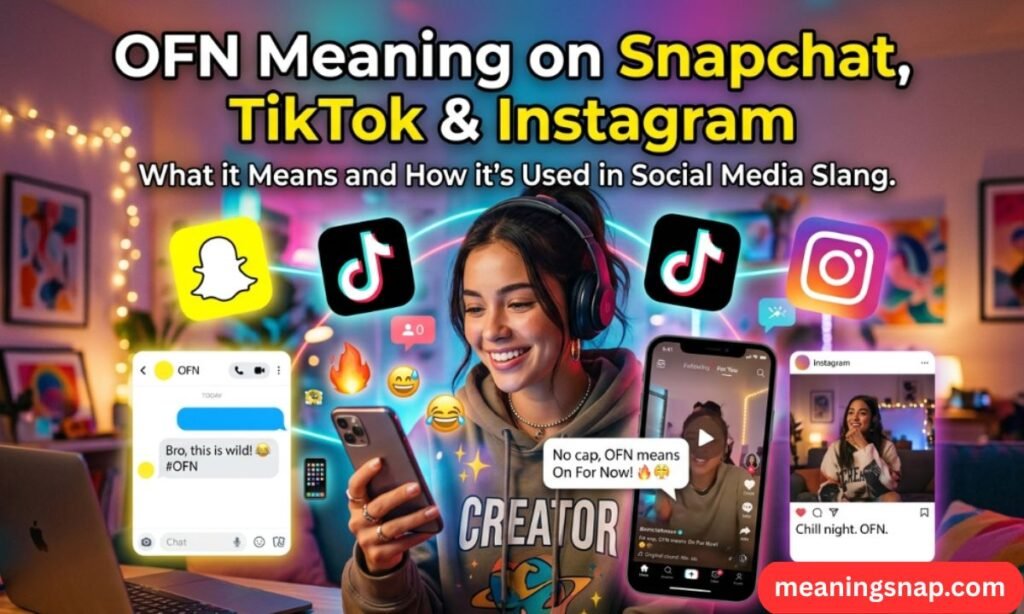
OFN shows up across pretty much every major platform, but it leans slightly different depending on where you see it. On Snapchat, it’s most common in captions and direct replies, usually backing up a story someone’s telling through Snaps. On TikTok, it tends to show up in comments reacting to something surprising in the video, often the “I swear” or shocked version rather than the dismissive one.
Instagram usage splits between captions, Stories, and Instagram DMs. In captions and Reels comments, OFN often adds emphasis to something genuine the poster is sharing, similar to how it functions in a TikTok comment section. In direct messages, it behaves more like it does in regular texting, flexible and dependent on whatever the conversation needs at that moment. The OFN meaning on Instagram doesn’t shift from platform to platform so much as the setting around it does, formal captions versus loose DMs changing how intense it reads.
It also pops up in gaming chats and Discord servers just as often as it does on more mainstream apps, usually as quick emphasis during a match (“that shot was insane ofn”) rather than anything tied to gaming terminology specifically. WhatsApp and regular text messages see less of it than Snapchat or TikTok, mostly because those platforms skew toward a slightly older, less meme-heavy user base.
Across all of them, OFN stays casual. It’s not something you’ll see in a brand caption or a professional post, and that’s by design. Part of what makes slang like this work is that it signals informality on sight, before anyone even reads the rest of the message.
Also Read: GNG Meaning: What It Means in Text, TikTok & Slang
OFN in a Sentence
Seeing OFN play out in real conversations makes the different meanings click faster than any definition can. Here are a few examples across different tones.
Sincere and backing up a claim:
Maya: I actually met her at the airport, ofn Chris: no way that’s wild
Casual agreement, low stakes:
Riya: this song is literally the best thing released this year Noah: ofn no skips on this album
Group chat energy, dismissive tone:
Elena: guys apparently the concert got pushed back a week Kai: ofn we’ve known since Tuesday 💀
Shocked reaction, standalone:
Zane: she said she’s not coming to the wedding Ava: OFN
Sincere, in a DM rather than a group chat:
Leah: I promise I’m not mad at you, ofn Owen: okay good, you had me worried
These examples cover the range OFN actually gets used for. Notice none of them explain the term inside the conversation itself. That’s realistic. In actual texting, nobody pauses to clarify which OFN they mean, which loops back to why reading tone matters so much.
OFN vs FR, ONG & No Cap
OFN belongs to a small family of texting terms that all revolve around backing up truth, though they don’t work as interchangeably as people assume. Someone fluent in this kind of texting slang tends to reach for a specific one depending on how serious the claim is, the same way word choice shifts in any casual chat language. Seeing them side by side makes the differences clearer than any single description could.
| Term | Meaning | Tone | Best Used For |
|---|---|---|---|
| OFN | I swear / for real (or “old news,” or shock, by context) | Casual, sometimes intense | Backing up a claim or reacting to surprising news |
| FR | For Real | Casual, straightforward | Agreeing with or confirming a statement |
| ONG | On God | Casual, emphatic | Swearing something is true, similar to OFN’s primary meaning |
| No Cap | No lie | Casual, blunt | Stating something honestly, no exaggeration |
FR and ONG are the closest matches to OFN’s primary meaning, though ONG carries a slightly heavier, more emphatic weight since it invokes something bigger than a simple statement. No Cap works similarly but centers specifically on the absence of exaggeration rather than swearing to something. NGL, short for “not gonna lie,” is a cousin of this group too, though it introduces a confession rather than backing up a claim.
None of these four terms are perfect substitutes for each other, and part of texting fluently is knowing which one fits a given moment. OFN stands out from the group mainly because of its double life. FR, ONG, and No Cap all stick to one meaning, while OFN can flip entirely based on context, which is exactly why it trips people up more than the others.
If you search any of these on Urban Dictionary, you’ll notice the community-submitted definitions argue with each other constantly, which is honestly a pretty accurate reflection of how messy slang gets once thousands of people are using it slightly differently. The OFN meaning specifically has more disagreement attached to it than FR or No Cap simply because it’s doing more work as a single abbreviation.
Read Also: LFG Meaning Explained: What It Really Means in Text, Gaming and Online Slang
OFN Meaning in Refrigeration and HVAC (A Totally Different OFN)

Worth a quick mention since it shows up in search results right alongside everything else here: OFN has a completely separate meaning outside of texting. In HVAC and refrigeration work, OFN stands for Oxygen-Free Nitrogen, a high-purity nitrogen gas technicians use to pressure-test pipework, flush out moisture, and reduce oxidation while brazing copper joints.
This OFN has nothing to do with the slang version, and the two aren’t related in any way beyond sharing the same three letters. It’s an industry term used by refrigeration engineers and air conditioning installers on the job, not something that shows up in a group chat or a TikTok comment. If a search for “OFN meaning” landed you here looking for the gas rather than the slang, that’s the one you’re after. The rest of this guide sticks to the texting side of things.
OFN Meaning FAQ
What does OFN mean in texting?
OFN most commonly means “On Foenem,” a way of saying “I swear” or “for real” to back up a statement. The OFN full form can also stand for “Old Fing News” or “Oh F No,” depending on how it’s used, so context always decides which one you’re reading.
Is OFN the same as FR?
They’re closely related but not identical. FR (For Real) only confirms honesty, while OFN can also mean old news or shock, so it carries more range than FR does. Swapping one for the other usually still gets your point across, but they’re not perfect matches.
What does OFN mean on Snapchat?
On Snapchat, OFN usually backs up whatever story or claim someone is making in a Snap or caption, functioning the same way it does in regular texting. It’s less common there as the dismissive version, since Snaps tend to share newer information rather than repeat old news.
Can OFN be negative?
Yes. When it stands for “Old Fing News,” it reads as dismissive, and when it stands for “Oh F No,” it signals refusal or shock, both of which carry a sharper tone than the sincere version. Neither is aggressive by default, but tone in the surrounding message can push either one further.
Is OFN a Gen Z slang term?
It’s most closely tied to Gen Z texting culture and spread heavily through TikTok and Twitter/X, though its roots go back further to Chicago hip-hop and AAVE. Millennials use it too, just less consistently, and usually only after picking it up from someone younger.
Bottom Line on the OFN Meaning
Next time OFN shows up in a text, you won’t have to stare at your phone wondering which version you just got. Check what came right before it, glance at the punctuation, and the meaning usually gives itself away. That’s really all decoding modern texting slang comes down to, reading the moment instead of memorizing a fixed definition.

Alex Morgan is a writer focused on explaining slang, words, phrases, acronyms, and popular expressions in a simple and easy-to-understand way. Through clear explanations and helpful examples, Alex helps readers quickly understand what words and phrases mean and how they’re commonly used.