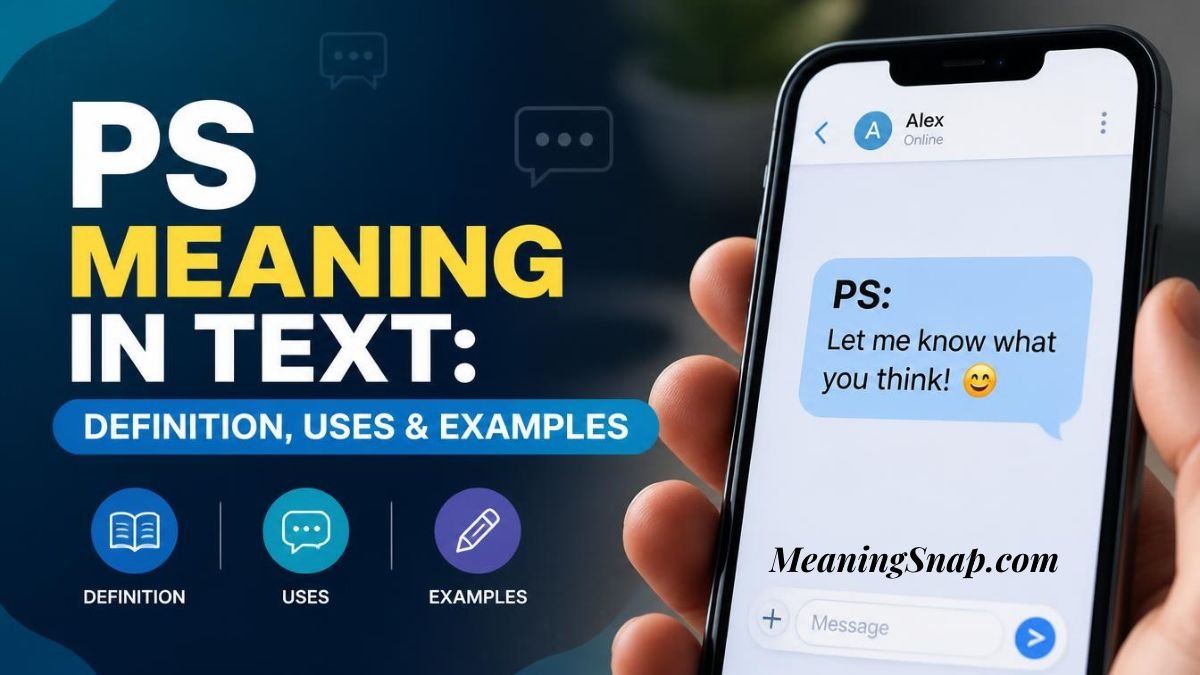
Your friend sends a long text about weekend plans, and the last line starts with “PS.” Quick pause. What’s the PS meaning in text, and why did it land at the bottom?
The short answer is simple. PS stands for postscript, a Latin-rooted way of saying “one more thing.” People have tacked it onto letters for centuries, and it slid into texts, captions, and emails with little change. It’s one of the easier abbreviations to decode once you spot the pattern. Below, you’ll see where it comes from, how to read it, and how to use it without sounding stiff. You’ll also meet the odd cases where PS means something else entirely, like a game console or a job title.
What Does PS Mean in Text?
PS stands for “postscript,” an extra thought added after the main message. In a text, it flags a quick afterthought, reminder, joke, or sweet note. The term comes from the Latin post scriptum, which means “written after.”
Merriam-Webster defines a postscript as a note added to a finished letter, article, or book. A text works the same way. You finish your message, realize you’ve got one more thing to say, and out comes the PS.
Here’s how common this is. Postscript is the main PS meaning in text by a wide margin, and it’s the one you’ll meet in everyday chats. Other meanings exist, but each needs a specific setting, like a gaming chat or a government office. We cover those near the end.
Where PS Meaning in Text Comes From
PS comes straight from Latin. Post means “after,” and scriptum means “written,” so postscriptum translates to “written after.” Merriam-Webster traces the English word postscript back to 1551.
Fun Fact: Merriam-Webster dates the first known use of “postscript” to 1551. That’s more than 400 years before anyone sent a text message.
Back in the letter-writing days, a postscript saved time and paper. You’d sign your name, remember something important, and squeeze it in below. Rewriting the whole page wasn’t worth the effort.
Email and texting changed the math, since you can edit before you send. The editors of the Chicago Manual of Style even call postscripts a little old-fashioned for that reason. Yet people still use them, and the PS meaning in text today leans toward style: a playful last line, a warm sign-off, a punchline.
Read Also: Etc Meaning in Text: What It Means and When to Use It
Why People Add a PS to a Text
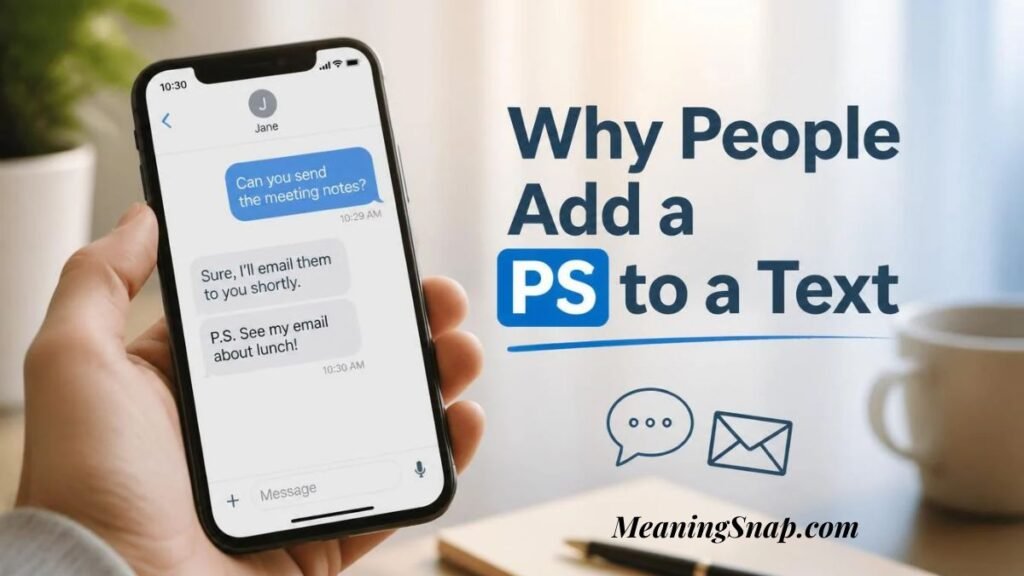
Nobody sends a PS by accident. The PS meaning in text depends on which of four jobs it does.
The forgotten detail
You hit send, then remember the parking spot, the time change, or the dish you promised to bring. Rewriting the whole message feels silly. A PS patches the gap in one line and keeps the main text clean.
The friendly reminder
Reminders land well at the bottom of a message. The line sits last, so it’s the last thing your eyes hit before you reply. That makes a PS handy for small to-dos, like bringing an ID or locking the door.
The joke or punchline
Comedy runs on timing. A PS lets you finish a normal message, then drop the funny part after a beat. The extra line changes how the whole text reads.
The sweet or teasing note
A PS also carries warmth. A compliment, a thank-you, or a gentle tease fits there without making the main message feel heavy. It’s a low-pressure way to say something kind.
You Also Like: LOML Meaning in Text: What It Says and How to Reply
PS Meaning in Text vs. a Traditional Letter
The idea stays the same, but the setup changes. This table shows how a PS in a text compares with one in a paper letter.
| Feature | Traditional letter | Text message |
|---|---|---|
| Where it sits | Below the signature | After the main message, often in the same bubble |
| Why people add it | Rewriting the page took too long | Style, humor, or a late thought |
| Typical length | One or two lines | One short line |
| Punctuation | P.S. or PS, usually with a colon | PS, ps, or P.S., with or without a colon |
| Tone | A personal touch | Casual and playful |
The biggest shift is intent. On paper, a postscript often fixed a real gap, because ink doesn’t erase. In a text, it’s more often a choice. That’s why the PS meaning in text feels lighter than the postscript at the bottom of a formal letter.
How to Read PS Meaning in Text From Context

Same two letters, different jobs. A few clues tell you which PS meaning in text you’re reading.
Clues: PS means postscript
Look for these signs:
- It follows a complete message, so it never opens a conversation.
- It adds a new thought instead of repeating the main point.
- A colon, a period, or a line break often comes right after it.
- The tone stays light and brief.
Clues PS means something else
A number glued to the letters, like PS5, points to a gaming console. A chat about photo editing, a school address, or a government job points elsewhere too. When the topic is niche and the message has no main body, check the surrounding words before you decide.
Read Also: SMH Meaning: What Does SMH Mean?
PS Meaning in Text: Real Conversation Examples
Seeing the PS meaning in text in action beats any definition. Here are six short chats, each with a different tone.
Jess: See you at 7! PS: bring your charger, mine died again.
That one’s friendly and practical. The PS carries a small request, and the tone stays easygoing.
Dan: Finished the whole pizza. PS: it was the large.
Dan uses the PS as a punchline. The joke lands because the extra detail makes the first line sound worse.
Priya: Meeting moved to 3 p.m. PS: don’t forget the slides.
This one works at the office. The news comes first, and the PS handles the small to-do.
Sam: Thanks for today. PS: you made my week.
Warm and sincere. Putting the compliment last gives it room to breathe.
Leo: Wi-Fi’s down again. PS: I love paying for this.
That’s sarcasm. The PS flips the meaning of “love” and signals plain frustration.
Mia: I got the job!!! PS: dinner’s on me.
Pure excitement. The big news leads, and the PS tacks on a bonus.
How to Use PS in Your Own Texts
Writing a good PS takes about ten seconds. Follow these four steps:
- Finish your main message first, with the key point up top.
- Add PS, then a colon or a space, then your extra thought.
- Keep it to one idea and one line.
- Match the mood. A joke PS on a serious message can land badly.
Here’s a quick before and after. Before: “Are we still on for Friday? Also, can you bring the speaker?” After: “Are we still on for Friday? PS: bring the speaker if you can.” The second version puts the question first and the favor last, which keeps the main point clear.
You May Like: TGIF Meaning in Text: The Real Definition, Uses, Examples & Social Media Guide (2026)
PS Meaning in Text on Instagram, TikTok, and Snapchat
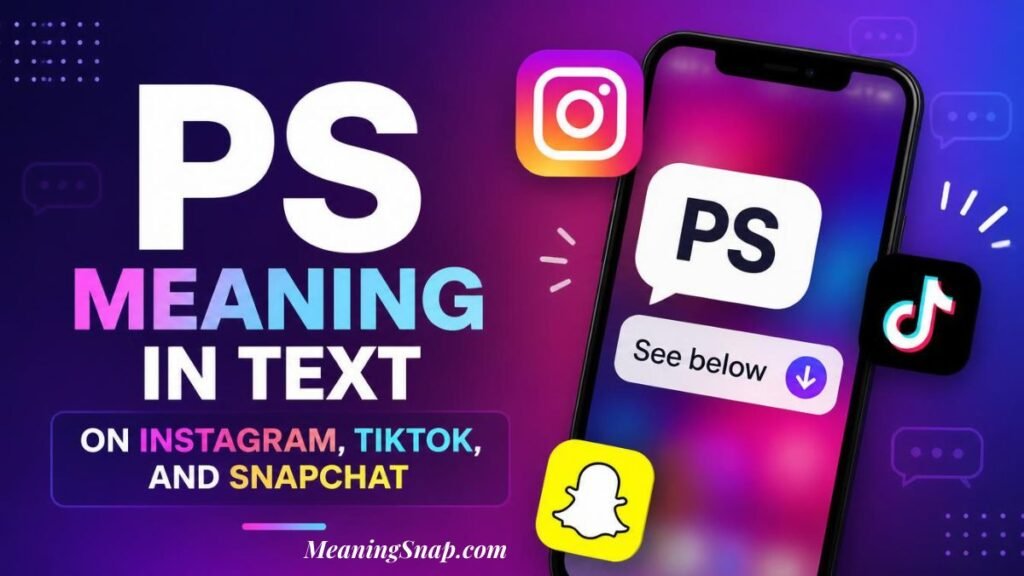
The PS meaning in text doesn’t change on social apps. It still means postscript. What changes is where it shows up, as the table below shows.
| Platform | Where PS shows up | Example |
|---|---|---|
| End of a caption or a comment reply | “Loved this trip. PS: the sunset was free.” | |
| TikTok | Video captions and comments | “Day 3 of learning guitar. PS: my neighbors hate me.” |
| Snapchat | Chat messages sent with or after a snap | “Check my story. PS: ignore the mess.” |
Dictionary.com lists no social-media-only sense of PS, so the same postscript meaning carries across all three apps. Captions run short, which makes a PS a neat spot for a last-line joke or a quick tag.
PS Meaning in Text From a Guy or a Girl
Search around, and you’ll find people asking whether PS means something different depending on who sends it. It doesn’t, because the PS meaning in text stays the same for everyone. Neither Merriam-Webster nor Dictionary.com attaches a gendered meaning to PS.
What changes the feel is the content and your history with the sender. A PS about snacks from a coworker is logistics. A PS with a compliment from a close friend is affection. Read the line itself, not the sender. If a PS leaves you guessing, a quick question clears it up faster than overthinking.
Read Also: WYG Meaning in Text: What It Means & How to Reply
PS Meaning in Text in a Relationship (and “P.S. I Love You”)

In a relationship, the PS often carries the softest line of the message. Partners and close friends use it for compliments, inside jokes, and small promises. The main text handles the plans, and the PS handles the feelings.
You may also think of the title that made the phrase famous. Cecelia Ahern published the novel PS, I Love You in 2004, and a film version starring Hilary Swank and Gerard Butler followed in 2007. In the story, a widow receives letters from her late husband, and each one ends with that same line. The title shows what a PS can do at its best. Instead of an afterthought, it carries the line that matters most.
PS Meaning in Text: PS vs. P.S. vs. PPS
Two letters, several ways to write them. This table shows the common forms and where each one fits.
| Form | Where you’ll see it | Note |
|---|---|---|
| P.S. | Letters and formal writing | The classic form with periods, which Dictionary.com lists as an abbreviation of postscript |
| PS | Texts, emails, and captions | The form the Chicago Manual of Style prefers, with no periods |
| p.s. | Casual chats | Dictionary.com lists the lowercase version too |
| PS: | After any of the forms above | Chicago says a colon or a period can follow PS |
| P.P.S. or PPS | A second afterthought | Dictionary.com lists it as an additional postscript, from the Latin post postscriptum |
Style guides don’t agree on periods, so check what your school or workplace follows. If nobody’s checking, pick one form and stay consistent.
A PPS stacks a second afterthought under the first, like “PPS: still waiting on my charger.” It’s fun once, but a third one starts to feel like rambling. Keep in mind that PPS also means parliamentary private secretary in British politics, so context matters.
PS Meaning in Text at Work and in Email
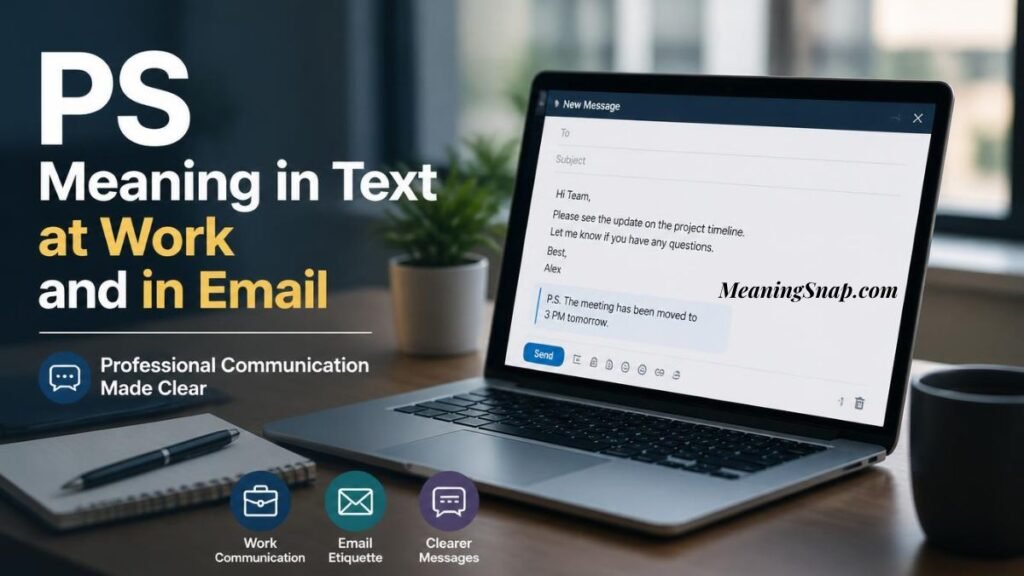
The PS meaning in text carries over to work, too. In a work email, a PS goes below your signature, the same spot it held on paper. It reads friendly and a little personal. Some writers add a short PS to a business letter for that human touch, and others skip it. Follow your reader’s tone.
Here’s a simple rule. If the extra detail affects a decision, put it in the main message. A PS works for a thank-you, a lunch plan, or a light aside, not for a deadline or a request someone must see.
In a work chat on Slack or Teams, the same logic holds. A PS fits a casual team, but a stiff or formal one may find it odd. When in doubt, drop it and write a normal sentence.
Read Also: IFG Meaning in Text: What It Stands For and How to Reply
Common Mistakes With PS Meaning in Text
Most slip-ups with PS meaning in text come down to three habits.
First, people bury the main point in the PS. If the message hinges on one line, that line belongs up top. A reader who skims might treat the PS as a side note and miss it.
Second, people stack too many. One PS feels like a charming afterthought. Four feel like the writer forgot how to end a message.
Third, people open with PS. The term means “written after,” so it needs something to come after. A text that starts with PS reads odd, and the reader has no main message to attach it to.
Other Things PS Can Stand For
PS isn’t always a postscript, so the PS meaning in text can shift in niche settings. This table lists the other meanings you might meet, with how common each one is.
| Meaning | Where it shows up | How common |
|---|---|---|
| Postscript | Texts, letters, emails, captions | Most common |
| PlayStation | Gaming chats, as in PS5 or PS4 | Common in gaming talk |
| Photoshop | Design and photo-editing talk | Niche, depends on the group |
| Public school | School names, like P.S. 123 in New York City | Regional |
| Private or permanent secretary | Government offices | Professional and regional |
| Pulmonary stenosis or performance status | Medical records | Technical |
Two of these need a little more care. In government, the meaning shifts by country and office. Bangladesh, for example, uses “PS to PM” for the private secretary to the prime minister.
The medical meanings belong in clinical notes, not in your group chat. A heart-valve term and a cancer-care score both use PS in hospital paperwork. If you see PS in your own medical records, ask your doctor’s office what it stands for. Never guess from the abbreviation alone.
Read Also: PSA Meaning in Text: What Does PSA Mean in Chat? (Updated 2026)
Alternatives to PS in Text
Sometimes PS feels too formal or too long. This table shows quick swaps and the mood each one sets.
| Phrase | Tone | Best for |
|---|---|---|
| btw | Casual | A quick side thought |
| oh, and | Casual, spoken | A small add-on |
| one more thing | Friendly, a little dramatic | An important add-on |
| side note | Neutral | A tangent |
| edit: | Online, practical | Fixing a post or comment you already sent |
None of them carry the “written after” feel of a PS, so pick PS when the add-on works as a closing note.
FAQs
Is PS formal or informal in a text?
Both work. In texts, it reads casual and friendly, while a P.S. in a letter or business email feels more traditional.
Is PS formal or informal in a text?
Both work. In texts, it reads casual and friendly, while a P.S. in a letter or business email feels more traditional.
Should a PS go in the same text or a separate one?
Keep it in the same message when you can. Send it separately only if the extra thought hits you after you press send.
Is PS still used today?
Yes. Chicago and Merriam-Webster still cover it, and people keep adding it to texts, emails, and captions.
Do I need a colon after PS?
No. Chicago says either a colon or a period can follow PS, and texts forgive either choice, or none at all.
How do you say PS out loud?
Say the letters, “P-S,” or say the full word, “postscript.”
Do I need to reply to a PS?
Only if it asks something. A question or request deserves an answer, while a joke or compliment is fine with a quick reaction.
Using PS Well in Your Next Text
The PS meaning in text is simple once you know its job. It’s the line you add after the main message, usually a reminder, a joke, or a kind word. Check the context before you assume the meaning, since PS5 and a PS to the prime minister aren’t postscripts. Keep your own PS short, stick to one idea, and let it do what it has done for centuries: say the last thing that matters. Next time you spot one, read it as the writer’s final word, then decide whether it needs a reply.

Alex Morgan is a writer focused on explaining slang, words, phrases, acronyms, and popular expressions in a simple and easy-to-understand way. Through clear explanations and helpful examples, Alex helps readers quickly understand what words and phrases mean and how they’re commonly used.