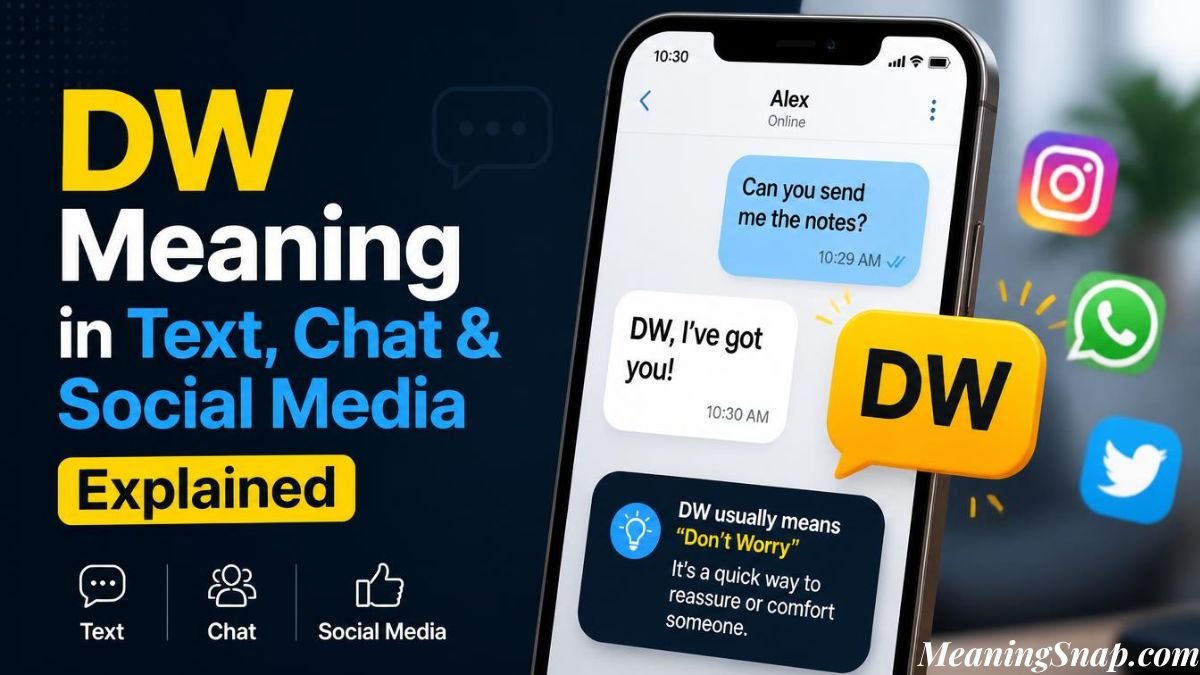
Someone texts you “running 10 min late, sorry!!” and all you get back is “dw.” No punctuation, no emoji, nothing else. For a second you might wonder if they’re annoyed or just typing fast. Then it clicks. That’s usually the moment people first look up the DW meaning and realize it’s not attitude at all; it’s the opposite. DW is one of those tiny abbreviations that shows up constantly in texts, group chats, and comment sections, and once you know it, you’ll spot it everywhere. Here’s what it stands for, when people use it, and the handful of situations where it means something else entirely.
What Does DW Mean?
DW stands for “don’t worry.” That’s the short answer, and it covers the overwhelming majority of times you’ll run into it in a text, DM, or comment.
Quick Answer: DW means “don’t worry.” People send it to reassure someone fast, without typing out a full sentence.
People reach for DW after apologizing for something small, when a friend seems stressed about nothing serious, or just to close out a topic without more back and forth. It works fine as a full reply on its own, no extra words needed.
Jess: “ugh sorry I forgot to text you back last night” Sam: “dw lol I was asleep anyway”
That single “dw” does the job of an entire reassuring paragraph. It tells Jess nothing’s wrong, no explanation is needed, and the conversation can move on.
Where DW Came From
DW is old by internet standards. Early entries for it show up on Urban Dictionary as far back as 2003, though people were already using it in chatrooms and instant messengers like AOL and Yahoo before anyone bothered to document it. It grew up next to other clipped phrases from that era: brb, lol, tbh. Same idea behind all of them. Type less, say the same thing.
What’s a little unusual is that DW never quite faded the way some 2000s internet slang did. It moved from AIM windows to text messages to Instagram DMs without losing its meaning along the way, which isn’t true of most slang that old.
Read Also: Endeavor Meaning: Definition, Examples & How to Use It
DW in Everyday Texts and Instagram DMs
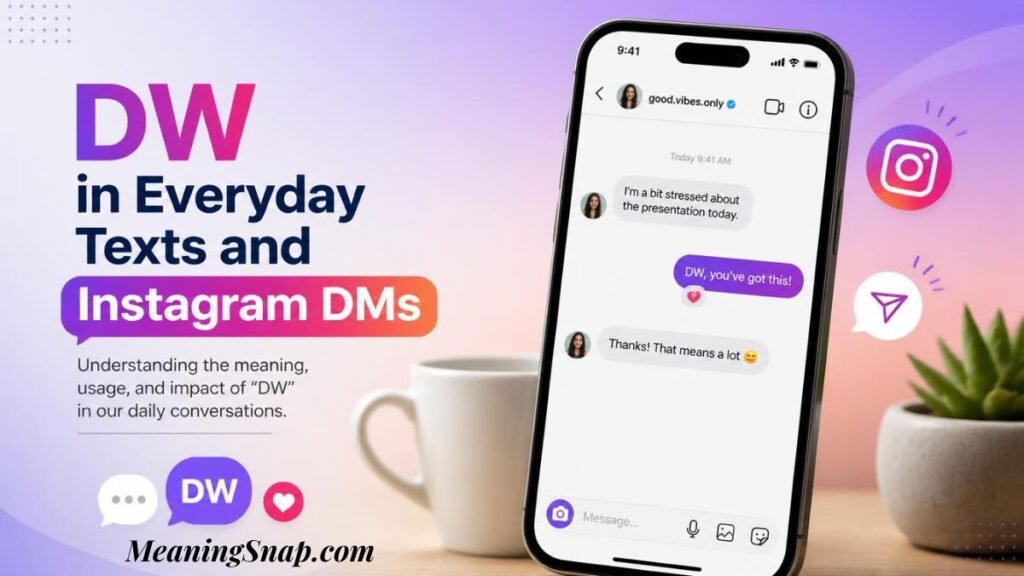
The meaning barely shifts depending on where you see it. In a regular text, an Instagram DM, or a comment, DW still means “don’t worry” almost every time.
A couple of quick examples:
- Group chat, trip planning: “guys I still haven’t booked my flight” → “dw we’ll figure it out”
- Instagram comment, someone worried about a typo in their caption: “no one’s even gonna notice, dw”
That consistency is worth knowing before you assume DW means something different just because it showed up somewhere new. The platform-specific sections below cover the few places where tone, not meaning, genuinely shifts.
Does DW Always Mean “Don’t Worry”? The Other Real Meanings
“Don’t worry” covers the huge majority of cases, but DW has a few other meanings that show up often enough to be worth knowing.
Dear Wife / Darling Wife
In parenting forums, infertility and pregnancy communities, and some marriage-focused message boards, DW stands for “dear wife” or “darling wife.” It’s part of a small family of similar shorthand from that same forum culture: DH for dear husband, DD for dear daughter, DS for dear son. Someone posting “my DW just got back from her appointment” is talking about their spouse, not reassuring anyone. This usage is older and far more niche than “don’t worry,” mostly confined to that specific corner of the internet, but it hasn’t disappeared. Occasionally the “dear” gets used with a wink, too, when someone’s mildly annoyed with their spouse and wants to complain about them in a lighthearted way rather than a genuinely affectionate one.
Doctor Who
In fandom spaces built around the BBC series, DW is shorthand for Doctor Who itself, not the phrase. Context makes it obvious fast, since nobody’s discussing regeneration episodes while also comforting a friend mid-conversation. The Discord section below covers exactly where this mix-up tends to happen.
There’s a related one worth a quick mention: D.W. is also the name of Arthur’s little sister in the Arthur children’s book and TV series, and she’s become a fairly memed character in her own right online. It’s a niche reference, but if you grew up watching PBS Kids, it might click faster than the show acronym does.
Data Warehouse
In IT and business settings, DW stands for data warehouse, a system used to store and organize large amounts of company data for reporting and analytics. It shows up in job descriptions, technical documentation, and internal work chats, essentially never in a casual text.
Also Read: OML Meaning in Text: What It Means & How to Use It
How to Tell Which DW Someone Means
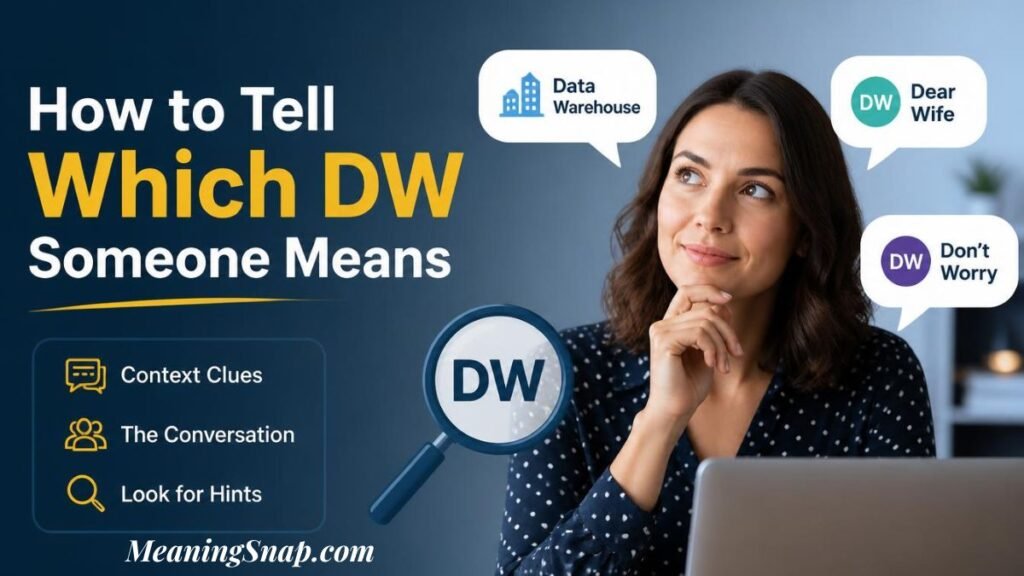
With four or five possible meanings floating around, context does most of the work for you.
- Who’s texting and about what. A husband typing “picking up DW from work” means dear wife. A friend replying to your apology means don’t worry.
- The platform. A parenting forum thread or marriage-focused post points to dear wife. A Doctor Who subreddit or fan Discord points to the show. A regular DM or comment points to don’t worry, nearly every time.
- Whether it’s a stand-alone reply. DW used as the entire message, with nothing else attached, almost always means don’t worry. That’s the only meaning built to work on its own like that.
If none of that clears it up, don’t worry is still the safest bet. It’s the meaning behind the overwhelming majority of everyday uses, and if you’re ever genuinely unsure in a real conversation, asking “wait, dw as in don’t worry?” is a completely normal thing to send.
Is DW Rude, Dismissive, or Just Casual? Reading the Tone
Because DW is so short, it can land differently than the sender meant. A few examples show the range:
- Sincere: “hope you’re not upset about the mix up” → “dw, i mean it, we’re all good.” No hidden edge here.
- Neutral, just efficient: “sorry for the late reply!” → “dw.” Not cold, just brief.
- Dismissive: someone shares something they’re genuinely nervous about and gets a flat “dw” with nothing else. In that context, it can read as brushing the person off instead of comforting them.
- Soft, almost flirty: on dating apps, a quick “dw, I’m not judging you lol” after someone overshares tends to read as gentle rather than dismissive.
- Self-deprecating, a little sarcastic: after someone visibly messes something up and jokes about it, “dw, definitely didn’t just tank the whole group project lol” reads as humor aimed at themselves, not real reassurance.
The difference usually comes down to what came right before it, and whether anything else is attached. A bare “dw” replying to something someone’s genuinely anxious about can feel cold. The same “dw” followed by a few more words, “dw, seriously, it happens,” reads as warm.
Still not sure what that “dw” in your last text meant? Our free slang tools can decode it in seconds.
Free No Sign Up Need
Try Our Free Slang ToolsDW vs Other Reassurance Slang
DW isn’t the only shorthand people lean on to calm someone down. Here’s how it stacks up against the ones it gets confused with most.
| Term | Meaning | Typical Use |
|---|---|---|
| DW | Don’t worry | Reassuring someone before or after a small problem |
| NP | No problem | Replying to a thank-you or a request, more transactional than comfort |
| NVM | Never mind | Dropping a topic, not necessarily reassurance |
| No worries | Don’t worry, spelled out | Slightly warmer, common in UK and AU English |
| It’s fine | Everything’s okay | Can read flatter or more clipped than DW |
| All good | Everything’s okay | Casual and upbeat, similar warmth to DW |
| IDC | I don’t care | Signals indifference, not reassurance |
The distinction worth remembering: DW is about easing someone’s mind before or after something happens. NP and IDC aren’t reassurance at all, they’re just closing out a topic.
How to Respond to a DW
There’s no single right way to respond to a DW, but the reply usually matches how the conversation started.
Casual and low-stakes, a thumbs-up emoji, “okay good lol,” or “appreciate that” all work fine. If the DW was reassuring you about something that mattered to you, something a little warmer lands better: “thank you, that means a lot” or “okay, I trust you on that.” If the DW felt dismissive and you want a real answer, try “I get that, but I’d still like to talk about it” rather than pushing back with more questions. None of these need to be long. The point of responding to a DW at all is usually just to confirm you got the message, not to open a new conversation.
Read Also: WYD Meaning: What Does WYD Mean in Texting?
When to Skip DW at Work
DW works fine in a casual Slack message to a coworker you’re friendly with. It’s less safe in an email to a client, a message to a manager you don’t know well, or anything that might get forwarded.
The issue isn’t that DW is inappropriate; it’s that abbreviations read as more casual than intended once they land in a formal thread, and not everyone reading it will know what it means. A client who’s never seen the shorthand before might read it as curt rather than reassuring. Spelling out “don’t worry about it” costs two extra words and removes any doubt.
DW Meaning on WhatsApp
On WhatsApp, DW still means “don’t worry,” and it shows up constantly in family groups and international friend chats since WhatsApp is the default messaging app in most of the world outside the US. Because those chats often mix generations and formality levels, DW tends to appear alongside fuller phrases rather than replacing them outright, something like “dw, I’ll handle the tickets, no worries at all.”
DW Meaning on Snapchat
DW means the same thing on Snapchat as anywhere else: don’t worry. Snapchat conversations move fast and disappear, so DW functions almost like a verbal tic there, tossed in to keep a Snap thread moving rather than to make a big statement. A typical exchange: “streak’s about to end lol” → “dw I got it.”
DW Meaning on TikTok
On TikTok, DW shows up constantly in comment sections, almost always meaning “don’t worry.” Commenters use it to reassure people who are anxious about a video topic or a small mistake someone points out, like “dw everyone messes this up the first time” under a tutorial. It’s far more common in replies underneath a video than in captions themselves.
DW Meaning on Discord
Two separate things happen with DW on Discord, and they don’t overlap. In a friend group’s server or a game’s voice channel, it gets used exactly like it does everywhere else: a quick “dw, gg next round” after someone flubs a play. In Doctor Who fan servers specifically, DW usually refers to the show, showing up in channel names like “dw-discussion” or in pinned rules about spoiler tags. If you’re in a general gaming server, assume don’t worry. If the server is clearly built around the show, assume Doctor Who.
DW Meaning in Text From a Girl
There’s no different meaning of DW depending on who’s sending it. From a girl, a guy, or anyone else, it means “don’t worry” the vast majority of the time. This search mostly exists because people want to know if there’s a hidden flirty or romantic layer to it. There usually isn’t, though tone can read warmer in a one-on-one conversation than in a group chat, the same way it does for anyone sending it.
You May Like: RSVP Meaning: What It Stands For & How to Use It (Complete Guide)
DW Meaning in Text From a Boy
Same answer as above: DW means “don’t worry” regardless of who sends it. The one place gender changes the meaning is the “dear wife” usage covered earlier, which is almost always written by a husband referring to his spouse, not the other way around. Outside that specific context, a “dw” from a guy reads exactly the same as one from anyone else.
DW Meaning in Medical Contexts
Outside of texting, DW shows up in two unrelated medical contexts. In pharmacy and nursing notes, DW is shorthand for distilled water, used in dosage and preparation instructions. In radiology, DW, or DWI, refers to diffusion-weighted imaging, an MRI technique that tracks how water molecules move through tissue, often used to catch strokes and tumors early. Neither has anything to do with texting slang, and the two rarely get confused since they show up in completely different settings.
DW Meaning on Urban Dictionary
Urban Dictionary has hosted community-submitted definitions for DW for over two decades, with entries dating back to 2003. The most upvoted definitions consistently point to “don’t worry,” matching how the term is used everywhere else. Because anyone can submit a definition, Urban Dictionary also carries a handful of joke entries and regional variations that don’t reflect common usage, so it’s worth treating as a snapshot of slang culture rather than a dictionary in the strict sense.
Frequently Asked Questions
What does DW mean in a text?
DW means “don’t worry.” It’s used to reassure someone quickly, often as a stand-alone reply.
Does DW always mean “don’t worry”?
Not always, but almost always. In parenting and marriage forums it can mean “dear wife,” and in Doctor Who fan spaces it refers to the show.
Is DW considered rude?
Not by default. It can come across as dismissive if it’s the only reply to something someone’s genuinely upset about, but on its own it’s meant as reassurance, not a brush-off.
What’s the difference between DW and NP?
DW reassures someone that something isn’t a problem. NP, short for no problem, typically replies to a thank-you or small request rather than calming someone down.
Can you use DW in professional messages?
It’s fine in casual internal chats like Slack, but it’s better to spell out “don’t worry about it” in emails or messages to people outside your immediate team.
Bottom Line
Most of the time, seeing DW in a text just means someone’s telling you to relax, nothing more complicated than that. Keep an eye on where you’re seeing it, though. In a Doctor Who fan group or a parenting forum, those two letters are doing a completely different job. When in doubt, look at who sent it and what they were replying to. That’s usually all the context you need.

Alex Morgan is a writer focused on explaining slang, words, phrases, acronyms, and popular expressions in a simple and easy-to-understand way. Through clear explanations and helpful examples, Alex helps readers quickly understand what words and phrases mean and how they’re commonly used.