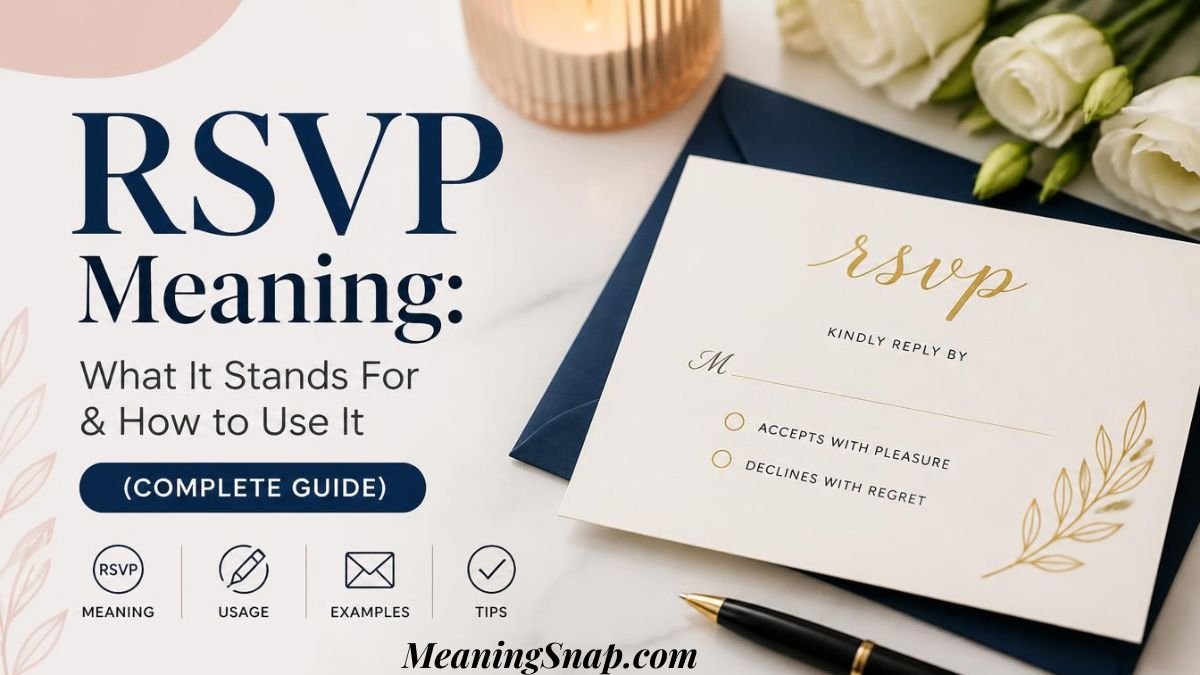
I still remember standing in my kitchen holding a wedding invitation, staring at the letters “RSVP by March 15th” like they were written in code. Wait, technically they kind of were, just French code. I had no idea if I was supposed to call, text, mail something back, or show up and hope for the best. Turns out, a lot of people search for RSVP meaning every month for the exact same reason I did that day. If you’ve ever felt that same confused pause before an invitation, you’re in good company.
This guide covers more than a one-line definition. You’re getting the full RSVP definition, where the phrase comes from, how to use it correctly across texting and email, and copy-paste reply examples for every kind of invitation you’ll run into. Whether you’re hosting or replying, this has you covered.
Quick Answer: RSVP stands for the French phrase “Répondez s’il vous plaît,” which means “please respond.” It’s used on invitations to ask guests to confirm attendance by a set deadline, whether the answer is yes or no.
What Does RSVP Stand For? The Real RSVP Meaning and French Origin
RSVP is an abbreviation for “Répondez s’il vous plaît,” a French phrase that translates to “please respond.” That’s the short version of the RSVP definition, but the full story is more interesting than four letters suggest. French was the language of diplomacy and high society for centuries, so when formal invitations became a thing in English-speaking countries, they borrowed the French phrase whole. The habit stuck, and the RSVP abbreviation became standard on invitations everywhere, even in places where nobody speaks a word of French.
Here’s the twist: France barely uses RSVP anymore. Modern French invitations are more likely to say “Réponse attendue avant le…” (answer expected before), and the shorter SVP covers “please” on its own. So the phrase that feels so formal in English is considered old-fashioned back home.
As for pronunciation, most people just say the letters out loud, R-S-V-P, rather than spelling out the full French phrase. That’s the easiest way to say it. Knowing the French abbreviation matters here too, since it explains the deeper RSVP meaning behind the redundant “please RSVP” phrase, something we’ll get into next.
Also Read: MBN Meaning in Text: Complete Guide for 2026
Is RSVP a Verb or a Noun? Grammar, Capitalization, and the “Please RSVP” Debate
RSVP does double duty in English. As a verb, it means “to reply to an invitation,” like in “Please RSVP by Friday” or “She RSVP’d yes within an hour.” As a noun, it refers to the reply itself, as in “We got fifty RSVPs for the reunion.” Both uses are correct, and native speakers switch between them without thinking twice.
Past tense gets a little messy. You’ll see RSVP’d, RSVPed, and even RSVP’ed floating around. RSVP’d is the most common in casual writing, though none of the three forms is technically wrong. Pick one and stay consistent within the same piece of writing.
Now, about capitalization. RSVP is almost always written in all caps, since it’s an abbreviation of a French phrase rather than a regular word. You’ll occasionally see it written as “Rsvp” or lowercase “rsvp” in a group chat, and that’s fine casually, but formal invitations and professional emails should stick to the capitalized version.
And yes, “please RSVP” is redundant. The “SV” in RSVP already means “s’il vous plaît,” so “please RSVP” technically translates to “please please respond.” It’s common enough that nobody minds, but “RSVP by [date]” works just as well without the extra please. Understanding this grammar piece is part of getting the full RSVP meaning right, not just the four-letter shorthand.
How to RSVP in 2026: Text, Email, WhatsApp, Instagram, and Facebook Events

The way people respond to an RSVP request looks nothing like it did twenty years ago. A formal RSVP card mailed back in an envelope still shows up for weddings, but most invitation replies now happen through a screen, whether that’s a text thread, an email invitation, or a dedicated RSVP link. Here’s a look at how a couple of these conversations play out.
Wedding text exchange:
Mom: “Did you RSVP for the wedding yet? They need the final headcount by next week.” You: “Not yet, sending it in tonight! Putting down yes plus one.”
Group chat barbecue invite:
Jordan: “BBQ at my place Saturday, bring a side if you can. RSVP so I know how much food to grab.” You: “In! I’ll bring the potato salad.”
Facebook Events works a little differently. You get three response options, Going, Interested, and Can’t Go, and only “Going” or “Can’t Go” counts as an actual RSVP. Marking “Interested” doesn’t tell the host anything solid, so if you know you’re attending, pick Going instead. WhatsApp has its own event feature built into group chats now too, letting members respond with a clear yes or no. Digital events like webinars and online workshops usually swap the RSVP card for a straightforward registration link, and Eventbrite and Meetup both use this same system for everything from small meetups to full virtual events. No matter the platform, the RSVP meaning stays the same: the host needs your answer.
RSVP isn’t the only invite term that trips people up, our tools can decode the rest too.
LEAD_SENTENCE_GOES_HERE
Try Our Free Slang ToolsCopy-and-Paste RSVP Reply Examples for Every Situation
Knowing what RSVP means doesn’t always make it easier to write the actual reply, especially when you’re staring at a blank text box trying to sound polite without overthinking it. These templates keep the RSVP meaning intact while doing the hard part of wording it for you.
For a wedding invite:
Host: “So excited to celebrate with you! Can you RSVP by May 1st?” You: “Wouldn’t miss it! Confirming yes for two, happy to send my meal preference whenever you need it.”
For declining a casual invite:
Friend: “Game night Friday, you coming?” You: “Can’t make it this time, have so much fun! Count me in for the next one.”
For a corporate event reply:
Manager: “Please RSVP through the link for the company picnic.” You: “RSVP’d for myself and two family members, thanks for the reminder.”
A short script works for almost any format, whether you’re replying by email, text, or an online RSVP form. Start with a clear yes or no, add any requested details like a plus-one or dietary restrictions, and close with a quick thank-you. No guest needs more than three sentences to give a host a definite answer.
RSVP Etiquette: US vs UK Rules (and the Mistakes Everyone Makes)
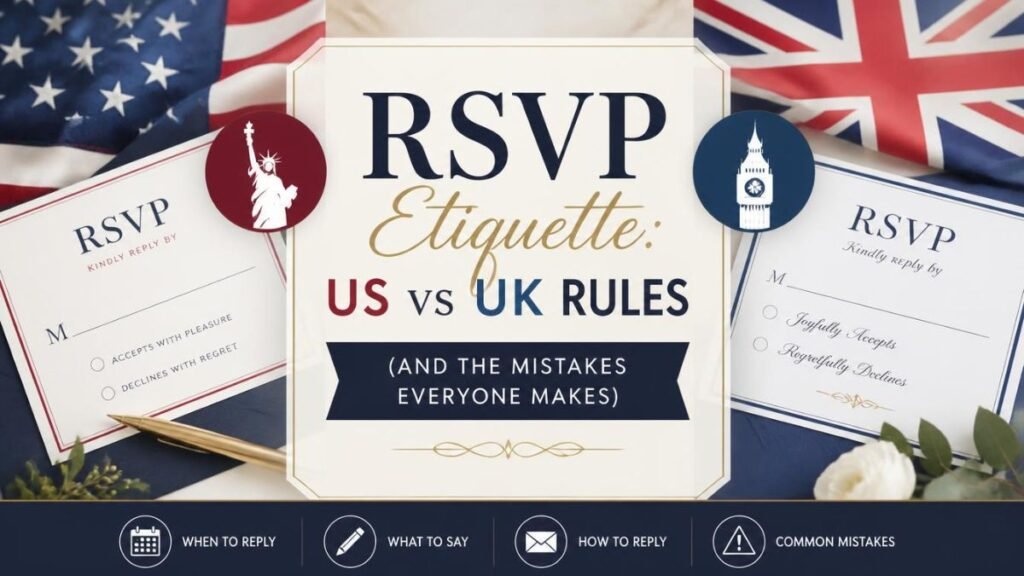
RSVP etiquette isn’t identical everywhere, even between two English-speaking countries that share most invitation customs. In the US, “regrets only” invitations are common for big family gatherings and low-key work events, meaning you only need to respond if you can’t make it. In the UK, that shortcut is far less common. British invitation etiquette leans slightly more formal by default, and guests are generally expected to reply either way, rather than assuming silence means yes.
Deadlines matter on both sides of the Atlantic. Four to six weeks before a wedding is typical for an RSVP deadline, and missing it puts real pressure on caterers, seating charts, and the overall budget for the event. A late RSVP isn’t the end of the world, but reaching out to apologize and ask if there’s still room beats staying silent.
A few mistakes show up constantly, no matter the country. People assume the host will chase them down for an answer instead of responding promptly on their own. Guests bring an uninvited plus-one because the invitation didn’t specifically say no. And plenty of people reply with a vague “maybe” when the host needed a clear answer to plan food and seating. Etiquette differences aside, the core RSVP meaning, respond clearly and on time, holds true everywhere.
Read Also: Alr Meaning in Text: What It Means, How to Use It, and Real Chat Examples
“Regrets Only,” “RSVP ASAP,” and Other RSVP Variations You’ll See
Beyond the standard RSVP request, you’ll run into a handful of variations depending on the type of invitation. Here’s a quick side-by-side of the phrases you’re most likely to see and what each one asks of you.
| Phrase on the Invitation | What It Means |
|---|---|
| RSVP, regrets only | Only respond if you cannot attend; silence means you’re expected |
| RSVP ASAP | Respond as soon as possible, usually because space or catering numbers are tight |
| RSVP by [date] | A plain, direct deadline with no extra wording needed |
| Please reply | The simplest English swap for RSVP, no French required |
| Kindly respond | A more formal, polished version often used for professional invitations |
| Confirm your attendance | Common in corporate events and conference invitations |
| Let me know | The most casual version, typically used between friends |
Each of these still circles back to the same RSVP meaning: the host wants a clear response. The tone shifts depending on the wording, from the warmth of “let me know” between friends to the polish of “kindly respond” on a formal invitation card. You’ll also hear “RSVP list” used by event planners, referring to the running list of confirmed guests they’re tracking as replies come in. Whichever version you spot, treat it with the same promptness you’d give a direct RSVP.
Read Also: WTW Meaning in Text: What It Really Stands For and How to Reply in 2026
The Soft RSVP Problem: Why a “Yes” Doesn’t Always Mean They’re Showing Up
Here’s the thing nobody talks about enough: an RSVP isn’t the guaranteed commitment it used to be. Plenty of people say yes to an invite with good intentions and then cancel last minute, or just don’t show up at all. This “soft RSVP” pattern has gotten common enough that hosts now plan around it, especially for casual events like birthday parties, barbecue parties, and game nights, where the stakes feel lower than a wedding.
Part of this comes from how easy it is to RSVP now. A tap on a Facebook Events button or a quick reply in a group chat takes way less effort than mailing back a paper card, so the emotional weight of saying yes has faded along with the effort itself. Social plans also compete with more last-minute options than they used to, which makes canceling feel less like breaking a promise and more like adjusting a loose plan.
Hosts have adapted by slightly overestimating their headcount for casual gatherings, sending reminder texts closer to the event, and saving the strict “no flaking” expectation for occasions where real money is on the line, like weddings or catered corporate functions. If you do have to back out after saying yes, a quick heads-up text goes a long way. That shift doesn’t change the RSVP meaning itself, just how seriously people treat the reply.
When You Don’t Need to RSVP
Not every invitation requires a formal reply, and figuring out when to skip it saves everyone some back-and-forth. Open house events are the clearest example. Since guests come and go on their own schedule, hosts don’t need an exact headcount, so there’s nothing to RSVP to in the first place.
Public events work the same way. Festivals, concerts, and street fairs don’t track individual attendance, so no host is waiting on your reply. Very small gatherings fall into a gray area too. If a close friend texts “come over Saturday,” a quick “sounds good” covers it without needing anything more official.
The clearest rule of thumb: if the invitation doesn’t mention a deadline, a card, or a link, it’s not expecting a formal RSVP. Even here, the RSVP meaning holds: only respond when a reply is genuinely being requested. That said, letting a host know you’re coming to a dinner party is still the polite move, since food and seating depend on it either way, and a short reply costs you nothing.
You Also Like: FWM Meaning in Text (2026): What It Really Means, Examples, Slang & Full Guide
RSVP Meaning in Wedding Cards
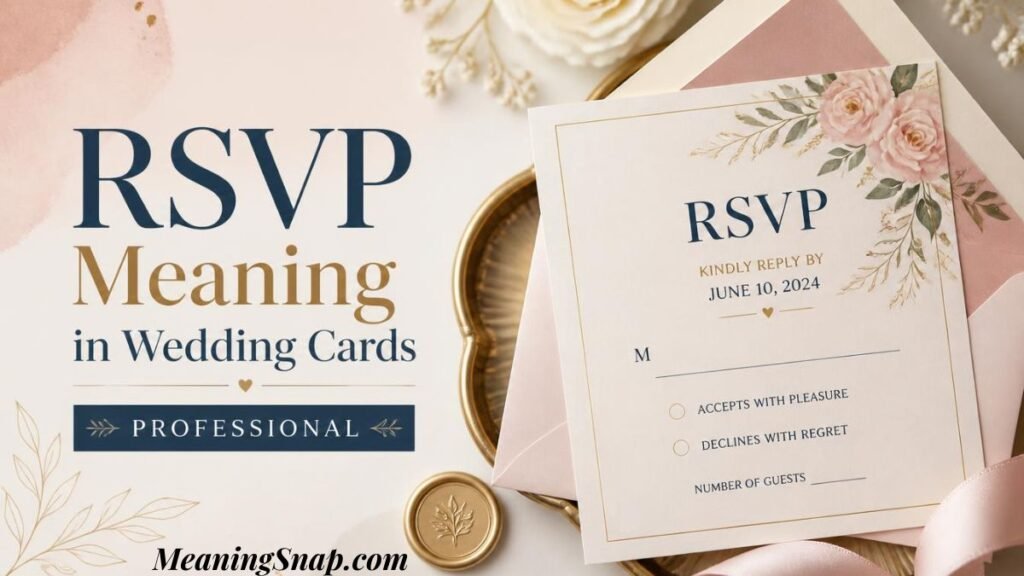
Wedding invitations are where most people first run into RSVP, usually printed in fancy script under a small envelope pocket. On a physical wedding card, the RSVP line almost always comes with a deadline and a mail-back card, sometimes with checkboxes for “accepts with pleasure” or “declines with regret.” Some cards add a line for meal choice or a plus-one name, so filling out that section matters as much as sending it back on time.
Wording varies by formality. A traditional card might say “The favor of a reply is requested by [date],” which means the exact same thing as RSVP without using the initialism at all. Modern wedding invites lean simpler, often printing “RSVP by [date] to [website or phone number]” instead of a mail-back card. Either way, the wedding invite is asking for the same thing: a clear answer that helps the couple finalize catering numbers and seating charts. Responding late on a wedding RSVP puts real pressure on vendors, so even a quick note explaining the delay beats staying silent.
RSVP Meaning in Invitation Cards
Outside of weddings, invitation cards use RSVP the exact same way, just with less formal wording. Birthday parties, baby showers, graduation parties, and holiday gatherings all print RSVP somewhere on the card, usually with a phone number, email, or a simple deadline attached. The core RSVP meaning doesn’t change from one type of card to another. It’s still a request to confirm whether you’re coming.
What changes is how strict the etiquette feels. A milestone birthday card might request a response by a set date because the host booked a venue with a fixed headcount. A casual holiday card might just say “RSVP if you can,” with no real deadline attached, more of a courtesy than a requirement. When a card doesn’t specify how to respond, a text or a phone call to the host works fine. The safest move with any invitation card is treating the request as genuine, even when the wording feels casual, since somebody is still planning food and seating around your answer.
Read More: JP Meaning in Text: What It Means in Chat, Social Media, and Online Slang
RSVP Meaning in Medical Contexts
RSVP means something completely different once you step into a hospital. In UK nursing and clinical settings, RSVP is a structured handover tool that stands for Reason, Story, Vital Signs, and Plan. Nurses and junior doctors use it to report a patient who’s showing signs of deterioration to a senior clinician quickly and clearly, similar to the SBAR framework used in other healthcare systems.
This version of RSVP has nothing to do with invitations. It’s a communication checklist built to reduce the risk of important details getting lost when someone reports a patient’s condition under pressure. If you’ve come across RSVP meaning in a nursing textbook or hospital training material, this clinical framework is most likely what’s being referenced, not an invitation reply. It’s worth knowing the distinction exists, but this guide focuses on the invitation side of RSVP, the one you’ll use day to day.
RSVP Meaning and Pronunciation
People occasionally wonder if RSVP has a correct way to say it out loud, especially since it’s rooted in French. The short answer: no need to overthink it. Almost everyone in English-speaking countries says the four letters individually, R-S-V-P, the same way you’d say any other initialism like ASAP or FYI.
You won’t hear people pronouncing the full French phrase in everyday conversation, even at a formal wedding. Saying “Répondez s’il vous plaît” out loud is reserved for trivia nights and etymology explanations, not actual invitations. If you’re ever unsure, sticking to the letter-by-letter pronunciation is always safe, and it won’t change how anyone interprets the RSVP meaning behind it. The only real mistake worth avoiding is writing out “RSVP please” or misspelling the acronym on a formal card, since that’s the detail people notice more than how you say it out loud.
Want to search More Slang or decode or translate check out our Free Tool Now.
LEAD_SENTENCE_GOES_HERE
Try Our Free Slang ToolsRSVP Meaning in Microsoft Teams
Workplace calendars turned RSVP into something you click instead of write. When someone sends a Microsoft Teams meeting invite, you’ll typically see three response buttons: Accept, Tentative, and Decline. That’s the modern, corporate version of an RSVP request, just built directly into the calendar instead of a card or email.
Choosing Tentative works similarly to marking “Interested” on Facebook Events. It tells the organizer you might attend without giving them a firm answer, which isn’t always helpful if they’re booking a meeting room or ordering lunch for the group. If you already know you’re attending or skipping, Accept or Decline gives the organizer a cleaner headcount to work with. Outlook uses the same three-option system, and both platforms send the organizer a running tally as responses come in, similar to how an RSVP list works for an in-person event. For recurring meetings, updating your response instead of leaving it on the original reply also keeps that tally accurate.
RSVP Meaning in Slang and Texting Culture

In texting and group chats, RSVP keeps its original meaning, just with a much more relaxed delivery. You’ll see it typed in lowercase, shortened further in some threads, or dropped into a sentence casually, like “gonna rsvp tonight” instead of a formal reply. None of that changes what the word is asking for. It’s still a request to confirm.
What shifts is the tone. Friends might use RSVP jokingly, tacking on extra emphasis like “hard yes” or “hard pass” instead of a plain yes or no, especially in a group chat full of inside jokes. Some people also treat an emoji reaction, like a thumbs-up on a group message, as an informal RSVP, even though it’s less reliable than an actual written reply. If the plans matter enough, following up with a real response is still worth the extra ten seconds, emoji reaction or not.
RSVP Meaning in Business
Corporate events run on RSVP the same way weddings do, just with different stakes attached. Conferences, client dinners, company parties, and product launches all rely on accurate RSVP numbers to book venues, order catering, and plan seating. A business RSVP request usually comes through an event registration link, tools like Eventbrite or Cvent, or a company-wide calendar invite.
Professional settings tend to treat RSVP etiquette a little more strictly than casual gatherings. Replying late, or not at all, can read as unprofessional in a way that skipping a friend’s barbecue never would. Most corporate invitations also ask for details beyond a simple yes, like dietary restrictions or which sessions you plan to attend at a conference. Giving that information along with your RSVP saves the organizer from following up individually, which matters more in a business setting where someone’s job might depend on getting the headcount right.
RSVP Meaning at Concerts
Concerts work differently from most other events that use RSVP. When you buy a ticket, that purchase already confirms your attendance, so there’s usually nothing left to RSVP to. The ticket itself functions as your response.
RSVP still shows up around concerts in a couple of specific situations. Free shows, industry showcases, and smaller venue gigs sometimes use a guest list instead of ticket sales, and getting on that list requires an actual RSVP through the venue, artist, or promoter. Meet-and-greet add-ons and backstage passes work the same way, often requiring a separate RSVP beyond the concert ticket itself. Outside of those cases, if you already have a ticket in hand, there’s no RSVP meaning to worry about. The ticket has already done that job for you.
Frequently Asked Questions
Is RSVP still used today, or is it old-fashioned?
It’s still the standard on most invitations, from wedding invites to office party emails. The RSVP meaning hasn’t changed even as the delivery method has, from paper cards to text threads.
Do you have to RSVP if you’re not going?
Yes, unless the invitation says “regrets only.” The RSVP meaning is please respond, not please respond only if you’re coming, so the host needs to hear from you either way.
What does RSVP regrets only mean?
It means you only need to reply if you can’t attend. No response is taken as a yes, so silence works in your favor here instead of against it.
Is RSVP always capitalized?
In formal writing, yes. Casual texting sometimes drops it to lowercase “rsvp,” which is fine in a group chat but not on a professional invitation.
What’s a polite way to decline an RSVP over text?
Keep it short and warm: thank them for the invite, say clearly that you can’t make it, and mention you’re sorry to miss it. No long explanation needed.
How do you pronounce RSVP?
Most people say the four letters individually, R-S-V-P, rather than the full French phrase. That’s the standard and easiest way to say it out loud.
Is “please RSVP” grammatically wrong?
It’s redundant rather than wrong, since the phrase already includes “please” in French. It’s common enough that nobody will bat an eye if you use it anyway.
Conclusion
Four letters, one French phrase, and a lot of confusion for anyone seeing it for the first time. That’s the honest RSVP meaning in a nutshell: a polite but direct request to confirm your attendance, whether the answer is yes or no. Once you know the backstory and the etiquette behind it, replying to any invitation gets a lot less stressful.
Bottom line: respond by the deadline, give a clear answer instead of a vague one, and follow through once you’ve said yes. Whether you’re hosting a corporate event or replying to a friend’s barbecue invite, the RSVP meaning comes down to clarity and timing. Next time that little acronym shows up on an invitation, you’ll know exactly what to do with it.

Alex Morgan is a writer focused on explaining slang, words, phrases, acronyms, and popular expressions in a simple and easy-to-understand way. Through clear explanations and helpful examples, Alex helps readers quickly understand what words and phrases mean and how they’re commonly used.