My friend Jake texted me one night: “I’ll pick you up at 7, that new Thai place?” I said sure, no big deal. His reply was one word: “okg.” No emoji, no punctuation, nothing else. I sat there staring at my phone, trying to figure out if he was excited, annoyed, or just typing with one thumb while walking his dog. If you’ve had that exact moment of confusion, you’re not alone. Searching OKG meaning in text has turned into one of those fast-growing slang questions, and honestly, that’s because the term is genuinely this ambiguous. Here’s the thing: OKG isn’t some secret code with one locked-in definition.
It’s a casual acknowledgment that Gen Z and millennials toss into chats, group threads, and comment sections when a full sentence feels like too much effort. By the time you finish this guide, you’ll know exactly what OKG means, when it reads as warm, when it reads as flat, and how to reply without overthinking it.
What Does OKG Mean in Text?
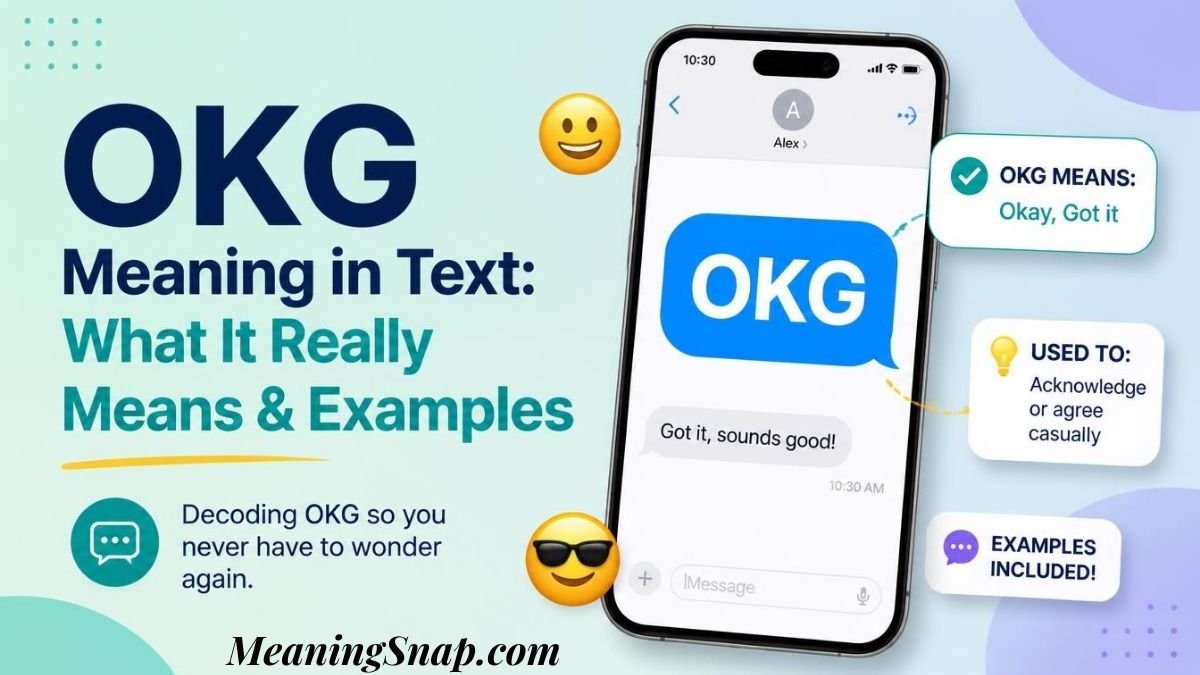
So what’s the real OKG meaning in text? At its core, OKG works as a relaxed version of “okay,” something like “okay, good” or “okay, got it,” though nobody agreed on that in some official meeting. It just happened, the way most texting slang happens.
Quick Answer: OKG usually signals a friendly, low-effort “okay.” It tells the other person you saw the message, you’re fine with it, and you don’t feel the need to add much else.
Here’s where things get messy, though. Search around and you’ll find sites confidently telling you OKG stands for exactly one thing. One page insists it’s “Okay, Good.” Another swears it’s “Okay, Got it.” A third claims it’s short for “Okay, Girl” or “okay gee.” None of them cite an actual source, because there isn’t one to cite. Unlike LOL or BRB, OKG never landed in a dictionary with one fixed meaning. It’s living slang, and living slang shifts depending on who’s typing it and what came right before it in the conversation.
What stays consistent across almost every real use is the vibe: quick, low-effort, and generally positive. Nobody fires off “OKG” when they’re furious. If a person is upset, you’ll get a full paragraph or total silence, not a cheerful three-letter reply. That consistency in tone is more reliable than any single “official” definition floating around online.
Where Did OKG Come From?
Nobody can point to the exact day the OKG meaning slang first showed up, and any article that claims otherwise is guessing. What we do know is that it fits a pattern. Texting culture has spent decades shrinking phrases down: OK became K, “got it” became “gotcha,” and eventually people started tacking extra letters onto OK itself, OKG being one version among several (okie, okay-dokie, kk).
Understanding the OKG meaning in text also means knowing what it doesn’t mean historically. This kind of casual expression spreads because it’s fast to type and impossible to misread as angry. Group chats, comment sections, and Discord servers all reward short replies, and OKG fits that space perfectly.
Interestingly, OKG already existed before texting made it slang. Look it up on Wikipedia and you’ll find a short disambiguation page listing a few real, unrelated meanings: OKG AB is an actual Swedish nuclear power company, and ornithine alpha-ketoglutarate is a real amino acid compound sometimes used in sports supplements. Neither has anything to do with texting, but it’s a fun reminder that three-letter combinations get recycled constantly across totally different specialized fields.
If you ever see OKG in a scientific or business context, it’s almost always one of these older, unrelated meanings and not the texting slang at all. That’s worth knowing, because a lot of pages online blur the line between the real technical terminology and the slang, presenting vague guesses about niche industries as if they were confirmed facts. The honest answer is simpler: the texting slang and the older technical terms just happen to share three letters, nothing more.
Read More About: What Does FAFO Mean in Slang? Full Guide (2026)
OKG on Snapchat, WhatsApp, Instagram & TikTok
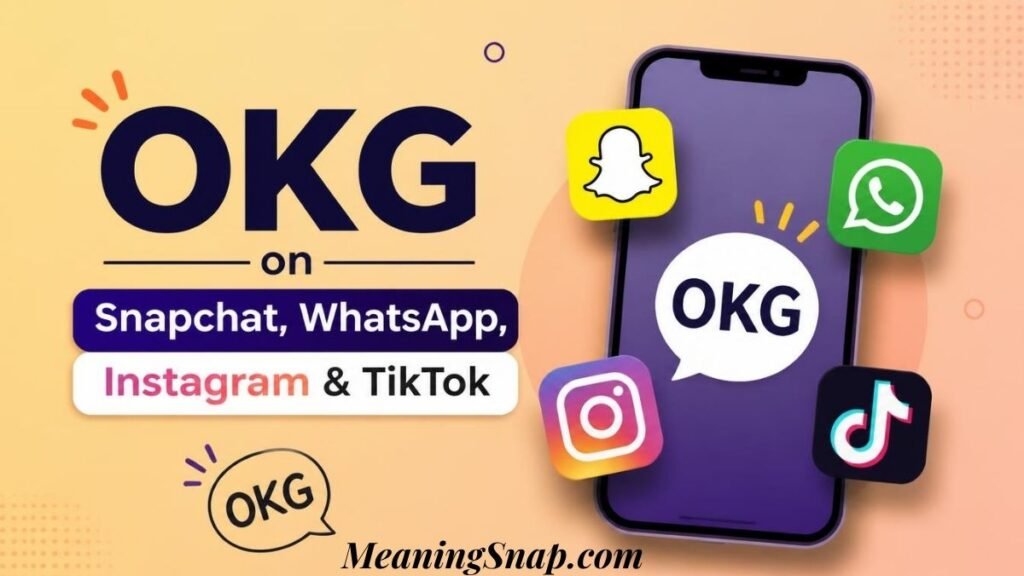
The OKG meaning in text shifts slightly depending on where you see it, and platform matters more than people expect.
On WhatsApp, OKG usually confirms plans. Someone sends a time or location, and OKG closes the loop without dragging the conversation out.
Maya: “Movie’s at 8, meet you outside?”
You: “OKG, see you there!”
Snapchat works a lot like WhatsApp here. If you’re specifically after the OKG meaning in snap, it’s the same quick confirmation, just wrapped around a disappearing photo or story instead of a plain text bubble. Because snaps vanish fast, people default to the shortest possible reply, and OKG fits that rhythm well.
On Instagram and TikTok comments, OKG often shows up as a quick, public reaction, agreeing with a caption or acknowledging a post without writing a full sentence. It reads lighter here than in a private chat, closer to a thumbs-up than a real reply.
Group chats are where the OKG meaning in chat becomes clearest. It works almost like a check mark: when someone drops a reminder or an update, a few people reply “okg” just to confirm they saw it, and the conversation moves on without anyone repeating themselves.
Dating apps tell a slightly different story. A quick “okg” after locking in a date can feel casual and confident, but sent right after a longer, more personal message, it can come across as underwhelming. Context, again, decides everything.
Instant messaging apps built for work, like Slack or Teams, treat OKG a bit differently than personal chat apps do. Coworkers use it the same way they’d use a checkmark reaction: fast, functional, and not meant to carry much emotional weight. The casual expression that feels perfectly natural in a friend group chat can read a touch too breezy in a channel full of managers, which is part of why platform context matters as much as the words themselves.
Is OKG Rude or Just Casual?
Short answer: OKG is not inherently rude. Most of the time, it’s just efficient. The confusion around the OKG meaning in text often comes down to two things: punctuation and context.
Punctuation and capitalization do a lot of the work here. “Okg!” with an exclamation point reads warm. “OKG.” with a period, especially in a longer thread, can feel clipped or final. Lowercase “okg” tends to feel the most neutral and casual of the three.
Take this exchange with a manager on Slack:
Sarah: “Please send the report by 5.”
You: “OKG.”
In a professional setting, that reply can land as dismissive, even if you didn’t mean it that way. Professional communication generally rewards a slightly fuller response; something like “OKG, sending it by 5” reads as engaged rather than rushed.
One common mistake people make is assuming a short OKG always signals low interest. In reality, fast-paced conversations between close friends often run on short replies precisely because the relationship doesn’t need extra reassurance. Sometimes the shorter the reply, the more comfortable the two people already are with each other.
A few small habits help avoid misreading tone:
- Look at the last several messages, not just the one word, before deciding someone sounds cold.
- Notice whether the person always types short replies or only started doing it in this specific conversation.
- Ask directly if something feels off instead of guessing at hidden meaning.
None of these fixes require a long conversation about feelings. A quick, appropriate response usually clears things up faster than sitting with the worry.
Read Also: What Does FMB Meaning in Text? The Real Meaning, Explained
OKG Meaning in Text From a Girl or a Guy: Does It Change?
Short version: not much, though people love asking the question. Plenty of people search for the OKG meaning in text from a girl and, separately, the OKG meaning in text from a guy, as if gender flips the definition. It mostly doesn’t. A guy and a girl typing “okg” in the same context, same tone, same punctuation, mean roughly the same thing.
What shifts the read is the individual person’s texting habits, not their gender. Some people default to short replies no matter who they’re talking to. Others add emojis and extra words regardless of the topic. If someone always texts in clipped, short bursts, an “okg” from them is completely normal, not a sign of anything deeper.
This question shows up so often mostly because people search for patterns where none exist. A three-letter word simply doesn’t carry enough information to reveal gender, mood, or hidden intentions on its own. The rest of the conversation, the emojis, the response time, the follow-up messages, tells the real story every time.
Where this question comes up most is dating and early-stage flirting, where every text gets over-analyzed. If a crush replies “okg” to a longer message, it’s easy to spiral into reading disinterest into three letters. Before doing that, look at their usual pattern. Someone who always texts short isn’t suddenly cold. Someone who usually writes paragraphs and suddenly drops to “okg” might genuinely be distracted or busy, but that’s a pattern shift, not something built into the word itself.
OKG vs OK, K, Kk, Bet & Got It
Once you understand the OKG meaning in text, comparing it with its close cousins gets a lot easier, and picking the right one changes the tone of a reply more than most people realize.
| Example / Context | What It Means / How It Feels |
|---|---|
| “OKG, sounds good!” | Warm, casual agreement, the most common reading |
| “OK.” | Neutral on its own, can feel flat in a longer thread |
| “K” | Abrupt, often reads as annoyed even when it isn’t |
| “Kk” | Friendly and quick, softer than a plain K |
| “Bet” | Enthusiastic agreement, common Gen Z default for “for sure” |
| “Got it” | Focused on understanding, doesn’t signal much positive or negative |
| “Roger” | Formal or military-style, usually used jokingly in casual chats |
Picking between these comes down to tone and audience. OKG sits in a comfortable middle spot: friendlier than a bare “K,” less enthusiastic than “Bet,” and less robotic than “Roger.” That middle-ground feel is part of why it’s caught on with younger texters who want something quick but not cold.
None of these alternative expressions are wrong choices, exactly. They just carry different weight. Swapping “OKG” for “K” in a friendly thread can make a warm exchange feel oddly tense, while swapping “K” for “OKG” in a rushed work chat can slow things down more than intended. Matching the word to the situation matters more than memorizing a single definition for any of them.
One quick note on look-alikes: terms like OPG, OHK, OKF, and OKJ show up in similar searches, but they’re separate slang with their own scattered, inconsistent definitions online, not variations of OKG. If a page you land on treats one of those as settled fact, apply the same skepticism you’d apply here: check whether the definition is backed by an actual source or just another guess.
Read More: WY Meaning in Text: What It Really Means & Examples
How to Respond to OKG
Now that the OKG meaning in text makes sense, responding gets a lot easier too. Match the energy you got, and the conversation keeps moving naturally.
If a friend sends you “okg” after you suggested plans, a simple “cool, see you then” keeps things easy. If you’re unsure whether the tone felt off, asking directly beats guessing. Something like “all good?” clears up more confusion in five seconds than twenty minutes of overanalyzing a text.
Priya: “I used the last of your shampoo, sorry!”
You: “okg, no worries, I’ll grab more.”
That kind of appropriate response, short and matching their brevity, keeps casual conversations feeling casual instead of turning a non-issue into a whole thing.
In more formal settings, expand slightly. Instead of a bare “OKG,” add the next action: “OKG, I’ll have this done by Friday.” It keeps the acknowledgment but removes any risk of sounding dismissive in professional communication or semi-formal group threads at work.
A friendly response doesn’t need to be long to land well. Pairing OKG with one extra detail, a time, a thank-you, a small comment about the plan, turns a flat-sounding word into a genuinely warm reply. The goal isn’t to abandon the shorthand people like about OKG in the first place; it’s to add just enough to remove any doubt about how you meant it.
Read Also About: 304 Meaning: What Does 304 Mean in Slang?
Real Text Message Examples of OKG
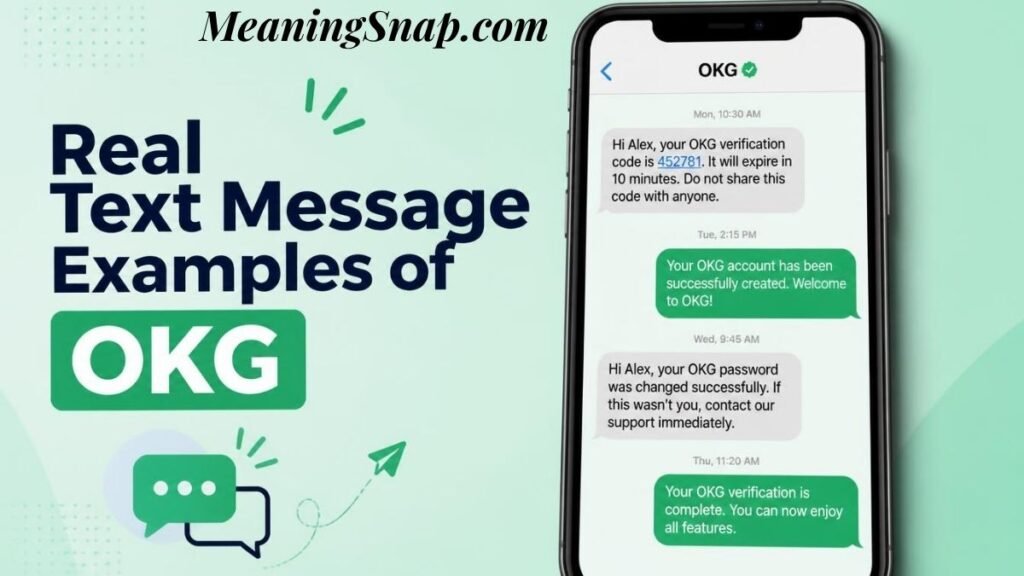
These examples show the OKG meaning in text in action across a handful of different relationships, and seeing it in context makes the whole thing click faster than any explanation.
Aisha (sister): “Mom wants us there by noon.”
You: “okg, I’ll be ready.”
Group chat: “Reminder: dress code tonight is casual, not fancy!”
Reply: “okg noted 👍”
Marcus: “Running 10 minutes late, my bad.”
You: “okg no rush.”
Coworker on Teams: “Meeting moved to 3 PM.”
You: “OKG, thanks for the heads up.”
Dating app match: “I’ll book the restaurant, see you Friday?”
You: “okg, can’t wait!”
Notice how the tone shifts slightly in each one: warm with a sister, relaxed with friends, a touch more polished with a coworker. The word barely changes, but the surrounding message and punctuation do all the emotional work.
Reading back through these conversation examples, a pattern emerges. OKG almost never carries the full weight of the message on its own. It leans on whatever comes right before it, the plan, the update, the joke, and simply confirms that the message landed. Once you notice that pattern, decoding any new “okg” you get becomes a lot less stressful.
FAQ
What does OKG mean in text?
The OKG meaning in text is a casual, friendly way of saying “okay.” Most people read it as something close to “okay, good” or “okay, got it,” though there’s no single official definition.
Is OKG rude in a text message?
No, OKG isn’t rude by default. It can feel a little flat in formal settings, so adding a word or two keeps professional replies from sounding dismissive.
What does OKG mean on WhatsApp or Instagram?
On WhatsApp, it usually confirms plans or details. On Instagram and TikTok, it often shows up as a quick, casual reaction in the comments.
Does OKG mean something different from a guy or a girl?
Not in any meaningful way. The word itself doesn’t carry a gender-based meaning; a person’s usual texting style matters far more than who’s sending it.
How should I respond to OKG?
Match the tone you received. A short, friendly reply works in casual chats, while adding a next step or detail works better in professional communication.
What does OKG mean in text on Urban Dictionary?
There’s no single Urban Dictionary entry everyone agrees on, and definitions there shift from post to post. The safest read is still the general one: a casual, low-effort way of saying okay.
Conclusion
By now, the OKG meaning in text should feel less like a mystery and more like second nature. It’s a fast, flexible way to say “okay” that Gen Z and millennials use across texts, DMs, and comments. The exact meaning shifts a little depending on the platform, the relationship, and the punctuation around it, but the core feeling stays the same: quick acknowledgment, generally positive, rarely meant as an insult.
Think of it this way: OKG works less like a fixed word and more like a small container that picks up the tone of whatever surrounds it. Drop it into a warm exchange and it sounds warm. Drop it into a rushed work thread and it sounds efficient. That flexibility is exactly why it spread so fast among casual texters who’d rather send one confident word than overthink a full reply.
Next time someone sends “okg” and you’re not sure how to take it, look at their usual texting habits before assuming the worst. Most of the time, it just means exactly what it looks like: okay, good, moving on.

Alex Morgan is a writer focused on explaining slang, words, phrases, acronyms, and popular expressions in a simple and easy-to-understand way. Through clear explanations and helpful examples, Alex helps readers quickly understand what words and phrases mean and how they’re commonly used.