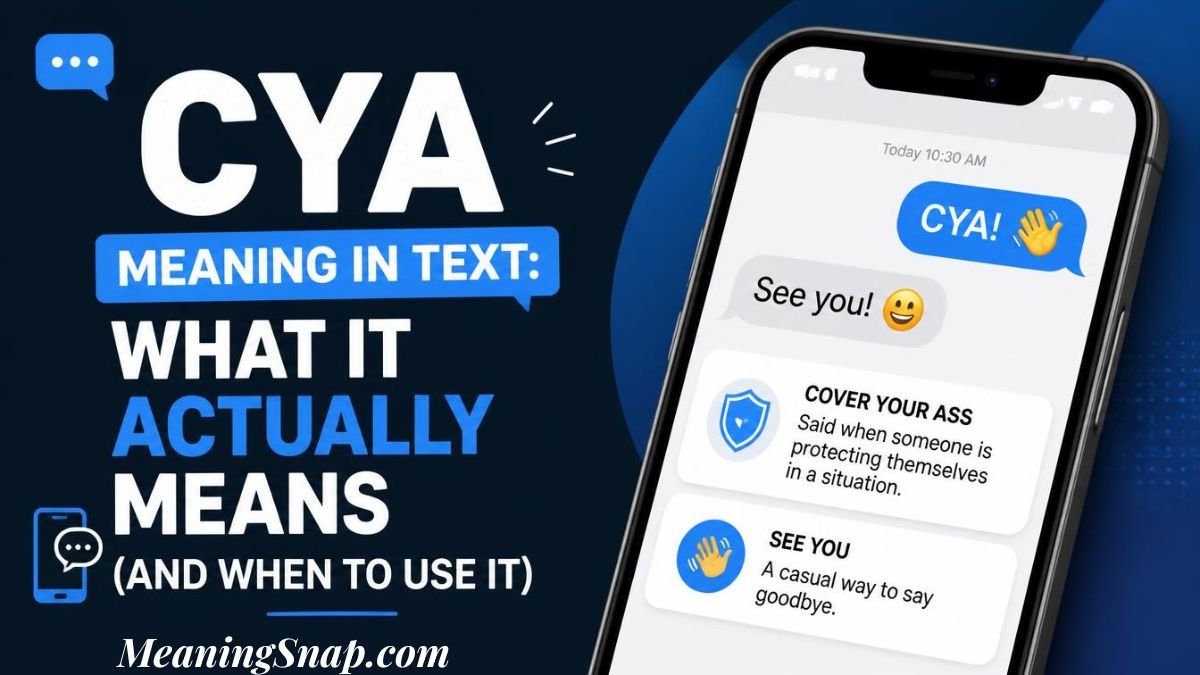
Your friend texts “omw, cya in 10” and you don’t even blink. Then a coworker sends “looping the whole team in, just to cya” and suddenly you’re squinting at your screen, wondering if you missed a memo. That’s the strange thing about CYA meaning in text, it can point to two totally different ideas depending on who sent it and why. One version is a breezy goodbye. The other is basically office self-defense. Once you know what to look for, telling them apart takes about two seconds.
What Does CYA Mean in Text? (Quick Answer)
Quick Answer: CYA has two common meanings, and context decides which one you’re dealing with. In everyday texting slang, it’s short for “see you,” a quick way to say goodbye. In workplace or formal communication, CYA usually stands for “cover your ass,” meaning protecting yourself by documenting decisions or keeping records.
A text from a friend and a note from a coworker are pointing at two completely different definitions, even though the letters are identical. So when someone asks what the CYA meaning in text actually is, the honest answer is: it depends who’s texting. Friends use it as a goodbye. Coworkers use it as a warning label.
The Two Real Meanings of CYA
CYA is one of those internet slang terms that only makes sense once you separate its two identities. The CYA meaning in text splits cleanly into a friendly camp and a defensive camp, and mixing them up is where the confusion, and the occasional awkward reply, comes from.
“See You” — The Casual Sign-Off
This version shows up constantly in friends chat and everyday casual chat. It works exactly like “bye” or “later,” just with a bit more shorthand flair. Someone types “cya” and they mean exactly that, they’ll see you soon.
Priya: heading out now, cya tomorrow
Jake: sounds good, cya!
Short, upbeat, no hidden agenda. Whether you’re texting, replying to a Snapchat message, or wrapping up a group chat on Instagram, this friendly goodbye doesn’t change from app to app.
“Cover Your Ass” — The Workplace Version
The second meaning lives almost entirely in professional communication, and it behaves nothing like the first. Here, CYA describes the instinct to protect yourself, usually by putting something in writing so nobody can later claim you dropped the ball.
Manager: Loop the whole team in on that email, just to CYA in case the client pushes back later.
Nobody’s saying goodbye in that message. They’re talking about keeping records and covering themselves, sometimes literally called a “CYA email” or “CYA memo.”
Also Read: HMU Meaning in Text: What Does HMU Mean?
Where CYA Came From
Neither meaning is new, they just came from very different worlds. The “cover your ass” phrase has roots in military and office culture going back decades, where paperwork existed specifically so blame couldn’t land on one person. It eventually became workplace slang for the habit of documenting everything, sending the extra email, cc’ing the right person, just to protect yourself if something went wrong later.
The “see you” version is much younger and came straight out of early texting and instant messaging, back when slow typing turned every phrase into shorthand. TTYL, BRB, and GTG all came from that same era, and CYA slid in right alongside them as a shorter way to type “see ya.”
Two unrelated origin stories, one identical abbreviation. Email made things murkier still, office messages kept the “cover yourself” sense alive well into the 2000s, while texting kept the goodbye version thriving among friends, and neither one ever really faded out. That overlap is exactly why the CYA meaning in text depends so heavily on who’s sending it.
How to Use CYA as a Text Sign-Off
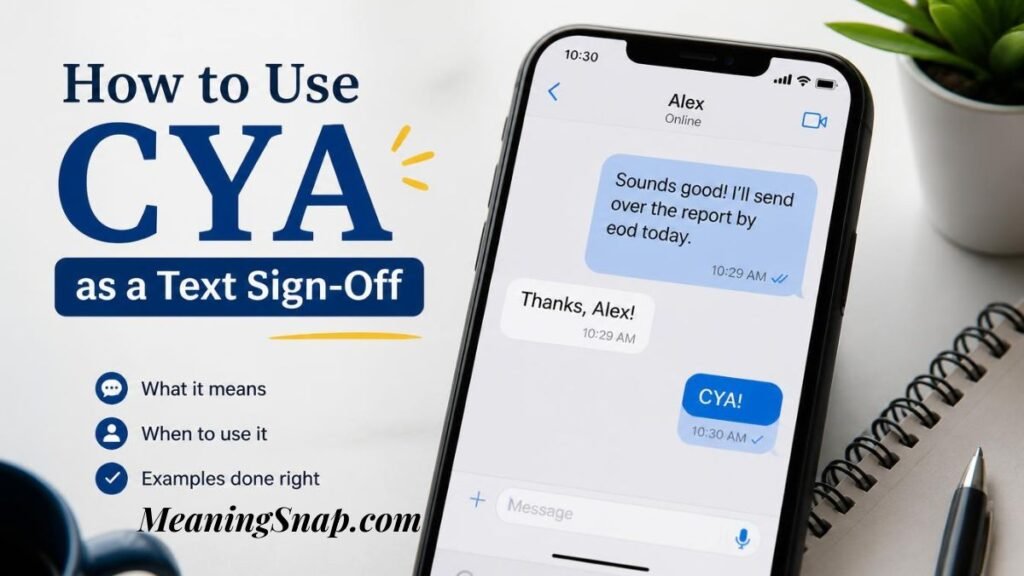
Using CYA casually is about as low-risk as texting slang gets, but a few small details change how it lands. Tone, timing, and who you’re talking to all shape whether it reads as friendly or dismissive. That’s really the heart of the CYA meaning in text between friends, it’s just a wave goodbye, nothing more.
Example 1 (Casual friend goodbye):
Mia: okay I gotta run, cya later!
Sam: bet, cya
Example 2 (Sincere, warm exit):
Grandma: Talk soon sweetie, cya this weekend
You: can’t wait, cya!!
Example 3 (Sarcastic or cold exit):
Alex: whatever, cya
Jordan: …okay then
Notice how punctuation and extra words do most of the emotional work. “Cya!!” reads completely differently than a flat “cya” dropped at the end of an argument. When you’re using CYA in text with people you’re close to, this rarely causes problems. Gamers sign off the exact same way after a match, and it lands just as casually.
A few quick tips keep it from landing wrong:
- Add a word or emoji if the mood is warm, “cya soon!” instead of just “cya”
- Skip it entirely if the conversation is serious or unresolved
- Match the other person’s energy, a playful “cya” deserves a playful reply
Capitalization Changes the Tone
Here’s something most explanations skip: how you capitalize CYA actually shifts its text tone. Lowercase “cya” almost always reads soft and casual, the texting version of a small wave. All-caps “CYA” reads heavier, more clipped, sometimes almost sharp.
“cya later!” feels light and friendly. “CYA.” with a period and nothing else can come across blunt, even if that’s not the intention.
This small formatting choice is a big part of the CYA meaning in text that doesn’t get mentioned often. All-caps CYA is also the version most associated with the “cover your ass” meaning, so seeing it in full capitals can nudge a reader toward that colder interpretation, even in a casual chat. Punctuation plays a role too, a trailing exclamation point almost always signals warmth, while a period or nothing at all can flatten the tone considerably. If you want your goodbye to land soft, lowercase does the job better than shouting it in caps.
Read Also: MK Meaning: What Does MK Mean in Text?
CYA at Work: The “Cover Your Ass” Culture

This is where the CYA meaning in text shifts entirely away from goodbyes. In workplace slang, CYA rarely has anything to do with leaving a conversation. It describes a mindset: protect yourself, keep records, and make sure decisions are documented in case anyone questions them later.
Coworker: I’m cc’ing you and the director on this, purely CYA, don’t want any confusion about who approved it.
This kind of CYA communication isn’t about being difficult. It’s a defensive habit common in industries where accountability really matters, healthcare, legal, finance, project management, anywhere a paper trail can save someone’s job. Sending a follow-up email that recaps a verbal agreement, or replying-all “confirming for the record,” both fall under this umbrella.
One important distinction: while “see you” CYA is completely harmless as a sign-off, using the goodbye version in formal emails or reports can look unpolished. Save “cya” for texts and casual chat, and stick to formal language like “regards” or “best” in anything resembling professional settings.
Is CYA Rude or Just Casual?
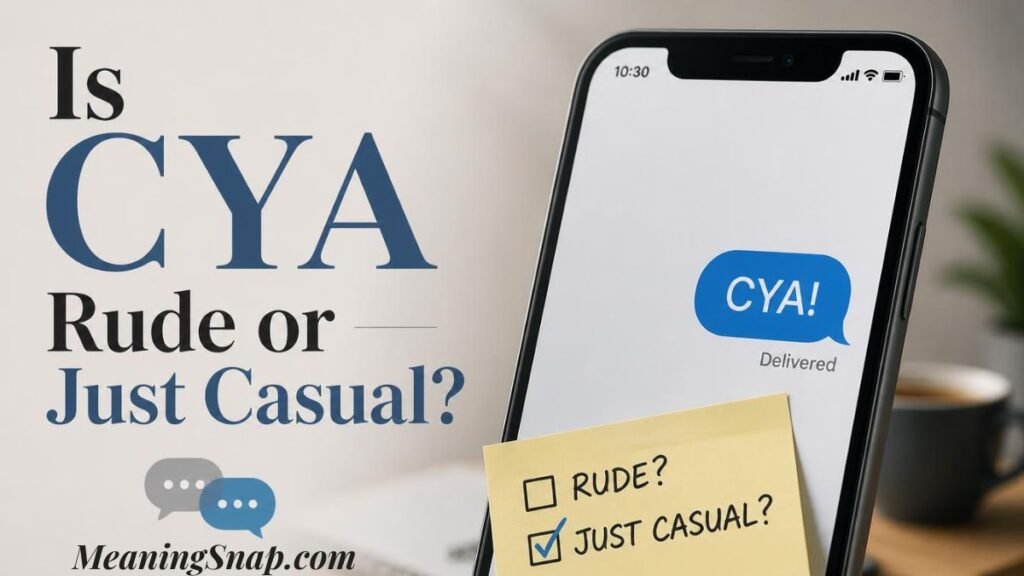
Most of the time, CYA is about as neutral as texting slang gets. So the CYA meaning in text isn’t fixed, it moves with the situation it’s dropped into.
When it’s not rude: A quick “cya” at the natural end of a casual chat, after plans are set, after a call wraps up, or as a quick goodbye between people who text like this all the time.
When it can feel rude: Replying “cya” to something emotional or unresolved. Ending an argument with an abrupt goodbye instead of actually addressing what was said. Using it as a one-word reply when someone clearly wanted a real response.
Example:
Taylor: I’m actually pretty upset about what happened earlier, can we talk about it?
Casey: cya
That kind of exit reads as dismissive, not because the word itself is rude, but because of what it’s replacing, an actual response. Message interpretation in these moments comes down to context, not the abbreviation. The same three letters can be a warm casual farewell or a cold response, and only the situation around it tells you which.
Read Also: TMP Meaning in Text | What It Really Means in Chats, Texts & Online Conversations in 2026
CYA vs Other Sign-Offs
CYA isn’t the only quick way to end a text conversation, and compared with other sign-offs, the CYA meaning in text stays closer to a soft exit than an abrupt one. Here’s a quick reference for when each one fits best.
| Sign-Off | What It Implies | Example |
|---|---|---|
| CYA | Casual, friendly, “see you soon” | “cya tomorrow!” |
| TTYL | Ending the chat for now, talk later | “gtg, ttyl” |
| BRB | Short break, coming right back | “brb, phone’s ringing” |
| GTG | Have to leave immediately | “gtg, bell’s about to ring” |
| Take care | Slightly warmer, more sincere | “take care, see you soon” |
| See ya | Nearly identical to CYA, spelled out | “see ya this weekend” |
CYA and “see ya” are functionally the same thing, just formatted differently. TTYL and BRB both suggest the conversation is paused, not over, while CYA and GTG usually mean the interaction is wrapping up for good, at least for now.
Common Mistakes to Avoid
A few small mix-ups come up again and again with this chat abbreviation.
- Assuming CYA always means “see you.” In a work email, it’s far more likely to mean “cover your ass,” and reading it the wrong way can cause real confusion.
- Using casual “cya” in formal emails or reports. It instantly clashes with professional communication and can read as careless.
- Overanalyzing a bare “cya” between close friends. Most of the time it really is just a quick goodbye, not a snub.
- Typing CYA in all caps during a casual chat without realizing it can read colder than intended.
- Missing that Gen Z and Millennial online conversations often treat CYA as pure filler at the end of a chat, so it rarely carries deeper meaning between people who text often.
Getting the CYA meaning in text right usually just takes a second of context-checking, who sent it, where, and why. Most mix-ups come from applying one meaning where the other belongs, once you separate the two, the rest sorts itself out fast.
CYA on Snapchat, TikTok & Instagram
Good news here, there’s nothing new to learn. The social media slang meaning of CYA doesn’t shift depending on the app. A Snapchat abbreviation like “cya” in a chat means the same casual goodbye it means in a regular text.
Snapchat: “streak’s safe, cya!” is just a quick sign-off before closing the app.
TikTok: you’ll see “cya” in comments or captions wrapping up a thought, same breezy tone.
Instagram: “cya in the group chat” works exactly like it would over SMS.
The only real difference across platforms is speed, people tend to type even shorter on Snapchat and TikTok, so “cya” shows up more often than the fuller “see ya.” Beyond that, social media usage of CYA follows the same rules as any other casual chat.
Related Post: WYO Meaning in Text: What It Really Means & Examples
FAQs
What does CYA mean in text?
CYA usually means “see you,” a casual way to say goodbye in a text or chat. In professional settings, it often means “cover your ass,” referring to protecting yourself by documenting decisions.
Can CYA mean something else besides “see you”?
Yes. Its most common alternate meaning is “cover your ass,” used mostly in workplace slang to describe keeping records or covering yourself in case of blame.
Is CYA rude to text someone?
Not usually. It only feels rude when it replaces a real response to something serious, or when it ends a conversation abruptly instead of addressing what was said.
Does capitalization change the CYA meaning in text?
Somewhat. Lowercase “cya” reads casual and soft, while all-caps “CYA” can come across more blunt and is more often linked to the workplace meaning.
Should I use CYA at work?
Only in the “cover your ass” sense, like a “CYA email.” Avoid using it as a literal goodbye in formal communication, since it can look too casual for professional settings.
What’s the difference between CYA and TTYL?
CYA usually signals the conversation is wrapping up for good, at least for now, while TTYL implies you’ll pick the conversation back up again soon.
Bottom Line
Now that you know both sides of the CYA meaning in text, you can reply with confidence. A quick, lowercase “cya” from a friend is just a goodbye. An all-caps “CYA” in a work email is someone covering their bases. Same three letters, two completely different jobs, and now you can tell them apart in half a second.

Alex Morgan is a writer focused on explaining slang, words, phrases, acronyms, and popular expressions in a simple and easy-to-understand way. Through clear explanations and helpful examples, Alex helps readers quickly understand what words and phrases mean and how they’re commonly used.