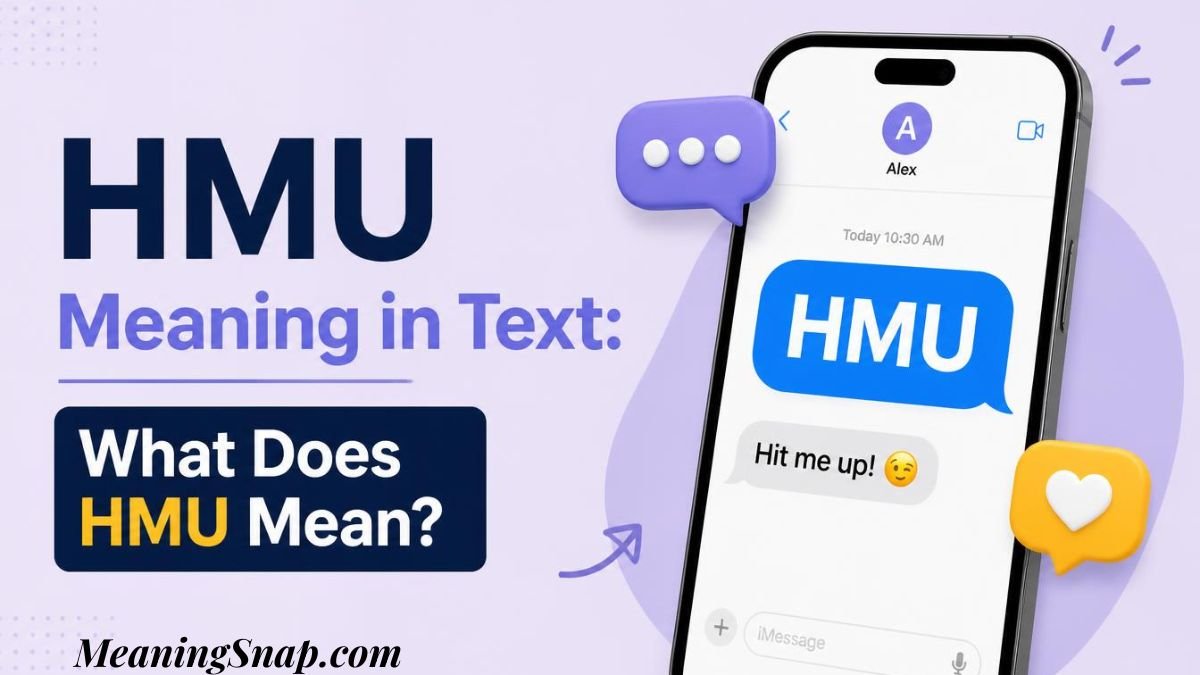
Your phone buzzes. It’s a text from someone you haven’t heard from in weeks, and all it says is “hmu.” No context, no explanation, three letters staring back at you. Do you text back? Call? Wait for them to say more? If you’ve ever paused over a message like that, you’re not alone. HMU meaning in text is one of those texting abbreviations that everyone assumes everyone else already knows, until you’re the one left guessing.
What Does HMU Mean? (Quick Answer)
Quick Answer: HMU stands for “Hit Me Up.” In slang, it’s a casual way of saying “contact me,” “reach out to me,” or “let me know” when you’re free. It doesn’t specify how, so it might mean text me, call me, or message me on social media.
That’s the short version, but there’s more to unpack. HMU shows up constantly in casual texting, group chats, and social media comments, and it’s become one of the most common texting abbreviations in modern online communication. It’s not a new term either. It moved from spoken slang to typed slang, which is part of why the HMU meaning in text sometimes trips people up when they see it written out instead of hearing it said out loud.
People also write it a few different ways. You’ll see it as HMU, Hmu, or lowercase hmu, and none of those variations change the meaning. Capitalization here is a texting habit, not a signal. The one thing that stays constant across every version is the underlying request: get in touch when it works for you.
The core idea behind HMU is simple: someone is opening the door for you to get in touch, on your own time, in whatever way works. There’s no pressure attached to it, and that’s exactly the point.
Where HMU Came From (a Quick History)
HMU didn’t start on a phone screen. The phrase “hit me up” has been part of casual American English for decades, showing up in hip-hop lyrics and everyday speech well before texting existed. Rappers and R&B artists used “hit me up” as a laid-back way to say “get in touch,” and the phrase carried that same relaxed, low-stakes energy into mainstream conversation.
Once texting and instant messaging took off in the 2000s, people started shortening everything to save keystrokes. “Hit me up” became HMU, joining a wave of texting abbreviations like BRB and LOL that turned full phrases into quick keyboard shortcuts. AIM and early flip-phone texting are where a lot of this shorthand first caught on, long before Instagram or Snapchat existed.
By the time social media apps became the main hub for casual conversation, HMU had already settled into everyday texting slang. It didn’t need reinventing. It needed a bigger stage, and platforms built around quick replies and direct messages gave it exactly that.
Slang dictionaries and early internet forums picked it up not long after texting went mainstream, which is a big reason the HMU meaning in text has stayed so consistent over the years. If you look up HMU on Urban Dictionary, the top entries all land on the same definition covered here, “hit me up,” which says a lot about how settled this one is compared to slang that shifts every few years. That kind of staying power is rare in internet culture, where most abbreviations either fade out or mutate into something else entirely.
Read Also: MK Meaning: What Does MK Mean in Text?
What People Actually Mean When They Text You “HMU”
Here’s the thing about HMU: it’s intentionally vague. When someone sends it, they’re rarely asking for a phone call at a specific time. They’re leaving the method and the timing up to you.
Most of the time, HMU is a low-pressure invitation. It covers any of the following, depending on the moment:
- “Text me” when you get a chance
- “Message me” on whatever app you both use
- “Let me know” if you want to hang out or need something
- “Reach out to me” if plans change or you have questions
- A general “stay in touch” with no real urgency behind it
The lack of specifics is a feature, not a flaw. Someone saying HMU isn’t demanding an immediate response. They’re letting you know the line is open. Turns out, that openness is exactly what makes HMU so easy to drop into almost any casual message without it feeling like a big ask.
Also Read: TMP Meaning in Text | What It Really Means in Chats, Texts & Online Conversations in 2026
HMU in Real Texts and DMs
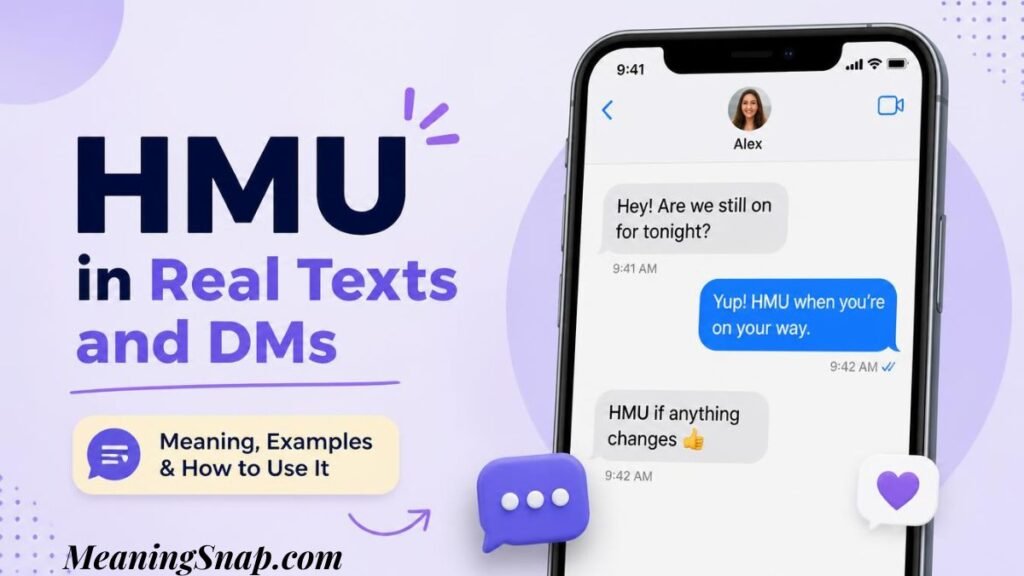
Seeing HMU used in context makes the meaning click faster than any definition. Here are five real-world examples that show how differently it lands depending on who’s sending it and why.
Example 1: Making plans
Jordan: “party’s at my place Saturday, hmu if you’re coming” Alex: “bet, I’ll let you know by Friday”
Example 2: Offering help
Sam: “hmu if you need notes from today’s class” Priya: “omg yes please, hmu is a lifesaver”
Example 3: Casual check-in
Mia: “been way too long, hmu sometime this week” Casey: “for sure, things have been chaotic lol”
Example 4: After meeting someone new
Drew: “it was cool talking to you tonight, hmu if you’re ever in town again” Riley: “definitely will, thanks for the recs”
Example 5: Dry, low-effort reply
Taylor: “you coming tonight or nah” Jamie: “idk yet, hmu later and I’ll decide”
Example 6: Sarcastic
Nina: “you never text back first” Leo: “wow ok, hmu next time then I guess 🙄”
Notice how the tone shifts each time. Example 1 is about coordinating plans, Example 2 is genuinely helpful, and Example 6 flips the phrase into a light jab instead of a real invitation. That range is normal. HMU bends to fit whatever mood the conversation already has, and the words around it do most of the work in setting that mood.
Where You’ll See HMU
HMU shows up across nearly every messaging app and social platform, though how it’s used shifts slightly depending on where you see it:
- Instagram: In DMs, comments, or story replies, often after meeting someone or seeing their post, like a comment that just says “hmu 🙌” under a photo. The HMU meaning on Instagram comes down to “message me here.”
- Snapchat: Casual chats and streak-adjacent messages, usually about hanging out. What does HMU mean in Snap? Almost always “send me a Snap first” or “message me,” since Snapchat itself is the messaging app being pointed to.
- TikTok: Comments under videos, sometimes half-joking, sometimes a genuine invite, like “hmu if you know this sound.” The HMU meaning on TikTok stays the same as everywhere else, it’s just dressed up as a comment instead of a text.
- WhatsApp: Group messages when coordinating plans or checking who’s free. The HMU meaning in WhatsApp doesn’t change from regular texting, it’s just someone asking to be messaged in that thread instead of by SMS.
- Discord: Gaming chats and group servers, often about joining a game or voice call.
Dating apps deserve their own mention here since it’s one of the most common places people run into HMU today. On Tinder, Bumble, or Hinge, “hmu on Snap” or simply “hmu” is a common way to suggest taking things off the app and into regular texting, without sounding overly forward about it. The HMU meaning in text stays identical on every one of these platforms. What changes is only the audience and the stakes attached to it.
Does HMU Mean Call Me or Text Me?
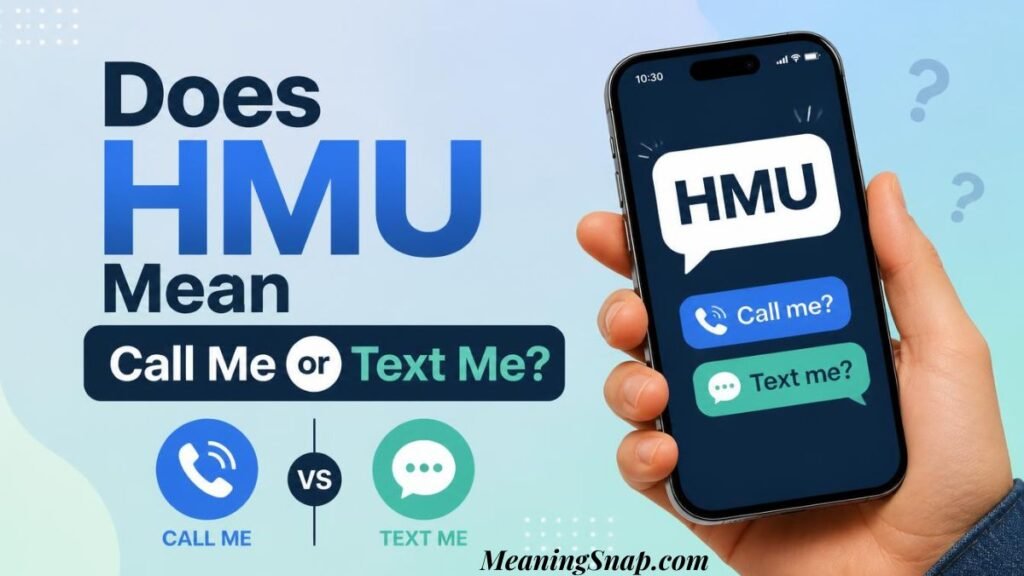
This is one of the most searched questions about HMU, and the honest answer is: it depends, but it usually leans toward texting or messaging rather than a phone call.
HMU is a communication request, not a specific one. In most casual contexts, especially among Gen Z and younger Millennial texters, “hmu” defaults to a text message, a DM, or a message through whatever app you already talk on. Actual phone calls have become the exception in casual friend groups, not the norm, so HMU rarely means “please call me.”
That said, context matters. If someone says “hmu when you land” before a trip, they might genuinely want a quick call to confirm you’re safe. If it’s “hmu about the party,” they almost certainly mean a text or DM. When you’re unsure, texting first is the safer default. If they wanted a call specifically, they’d usually say so.
This is really the whole reason HMU meaning in text confuses people who grew up with landlines and scheduled phone calls. Older generations tend to read “contact me” as “call me,” while younger texters read it as “message me however is easiest.” Neither reading is wrong, it’s just a generational difference in what “get in touch” defaults to.
Is HMU Flirty, Rude, or Just Casual? (Reading the Tone)
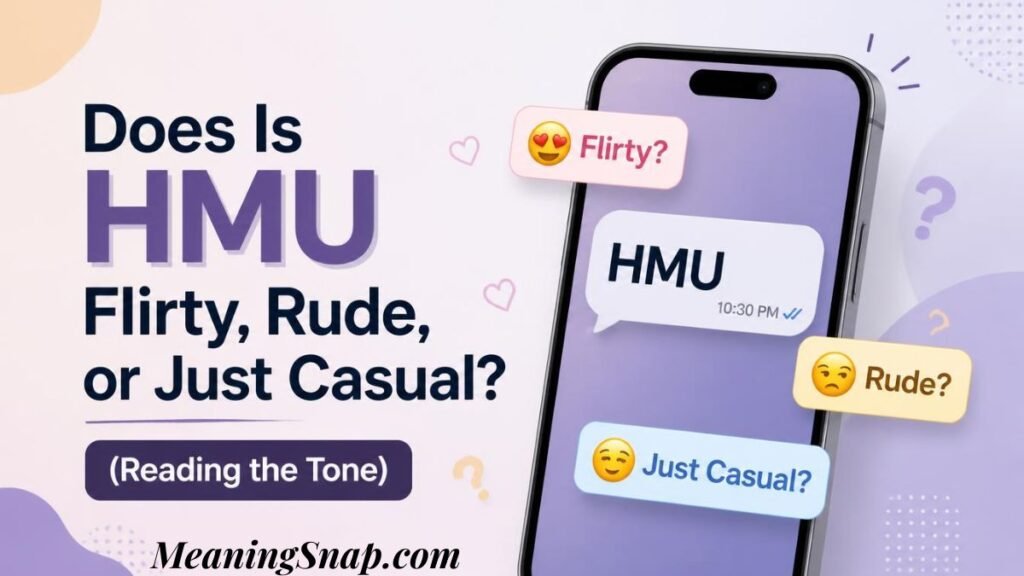
HMU doesn’t carry one fixed emotional weight. It’s neutral by default, but the surrounding message and your relationship with the sender shape how it actually reads.
In a friendly tone, HMU reads exactly how it looks: casual, warm, no hidden agenda. Between friends, it’s basically interchangeable with “let me know” or “talk soon.”
In a flirty tone, HMU often carries romantic interest, especially after a first date, a match on a dating app, or a compliment-heavy conversation. The flirtiness comes from context clues around it, not the abbreviation itself.
There’s no real difference in HMU meaning from a girl versus HMU meaning from a guy or a boy either. The words don’t change based on who’s sending them, only the same context clues already covered here, like emojis, punctuation, and what’s said around it, decide the tone. A guy texting “hmu later, we still on for the game?” is talking about plans, not flirting. A girl texting “hmu whenever, no rush” after a good first date is more likely leaving the door open for something more. Same three letters, completely different situation behind them.
As for whether HMU is rude, it almost never is. It comes across as a little dry or low-effort in a neutral tone, especially if it’s the entire message with nothing else attached. But rude implies intent to offend, and HMU isn’t built for that. It’s too vague and too low-stakes to carry real hostility.
The one place it feels off is professional communication. In a formal writing or workplace context, HMU reads as too casual, even if it’s not disrespectful. It doesn’t match the register.
Emojis attached to HMU also shift the read fast. “Hmu 😩” leans dramatic or flirty, “hmu 🙄” reads sarcastic, and “hmu 🎮” is almost always about gaming, not romance. The abbreviation stays the same, but whatever surrounds it in the message is doing most of the actual communicating.
How to Reply to HMU
Replying to HMU is simpler than people make it. Since it’s an open invitation, your reply just needs to match the intent behind the original message.
If someone’s making plans, respond with your actual availability: “hmu Friday and I’ll be free” works fine. If they’re offering help, a quick thanks plus a specific ask closes the loop, like “hmu is so nice of you, can you send those notes tonight?” And if it’s a general “stay in touch” message with no urgency, a short “will do” or “for sure, talk soon” is more than enough.
You don’t need to overthink your reply length or tone. HMU sets a casual bar, so your response can stay just as short. A one-word “sure” or “will do” is a completely acceptable reply, and adding a specific day, time, or app is really the only thing that turns a vague HMU into an actual plan.
HMU vs Similar Texting Slang
HMU often gets grouped with other texting abbreviations, but each one carries a slightly different meaning or level of urgency. Seeing them side by side makes the differences clearer than trying to explain each one separately.
| Term | Meaning | Typical Use |
|---|---|---|
| HMU | Hit Me Up, contact me generally | Open-ended, any method |
| DM me | Message me on social media specifically | Platform-specific request |
| Text me | Send a text message specifically | Phone texting only |
| LMK | Let Me Know | Waiting on a decision or answer |
| BRB | Be Right Back | Temporary pause in a live chat |
The biggest difference is specificity. HMU and LMK stay vague on purpose, while “DM me” and “text me” point to one exact method. BRB isn’t really a communication request at all, it’s a placeholder for stepping away. Out of every term on that list, the HMU meaning in text is the loosest one, which is exactly why it fits so many different situations.
Other Meanings of HMU (Outside Texting)
“Hit me up” is by far the most common meaning, but HMU stands for something completely different in a couple of specific industries, and mixing them up is an easy mistake.
In the beauty and film world, HMU means “Hair/Makeup.” It shows up as a photo credit on Instagram or TikTok, tagging whoever did someone’s hair and makeup for a shoot, wedding, or event. A caption like “loved how this turned out, HMU: @artistname” isn’t inviting anyone to text. It’s crediting the stylist behind the look, and you’ll see the related tag HMUA, for “hair and makeup artist,” used the same way.
In a hospital setting, some hospitals use HMU to label a “Hospital Medicine Unit” or “Hospitalist Medicine Unit,” a department that treats patients with general medical needs. This one isn’t a universal medical abbreviation, it’s specific to how individual hospitals name their units, so it’s worth confirming with the hospital directly if you see it on paperwork or signage.
Context sorts out which HMU you’re looking at almost instantly. Under a glam photo, it’s hair and makeup. On hospital documents, it’s a department name. In a text or DM, it’s still just “hit me up.”
Also Read: WYO Meaning in Text: What It Really Means & Examples
When You Should Skip Using HMU
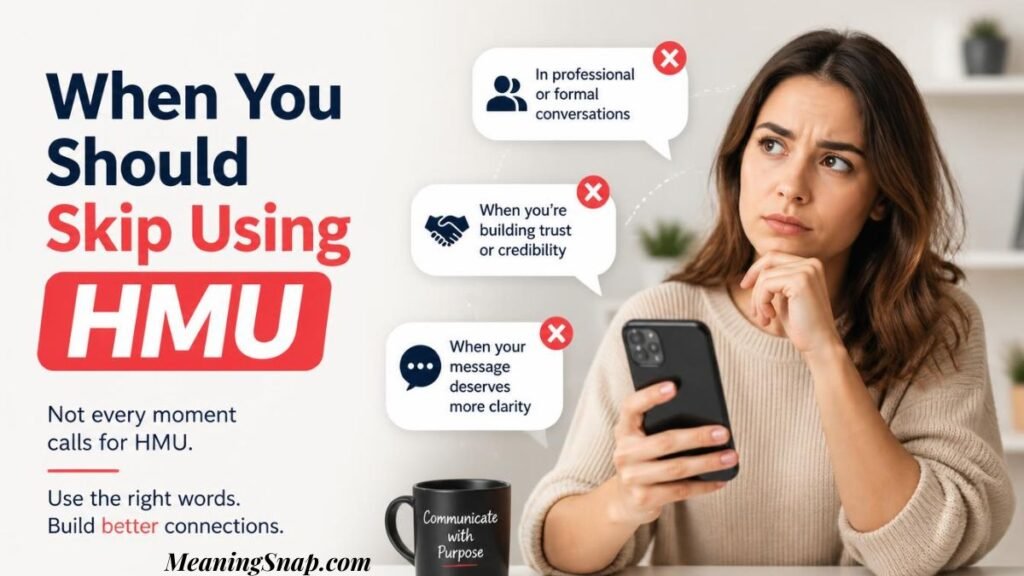
HMU works well in casual settings, but it has clear limits. A few common missteps are worth avoiding.
Using HMU in formal writing is the most frequent mistake. Job applications, professional emails, and networking messages with coworkers or new business contacts call for full phrases like “please reach out” or “feel free to contact me.” HMU in that setting reads as underprepared, not friendly.
Another common misread is assuming HMU always means something flirty. Outside of dating contexts, it’s usually just casual shorthand with zero romantic undertone. And a smaller but real mistake is overanalyzing it entirely, treating a three-letter abbreviation like it’s loaded with hidden meaning when it’s almost always exactly what it looks like: a casual invite to get in touch.
Ignoring context is the last common trap. Reading HMU on its own, without looking at who sent it or what the conversation has been about, is how most of the confusion around its tone happens in the first place. The abbreviation barely changes. The situation around it does all the heavy lifting.
FAQs About HMU
What does HMU mean in text?
The HMU meaning in text is “Hit Me Up,” a casual way to say “contact me” or “reach out to me” whenever you get a chance.
What does HMU mean on Snapchat or dating apps?
On Snapchat, it usually means “message me” to keep a conversation going. On dating apps like Tinder or Bumble, it often signals moving the chat to texting or another app.
Does HMU mean call me or text me?
It usually means text me or message me rather than call. Phone calls are the exception in casual texting, so HMU defaults to a text or DM unless the context suggests otherwise.
Is HMU rude or flirty?
Neither by default. HMU is neutral on its own, and its tone shifts based on who’s sending it and what else the conversation includes.
Should I use HMU in professional messages?
No. HMU is too casual for professional communication or formal writing. Stick to full phrases like “please reach out” or “feel free to contact me” in those settings.
Is HMU an invitation?
Usually, yes, in a loose sense. It’s an open invitation to contact someone, not a firm plan or a demand for a specific response.
What’s the difference between HMU and DM me?
HMU is open-ended about how you get in touch, while “DM me” points to one specific method: a direct message on that platform.
Bottom Line on HMU
At the end of the day, HMU is just a shortcut for staying in touch, nothing more mysterious than that. The next time someone texts you “hmu,” you’ll know exactly what they’re asking for and exactly how to reply.

Alex Morgan is a writer focused on explaining slang, words, phrases, acronyms, and popular expressions in a simple and easy-to-understand way. Through clear explanations and helpful examples, Alex helps readers quickly understand what words and phrases mean and how they’re commonly used.