Your group chat lights up, and someone drops “not gonna lie, I fw you” with zero explanation. You reread it twice. Sweet? Sarcastic? A little unsettling? That’s the confusion behind FW meaning in text, and it trips up more people than you’d guess. FW shows up in text messages, TikTok comments, work email subject lines, even Discord servers, and it means two almost opposite things depending on where you spot it. One version is completely G-rated. The other one isn’t, but it’s not what you’re picturing either. Here’s the full picture: when it’s a compliment, when it’s a warning, and when it just means someone forwarded an email.
What Does FW Really Mean?
The FW abbreviation has exactly two roots, and neither one is a mystery once you know what to look for. The first is simple: “forward,” the same word your email client sticks in front of a subject line when a message gets passed along. The second is FW slang, short for a well-known swear word paired with “with.” People use it to say they like, support, or vibe with someone or something, though it can also mean the rougher opposite: messing with someone or clashing with them.
Once you separate those two roots, the FW meaning stops being confusing and starts being obvious.
Quick Answer: FW almost always means one of two things. In email or work chat, it means “forward.” In texting, TikTok comments, or DMs, it’s slang built around a curse word plus “with,” used to say you like, trust, or associate with someone. Context is what separates the two.
That single abbreviation covering both a workplace habit and a piece of texting slang is exactly why so many people search “FW meaning in text” instead of just guessing. A parent forwarding a chain email and a teenager texting their crush are using the same three letters for entirely different reasons. Reading the room, or in this case the thread, tells you which one you’re dealing with. If there’s a link, an attachment, or “Re:” nearby, you’re looking at the email version. If it’s sitting inside a casual sentence with no attachment in sight, it’s the slang one.
Quick Meaning Table
Here’s a fast reference for every real meaning FW carries, from the everyday to the niche.
| Context | What FW Means | Example |
|---|---|---|
| Email or work chat | Forward | “FW: Q3 budget review” |
| Texting or DMs (positive) | To like, support, or vibe with someone | “I fw your new haircut” |
| Texting or DMs (rougher) | To mess with, clash with, or toy with someone | “Don’t fw him, he’s not playing” |
| Soccer or football | The Forward position | “Our new FW scored twice this season” |
| Location shorthand | Fort Worth, Texas | “Flying into FW this weekend” |
You May Read: CYA Meaning in Text: What It Actually Means (and When to Use It)
Where FW Actually Came From
The FW meaning you see in slang today didn’t appear overnight. It goes back to African American Vernacular English (AAVE), where “fing with” someone already meant engaging with them, whether that engagement was warm or antagonistic. As online slang spread through hip-hop culture and everyday text conversations in the 2000s, the phrase got shortened the same way “as f” became “af.” By the 2010s, FW was common enough on Twitter and in group texts that it needed no explanation among the people using it.
The email meaning has a completely separate, much older history. “Fw:” as a subject line marker goes back to the earliest days of forwarding messages between inboxes, a convention that predates most of today’s social media platforms entirely. Nobody invented it for texting. It just carried over once people started copying email habits into casual chat.
Here’s the thing: these two histories never crossed paths at all. One grew out of American street culture and spread through music and texting. The other grew out of office software. They landed on the same two letters by coincidence, not design. And while the slang version started in the US, you’ll now see the identical use in British slang, Australian slang, and Canadian slang group chats, since platforms like TikTok and X don’t respect borders anymore. A teenager in Manchester and one in Toronto will text “I fw that” with the same meaning behind it, even though neither picked it up from a textbook.
FW in a Sentence (Real Examples)
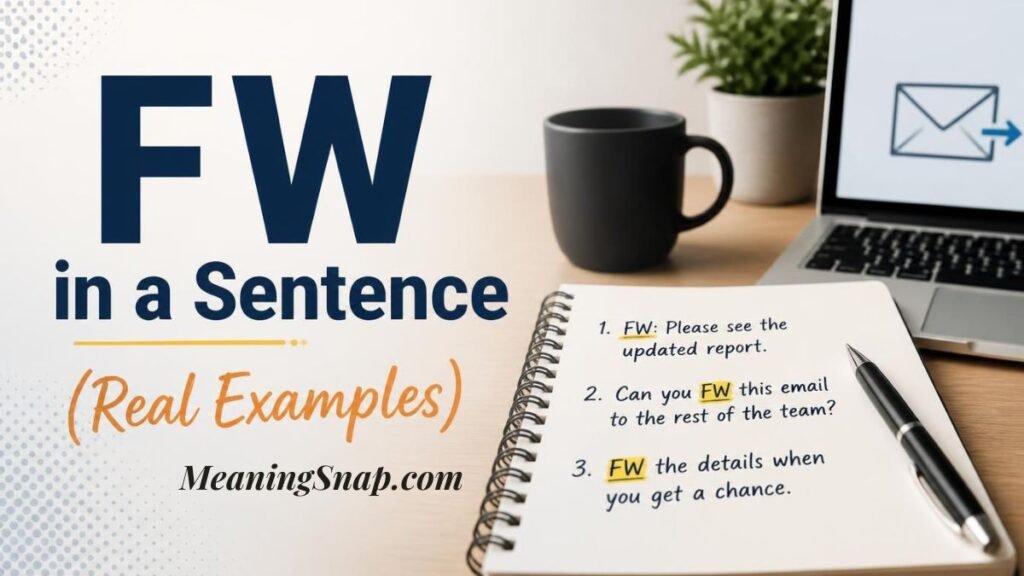
Definitions only get you so far. Seeing the FW meaning play out in a sentence across a few different tones makes it click faster than any explanation.
A sincere, low-key compliment:
Maya: ngl I fw this song so hard
Jordan: same, I’ve had it on repeat since Tuesday
A slightly nervous, flirty admission:
Diego: I fw you, ngl
Priya: wait fr??
The rougher, warning-toned version:
Theo: yo don’t fw my sister, she’s not the one
Marcus: relax man, I was just being nice
The plain, professional version:
Subject: FW: Meeting moved to 3pm
Nora: just fw’d you the invite, check your inbox
And a sarcastic one, where tone does all the work:
Elena: I fw waiting 45 minutes for a table, love that for us
Sam: same energy as loving Mondays
Notice how none of these need extra explanation once you’re inside the conversation. Conversation context tells you everything: a subject line means forward, a compliment about a song means like, and a warning about someone’s sister means stay away. The tone of the message around FW carries more weight than the letters themselves, which is exactly why the same abbreviation can sound sweet in one thread and sound like a threat in another.
One more thing worth noticing: nobody in these examples stopped to explain what FW meant mid-conversation. That’s the real test for whether a piece of slang has gone mainstream. Terms that still need a footnote haven’t caught on yet. FW passed that point years ago among people who grew up texting.
Also Read: HMU Meaning in Text: What Does HMU Mean?
FW in Email and Work Chat vs. FW in Texts and DMs
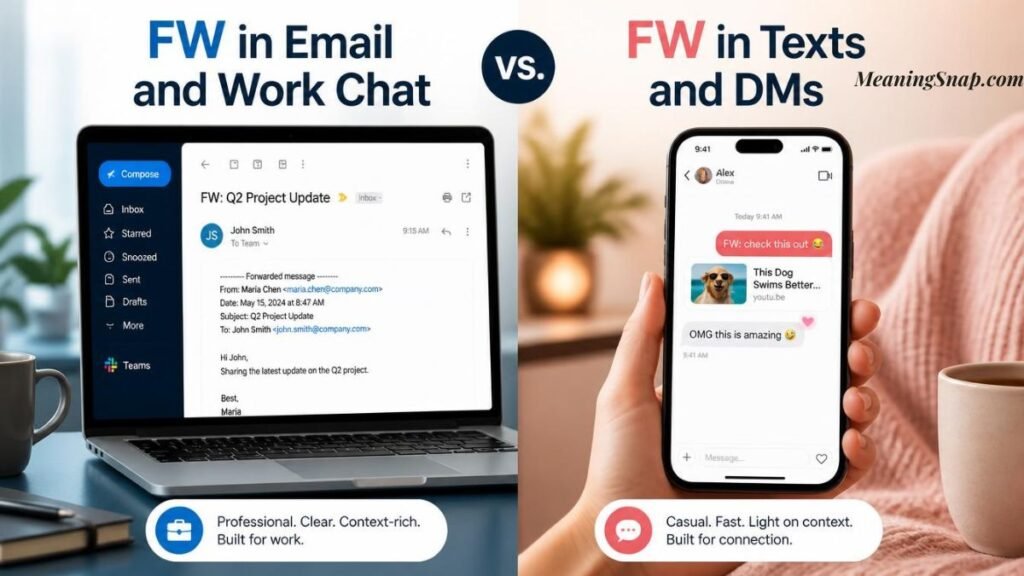
The FW meaning splits cleanly along one line: work versus casual. Mixing up these two versions is an easy way to confuse a coworker or, worse, an interviewer. The email meaning is standard, boring, and completely safe for formal communication. The slang meaning is neither of those things, and it doesn’t belong anywhere near business emails.
Good
Using FW to forward a document, a calendar invite, or a client email is fine in any professional setting. It’s been standard practice in email subject lines for decades, and nobody reading “FW: Contract Draft” will think twice about it.
Avoid
Texting a manager “I fw this project” instead of “I’m on board with this project” reads as unprofessional at best and confusing at worst, especially to anyone over 40 who’s never seen the slang version. Stick to standard English and polite alternatives like “I’m into this” or “count me in” for anything work-related. Save the slang for friends who already know what it means.
The line gets blurrier on Slack or Teams, where tone tends to loosen up compared to formal email. Even there, though, the slang meaning of FW is a gamble. A coworker who reads it as “forward” instead of “vibe with” will just be confused about what document you’re supposedly sending them. When the stakes involve your job, clarity beats cool shorthand every time.
Meanings Most People Don’t Know
The FW meaning isn’t limited to slang and email, even though those two dominate search results. Two more legitimate meanings get buried under all the slang content online, and both are worth knowing if you want the complete picture instead of just the viral one.
In soccer and football stat sheets, FW is shorthand for the Forward position, right alongside GK for goalkeeper and MF for midfielder. You’ll see it on team rosters, fantasy league apps, and match commentary graphics without a single mention of slang anywhere nearby.
FW is also regional shorthand for Fort Worth, Texas, most commonly paired with Dallas as DFW, the name of both the metro area and its international airport. Someone texting “landing in FW around 6” almost always means the airport, not a compliment. Local real estate listings, flight boards, and traffic apps in North Texas use the same shorthand without a second thought.
Fantasy football and soccer apps lean on the position abbreviation just as heavily. Scroll through a Premier League or MLS lineup graphic and FW will sit right next to GK, DF, and MF, doing a job that has nothing to do with feelings one way or the other. Neither of these meanings overlaps with the slang version, which is honestly part of the appeal of a three-letter abbreviation. Context does the heavy lifting every time, whether you’re reading a lineup, a boarding pass group chat, or a text from your crush.
Read More: MK Meaning: What Does MK Mean in Text?
Why People Use FW Instead of Spelling It Out
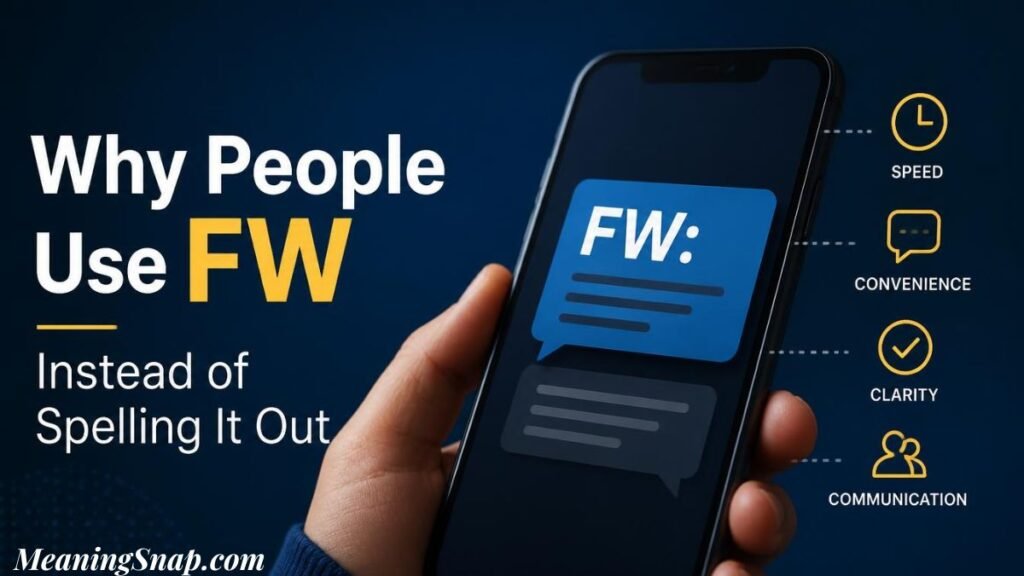
The slang version of FW exists mainly because spelling out the full phrase feels like a lot for something this casual. Shortening a profanity abbreviation into two letters lets people express a strong opinion without typing out a curse word, the same logic behind “af” or “asf” among Reddit and X regulars. It also slides past content filters on platforms that flag explicit language, which is a big part of why it caught on so fast in comment sections.
That same shortcut is exactly what causes the tone confusion behind most FW meaning searches. Because FW carries both a positive meaning and a rougher, more negative meaning, the same three letters can read as a compliment or a warning depending entirely on the sentence around them. “I fw you” between two people who are clearly into each other reads as affection. “Don’t fw them” in a warning from a friend reads as a boundary. Neither one is inherently offensive slang, but both lean casual enough that appropriate language for the workplace rules them out completely.
If you’re ever unsure which version someone means, look at what surrounds it. A name, a compliment, or a “ngl” nearby usually signals the warm version. A warning, an insult, or tension in the conversation signals the other one. When in doubt, asking “wait, good fw or bad fw?” is a completely normal thing to text back, and most people won’t even blink at the question.
Slang That Travels With FW
FW rarely shows up alone. It tends to travel with a small cluster of related abbreviations that mean similarly casual things, and knowing them helps the whole conversation make sense.
- FR (“for real”) backs up a statement, similar to saying “I’m serious”
- W (“win”) celebrates something going well
- No cap means no lying, the opposite of exaggerating
- Bet confirms agreement, close to saying “deal”
- FWB (“friends with benefits”) is a completely different phrase that just happens to share two letters with FW
- FWIW (“for what it’s worth”) softens an opinion before sharing it
These alternative phrases show up across TikTok slang, Snapchat slang, and Instagram slang in roughly the same way, since Gen Z and Millennials tend to borrow the same shorthand across whichever app they’re using that week. YouTube comment sections and Discord slang follow the same pattern, and WhatsApp group chats aren’t far behind now that the terms have spread well past their original platforms. None of them mean the same thing as FW, but they’re the terms most likely to sit right next to it in an actual conversation, and mixing them up is an easy way to misread a message.
Learning FW on its own only gets you halfway there. The real fluency comes from recognizing how these terms stack together, since a single text can easily carry two or three of them at once, like “ngl I fw you, no cap.”
FW Meaning in a Relationship: From a Guy or From a Girl
Turns out, the FW meaning doesn’t change based on who’s sending it. A guy texting “I fw you” and a girl texting the same three words are drawing from the same slang, not two separate ones. What people are asking when they search FW meaning in relationship contexts isn’t about grammar. It’s about intent: is this flirting, or just a friendly compliment?
Context still does most of the work here, the same way it does everywhere else in this guide. A guy sending “I fw you” out of nowhere, especially paired with compliments or a string of texts that keep the conversation going, usually points toward interest. The same phrase dropped into a group chat right after someone posts a good meme reads as nothing more than approval.
Connor: ngl I fw you, you’re so easy to talk to
Aaliyah: wait are you being serious rn
Farah: I fw you too but let’s not make this weird lol
Owen: too late, already weird, in a good way though
Neither example needed extra words to land the tone. The mix of hedging phrases like “ngl” and a follow-up question signals more interest than the three letters alone ever do. If someone sends FW once and drops the subject, it’s casual. If they keep circling back to it, that’s the actual signal worth paying attention to, not the abbreviation itself.
How to Respond to “I FW You”
Once you’ve got the FW meaning locked in, replying is the easy part. Getting an “I fw you” text puts the ball in your court, and how you respond depends entirely on how you feel about the person sending it.
A casual, matching-energy reply:
“ngl I fw you too”
A funny, deflecting option if you’re not ready to get serious:
“stoppp you’re gonna make me blush”
A more sincere response if the feeling is mutual:
“not gonna lie, I’ve been feeling the same way”
A polite way to acknowledge it without reciprocating:
“aw that’s sweet, I appreciate you”
This exact phrase shows up constantly in dating apps like Tinder and Bumble, usually as a low-pressure way to show interest without committing to anything bigger. It works the same way on Reddit and X when someone comments it under a post they enjoy, functioning less like a declaration and more like a low-key thumbs up.
Whatever you choose, matching the tone of the original message, whether that’s playful, sincere, or somewhere in between, keeps the conversation feeling natural instead of forced. Overthinking the reply usually causes more confusion than the original text ever did, since FW is meant to be quick and low-pressure by design.
Read More: TMP Meaning in Text | What It Really Means in Chats, Texts & Online Conversations in 2026
Frequently Asked Questions
What does FW mean in texting?
The FW meaning in texting is a slang phrase built around a curse word plus “with,” used to say you like, support, or vibe with someone. In email, the same letters mean “forward.”
Is FW always a good thing?
No. FW slang carries both a positive meaning (liking or supporting someone) and a rougher one (messing with or clashing with someone). The surrounding sentence tells you which one applies.
What does “I don’t fw that” mean?
It means you don’t like, support, or want to be associated with whatever’s being discussed, whether that’s a person, a decision, or a situation.
Is FW considered rude?
It’s casual rather than rude, but it’s not appropriate language for formal writing or professional settings. Save it for friends and casual conversations.
Can I use FW in a business email?
Yes, but only in its “forward” sense. “FW: Meeting Notes” is completely standard. The slang meaning has no place in business emails.
Is FW still used in 2026, or is it fading out?
The slang FW meaning is still active across text messages, TikTok, and Instagram, though like most internet slang, its popularity shifts as newer terms like “no cap” or “W” take up more space in everyday conversations.
Does FW mean the same thing on every social media platform?
The slang meaning stays consistent across TikTok, Instagram, Snapchat, and X. The only real shift happens in email or work chat, where FW switches back to “forward” no matter which app you’re using.
Bottom Line
FW packs two unrelated meanings into three letters, and both are simple once you’ve got context on your side. A subject line means forward. Someone saying they fw your song means they’re into it. A warning about someone’s sister means keep your distance. The letters never change, only the room you’re standing in when you read them.
Next time FW shows up in your messages, the FW meaning won’t need a second read. You’ll already know whether to smile, reply with a link of your own, or quietly step back.

Alex Morgan is a writer focused on explaining slang, words, phrases, acronyms, and popular expressions in a simple and easy-to-understand way. Through clear explanations and helpful examples, Alex helps readers quickly understand what words and phrases mean and how they’re commonly used.