Your friend texts, “ngl you’re kind of a mess sometimes,” and right as your stomach drops, the next bubble shows up: “JP.” Two letters, and the whole tone of the conversation flips. If you’ve stared at your phone deciding whether to laugh or feel a little stung, you already know why the JP meaning in text matters so much right now. It shows up after jokes, teasing, gaming trash talk, and even flirty texts on dating apps, usually right when a message needs a little softening.
Some people use it every day without thinking twice. Others see it and have no clue what it’s supposed to signal. Here’s what JP means, where it shows up, and how to use it, or read it, without getting it wrong.
What Does JP Mean in Text?
The Short Answer
The most common JP meaning in text is Just Playing. People add it after a comment that might land as harsh, sarcastic, or a little too bold, as a way of saying I’m not serious, don’t take this personally. Think of it as a built-in disclaimer for humor.
It works alongside other texting abbreviations that soften tone, but JP carries its own flavor. It’s less formal than typing out “just kidding,” and a little more playful than JK, which we’ll get into shortly. People reach for it in group chats, comment sections, and gaming lobbies, anywhere a joke needs a wink attached to it.
A Real Text Example
Sam: ngl you’d lose in a fight against a golden retriever Sam: JP 😭 love you
That single JP flips a slightly savage joke into something silly and affectionate. Without it, the line reads like an insult. With it, it’s clearly a joke, and that’s the whole point of the JP meaning in text in one exchange.
Where JP Came From
There’s no single moment where JP appeared, and that’s normal for slang terms like this one. It grew out of the same casual family as JK (Just Kidding), tossed into chats and comment sections until it stuck. Texting culture has always shortened phrases to fit character limits and match the pace of a real conversation, and JP fits that pattern.
Gaming chats and group texts get credit for spreading it further, since both spaces reward quick reactions. A player types something harsh mid match, then follows up with JP before anyone reads too much into it. Group chats do the same thing with jokes about a friend’s outfit, choices, or terrible taste in movies.
Early internet culture leaned on short forms partly out of necessity, since old messaging apps and flip phones made typing slow and charged by the character. That habit carried into modern mobile phone culture, where speed still matters even with unlimited texting. JP fits neatly into that lineage of clipped, functional internet abbreviations, and it’s part of why the JP meaning in text feels so at home in fast moving chats.
Read Also: FYI Meaning in Text: What Does FYI Mean and How to Use It?
JP vs. JK: What’s the Real Difference
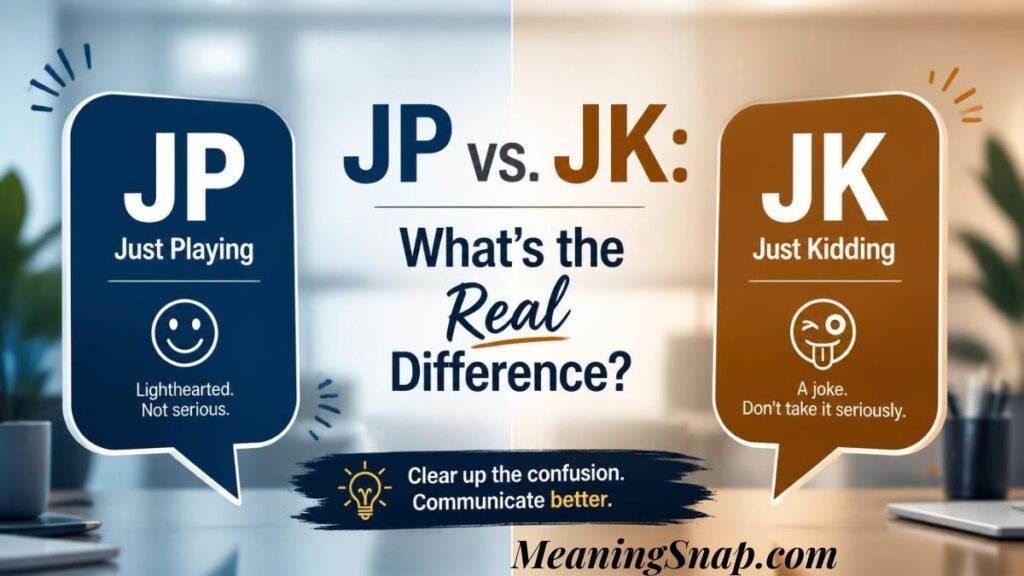
If you’ve wondered whether JP and JK mean the exact same thing, you’re not alone. Both work as a joking or not serious signal, but they land differently once you notice the details, and the JP meaning in text overlaps just enough with JK to cause real confusion.
JK, short for Just Kidding, reads as the more universal option. Almost everyone recognizes it, including people outside Gen Z and Millennial circles, since it’s been part of texting slang for decades. JP feels newer and a bit more playful, closer to a wink than a straightforward correction. People tend to reach for JP when the joke already has some warmth to it, and for JK when they need to clear up a genuine misunderstanding fast.
Here’s how JP stacks up against the abbreviations it gets confused with most:
| Term | What It Signals | Typical Tone | Example |
|---|---|---|---|
| JP | Just Playing, softens a tease | Playful, casual | “you snore so loud lol JP” |
| JK | Just Kidding, clears up confusion | Neutral to playful | “wait I’m serious, jk I’m not” |
| LOL | Shows amusement, doesn’t clarify intent | Light, casual | “lol that’s so random” |
| LMAO | Stronger reaction of humor | Casual, expressive | “lmao you did not just say that” |
| “Kidding” (spelled out) | Same as JK, slightly more formal | Neutral | “kidding, you look great” |
The biggest difference people miss: JK and JP clarify a joke, while LOL and LMAO mostly react to one. If someone needs to walk back a comment, JP and JK do that job. LOL just shows they found it funny, without saying whether they meant it.
How JP Shows Up Across Texting, Social, Gaming, and Dating Apps
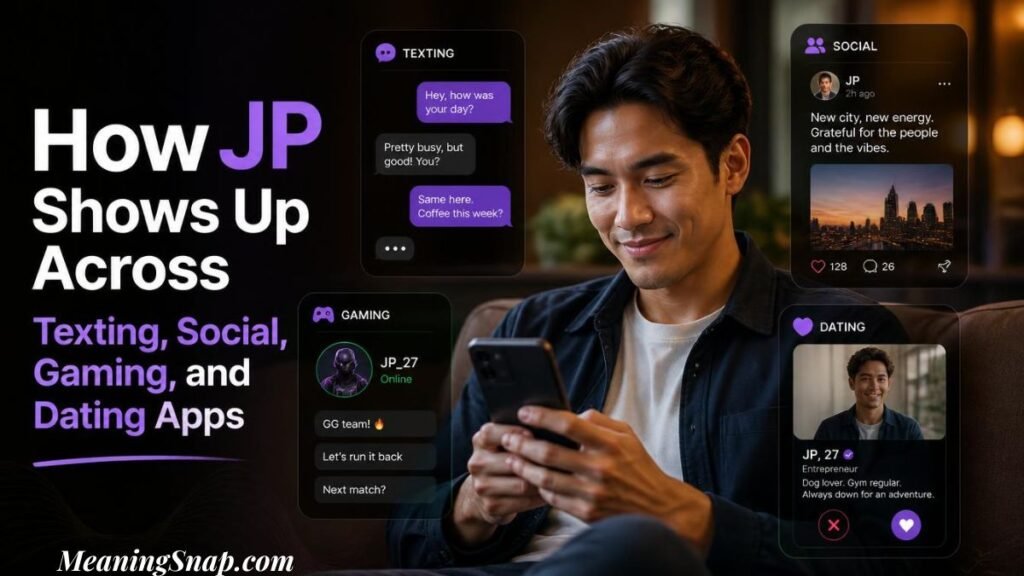
The JP meaning in text doesn’t change much from platform to platform, but how it gets used shifts depending on where the conversation happens. Texting between friends, commenting on social media, gaming chats, and dating apps all lean on it a little differently.
In group texts and one-on-one messaging, JP shows up right after a joke about someone’s habits, choices, or mishaps. On social platforms like Instagram and TikTok, people drop it in comments to soften a playful roast on someone’s photo or video. Gaming conversations use it constantly during multiplayer chats, since trash talk moves fast and nobody wants a teammate taking a joke personally mid match. Dating apps add another layer, since JP often follows a bold or flirty line the sender wants to test out without fully committing to it.
A few examples show the range:
- Group chat: “you’d definitely get lost in a parking lot lol JP”
- Instagram comment: “the audacity of this fit 😭 jp bestie you ate”
- Gaming chat: “bro you’re so bad at this game, jp you carried that whole round”
- Dating app: “not gonna lie you seem like a lot to handle… jp, kind of into it tho”
Each one uses the same two letters to do the same basic job: take the edge off a comment that might sting without it. The context changes the stakes, though. A joke in a gaming lobby disappears in seconds. A joke on a dating app sticks around a little longer, since first impressions carry more weight there.
JP Meaning on Snapchat
Snapchat conversations lean on the same Just Playing meaning as texting and other apps, just with the platform’s own format layered on top. Someone might snap a picture with a caption like “you looked rough today lol JP,” using the disclaimer the same way group chats do. Streaks and quick back and forth snaps move fast, so JP shows up as a quick way to soften a joke between friends without breaking the pace of the conversation.
The only real difference on Snapchat is the format. Captions sit on top of photos or short videos instead of plain text, so JP often appears alongside an emoji or a laughing sticker rather than standing alone in a sentence. The meaning behind it stays the same as anywhere else the JP meaning in text shows up.
Also Read: FW Meaning in Text: What Does “FW” Mean in Chats, Social Media, and Online?
Other Things JP Can Mean
Even though Just Playing dominates casual conversations, the JP abbreviation carries a few other meanings depending on where it shows up. Context almost always makes the intended meaning obvious, so the JP meaning in text rarely gets confused with these once you spot the setting.
In travel, geography, and business writing, JP is the standard shorthand for Japan. You’ll see it on shipping labels, international forms, and abbreviated country lists next to codes like US or UK. In legal and government contexts, JP stands for Justice of the Peace, an official authorized to handle certain civil duties like officiating weddings or witnessing documents. That usage sits in formal environments and rarely crosses over into texting slang.
Gamers might also run into JP as Jump Point or Jump Power in specific games, terms tied to movement mechanics rather than conversation between players. This meaning stays contained to discussions about how a game works, so it’s easy to tell apart from the joking version once you know the setting.
None of these alternate meanings overlap much with the texting version, since the surrounding conversation gives it away fast. Nobody reading a shipping form mistakes JP for Just Playing, and nobody in a group chat about someone’s terrible parallel parking thinks the topic switched to Japan.
JP Meaning in Business and Job Listings

In professional and recruiting spaces, JP sometimes stands for Job Posting, shorthand recruiters and HR teams use when sharing open roles internally or across job boards. A message like “new JP for a marketing role just went up” refers to a listing, not a joke.
Academic and workplace settings also use JP for Joint Project, describing a shared assignment or collaboration between two or more people or teams. Both meanings depend heavily on the surrounding conversation, since a casual group chat and a recruiting Slack channel read the same two letters completely differently. Mixing this up matters, replying “JP 😂” to a recruiter sharing a real job posting tends to land the wrong way.
JP Meaning in Medical Contexts: The JP Drain
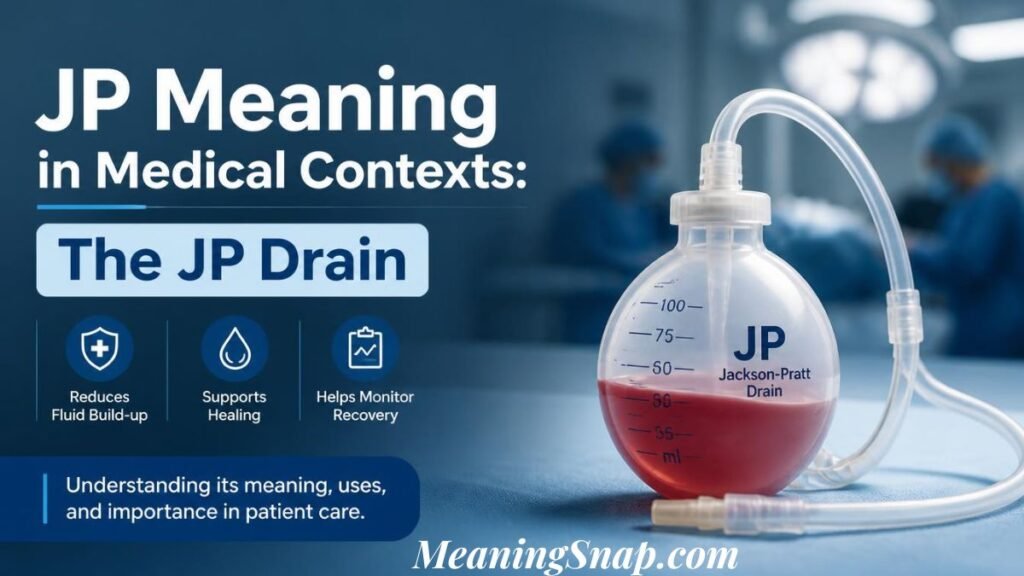
In medical settings, JP usually refers to a Jackson-Pratt drain, commonly shortened to JP drain. It’s a small suction device doctors place near a surgical incision to draw excess fluid away from the wound while it heals. Patients recovering from certain surgeries, like some abdominal or reconstructive procedures, often go home with one temporarily.
Nurses, surgeons, and patient care instructions use “JP drain” constantly, and it has nothing to do with texting slang. If a family member mentions a JP drain after a hospital visit, they’re talking about a piece of recovery equipment, not sending mixed signals about a joke.
Also Read: CYA Meaning in Text: What It Actually Means (and When to Use It)
JP Meaning in Books and Libraries
Outside of texting, JP shows up as a real library classification. Many public libraries label picture books for young children with a JP call number, short for Juvenile Picture Books. It’s a shelving category, not slang, meant to help parents and librarians find age appropriate books quickly.
This meaning has nothing to do with joking or texting. A librarian pointing a parent toward the JP section is talking about board books and picture books for young kids, not a playful tone softener. Context makes the difference obvious right away, since nobody confuses a library catalog with a group chat.
JP as French Slang: A Common Mix-Up
People searching for a French meaning behind JP are usually thinking of a different abbreviation that sounds close: JPP. In French texting slang, JPP stands for “j’en peux plus,” which translates to something like “I can’t take it anymore.” French speakers use JPP after something exhausting, frustrating, or even overwhelmingly funny, closer to “I’m done” than to a joke softener.
JP by itself doesn’t carry an established meaning in French texting the way JPP does. If a message uses JP with French text around it, it’s worth checking whether the sender meant JPP instead, since one missing letter changes the meaning completely. Outside of that mix-up, the JP meaning in text most people search for stays tied to English language texting slang.
JP on Urban Dictionary: What It Says
Urban Dictionary is crowdsourced, so entries under JP vary depending on who submitted them and when. The most upvoted definitions line up with what shows up everywhere else, Just Playing, used the same way people use it in texts and comments.
Past that top definition, things get more personal. Some entries use JP as a nickname description for someone with a specific personality, similar to how people write personal definitions for name initials. Others tie JP to Jamaica Plain, a neighborhood in Boston, which has nothing to do with texting slang at all. Because anyone can submit a definition, Urban Dictionary works better as a snapshot of internet culture than a dictionary in the traditional sense. For a reliable answer, the top voted “Just Playing” definition matches what shows up across texting, social media, and gaming chats.
Common Mix-Ups With JP
Mixing up the JP meaning in text with something else doesn’t usually cause a disaster, but it can lead to a confusing few seconds before the conversation makes sense again. A few mix-ups come up more than others.
The most frequent one happens when JP shows up in a conversation about travel or global business right after a joke, and the reader briefly wonders if someone switched topics to Japan out of nowhere. Another common mix-up treats JP as if it fully erases whatever came before it, when a comment already crossed a line before the JP even got typed. Adding JP after something genuinely hurtful doesn’t undo the sting, it just adds two extra letters to an already rough message. A smaller mix-up happens in gaming spaces, where a newer player might see JP and assume Jump Point, especially in strategy or flight based games where that term shows up in tutorials.
Common Mistake: Tacking JP onto a comment that already crossed a line doesn’t cancel it out. Tone softeners only work on jokes the other person was already fine laughing at.
Reading the room before typing JP matters more than the abbreviation itself. If a joke lands well, JP adds a wink. If it doesn’t, JP can come across like an attempt to dodge accountability instead of a genuine tone softener.
Is JP Okay to Use at Work?
Professional communication runs on different rules than a group chat, and the JP meaning in text mostly stays out of that world. Work emails, client messages, and formal Slack channels call for clear language that doesn’t depend on the reader knowing online slang.
A few situations make JP a bad idea outright. Client facing emails, performance reviews, anything going to someone outside your immediate team, or any message a manager or HR department might read later are all places where JP reads as unprofessional at best and confusing at worst. Instead of leaning on the abbreviation, spelling out the intent works better in formal settings. Saying “just kidding” in full, or rewording the sentence so it doesn’t need a disclaimer at all, keeps the message clear without sounding like a group chat.
There’s a narrow exception. Some internal team chats, especially on Slack or Teams channels built around a casual culture, tolerate internet slang because the whole team already talks that way. Even then, reading the room matters more than any rule, since one new hire or client added to that channel changes things fast.
Here’s a quick breakdown of where JP does and doesn’t fit at work:
| Setting | JP Appropriate? | Better Option |
|---|---|---|
| Client email | No | Spell out the joke or remove it |
| Internal team chat (casual culture) | Sometimes | Match the team’s existing tone |
| Performance review | No | Clear, direct language |
| Formal Slack channel | No | “Kidding” or reword entirely |
Business communication holds up best when nothing needs decoding. JP works fine among friends because everyone shares context instantly. A work chat doesn’t always offer that same shortcut.
When JP Doesn’t Fix Anything
JP works best as a light touch, not a fix all. When someone uses it to walk back something that stung, the two letters don’t do much heavy lifting, and the JP meaning in text starts to matter less than the tone of the conversation it followed.
Text strips out facial expressions and voice entirely, leaving nothing but words on a screen. That’s part of why abbreviations like JP exist in the first place, they try to recreate the wink or laugh that would normally soften a comment in person. That trick only works when the joke had some warmth built into it to begin with. If a comment crosses into something sincere and hurtful, JP reads like an excuse rather than an explanation.
Jordan: honestly that joke earlier wasn’t funny, it kind of hurt Jordan: not looking for JP, just wanted to say it
That message skips the tone softener and says the real thing directly, which tends to land better than an abbreviation tacked onto a rough comment. Reading someone’s real reaction and responding to it, instead of leaning on JP as a blanket apology, keeps communication honest. Internet slang works well for genuine humor. It doesn’t replace meaning what you say, or skip a real apology when one is needed.
You May Like Also: HMU Meaning in Text: What Does HMU Mean?
How to Respond When Someone Sends You JP
Once JP lands in a chat thread, replying doesn’t take much thought. The right response depends on the tone of the message and how well the joke landed in the first place, and getting comfortable with the JP meaning in text makes this second nature fast.
A casual response keeps things moving without much thought, something like “lol fair enough” or a laughing emoji. A funny response leans into the joke instead of just accepting it, tossing back something like “wow rude but ok” or matching the energy with a tease of your own. A neutral response works when the joke didn’t fully land but wasn’t worth a whole conversation either, a simple “haha okay” does the job. A professional response only comes up in the rare case JP shows up at work, where acknowledging it briefly and moving the conversation back to business keeps things smooth.
Here’s what each tone might look like in practice:
- Casual: “lol fair enough 😭”
- Funny: “wow okay noted, watch your back”
- Neutral: “haha all good”
- Professional: “no worries, back to the report though”
None of these responses need much thought behind them. Matching the tone of the original message, whether playful, sarcastic, or somewhere in between, keeps the exchange feeling natural instead of forced.
Funny Ways People Use JP
Some of the funniest uses of JP lean into the joke instead of quietly walking it back. Doubling it up, like “jp jp,” adds emphasis and reads as more comedic than a single JP on its own. Pairing it with an exaggerated compliment right after an insult is another common move, stacking the joke instead of softening it quietly.
Riley: you’d definitely forget your own birthday Riley: jp jp… okay kind of just a little
The humor comes from timing more than the letters themselves. A JP dropped a beat too late, after someone’s already reacted, tends to land funnier than one that shows up instantly, since it makes the joke feel like an afterthought rather than a built in disclaimer.
You Also Like: MK Meaning: What Does MK Mean in Text?
Frequently Asked Questions
What does JP mean in text?
JP most often stands for “Just Playing,” used right after a joke or tease to show you’re not serious. That’s the core JP meaning in text across most casual conversations.
Is JP the same as JK?
Not exactly. JP and JK both soften a joke, but JK (Just Kidding) reads as more universal, while JP feels a bit more playful and casual.
What does JP mean in gaming?
In most gaming chats, the JP meaning in text still applies and softens trash talk between matches. In specific games, JP can also refer to Jump Point or Jump Power, a movement mechanic unrelated to joking around.
Can JP mean something other than Just Playing?
Yes. Outside texting slang, JP can stand for Japan, Justice of the Peace, or gaming terms like Jump Point, depending on the context around it.
Is it okay to use JP in professional messages?
Not usually. The JP meaning in text belongs to casual chats and social media, not client emails or formal workplace communication, where clear, spelled out wording works better.
Why do people use JP instead of just saying they’re joking?
Texting culture favors short, fast replies, and JP does the same job as a full sentence in a fraction of the characters, which fits how casual conversations move online.
Bottom Line
JP isn’t complicated once you’ve seen it enough times. It’s just Just Playing, a lightweight way to keep a joke feeling like a joke instead of an insult, whether that’s in a group chat, a comment section, a gaming lobby, or a slightly bold text on a dating app. The JP meaning in text depends on what came before it, not the other way around. Next time JP shows up in your messages, you’ll know exactly what it means and exactly how to reply.

Alex Morgan is a writer focused on explaining slang, words, phrases, acronyms, and popular expressions in a simple and easy-to-understand way. Through clear explanations and helpful examples, Alex helps readers quickly understand what words and phrases mean and how they’re commonly used.