Someone texts you “I’ll lyk tomorrow” and you’re left staring at your phone wondering what they mean, then five minutes later you see “lyk your fit today” in someone’s comments and now you’re genuinely confused. This happens more than you’d think. The LYK meaning in text shifts depending on where you see it, and this is why so many people end up Googling it mid-conversation. One version means someone will update you later. The other is a lazy spelling of “like.” Neither is wrong. They’re two different words sharing the same three letters.
Quick Answer
LYK stands for “Let You Know” in most texts, used when someone plans to update you once they have an answer. It sometimes appears as a casual spelling of “like” instead, mostly in captions and comments. Look at where the word sits in the sentence to know which one you’re reading.
What Does LYK Mean in Text?
LYK shows up everywhere in modern texting, from group chats to Instagram comments, and the letters carry more than one job. The LYK meaning most people run into first is “Let You Know,” a placeholder for someone who isn’t ready to answer yet. Someone asks if you’re free Friday, you’re not sure, so you type “lyk” instead of writing out the whole sentence.
The second job LYK does is stand in for the word “like” itself, dropped down to three letters. This version shows up in casual writing, especially where someone types fast and skips vowels. “I lyk your jacket” reads the same as “I like your jacket,” with less typing.
Both meanings count as internet slang, and neither one belongs in formal writing. Context tells you which meaning fits. A message ending in “lyk tomorrow” points toward the “let you know” version. A sentence with “lyk” sitting in the middle, doing the job a verb would do, points toward “like.”
People search for the lyk definition because the two meanings don’t overlap in any obvious way, and mixing them up changes the whole message. Someone typing “I’ll lyk about the party” means they’ll update you later. Someone typing “I lyk the song” means they enjoy it. Same three letters, different sentence, different meaning entirely.
Read Also: WSP Meaning in Text: Full Definition, Examples, and How to Reply
LYK Full Form: “Let You Know”
The full form of lyk in its most common use expands to “Let You Know,” a phrase people compress because typing the whole thing takes longer than three letters. You’ll see it show up right after a promise, or in place of one. “I’ll lyk once I check my schedule” means the same as “I’ll let you know once I check my schedule,” minus eleven characters.
This version of LYK works as a stand-in for a future action. The sender hasn’t given you the answer yet. They’ve told you an answer is coming. It shows up in work-adjacent group chats, friend group planning threads, and anywhere someone needs to buy time before committing to a yes or no.
Here’s the pattern worth remembering: lyk stands for something you’ll receive later, not something happening now. Compare it with a phrase like “I’ll tell you” or “I’ll update you,” and the meaning lines up exactly. The tone stays neutral. Nobody reads “I’ll lyk” as rude or dismissive on its own, though how someone follows through on it says more than the abbreviation itself.
One small detail worth catching: LYK in this sense almost always attaches to a verb like “will” or “I’ll.” Spot “I’ll lyk,” “will lyk,” or “lyk when” and you’re looking at “let you know,” not the other meaning.
Wait, Does LYK Also Mean “Like”?
Yes, and this is where most of the confusion starts. LYK shows up as an informal spelling of “like” across captions, comments, and fast-typed messages, especially from people who drop vowels out of habit. “Lyk” replaces “like” the same way “ur” replaces “your” or “u” replaces “you,” part of a broader pattern of shortened spelling built for speed over correctness.
This version doesn’t carry the same “update coming later” meaning at all. “I lyk this outfit” means someone enjoys the outfit, full stop. No follow-up message is coming. The word functions as a regular verb or filler, sitting in the middle of a sentence instead of trailing at the end.
Social media comments lean on this spelling often. Someone posts a photo, a friend types “lyk the hair” underneath, and the whole exchange wraps up in four words. This spelling choice isn’t new either. Texters have swapped “like” for “lyk” since flip-phone character limits made every letter count.
One pattern helps separate the two: the “like” version tends to sit before a noun (“lyk your fit,” “lyk this song”), while the “let you know” version tends to close out a sentence (“I’ll lyk,” “lyk tomorrow”). Position alone answers most of the confusion.
How to Tell Which Meaning Someone Means
Reading LYK correctly comes down to three quick checks: where it sits, what surrounds it, and whether a question got asked earlier in the conversation.
Start with position. If LYK closes out the sentence, or follows “I’ll” or “will,” it’s standing in for “let you know.” If it sits in the middle of a sentence, doing the work a verb does, it’s standing in for “like.”
Next, check what came before it. Someone asking “Are you free Saturday?” followed by a reply of “lyk” almost always means “let you know,” since a plan needs confirming later. Someone posting a photo followed by a comment reading “lyk the vibe” means “like,” since there’s nothing left to confirm.
Last, look at punctuation and capitalization, though this one’s less reliable. Some people cap LYK when they mean “let you know” and lowercase it for “like,” but plenty of texters ignore capitalization completely, so treat it as a tiebreaker rather than a rule.
Here’s a fast way to sort the two:
- LYK at the end of a sentence, especially after “I’ll” → Let You Know
- LYK in the middle of a sentence, next to a noun → Like
- LYK replying to a yes/no question → Let You Know
- LYK under a photo or post → Like
Once you’ve got the pattern down, the guesswork mostly disappears.
Related Article: SYS Meaning: What Does SYS Mean in Text, Medical Charts, and Tech?
LYK vs. LMK: Don’t Mix These Up
LYK and LMK look close enough on a screen to trip people up constantly, and the mix-up flips the entire meaning of a message. LMK stands for “Let Me Know,” the reverse direction of LYK’s “Let You Know.”
The difference comes down to who’s waiting on information. Type “LMK” and you’re asking the other person to update you. Type “LYK” and you’re telling them you’ll be the one providing the update. Mixing them up sends the opposite signal from the one intended.
A quick way to keep them straight: LMK has “me” energy, someone wants something from you. LYK has “you” energy, someone owes you something.
| Term | Full Form | Who’s Waiting |
|---|---|---|
| LYK | Let You Know | The person receiving the message |
| LMK | Let Me Know | The person sending the message |
“LMK if you’re coming tonight” asks for a response. “I’ll LYK if I’m coming tonight” promises one. Swap the two by accident and a simple scheduling text turns confusing fast, which explains why this pairing shows up often in searches comparing texting slang terms.
Where LYK Comes From
LYK grew out of the same environment that produced most texting abbreviations: SMS character limits and per-message charges from the early 2000s. Phones charged by the text back then, and shorter messages saved money along with time, which pushed an entire generation toward clipped spelling and dropped vowels.
“Let you know” made an obvious target for shortening since it shows up constantly in everyday planning texts. Cutting eleven characters down to three added up fast for anyone sending dozens of messages a day. The “like” spelling followed a similar path, riding the same wave of vowel-dropping that gave people “srsly,” “bc,” and “thx.”
Once smartphones removed the per-text pricing behind the trend, the habit stuck around anyway. Texting slang built during the character-limit era carried over into unlimited texting plans, then into social platforms like Twitter, Instagram, and Snapchat, where short, punchy language fits the format regardless of cost.
LYK never needed a viral moment or a meme to spread. It grew quietly, the way most functional abbreviations do, by solving a real problem for people typing fast on small keyboards.
Where People Use LYK Most
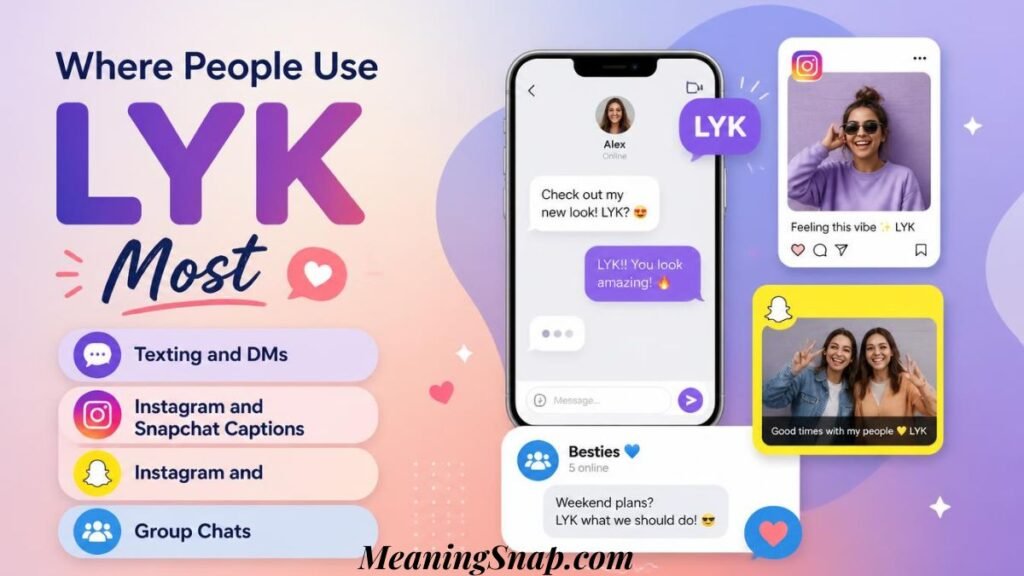
LYK shows up across nearly every messaging platform in use today, though the two meanings tend to cluster in different spots.
Texting and DMs
SMS and direct messages are where the “let you know” meaning lives most comfortably. Friends confirming plans, coworkers checking in on a task, or family members figuring out dinner all lean on “I’ll lyk” to buy a little time before giving a real answer.
Instagram and Snapchat Captions
Captions and comments favor the “like” spelling. A photo caption reading “lyk if u relate” or a comment saying “lyk this fit fr” leans into the casual, compressed style these platforms reward, where online slang and dropped letters read as normal rather than lazy.
Group Chats
Group threads mix both meanings depending on the moment. Someone might type “lyk when you’re all free” (let you know) a few messages after someone else typed “I lyk this idea” (like), and regular chat participants sort the difference without slowing down.
Real Conversation Examples
Seeing LYK in context makes the difference between the two meanings click faster than any explanation.
“Let You Know” Examples
Example 1 (Casual): Sam: You in for the movie tonight? Jess: Not sure yet, checking with my sister. lyk in a bit!
Example 2 (Work-adjacent): Coworker: Did the client approve the mockup? You: Still waiting to hear back. I’ll LYK the second I do.
Example 3 (Sincere): Partner: Are we still doing dinner with your parents Sunday? You: I’ll lyk tomorrow once I check my work schedule.
“Like” Examples
Example 4 (Casual comment): “lyk the new profile pic, when’d you cut your hair?”
Example 5 (Sarcastic): “oh I lyk TOTALLY believe you finished that assignment early lol”
When Someone Uses It to Avoid Committing
Example 6: Friend: Wanna hang this weekend? You: lyk not sure, depends how work goes
This one blends both feelings at once: a real answer isn’t ready yet, and the vague “lyk” softens the delay without sounding like a flat no.
Is LYK Appropriate for Work or Professional Chats?
LYK sits comfortably in casual workplace communication– think Slack messages between coworkers, quick check-ins, or informal project threads- but it doesn’t belong in formal writing.
A Slack message to a teammate saying “I’ll lyk once I finish testing” reads fine and saves a few seconds of typing. The same phrase in a client-facing email, a performance review, or a business communication document reads unprofessional and rushed.
The safest rule: match the abbreviation to the channel. Internal chat tools built for speed, like Slack, Teams, or Discord, tolerate shorthand like LYK without raising eyebrows. Anything landing in an inbox, a proposal, or a document meant to represent you formally deserves the full phrase instead.
Here’s the quick breakdown:
- Internal Slack/Teams messages: fine
- Texts with coworkers you know well: fine
- Client emails: avoid; write “I’ll follow up” or “I’ll update you” instead
- Performance reviews, reports, official documents: avoid entirely
One exception worth naming: even in casual settings, LYK loses its usefulness if you never follow through. The abbreviation buys goodwill only if an actual update shows up afterward.
Common Mistakes People Make With LYK
A handful of mix-ups come up again and again with this term, and most trace back to skipping the context clues covered earlier.
- Confusing LYK with LMK. The two look nearly identical at a glance, but they point in opposite directions: one promises an update, the other requests one.
- Reading “like” as “let you know” out of habit. Once someone learns the “let you know” meaning first, they sometimes apply it everywhere, even to comments where “like” fits better.
- Assuming LYK always needs a follow-up. Only the “let you know” version comes with an implied promise. The “like” version doesn’t owe anyone anything further.
- Using LYK in formal writing by accident. Autocomplete and muscle memory carry casual shorthand into emails more often than people realize, so a quick read-through before sending helps catch it.
- Treating capitalization as a reliable signal. Plenty of texters cap or lowercase LYK at random, so leaning on capitalization alone to decide the meaning leads to wrong guesses.
Catching these patterns early saves a confused follow-up text later in the conversation.
LYK at a Glance
| Context | What It Means | Example | Platform |
|---|---|---|---|
| End of a sentence, after “I’ll” | Let You Know | “I’ll lyk tonight” | Texts, Slack, DMs |
| Middle of a sentence, near a noun | Like | “lyk your energy” | Instagram, Snapchat, comments |
| Reply to a yes/no question | Let You Know | “lyk in a bit” | Group chats, texts |
| Under a photo or post | Like | “lyk this look” | Captions, comments |
| Formal writing | Neither, write it out | “I’ll follow up shortly” | Email, reports |
This table works as a fast reference for anyone still second-guessing a message mid-conversation. Save it, screenshot it, or bookmark this page, whichever gets you an answer faster the next time LYK shows up somewhere unexpected.
LYK Meaning in WhatsApp
WhatsApp doesn’t come with the old SMS character limits that pushed people toward abbreviations in the first place, but the habit stuck around anyway. Lyk meaning in WhatsApp works the same as texting: “I’ll lyk” promises an update once someone has one, whether that’s confirming a delivery, checking a schedule, or replying to a group plan.
Read receipts change the feel of it a little. Blue checkmarks show the message got read, so “I’ll lyk” followed by silence for hours reads more like a stall than it would in a regular text, where there’s no proof the message landed yet. WhatsApp business chats use the phrase too, mostly from customer service reps buying time before an answer arrives.
The “like” spelling shows up far less here since WhatsApp doesn’t build around captions or public posts. Nearly every WhatsApp use of LYK points to “let you know.”
My new Article: CFS Meaning Slang: What Does CFS Stand For in Texting & Social Media?
LYK Meaning on Instagram
Instagram splits LYK across three spots, and each one leans a different direction. Comments under a post lean toward “like”: “lyk this fit” or “lyk your energy” reads the same as tapping the heart button, with words attached. DMs swing back toward “let you know,” especially in conversations about plans, since Instagram DMs work like any other private chat.
Reels and post captions almost always use the “like” version, written by the poster rather than a commenter. A caption reading “lyk if you relate” invites agreement rather than promising a reply later.
Story replies sit somewhere in between. Someone replying to a poll or question sticker with “lyk” usually means “let you know,” since story questions often ask for a real answer. The rule from earlier still applies here: check whether LYK sits near a noun (like) or closes out a promise (let you know), and Instagram’s context sorts itself out fast.
LYK Meaning in Text: Urban Dictionary
Urban Dictionary’s entries for LYK match what shows up in everyday texting, since the site runs on crowdsourced submissions from people who use the term. The top-voted definition lists “let you know” first, with an example built around weekend plans.
A second entry lower on the page defines LYK as shorthand for “like,” specifically the exaggerated, stretched-out teen spelling popular in early-2000s chatrooms (“LyK OoH mI gAwD”). That entry skews older and more ironic than how people write LYK today, but it confirms the second meaning has stuck around for two decades.
Worth remembering: Urban Dictionary entries come from users, not editors, so definitions vary in quality and get voted up or down by whoever reads them. For LYK specifically, the crowd lines up with the two meanings covered throughout this guide.
LYK Meaning From a Girl
LYK doesn’t carry a different meaning based on who sends it. A girl texting “I’ll lyk” means the same thing a guy texting it means: an answer is coming, not yet. The same goes for the “like” spelling in a comment or caption.
Where gender plays a role is tone, not definition. “Lyk” from someone you’re dating might read as more meaningful simply because you’re paying closer attention to every word they send, not because the abbreviation itself shifts meaning. Reading romantic intent into LYK on its own leads to more confusion than clarity. Look at the surrounding message instead. A flirty “lyk your smile btw” carries different weight than a flat “I’ll lyk after class,” and that difference comes from the sentence around it, not from who typed it.
What Does LYK Mean on Snapchat
Snapchat’s whole format runs on speed, quick snaps, disappearing messages, and short captions, so LYK fits right in. Snap captions favor the “like” spelling almost exclusively: “lyk this filter” or “lyk ur hair today” shows up under photos the same way it does on Instagram.
Chat leans the other direction, toward “let you know.” Streak partners and close friends use “lyk” mid-conversation to defer plans without breaking the back-and-forth rhythm streaks depend on. Since Snapchat messages disappear by default, “I’ll lyk” sometimes doubles as a way to keep a conversation open without committing to a screenshot-able promise.
Snapchat’s informal, disappearing-message culture makes LYK feel even more at home there than on platforms where messages stick around permanently.
ILYK Meaning in Text
ILYK stands for “I’ll Let You Know,” the fuller version of LYK with the “I’ll” built directly into the abbreviation. It works exactly like “I’ll lyk,” compressed one step further. “ILYK once I check with my roommate” means the same thing as “I’ll let you know once I check with my roommate.”
People reach for ILYK in the same spots LYK shows up: group chats, casual work messages, and social apps, whenever an answer isn’t ready yet. The two abbreviations get used interchangeably by a lot of texters, and neither one reads as more formal or more casual than the other.
One mix-up worth flagging: ILYK looks close to ILY (“I love you”) at a glance, especially in a fast scroll through a chat thread. Reading the extra letters carefully clears that up immediately, since the two abbreviations mean entirely different things.
LYK Meaning in English
LYK isn’t a foreign word or a borrowed term. It’s built entirely from English, standing in for two English phrases: “let you know” and “like.” Anyone searching for a translation or a dictionary entry for LYK in another language won’t find one, because the abbreviation exists purely as shorthand, not as a standalone word with its own definition.
Standard English dictionaries don’t list LYK either, since it belongs to internet slang rather than formal vocabulary. Style guides and grammar references treat it the same way they treat “u,” “ur,” or “brb”: useful for texting, out of place in an essay, a resume, or a business report.
Read Also: What Does WYLL Mean in a Text? The Complete Guide to This Gen Z Slang
LYK Meaning in Greek
LYK doesn’t carry a distinct meaning in Greek, the language, or in Greek life, the fraternity and sorority system common at U.S. colleges. It doesn’t match any Greek alphabet letters, Greek words, or established Greek-organization terminology.
The confusion likely comes from the word “Greek” showing up in two unrelated contexts online, campus culture and the actual language, neither of which has adopted LYK as a term of its own. If you’re seeing LYK in a chat with someone in a fraternity or sorority, it’s functioning as regular texting slang, “let you know” or “like,” the same as anywhere else.
Frequently Asked Questions
What does LYK mean in text?
LYK usually means “Let You Know,” used when someone plans to give you an answer later. It occasionally means “like” instead, depending on where it sits in the sentence.
What is the full form of LYK?
The full form is “Let You Know.” A second, less common use spells out “like” in shorthand form.
Is LYK the same as LMK?
No. LMK means “Let Me Know” and requests information, while LYK means “Let You Know” and promises information. They point in opposite directions.
Is LYK rude or unprofessional?
LYK isn’t rude on its own, though it reads as casual. Skip it in emails, reports, or anything meant to look polished.
Does LYK ever mean someone is avoiding a real answer?
Sometimes. A vague “lyk, not sure” often softens a delay instead of committing to a yes or no.
Is LYK used the same way on every platform?
Not quite. Texts and DMs lean toward “let you know,” while captions and comments lean toward “like.” Reading the platform helps predict which meaning fits.
Bottom Line
LYK isn’t complicated once you know where to look. Let it close out a sentence or follow “I’ll,” and it means someone will update you soon. Let it sit next to a noun in a caption or comment, and it means “like,” nothing more. Once the meaning of LYK clicks, guessing stops. Next time LYK shows up in a text, you’ll know exactly how to read it, and exactly how to reply.

Alex Morgan is a writer focused on explaining slang, words, phrases, acronyms, and popular expressions in a simple and easy-to-understand way. Through clear explanations and helpful examples, Alex helps readers quickly understand what words and phrases mean and how they’re commonly used.