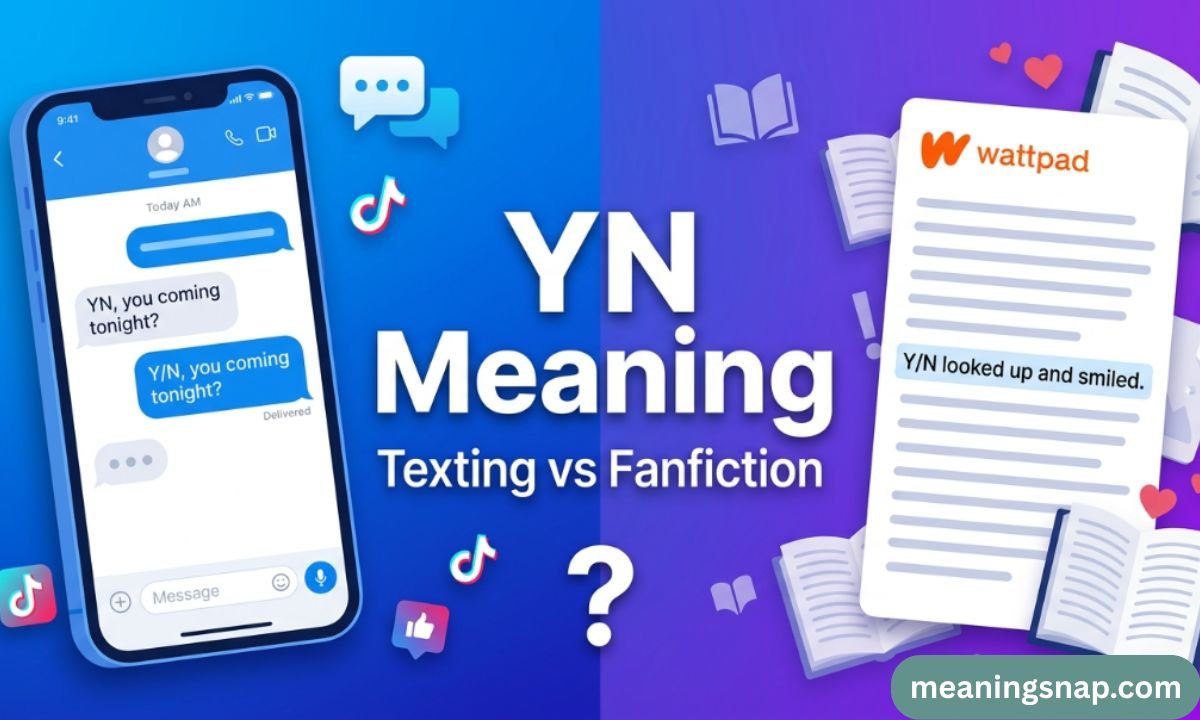
You’re three chapters deep into a Wattpad story at 1 a.m., completely hooked, when the writer drops a line like “Y/N looked up at him and smiled.” Wait, who’s Y/N? Did you skip a character introduction? Or maybe it happened in a group chat instead. Someone typed “yn?” after asking if you’re coming tonight, and you stared at your phone wondering if that was a typo. Either way, you landed here for the same reason everyone does. The YN meaning changes completely depending on where you saw it, and this guide breaks down both versions so you never have to guess again.
YN Meaning: Quick Answer Table
Before getting into the full explanation, here’s a fast reference so you can match your situation to the right meaning right away.
| Term | Meaning | Where You’ll See It | Example |
|---|---|---|---|
| Y/N | Your Name (reader-insert placeholder) | Fanfiction, Wattpad, AO3, Tumblr | “Y/N grabbed her coat and ran.” |
| YN | Yes or No | Texting, DMs, group chats | “YN, you coming tonight?” |
| yn | Casual lowercase texting shortcut | SMS, Instagram DMs, Snapchat | “movie tonight yn” |
| Y/N | Slash format specifically for surveys or forms | Response fields, spreadsheets, quick polls | “Attending event: Y/N” |
This table covers the core split, but each version has its own backstory worth knowing, especially if you’re active in fandom spaces or just trying to reply to a text without sounding confused. The quick answer is simple: check the setting first, then the meaning follows naturally. A Wattpad chapter and a group chat are not playing by the same rules, even if the letters on the screen look identical.
Read Also: What Does FFS Mean in Slang? Texting & Social Media Guide
YN Meaning in Fanfiction: The Real Origin
This is where the YN abbreviation actually comes from, and it’s a much bigger deal in fandom spaces than most people realize. In reader-insert stories, Y/N stands in for your name, letting anyone reading the fic drop themselves straight into the plot as the main character.
Why Writers Use “Y/N” Instead of a Real Name
Fanfiction writers, especially on Wattpad and AO3, use Y/N so the story works for every reader, not just one imagined person. Instead of naming a fictional character, the writer leaves a blank that your brain fills in automatically. It’s a formatting trick, and it’s a smart one. A story titled “Character x Reader” almost always includes Y/N somewhere in the first few lines.
Think of it this way: a regular novel gives you a protagonist with a fixed name, a fixed backstory, a fixed personality. Reader-insert fiction flips that setup on its head. The fandom character stays the same (the celebrity, the anime lead, the K-pop idol), but the main character slot stays open. That open slot is Y/N. It’s why these stories rack up so many reads across niche groups and fandom groups, since thousands of different readers can technically be the “main character” of the exact same fictional scenario at the same time.
The Gender-Neutral, Self-Insert Purpose
Here’s the thing that makes Y/N genuinely clever: it’s built to be gender-neutral and identity-neutral. Self-insert literature relies on the reader projecting themselves into the fictional scenario, and a fixed name would break that immersion for half the audience. Y/N keeps the door open. Readers picture their own name, their own face, their own life folded into someone else’s fandom story, and that’s the entire appeal of reader-insert fiction.
Where It Started: Wattpad, AO3, Tumblr, Reddit
The format took off on Wattpad in the early 2010s, spread through Tumblr roleplay communities, and eventually became standard practice on Archive of Our Own. Reddit fandom threads picked it up too, especially in K-pop fandoms and anime edits where “Y/N” content gets shared as short fictional scenarios alongside fan edits and romance edits. It’s not a new trend. It’s been quietly running fandom stories for over a decade, and it’s still one of the most searched fanfiction terms today.
Read More: What Does DTM Mean in Slang? TikTok Meaning & Social Media Use
What Does “YN” Mean in Texting and DMs? (Yes or No)
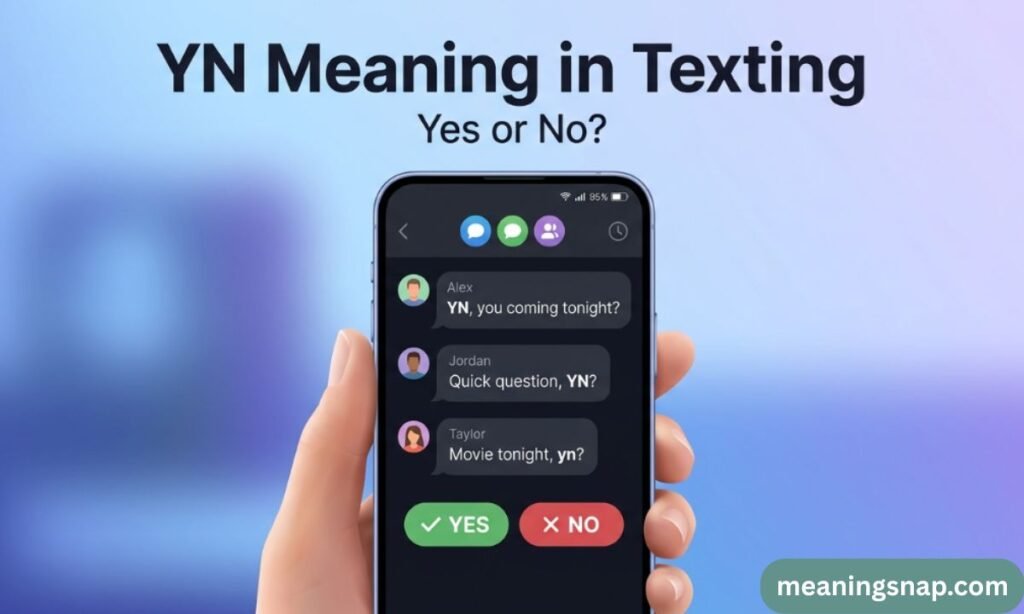
Switch over to regular texting, and YN means something completely different. Here, it’s a texting shortcut for “yes or no,” used the same way people use BRB, TBH, or FR.
How People Use It in Quick Response Questions
Someone asks a question that only needs a binary response, and instead of typing out “yes or no,” they shorten it. It shows up constantly in group chats, Instagram DMs, and casual messaging apps where speed matters more than spelling everything out. “YN, we still on for Friday?” gets the same job done as a full sentence, just faster.
This version of YN works as a kind of built-in response field. The person asking already knows they only need one of two answers, so they format the question to make replying almost effortless. You’ll spot it across nearly every messaging app in some form, from group chats planning weekend plans to quick check-ins between friends who don’t have time for a full paragraph.
Why It’s Faster Than Typing “Yes or No”
Texting shortcuts exist because typing full phrases on a phone keyboard is slow, and YN cuts a five-word question down to two letters. This is standard SMS slang behavior, the same logic behind IMO, FR, and IHY. Gen Z slang leans heavily on this kind of compression, and YN fits right into that pattern of chat lingo built for mobile messaging.
The short answer is that speed wins out over grammar in casual chat apps. Nobody’s grading a text message, and when a question only needs a yes/no answer, spelling out both words feels unnecessary. Millennials picked up plenty of texting shortcuts too (BRB, TTYL, LOL), but Gen Z pushed the habit further, compressing even simple two-word phrases like “yes or no” into a two-letter acronym. It’s less about laziness and more about matching the pace of the conversation happening around it.
Why Do Both Meanings Exist at the Same Time?
It’s a fair question. Most abbreviations settle into one meaning and stick with it, so why does YN split into two unrelated definitions? The honest answer is that they developed separately, in separate corners of the internet, without much overlap. The fanfiction meaning grew out of written reader-insert stories, a fandom-specific need with no connection to texting at all. The yes/no meaning grew out of general text message slang, the same casual shortening that gave us FR, TBH, and IMO.
They only look connected because they share the same two letters. Digital culture is full of overlaps like this, since new online slang tends to get built from whatever short combination of letters is quickest to type, and there are only so many two-letter combinations available. Once you know both origins, it stops feeling like a contradiction and starts feeling like two coincidentally identical shortcuts from two different communities.
Read Also: WYF Meaning in Text: What It Really Means (You’ll Be Surprised)
YN vs Y/N vs y/n: Does Capitalization or the Slash Matter?
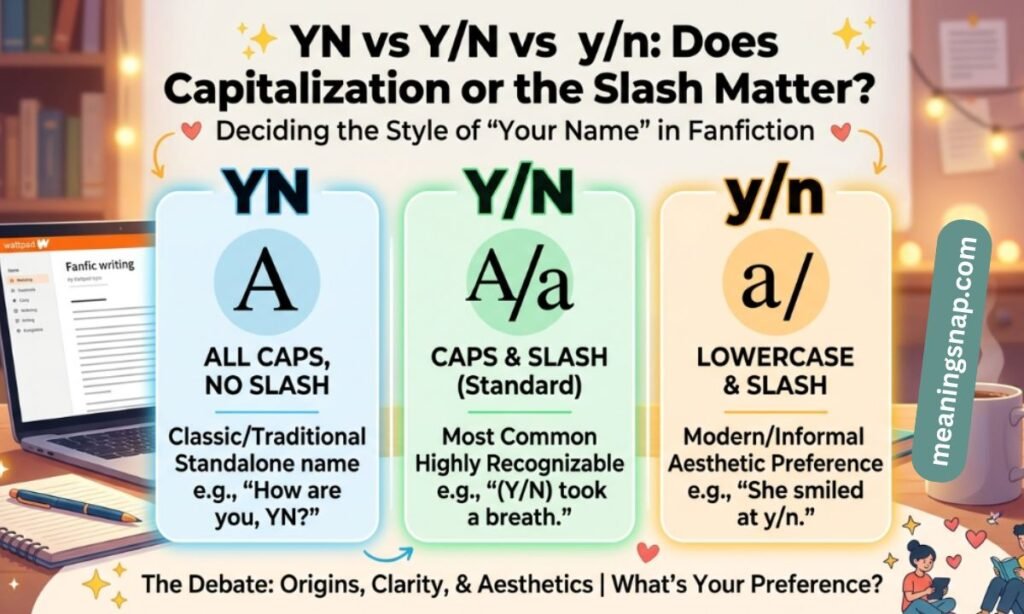
Short answer: yes, a little, and it depends on context. The slash format (Y/N) almost always signals the fanfiction placeholder meaning, since it visually represents “your name” as a fill-in-the-blank. Drop the slash and lowercase it, and “yn” usually points to the texting shortcut instead.
That said, this isn’t a strict rule. Some writers skip the slash entirely and just capitalize YN, and some texters use the slash out of habit. Context matters more than formatting. If you’re reading a story on Wattpad, it means your name. If you’re in a group chat replying to plans, it means yes or no.
How to Pronounce and Read “Y/N” Out Loud
People genuinely search this, and it’s a fair question since it looks unpronounceable at first glance. In fanfiction communities, readers usually just say “your name” out loud when reading a passage aloud, since that’s literally what it stands for. Some say “why-en” as two letters, similar to how people say “BRB” or “FYI.” There’s no single official pronunciation, but “why-en” works fine in casual conversation if you need to say it out loud.
This mostly comes up when someone’s talking about a fic with a friend rather than reading it silently. “Have you read that Y/N fic where she moves to Seoul?” flows a lot easier when the listener already knows Y/N gets read as “your name” in that context. In texting, nobody really says “YN” out loud at all. It stays a written shortcut, the same way people rarely say “IMO” or “TBH” as spoken words in everyday conversation.
Real Examples of YN in Use
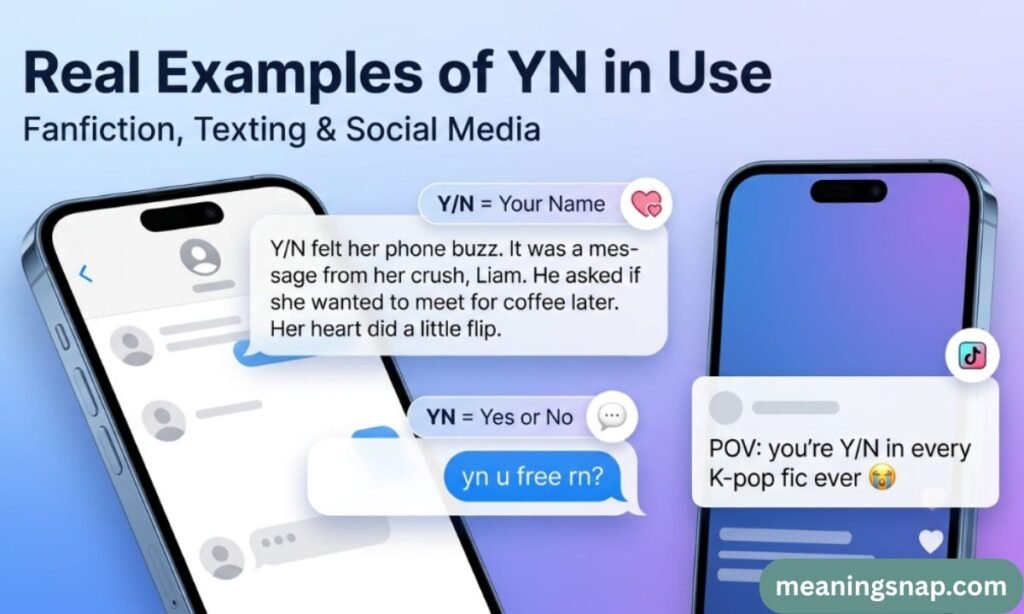
Seeing the term in context makes the difference between both meanings click faster than any definition can. Here’s a mix of examples across fanfiction, texting, and social captions.
Fanfiction Examples
- “Y/N felt her phone buzz and already knew who it was.”
- “He grabbed Y/N’s hand before she could walk away.”
- “Y/N, don’t do this,” he said, voice breaking.
Texting Examples
- “yn u free rn”
- “quick question, yn: are you mad at me?”
- “movie night at 8, yn?”
TikTok Caption Examples
- “POV: you’re Y/N in every K-pop fic ever 😭”
- “when the fic says Y/N and you already feel seen”
A Couple of Extra Tones
- Sarcastic: “yn but like, do you actually have a choice here”
- Sincere: “no pressure either way, just let me know yn so I can plan around it”
These examples show how much tone shifts depending on the setting. Fanfiction leans dramatic and narrative. Texting stays quick and casual. TikTok blends both, since a lot of fan edits reference reader-insert stories directly in captions and comment sections.
Common Mistakes People Make With the YN Meaning
A few mix-ups happen constantly, and clearing them up now saves confusion later.
Mixing up the two meanings. This is the big one. Someone unfamiliar with fandom spaces sees “Y/N” in a text and assumes it’s a typo for “yes or no,” when it’s actually a name placeholder from a completely different online space.
Assuming it’s always a placeholder. The opposite mistake happens too. Someone who spends time in fandom communities sees “yn” in a normal group chat and expects a fanfiction reference, when a friend is just asking a quick yes or no question.
Missing the slash in Y/N. Search engines and readers sometimes treat “YN” and “Y/N” as identical, but the slash carries meaning in fanfiction spaces specifically. Dropping it doesn’t change texting usage much, but it can make fanfiction references harder to search for correctly.
Assuming it’s the same across every platform. Someone new to online slang might assume YN means one fixed thing everywhere, the same way an abbreviation like “LOL” stays consistent no matter where you see it. YN doesn’t work that way. It’s less like a single word and more like two separate words that happen to share the same two letters. Bottom line: check the setting before you assume the meaning.
Similar Slang Worth Knowing
YN isn’t the only short abbreviation doing heavy lifting in online chat. A few others follow the same pattern of compressing a full phrase into a quick response option.
| Term | Meaning | Typical Use |
|---|---|---|
| POV | Point of view | Framing a TikTok or fan edit from a specific perspective |
| FR | For real | Agreeing or emphasizing something is true |
| TBH | To be honest | Prefacing an honest opinion |
| IMO | In my opinion | Softening a personal take |
| IHY | I hate you (affectionately) | Playful response to something funny or sweet |
Each of these works the same way YN does in texting: a quick, casual shortcut built for speed, not formality. POV shows up constantly across TikTok slang, framing a video or fan edit from a specific angle so the viewer feels like they’re living the moment themselves, which is honestly a similar idea to what Y/N does in written fanfiction. FR and IHY tend to show up more in playful, affectionate exchanges, while TBH and IMO soften an honest opinion before it lands. Knowing a handful of these makes reading Gen Z slang in DMs and comment sections a lot less confusing, especially once you notice how many of them exist purely to speed up a normal sentence.
Is YN Slang Still Popular in 2026?
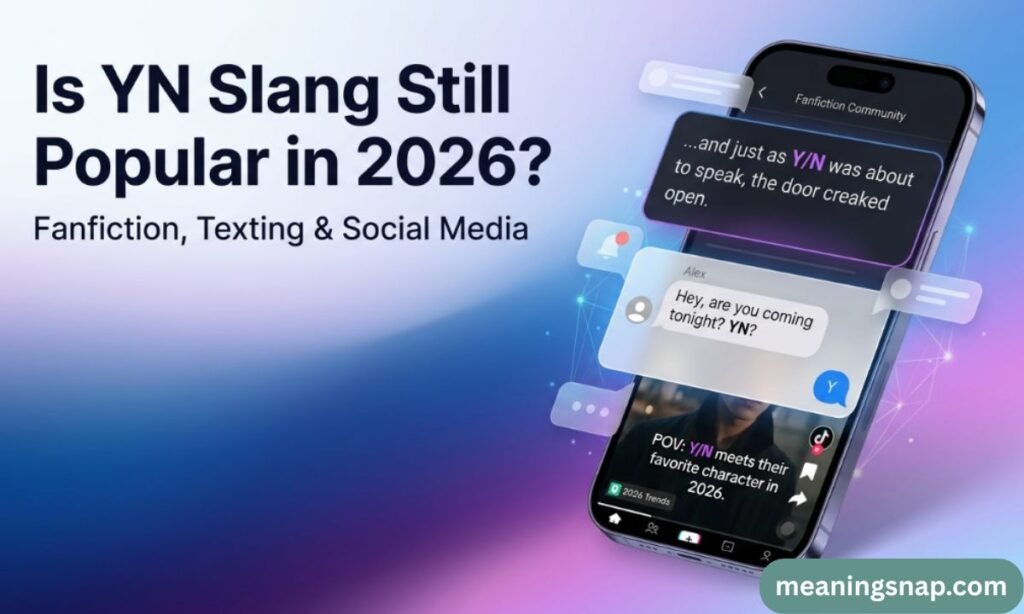
Both meanings are still very active, though they live in different corners of the internet.
Fanfiction use remains strong. Wattpad stories and AO3 works still rely on Y/N constantly, especially in K-pop fandoms and anime fan communities where reader-insert content stays popular year after year. Character x Reader tags remain some of the most searched fanfiction categories on both platforms.
Texting use continues steadily. YN as a yes/no shortcut hasn’t faded either. It’s a small, low-key texting shortcut, the kind that doesn’t trend or go viral but just quietly stays part of everyday chat lingo among younger users.
TikTok keeps both versions visible. POV videos and fan edits referencing Y/N fanfiction tropes circulate regularly, while comment sections use “yn” as a quick yes/no check just as often. Digital culture doesn’t really retire either meaning. They both just keep running in parallel.
Turns out, that’s the pattern with most internet culture that sticks around this long. Terms that solve an actual problem (naming a story’s reader, or shortening a common question) don’t need to trend to stay useful. They just become part of how online communities talk without anyone thinking twice about it. Whether you scroll through Wattpad stories on your commute or answer a quick yn text between classes, both versions of this term are locked into digital expressions for the foreseeable future, not going anywhere in 2026 or beyond.
FAQs
What does YN mean in slang?
It depends entirely on where you see it. In fandom and fanfiction spaces, YN (usually written Y/N) means “your name,” a placeholder that lets any reader insert themselves into the story. In regular texting, YN means “yes or no,” used to shorten a quick question down to two letters.
What does YN mean on TikTok?
On TikTok, you’ll see both versions depending on the video. Fan edits and POV videos tied to fanfiction tropes use Y/N as the reader-insert placeholder, while comment sections often use “yn” casually as a quick yes/no check, the same way it works in a normal group chat.
What does YN mean in texting?
In texting, YN is a shortcut for “yes or no,” usually tacked onto a quick question so the other person can answer fast without needing a full sentence.
What does Y/N mean in fanfiction?
In fanfiction, Y/N stands for “your name.” It’s a placeholder used in reader-insert stories so any reader can imagine themselves as the main character in the story, no matter their actual name.
Is Y/N the same as YN?
Mostly, yes, though the slash version (Y/N) is more common in fanfiction, while the plain letters (YN or yn) show up more in casual texting. Context tells you which one you’re dealing with faster than formatting does.
How do you pronounce Y/N?
Most people either read it as “your name” out loud in fanfiction, or say the two letters “why-en” the way you’d say BRB or FYI in casual conversation.
Is YN slang still used in 2026?
Yes. The fanfiction meaning stays active across Wattpad, AO3, and fandom-driven TikTok content, while the texting shortcut version continues to show up in everyday DMs and group chats.
Final Thoughts
At the end of the day, YN isn’t one term with one fixed meaning, it’s two shortcuts that happen to share the same two letters. One comes from fandom spaces and reader-insert stories, built to let anyone slot themselves into a fic as the main character.
The other comes from plain old texting habits, built to save a few seconds when a question only needs a yes or no answer. Neither one is going away anytime soon. Wattpad and AO3 keep churning out Y/N stories for K-pop fandoms and anime fans, and group chats keep leaning on yn whenever someone just needs a quick answer. Next time you see YN pop up in a text or a fic, you’ll know exactly which version you’re looking at, and exactly how to respond.

Alex Morgan is a writer focused on explaining slang, words, phrases, acronyms, and popular expressions in a simple and easy-to-understand way. Through clear explanations and helpful examples, Alex helps readers quickly understand what words and phrases mean and how they’re commonly used.