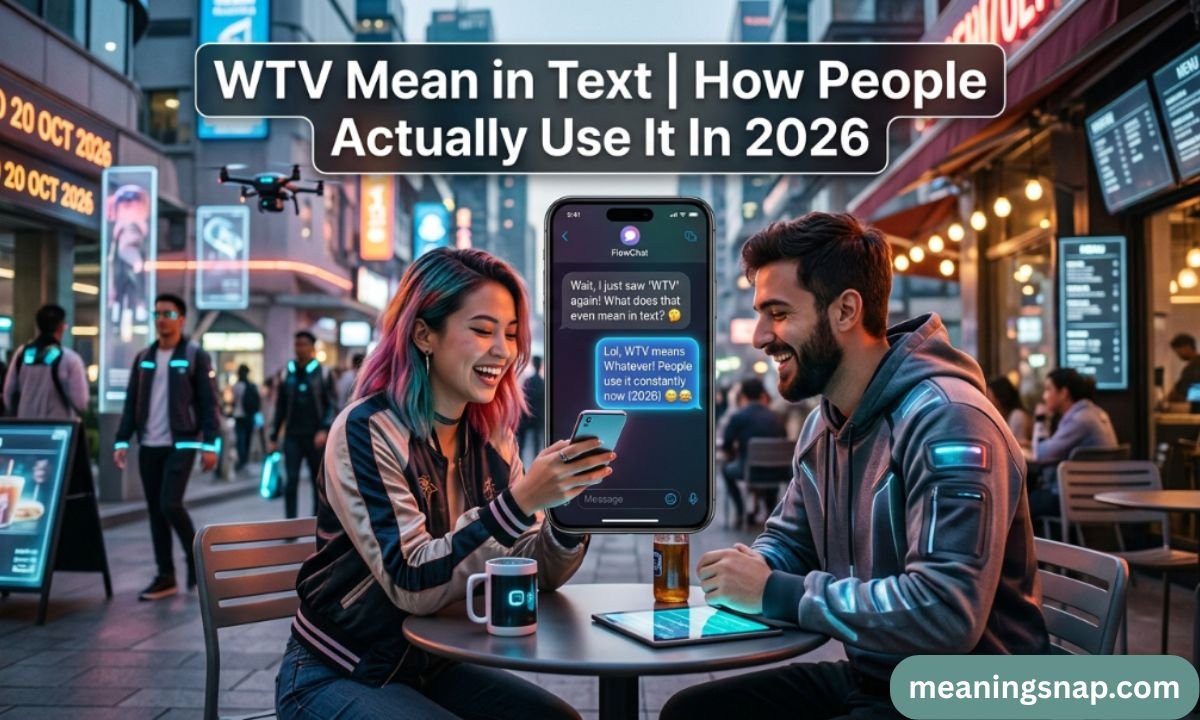
Picture this: your friend texts asking if you want to grab dinner Friday or Saturday, and you reply “wtv works for me.” Three letters, and suddenly they’re either relieved you’re easygoing or wondering if you’re annoyed with them. So what does WTV mean in text? On the surface, it’s just a shortcut for “whatever.” But how people use WTV in texting depends on punctuation, timing, and whatever came right before it in the conversation. Get the tone wrong and a harmless reply turns into an accidental cold shoulder. This guide breaks down what WTV actually means, where it came from, and how to read it, or use it, without sending the wrong signal.
What Does WTV Mean in Text?
WTV is a texting abbreviation for “whatever.” That’s the short version. People type it to shrug off a decision, agree without much enthusiasm, or signal they don’t have a strong opinion either way.
Quick Answer: WTV means “whatever.” It’s used to sound casual, flexible, or indifferent, and the exact vibe shifts depending on what surrounds it in the conversation.
The WTV abbreviation almost always shows up in lowercase. Typing it in all caps, like WTV, tends to read louder and can come across sharper or more annoyed, similar to how “FINE.” hits differently than “fine.” Most people don’t think twice about the spelling. They type it fast, mid conversation, the same way they’d type “brb” or “idk” without pausing.
What makes the WTV meaning tricky isn’t the definition. It’s the delivery. “Whatever” carries a wide range of moods in spoken English too, from a genuine shrug to outright sarcasm, and WTV inherited that same flexibility when it moved into texting. A friend asking where to eat and getting “wtv, you pick” reads totally different from someone getting a flat “wtv” after a disagreement. Same three letters, completely different conversation.
So when someone asks what does WTV mean in text, the literal answer is easy. Whatever people actually mean by it in the moment takes a bit more reading between the lines, which is what the rest of this guide covers.
Where Did WTV Come From?
Texting Character Limits Started It
Early SMS messages capped out around 160 characters, and every letter counted. Abbreviations like WTV, BRB, and IDK weren’t stylistic choices back then, they were practical ones. Typing “whatever” on a flip phone keypad meant pressing the same number key multiple times just to land on the right letter. Shortening it to three or four keystrokes saved real time and effort on a device that made typing genuinely tedious.
From “Whatever” to “WTV”: The Shortcut Timeline
“Whatever” has carried a dismissive or indifferent tone in spoken English for decades, long before texting existed. Once SMS took off in the late 1990s and early 2000s, and instant messengers like AIM and MSN Messenger picked up steam alongside it, the word got trimmed the same way hundreds of other common phrases did. WTV joined a wave of texting shorthand that included LOL, BRB, and TTYL, all built around the same goal: say more with less typing.
Why It Stuck Around After Character Limits Disappeared
Smartphones eventually removed the 160-character constraint, and predictive text made full words just as fast to type as abbreviations. WTV didn’t disappear, though. It stuck around because the shorthand had become part of how people text, not just a workaround for slow keypads. Typing “wtv” now signals something beyond speed. It signals a casual, low-effort tone on purpose, even when typing “whatever” would take roughly the same amount of time. The abbreviation became its own kind of punctuation for indifference, which is exactly why it survived long after the original reason for it disappeared.
See Also: YN Meaning Explained: What It Really Means in Texting, Fanfiction & Social Media (2026 Guide)
How People Use WTV Across Different Apps

WTV shows up slightly differently depending on where the conversation happens. The platform shapes the pace of the exchange and the expectations around a reply.
In iMessage and SMS
Texting is where WTV lives most naturally. Conversations here tend to be one-on-one and ongoing, so WTV often responds to a specific question or decision that’s already on the table.
Sam: movie or bowling tonight? Jordan: wtv, i’m down for either
On Snapchat and Instagram DMs
On Snapchat and Instagram, WTV often appears in fast back-and-forth chats, sometimes paired with an emoji to soften or sharpen the tone.
Mia: i can’t make it to the party anymore Chloe: wtv 🙄 have fun without me then
That extra emoji does a lot of work there, turning a plain “whatever” into something closer to genuine irritation.
In Discord, Gaming Chat, and Group Threads
In gaming and group chats, WTV usually settles a group decision fast, since nobody wants to hold up the game or the plan.
Player1: who’s picking the map Player2: wtv, you choose, just start the match
WTV also pops up on TikTok comments and WhatsApp group chats for the same reason it works everywhere else. It’s fast, low commitment, and doesn’t require the sender to explain themselves further. Across every platform, the core meaning of WTV stays the same. What changes is the pace of the conversation and how much punctuation or emoji gets layered on to carry a tone that plain text can’t always show on its own.
Read Also: What Does FFS Mean in Slang? Texting & Social Media Guide
Is WTV Rude? Reading the Tone Correctly
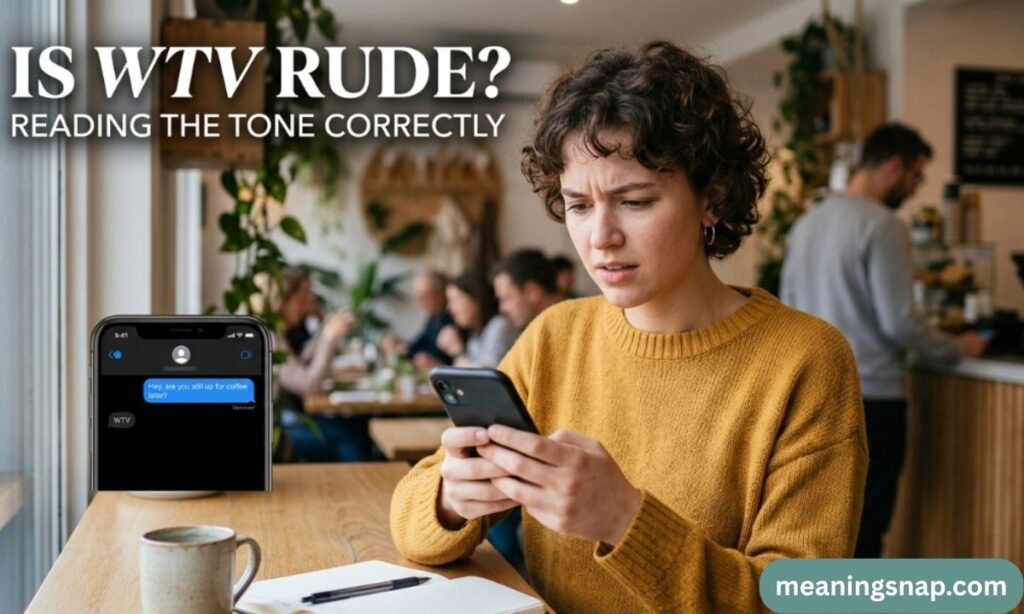
This is the question most people actually want answered. WTV isn’t rude by default, but it isn’t automatically friendly either. The tone depends on context, punctuation, and what led up to it in the thread.
Chill and Easygoing WTV
When someone uses WTV to answer a low-stakes question, it usually just means they’re flexible and don’t have a preference either way.
Text: where should we eat, wtv is fine with me
Passive-Aggressive WTV
WTV can carry a sting when it follows a disagreement or a request the person didn’t want to make in the first place.
Text: wtv, do it your way then
Flat-Out Dismissive WTV
Sometimes WTV shuts a conversation down entirely, especially when someone’s done arguing and wants the topic to end.
Text: wtv. i don’t want to talk about this anymore
How Punctuation and Emojis Change the Read
A period after WTV tends to make it land harder, closer to a door closing than a shrug. An emoji next to it, like 😂 or 🙄, tells the reader exactly which direction to take it. No punctuation at all usually reads as neutral or breezy, which is why most casual uses of WTV skip punctuation entirely.
Here’s a quick reference for how the tone shifts based on how WTV gets typed:
| Tone | Example Text | What It Signals |
|---|---|---|
| Chill | wtv, up to you | Genuine flexibility, no strong opinion |
| Sarcastic | wtv 🙄 sure | Annoyance dressed up as agreement |
| Dismissive | wtv. | Conversation is closed, mood is flat |
| Playful | wtv lol you know me | Light teasing, no real tension |
| Passive-aggressive | wtv, forget it | Frustration the person doesn’t want to explain |
Reading WTV correctly comes down to looking at what came before it in the conversation, not just the word by itself.
WTV vs W/E vs IDC vs NVM: What’s the Real Difference
WTV isn’t the only shorthand people use to sound indifferent in a text. A few others get used almost interchangeably, but they don’t all mean exactly the same thing once you look closely.
| Term | Full Meaning | Tone Level | Best Use Case |
|---|---|---|---|
| WTV | Whatever | Mild to sharp, depends on context | Responding to a decision or minor disagreement |
| W/E | Whatever | Nearly identical to WTV, slightly less common | Same situations as WTV, more of a stylistic variant |
| IDC | I don’t care | Neutral to dismissive | Genuinely no preference, lower emotional charge |
| NVM | Never mind | Retracting or dropping a topic | Backing out of a request or question already asked |
| IDK | I don’t know | Neutral, uncertain | Answering a question without a clear answer |
WTV and W/E function almost identically. They’re really just two spellings of the same shorthand for “whatever,” and most people pick whichever one their thumbs land on faster. IDC leans more neutral since “I don’t care” doesn’t carry the same built-in edge that “whatever” often has, especially in a heated exchange. NVM works differently altogether, since it usually walks something back rather than expressing indifference toward a choice someone else made.
Knowing the difference matters more than it seems at first. Replying “idc” to a friend’s restaurant pick reads as genuinely easygoing, while “wtv” to that same question can come off flatter depending on how the conversation’s been going up to that point.
Read Also: What Does DTM Mean in Slang? TikTok Meaning & Social Media Use
Mistakes People Make With WTV
A few misunderstandings around WTV come up again and again, and most of them are easy to avoid once you know what to look for.
The most common one is confusing WTV with WTF at a quick glance. Both start with W and T, both show up in fast texting, and both get typed in caps sometimes when someone’s typing quickly on a small keyboard. Skimming a message instead of reading it fully is usually the cause, so a second look before reacting saves a lot of unnecessary confusion and awkward follow-up texts.
Another mistake is dropping WTV into a serious or emotional conversation. Texting “wtv” in response to someone sharing bad news, or during an argument that actually matters to the other person, tends to land as cold even if that wasn’t the intent behind it. The word’s built-in casualness works against the sender in moments that call for more warmth or a fuller response.
People also assume WTV always carries the same meaning no matter who sends it or when. In reality, the same three letters can read as relaxed from one friend and irritated from another, based purely on their usual texting style. Someone who never uses punctuation might type “wtv” and mean nothing by it, while someone who’s normally expressive typing a flat “wtv.” might genuinely be upset about something.
Paying attention to a person’s typical texting habits makes WTV a lot easier to interpret correctly, and it prevents overreacting to a reply that was never meant to sting in the first place.
When to Skip WTV (Professional and Formal Alternatives)

WTV works fine in most casual texting, but it doesn’t belong everywhere, and knowing the difference keeps conversations running smoothly.
Situations Where WTV Works Fine
Group chats with friends, casual planning texts, and low-stakes decisions are all safe spots for WTV. Nobody’s reading too much into a quick “wtv” about pizza toppings or which movie to stream.
Situations to Avoid It
Work Slack messages, emails, texting a boss, or customer service conversations are not the place for WTV. It reads as careless or dismissive in a setting where the other person expects a clear, considered answer, even when that’s not how it was meant.
What to Say Instead
Swapping WTV for a slightly more polished phrase keeps the same flexible meaning without the risk of sounding indifferent to someone who doesn’t know your texting style.
Casual: wtv works for me Polite rewrite: Either option works for me, happy to go with your call.
Casual: wtv, not a big deal Polite rewrite: No worries either way, it’s not a big deal.
The polite versions take a few more words, but they remove any chance of the reader misreading tone, which matters a lot more in professional communication than it does in a group chat with close friends who already know how you text.
FAQs
What does WTV mean in text?
WTV means “whatever.” People use it to respond casually to a question or decision without committing to a strong opinion.
Is WTV rude or just casual?
It depends on context. WTV on its own is usually casual, but paired with a period, caps, or certain emojis, it can read as dismissive or annoyed.
What’s the difference between WTV and W/E?
Almost nothing. Both stand for “whatever” and get used the same way, WTV is just the more common spelling in texting today.
Can I use WTV in a work message?
It’s better to avoid it. WTV can come across as careless in professional settings, so a full sentence works better in emails or work chats.
Why do people confuse WTV with WTF?
The two abbreviations share the same first two letters and both show up in fast texting, so a quick skim can easily mix them up.
Bottom Line
Once you’ve got the WTV mean in text question sorted, the rest is just reading the room. WTV isn’t complicated once you know what to look for. It means “whatever,” full stop, but the tone riding underneath those three letters depends on punctuation, timing, and the conversation it’s answering. A relaxed “wtv, you pick” and a clipped “wtv.” are technically the same word doing two very different jobs. Next time you see WTV in a text, you’ll know exactly how to read it, and exactly how to reply.

Alex Morgan is a writer focused on explaining slang, words, phrases, acronyms, and popular expressions in a simple and easy-to-understand way. Through clear explanations and helpful examples, Alex helps readers quickly understand what words and phrases mean and how they’re commonly used.