You send a text, wait for a reply, and get back exactly one word: WDYM. If you’ve ever stared at your phone trying to work out the WDYM meaning in text before typing anything back, you’re not alone. No punctuation, no context, just four letters sitting there like a verdict. Is your friend confused? Annoyed? Did you say something wrong? That single message can send you into a mini panic spiral before you’ve even had your coffee.
Here’s the good news. WDYM almost always means exactly what it looks like: “what do you mean.” It’s not sarcasm, not a trap, not a subtweet in disguise. Most of the time, someone just needs you to clarify. But the tone behind it can shift the whole conversation, and that’s what actually trips people up.
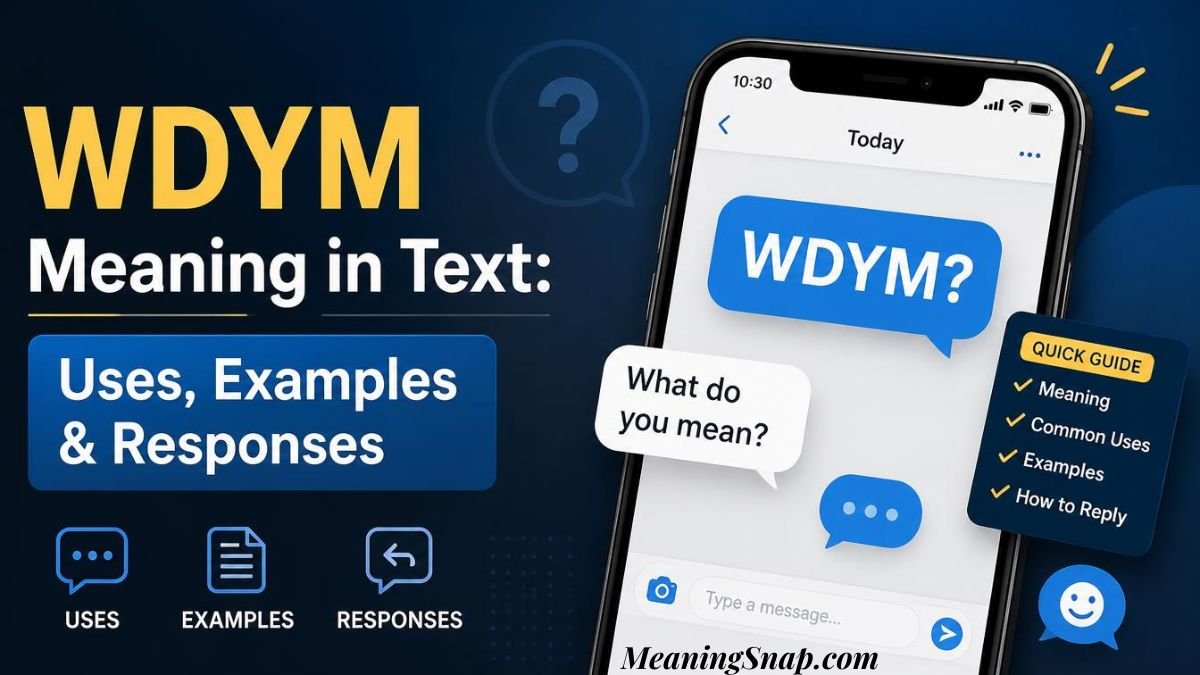
Quick Answer: The WDYM meaning in text is “what do you mean.” People use it to ask for clarification when a message is unclear, when they’re surprised by something someone said, or sometimes to push back on a statement they disagree with.
WDYM Meaning in Text: Where It Came From
The WDYM meaning in text hasn’t shifted much since it first caught on. It showed up as part of the same texting shorthand wave that gave us IDK, TBH, and IMO. It isn’t tied to one platform, one app, or one specific year. It grew out of people typing fast on small phone keyboards, where trimming a few letters just made sense.
There’s no verified origin story pointing to a single creator, meme, or launch moment. It’s shorthand that stuck because it’s useful, nothing more dramatic than that. If anyone tells you WDYM was “invented” by a specific influencer or platform, that claim isn’t backed by anything solid.
Where You’ll Actually See WDYM
The WDYM meaning in text stays the same everywhere, but where it shows up changes the vibe around it.
Texting & Group Chats
This is WDYM’s home turf. In one-on-one texts and group chats, it usually shows up right after someone drops a confusing statement, an inside joke with no context, or news that needs more explanation. It reads as neutral by default here, since texting culture already runs on short, clipped replies.
WhatsApp & Other Chat Apps
On WhatsApp, iMessage, and Facebook Messenger, WDYM works almost identically to regular texting, with one added wrinkle: read receipts. When someone sees “Read” under your message and then gets a WDYM reply ten minutes later, it can feel more loaded than the exact same reply sent instantly, purely because of the wait. The abbreviation hasn’t changed, delayed replies just make people read extra tension into it.
Group chats on these apps add another layer. A WDYM dropped into a group conversation often gets picked up by two or three people at once, turning a simple clarification request into a mini side debate. If you actually want a private answer instead of pulling in the whole group, it’s usually better to reply directly to that one person instead of the shared thread.
Social Media Comments & DMs
On Instagram, TikTok, and Snapchat, WDYM shows up constantly in comment sections and DMs, and the usage barely changes across these apps. Someone posts something ambiguous, dramatic, or out of character, and the replies fill up with “wdym.” The real difference is visibility. A WDYM comment under a public post carries more social weight than one sent privately, because other people can see it and pile on.
Gaming & Discord
In gaming chats and Discord servers, WDYM tends to show up mid-match, right after a teammate’s callout doesn’t make sense or a strategy call seems off. It’s usually fast and purely functional here. Nobody’s overthinking tone, they just need clarity before the next round starts.
Also Read: KMG Meaning in Text: Definition, Slang & Examples
Real WDYM Conversation Examples
Tone changes everything with the WDYM meaning in text, so here’s how it actually plays out across different moods.
Genuinely confused:
Friend 1: “I’m not coming tonight, long story.” Friend 2: “wdym?? what happened”
Mildly annoyed:
Partner: “You said you’d handle it.” Other: “WDYM I handled it, I sent the email an hour ago”
Playful and skeptical:
“I think pineapple on pizza is a crime.” “wdym it’s the best topping 😭”
Surprised and excited:
“I got the job!” “wait wdym you got it?? tell me everything”
Frustrated:
“We’re not doing the trip anymore.” “wdym not doing the trip, we booked flights”
The Tone Problem: Why WDYM Can Sound Rude (Even When It’s Not)
The WDYM meaning in text never changes, only how it lands does. Punctuation and capitalization change the tone completely. Lowercase and short, like a plain “wdym?”, usually reads as neutral, quick confusion. Add a second question mark and it leans toward real surprise or mild alarm. All caps with no punctuation at all often signals frustration or disbelief, since it reads like someone typed it fast without pausing to think.
Context carries more weight than the letters themselves. The same three words can sound curious, hurt, or combative depending on what came right before them. If you’re not sure how someone meant it, the safest move is to answer their actual question instead of guessing their mood first.
WDYM vs Similar Abbreviations
The WDYM meaning in text sometimes gets mixed up with a handful of similar-looking texting shorthand. Here’s how they actually differ.
| Term | Meaning | How It Differs from WDYM |
|---|---|---|
| WYM | What you mean | Same meaning, just shorter and more casual |
| WYD | What you doing | Asks about someone’s current activity, not asking for clarification |
| IDK | I don’t know | Expresses the sender’s own uncertainty, not a request to explain |
| IDGI | I don’t get it | Signals confusion without directly asking the other person a question |
WDY Meaning: How It’s Different From WDYM
WDY looks like a shortened version of WDYM with the M dropped, but it’s not really interchangeable with the WDYM meaning in text. Most commonly, WDY stands for an unfinished “what do you,” a lead-in phrase that only makes sense once the rest of the sentence shows up, like “WDY want for dinner?” or “WDY think about this outfit?” It works more like a starter phrase than a standalone question.
A smaller group of people use WDY to mean “why don’t you,” as in “WDY just call her instead of texting?” That reading shows up less often, and it usually needs the rest of the sentence to land properly.
Here’s the easiest way to tell them apart. WDYM always works as a complete question on its own, no extra words needed. WDY almost never does. If someone sends a lone “WDY?” with nothing else attached, they’ve probably cut themselves off mid-thought rather than intentionally sending a full question.
Read Also: DW Meaning in Text, Chat & Social Media Explained
WDYM From a Girl or a Guy: Does It Change the Meaning?
People search this hoping WDYM carries a hidden message depending on who sent it, like there’s a secret code buried in three letters. There isn’t. The WDYM meaning in text stays exactly the same regardless of who’s typing it: they want you to clarify what you meant.
What actually shifts is the relationship context surrounding it, not the word itself. A “wdym” from a crush right after a flirty text can feel loaded, like there’s more riding on your answer. The same “wdym” from a coworker asking about a meeting time reads as purely practical, nothing to overanalyze.
If you’re genuinely trying to read into someone’s intent, look at what was said right before the WDYM and how it was punctuated. That tells you far more than whether a girl or a guy sent it.
Bc WDYM and Huh WDYM: What These Combos Mean
Adding a word in front of WDYM changes its intensity, not its core meaning. “Bc wdym,” short for “because what do you mean,” usually shows up when someone’s pushing back on a statement, almost like starting an argument with the reason attached right away: “bc wdym you’re not coming, we made plans two weeks ago.”
“Huh wdym” works a little differently. It stacks two confusion signals together, “huh” as an instinctive reaction and “wdym” as the follow-up question, which makes it read as more genuinely baffled than either word on its own. You’ll usually see it after something comes out of nowhere: “wait…huh wdym she quit?”
Both combos still mean “what do you mean” at their core. The extra word just adds emotional flavor on top of it.
WDYM as a Joke or Meme
WDYM shows up a lot in funny or sarcastic contexts, especially as a caption under screenshots, memes, or reaction posts. In these cases, it’s rarely a real question. It’s more of a joke format, usually paired with an obviously wrong or absurd statement to poke fun at it.
A typical example: someone posts a screenshot of a wildly confident wrong answer with the caption “wdym???” The point isn’t to actually ask for clarification, it’s to react to how ridiculous the original statement is. Context makes this use obvious pretty fast, since it’s almost always attached to something clearly exaggerated or funny rather than a genuine point of confusion.
How to Respond to WDYM
Once you’ve got the WDYM meaning in text figured out, how you respond depends on who’s asking and how formal the conversation needs to stay.
Casual Responses
With friends or family, keep it short and natural instead of over-explaining:
- “Oh sorry, I meant [clarify]”
- “Just that [rephrase in fewer words]”
- “Nvm, I’ll explain later”
- “Lol I meant it as a joke, ignore me”
Formal Responses
For coworkers, teachers, or anyone you’d normally avoid texting-speak with, spell it out a bit more:
- “To clarify, I meant…”
- “Sorry for the confusion, what I’m saying is…”
- “Let me rephrase that so it’s clearer”
Is It Okay to Use WDYM at Work?
WDYM works fine in casual work chats with people you already text like friends, think coworkers on Slack or a relaxed team group chat. In emails, formal channels, or messages to anyone above you, it reads as too casual and a bit abrupt.
Swap it for something like “Could you clarify what you mean?” or “I want to make sure I understand, can you explain that part?” Same question, none of the texting-speak risk.
WDYM on Urban Dictionary: Any Other Meanings?
People search this expecting a hidden or alternate definition, but there isn’t one. Every widely used Urban Dictionary entry agrees on the same WDYM meaning in text: “what do you mean,” used when someone doesn’t understand what another person just said.
Urban Dictionary is crowdsourced, so individual entries vary in wording and examples, not in the core meaning. Unlike abbreviations that pick up secondary slang definitions over time, WDYM has stayed consistent across entries. If you spot a wildly different definition floating around, it’s likely a lookalike acronym with extra letters tacked on, not WDYM itself.
FAQs
What is the WDYM meaning in text?
It stands for “what do you mean.” People use it to ask someone to clarify or explain something they just said.
Is WDYM rude?
Not by default. It only reads as rude when it’s paired with sharp punctuation, all caps, or a clearly frustrated context.
What’s the difference between WDYM and WYM?
They mean the same thing. WYM is just a shorter, slightly more casual version of WDYM.
Is WDY the same as WDYM?
No. WDY is usually short for an unfinished “what do you…” phrase that needs more words to make sense, while WDYM is a complete, standalone question on its own.
Can I use WDYM at work?
It’s fine in relaxed team chats, but swap it for a full phrase like “could you clarify” in emails or formal messages.
Is WDYM used the same way on every app?
Mostly yes. The core meaning stays the same across texting, Instagram, TikTok, and Snapchat, though public comments carry more social weight than private DMs.
Is WDYM a Gen Z term?
Not exclusively. It’s heavily used in Gen Z texting, but it crosses generations easily since it’s just efficient shorthand for a common question, plenty of Millennials type it just as often.
Bottom Line
Next time WDYM lands in your inbox, check the punctuation before you check your anxiety. A lowercase, punctuation-free “wdym” is almost always just someone asking you to slow down and explain. Once you know the WDYM meaning in text and how to read the tone around it, you can answer the question, skip the guesswork, and let the conversation move on faster than you’d think.

Alex Morgan is a writer focused on explaining slang, words, phrases, acronyms, and popular expressions in a simple and easy-to-understand way. Through clear explanations and helpful examples, Alex helps readers quickly understand what words and phrases mean and how they’re commonly used.