You’re filling out a job application at 11 p.m. You type “job tittle,” and nothing happens. No red squiggle, no warning. That silence is the whole problem with title vs tittle, because both are real English words.
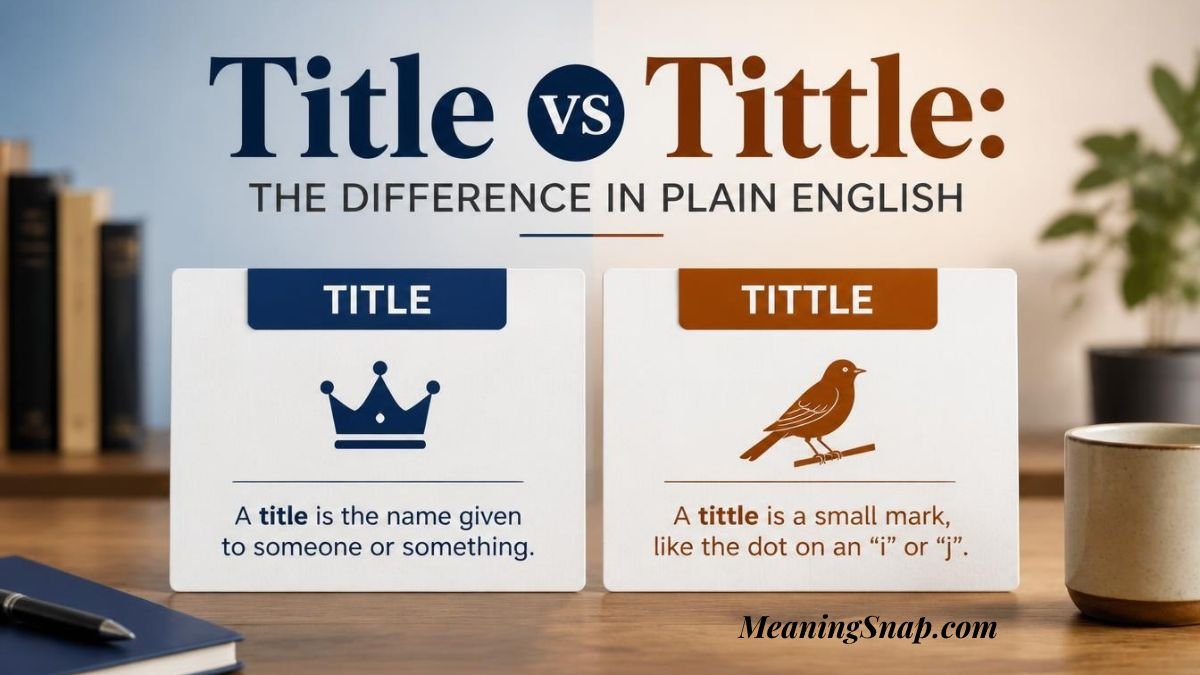
The short answer: write title. It names a book, a job, an honor, or a property right. Tittle is the tiny dot over an i or j, or a tiny amount of something. If your sentence is about a name, a role, or a prize, title is the word you want.
Below, you’ll get the meanings, the shared Latin root, a five-second test, and a short quiz. You’ll also meet the old phrase “jot and tittle” that keeps tittle alive. Along the way, you’ll see where this slip hides in real writing.
Title vs Tittle at a Glance
This table puts the title vs tittle difference side by side.
| Word | Meaning | Sounds like | Where you’ll see it | Example |
|---|---|---|---|---|
| Title | A name, a position, an honor, or a legal ownership right | TYE-tul | Everywhere, every day | “What’s your job title?” |
| Tittle | The dot over an i or j, or a tiny amount | TIT-ul | Typography talk and set phrases | “She never missed a tittle on her lowercase j.” |
Each word has its own entry in Merriam-Webster. Neither one is a misspelling of the other.
What Title Means in Everyday English
Title does more jobs than most words, which explains why the title vs tittle choice favors it so often. Merriam-Webster lists many senses, and four of them matter most here.
The first is a name. A book, song, movie, or painting has a title, and publishers also call each published book a title. A publisher can release ten new titles in a single season.
The second is a position or rank. Your job title tells people what you do, such as marketing manager. Merriam-Webster also counts words attached to a person’s name to show honor, rank, or office, like Professor or Captain.
The third is a championship. A team wins the league title, and a swimmer takes the 200-meter title.
The fourth is legal ownership. A title is the right to own property, or the document that proves it. Holding the title to a car or a house means you own it.
Title also works as a verb and an adjective. To title something means to give it a name, as in “She titled her essay after a childhood song.” The adjective appears in “title song” and “title role.”
Two smaller senses are worth knowing. Title can name a division of a law or code, as in Title IX. The plural, titles, can also mean the credits and on-screen text that run at the start or end of a film. Merriam-Webster lists both.
Read Also: Cocoon or Cacoon? Which Spelling Is Correct?
What Tittle Means, and Why It Hasn’t Disappeared
Tittle names a small mark in writing or printing. Merriam-Webster defines it as a point or small sign used as a diacritical mark. A diacritical mark is a small sign added to a letter, like the accent in café. The dot over a lowercase i or j is the example everyone knows.
Type designers treat that dot as part of the letter itself. Wikipedia describes the tittle as an integral part of the glyph of i and j. A glyph is the drawn shape of a letter. Wikipedia adds that the dot usually drops out when an accent lands on an i or j, as in í or ĵ. Tittles also appear in Cyrillic.
The second meaning is a tiny part or amount. Dictionary.com lists both senses, and so does Merriam-Webster. That second sense gives us phrases like “not a tittle of proof.”
You’ll meet tittle mostly in typography talk and set phrases. Everyday writing has plainer words for each sense: dot, bit, or speck.
Why Title vs Tittle Share the Same Root
They look related because they are. Merriam-Webster traces tittle to Middle English titel, from Medieval Latin titulus, from the Latin word for title. Its entry for title also points to Latin titulus, meaning an inscription. So the title vs tittle pair grew from one ancestor.
The split came from meaning. The Random House unabridged dictionary notes that Medieval Latin used titulus for a mark over a letter or word. English kept that small-mark sense in tittle and the label sense in title.
Here’s a small curiosity. Wiktionary quotes the 1611 King James Bible with the word spelled “title” in the verse where modern editions print tittle. Older spelling was looser, so the two words once overlapped on the page.
Read Also: Chief vs Cheif: Which Spelling Is Correct?
Common Title vs Tittle Mistakes and Why Spellcheck Misses Them
Three distinct slips show up, and each has its own cause.
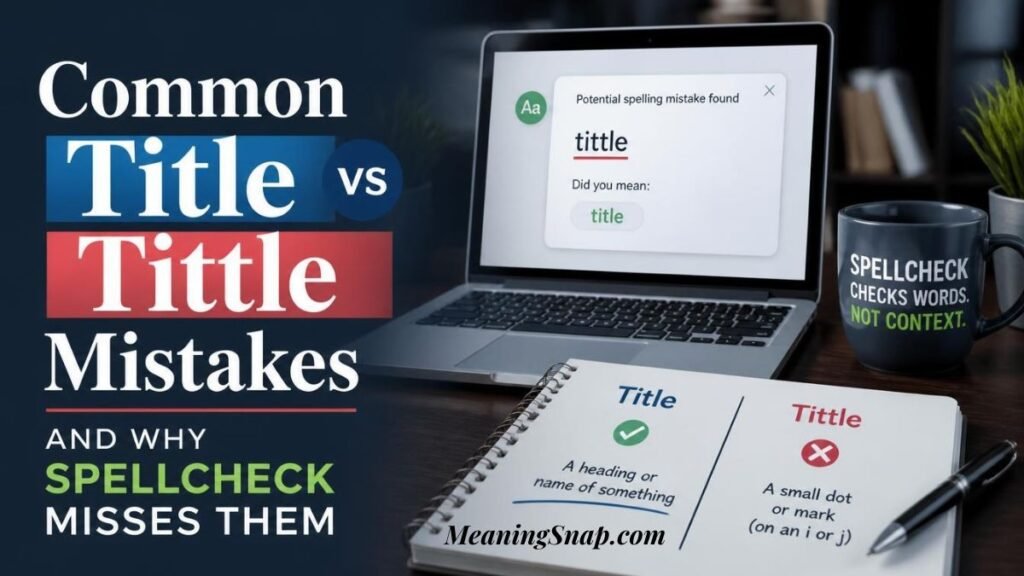
The forward slip is typing tittle when you mean title. The two words differ by one letter, and an extra t slips in when you type fast. Spellcheck adds to the trouble. A spellchecker asks whether a word exists, not whether you meant it. Tittle exists, so a basic checker has nothing to flag.
Common Mistake: Treating a clean spellcheck as proof. A word can pass the check and still be the wrong word. Read headlines, job fields, and captions out loud before you post them.
The reverse slip is writing title when you mean the dot. A sentence like “the title over the i” confuses anyone who knows the word tittle. Everyone else wonders what a title is doing on a letter.
The third slip hits the famous phrase. Some writers type “jot and title” by mistake. Modern dictionaries and Bible editions print tittle, so use that form.
Jot and Tittle: Where the Famous Phrase Comes From
“Jot and tittle” is the one place tittle still shows up in public. It means the smallest detail. People say “every jot and tittle” when they want something covered down to the last tiny point.
The phrase comes from Matthew 5:18. The King James Version reads “one jot or one tittle shall in no wise pass from the law.” Phrases.org.uk says it reached English through William Tyndale’s 1526 New Testament.
Each word points to a tiny mark. Jot comes from iota, the smallest letter of the Greek alphabet, which stands for the Hebrew letter yod. Tittle translates the Greek word keraia, which means a little horn. Easton’s Bible Dictionary describes it as a small stroke that separates one Hebrew letter from a similar one.
A related idiom, “to a tittle,” means exactly. If a copy matches the original to a tittle, nothing differs.
Title vs Tittle in Texts, Captions, and Formal Writing
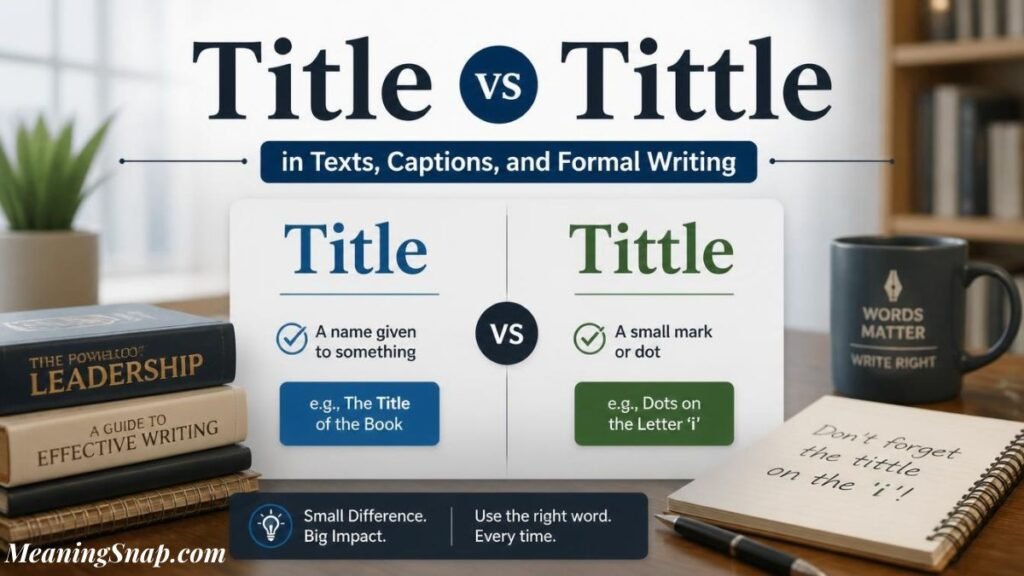
Context changes how you treat each word. In a text, a caption, or a comment, you want title unless you’re talking about the dot itself. Even then, most people say “the dot on the i,” and everyone understands.
Formal writing gives tittle a real job. A typography guide, a font review, or a Bible study can use it with precision. A reader who knows the word will notice if you swap in title. If your audience may not know tittle, add a quick gloss on first use, such as “the dot over the i.”
Literary writing also keeps the “jot and tittle” phrase for emphasis. In a title vs tittle choice for plain prose, this phrase is where tittle fits most naturally.
Read Also: Knaw or Gnaw: Correct Spelling Explained (2026 Guide)
Title vs Tittle in Real Sentences
Three common title vs tittle slips show how the fix works. Each wrong version names or labels something, so each needs title.
| Incorrect | Correct | Why |
|---|---|---|
| “My job tittle is project coordinator.” | “My job title is project coordinator.” | A job title names your position. |
| “New album out Friday. The tittle says it all.” | “New album out Friday. The title says it all.” | An album’s name is its title. |
| “Please add a tittle to every slide by Friday.” | “Please add a title to every slide by Friday.” | A slide heading is a title for that slide. |
Now four correct title vs tittle uses across different settings.
- Text to a friend: “What’s the title of that show you mentioned?” Your friend asks for the show’s name, so title fits.
- School: “My teacher circled the missing tittle on my j.” The dot over the j is a tittle.
- Work: “Congratulations on your new title as senior editor!” Here title means a position.
- Writing: “The editor checked the contract for every jot and tittle.” This fixed phrase means the smallest details.
A Five-Second Test for Title vs Tittle
Two quick checks settle most cases.
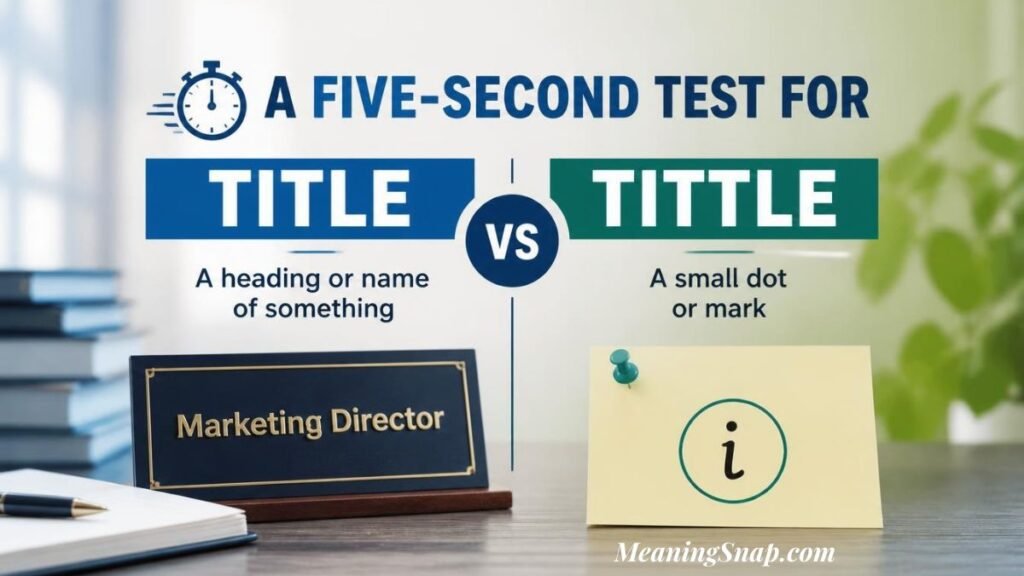
First, try the swap test. Replace the word with name, position, or championship. If the sentence still works, write title. If it needs dot or speck instead, write tittle.
Second, listen to the first vowel when you say the word. A long “eye” sound means title. A short “ih” sound means tittle.
For a memory hook, look at the word title. Its i wears a dot, and that dot is a tittle. Every title has a tittle, but a tittle never names anything.
Want to try a quick title vs tittle quiz? Fill each blank with title or tittle. Answers follow the list.
- “What’s the ___ of your favorite album?”
- “He forgot the ___ on his lowercase i.”
- “She earned the league ___ last season.”
- “I haven’t changed one jot or ___ of the plan.”
- “Her new job ___ is data analyst.”
- “Who holds the ___ to the house?”
- “The movie’s ___ song is stuck in my head.”
The answers are title, tittle, title, tittle, title, title, and title. Only two of the seven need tittle: the dot and the fixed phrase.
Title vs Tittle in Web and Content Work
If you publish online, you type the word title all day, so the slip can land in fields you rarely reread. Résumés, job-title fields, email signatures, and slide headings deserve a scan for tittle. So do video headings and social captions.
These web terms always use title, never tittle:
- Title tag: the HTML title element in a page’s head. It labels the browser tab and often supplies the clickable headline in search results.
- SEO title and meta title: common nicknames for the title tag. DreamHost notes that the title element is its own HTML element, not a meta tag.
- Title link: Google’s name for the clickable headline in search results. Google Search Central says Google can change it when the title tag doesn’t match the page content.
- Product title: the name a shopper sees on a product listing.
The H1 heading is a separate thing. It’s the visible headline on the page, and it can differ from the title tag.
Other Real Words That Spellcheck Lets Through
Title vs tittle belongs to a family of slips where both words are real. Later and latter look alike on the page, but later means after, while latter means the second of two things. Principal names a head or a main thing, and principle names a rule or belief.
Complement completes something, and compliment praises someone. Stationary means not moving, and stationery means paper and office supplies. The fix stays the same for every pair: reread the sentence and ask what you mean.
FAQs
Is tittle a real word?
Yes. Merriam-Webster and Dictionary.com both list it as a noun meaning a small diacritical mark or a tiny part.
Is title vs tittle a spelling mistake?
Not exactly. Both words have correct spellings, so the error is choosing the wrong word for your meaning.
Is the tittle only on the letters i and j?
Those two are the standard examples. Merriam-Webster’s definition is broader and covers any small point used as a diacritical mark.
Is it “jot and tittle” or “jot or tittle”?
Both appear. The Bible verse says “jot or tittle,” and English speakers also say “jot and tittle” for the smallest details.
What does tittle-tattle mean?
It means idle gossip and has nothing to do with the dot. Merriam-Webster calls it a reduplication of tattle, so the tittle there is just a sound echo.
Do you capitalize a job title?
Capitalize a formal title directly before a name and lowercase it after. Chicago (CMOS 8.20) and AP-based university style guides agree: “Professor Kim,” but “Kim, a professor of biology.”
Can I use tittle to mean a tiny amount?
Yes. Merriam-Webster lists a tiny part as a sense, as in “He didn’t care a tittle for the rumor.” It reads as formal or literary, so bit or speck fits better in texts and captions.

Alex Morgan is a writer focused on explaining slang, words, phrases, acronyms, and popular expressions in a simple and easy-to-understand way. Through clear explanations and helpful examples, Alex helps readers quickly understand what words and phrases mean and how they’re commonly used.